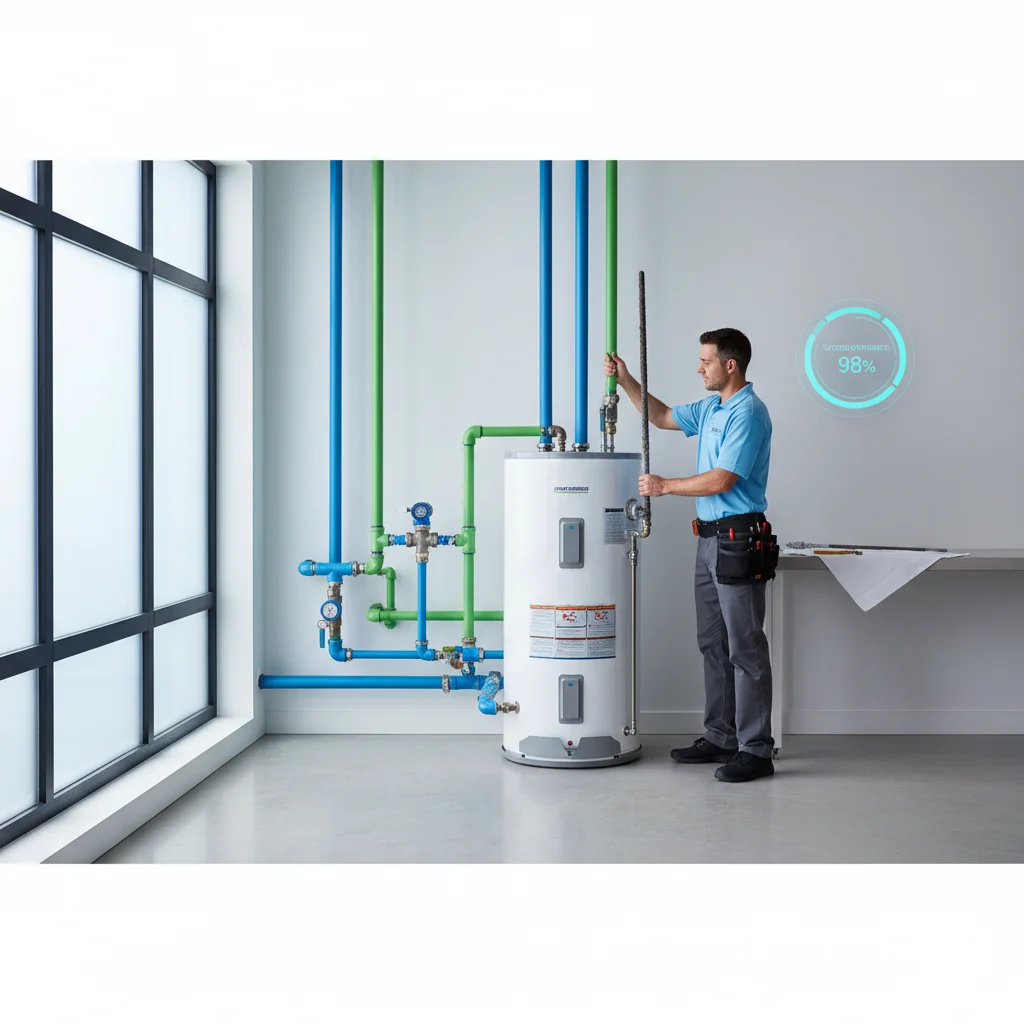
A failed anode rod can cut your water heater's lifespan in half. Most homeowners never check this $20 part until rust-colored water floods the basement and a $1,200 tank replacement becomes unavoidable. And the federal government won't help with standard tank repairs—only qualifying high-efficiency upgrades under the Inflation Reduction Act credits for 2026.
How Much Does It Cost to Replace a Water Heater Anode Rod?
Anode rod replacement costs $100 to $300 professionally installed in 2026, or $20 to $50 for DIY homeowners who buy the rod and handle the swap themselves. Professional service includes inspection, rod removal, and tank flushing, while DIY requires a socket wrench, pipe tape, and about 90 minutes of work. Standard tank water heaters use sacrificial magnesium or aluminum rods that corrode instead of the tank steel.
Replacing the anode rod every 3 to 5 years extends tank life from 8 years to 15 years or more, avoiding premature $1,000 to $2,000 replacement costs. But federal rebates don't cover maintenance on existing tanks—only new heat pump water heater installations under the 2026 IRA residential tax credits.
Professional plumbers charge $75 to $150 per hour for the service call, plus $25 to $150 for the rod itself depending on material and length. Magnesium rods cost $20 to $40 and work best in soft water, while aluminum-zinc alloy rods run $30 to $50 and resist sulfur bacteria that cause rotten egg smell in hard water areas.
So homeowners who skip this $100 service save nothing when the tank fails 5 years early and costs $1,200 to replace.
What's the Installation Cost and Can I Do It Myself?
DIY anode rod replacement costs $20 to $50 for the part and requires basic tools: a 1-1/16-inch socket wrench, adjustable wrench, pipe tape, and garden hose for tank draining. Professional installation adds $75 to $250 in labor but includes tank inspection, sediment flushing, and warranty protection against leaks or damage during removal.
Most standard 40-gallon to 50-gallon tanks have hex-head anode rods accessible from the top, while some models hide the rod under the hot water outlet requiring additional disassembly. And corroded rods often seize in the threads after years of mineral buildup, demanding penetrating oil, heat application, or a breaker bar for removal.
Homeowners comfortable with plumbing tasks complete the job in 60 to 90 minutes following these steps: shut off power and water, drain 2 to 3 gallons from the tank, remove the old rod, wrap new threads with pipe tape, install the new rod, refill the tank, and restore power. But professional service makes sense for older tanks where aggressive removal risks cracking the tank and flooding the space.
The real savings come from extending tank life, not the installation method. A $100 professional service every 4 years costs $500 over 20 years but saves $2,400 in avoided early replacements.
Which Water Heater Types Qualify for Federal Rebates With Anode Rod Upgrades?
Standard tank water heaters with anode rod maintenance don't qualify for federal tax credits in 2026 under Inflation Reduction Act programs. Only new heat pump water heaters meeting Uniform Energy Factor 3.75 or higher qualify for 30% tax credit (this federal credit ended for expenditures made after December 31, 2025)s up to $2,000 under Section 25D replacement provisions. And traditional gas or electric tank models receive zero federal incentives regardless of maintenance history.
Heat pump water heaters save $330 to $550 annually on electricity compared to standard electric tanks, with installed costs of $1,800 to $3,500 before rebates. California homeowners access additional state rebates through TECH Clean California offering $1,000 to $1,750 for qualified installations, stacking with federal credits for total savings of $2,000 to $3,750.
The federal Residential Clean Energy Credit (Section 25D) ended for expenditures made after December 31, 2025, and the IRS treats an expenditure as made when installation is completed (IRS FS-2025-05).
So maintaining an old tank with anode rod replacement extends its life but delivers zero rebate eligibility. Upgrading to a qualifying heat pump model unlocks $2,000 federal credits plus state incentives, with payback periods of 3 to 6 years from combined rebates and energy savings.
How Long Does an Anode Rod Last and When Should You Replace It?
Anode rods last 3 to 5 years in most residential water heaters depending on water hardness, usage patterns, and rod material composition. Magnesium rods corrode faster in soft water but provide better protection, while aluminum-zinc alloys resist sulfur bacteria and last longer in hard water with high mineral content. And softened water accelerates corrosion, shortening rod life to 2 to 3 years in homes with water softener systems.
Inspect the rod annually after year 3 by draining a few gallons, removing the hex head, and measuring remaining metal diameter. Replace when the rod has less than 1/2 inch of exposed core wire or shows 6 inches or more of bare wire without protective metal coating. Rust-colored water, metallic taste, or rotten egg smell signal advanced corrosion requiring immediate replacement before tank failure occurs.
| Water Type | Anode Rod Material | Replacement Interval | Cost |
|---|---|---|---|
| Soft water | Magnesium | 3-4 years | $20-$40 |
| Hard water | Aluminum-Zinc | 4-5 years | $30-$50 |
| Softened water | Powered Anode | 10+ years | $150-$200 |
Most manufacturers recommend inspection at year 3 and replacement by year 5 maximum, but regional water chemistry creates wide variation. Homeowners in areas with total dissolved solids above 500 ppm replace rods every 2 to 3 years, while those with TDS below 200 ppm stretch intervals to 5 to 6 years safely.
How Much Can You Save on Energy Bills by Maintaining Your Anode Rod?
Anode rod maintenance saves zero direct energy costs but prevents tank failure that forces early replacement with higher operating expenses. A properly maintained standard electric tank consuming 4,500 kWh annually costs $540 per year at $0.12 per kWh, unchanged by rod replacement. But premature tank failure leading to rushed emergency replacement often results in choosing cheaper, less efficient models that cost $50 to $100 more annually to operate.
The real savings come from avoiding $1,000 to $2,000 replacement costs every 8 years versus extending the same tank to 15 years through regular maintenance. Over 30 years, maintained tanks require 2 replacements costing $2,000 to $4,000, while neglected units need 4 replacements totaling $4,000 to $8,000—a $2,000 to $4,000 difference from $500 in maintenance.
And upgrading from a failed standard tank to a heat pump water heater saves $330 to $550 annually on electricity bills with 2 to 3 Uniform Energy Factor ratings. Use our free rebate calculator to find federal and state incentives for qualified heat pump models in your zip code.
So anode rod maintenance protects your investment and prevents forced upgrades, but switching to heat pump technology delivers actual energy savings of 50% to 60% annually.
Anode Rod vs. Tankless Water Heaters: Which Is Best for Your Climate Zone?
Tankless water heaters eliminate anode rod maintenance entirely with no storage tank to corrode, but cost $1,500 to $3,500 installed versus $800 to $1,500 for standard tank replacement. Gas tankless models save $100 to $150 annually in energy costs with 0.82 to 0.94 Energy Factor ratings, while electric tankless units require expensive electrical upgrades of $500 to $1,500 in older homes lacking 150-amp to 200-amp service.
California's mild climate suits heat pump water heaters better than tankless for maximum rebate eligibility and energy savings. Heat pump models qualify for $2,000 federal tax credits under 2026 IRA provisions plus $1,000 to $1,750 state rebates, totaling $3,000 to $3,750 in incentives. And tankless systems receive zero federal credits and limited utility rebates of $100 to $300 from select California providers.
Standard tank water heaters with regular anode rod maintenance work best for cold climates where heat pump efficiency drops below 2.0 COP in winter, and for homes with hard water above 180 ppm where tankless heat exchangers clog with mineral buildup requiring annual descaling costing $150 to $250.
But most California homeowners in climate zones 3 through 10 save more with heat pump upgrades than maintaining aging tanks or switching to tankless. Check eligibility for water heater rebates through state and utility programs before replacing standard tank models.
Official Sources
- U.S. Department of Energy - Energy Saver — Federal guidance on water heater efficiency and maintenance best practices
- ENERGY STAR Water Heaters — Qualification criteria and savings estimates for efficient models
- DSIRE USA — Database of State Incentives for Renewables & Efficiency tracking rebate programs
Frequently Asked Questions
What is a water heater anode rod and why does it need maintenance?
An anode rod is a sacrificial metal rod installed in storage tank water heaters to prevent tank corrosion through electrolysis. The rod, typically made of magnesium or aluminum with a steel core, corrodes instead of the tank steel when exposed to water and dissolved minerals. Without a functioning rod, tanks develop rust holes and leaks within 5 to 8 years instead of lasting 12 to 15 years with proper maintenance.
How often should you replace a water heater anode rod?
Replace the anode rod every 3 to 5 years depending on water chemistry and usage patterns. Inspect annually after year 3 by removing the hex head and measuring remaining metal—replace when less than 1/2 inch of core wire remains exposed or when 6 inches or more shows bare wire. Homes with water softeners need replacement every 2 to 3 years due to accelerated corrosion from softened water chemistry.
Can you replace a water heater anode rod yourself or do you need a professional?
DIY replacement costs $20 to $50 and requires a 1-1/16-inch socket wrench, pipe tape, and 60 to 90 minutes of work for homeowners comfortable with basic plumbing. Professional service costs $100 to $300 but includes tank inspection, sediment flushing, and warranty protection against damage during removal. Older tanks with seized rods benefit from professional service to avoid cracking the tank during aggressive removal attempts.
How much does it cost to replace a water heater anode rod?
Professional anode rod replacement costs $100 to $300 including labor and parts in 2026, while DIY homeowners pay $20 to $50 for the rod alone. Magnesium rods cost $20 to $40 and work best in soft water, while aluminum-zinc alloy rods run $30 to $50 for hard water applications. Powered anode rods requiring electrical connection cost $150 to $200 but last 10 years or more without replacement.
What happens if you don't maintain your water heater anode rod?
Neglecting anode rod replacement causes tank corrosion, rust-colored water, metallic taste, and eventual tank failure requiring $1,000 to $2,000 emergency replacement. Tanks without functioning rods last 6 to 8 years versus 12 to 15 years with regular maintenance, forcing 2 extra replacements over a 30-year period costing $2,000 to $4,000 more than $500 in preventive maintenance.
Ready to upgrade to a qualifying heat pump water heater? Use our rebate calculator to find federal tax credits and California state incentives worth $2,000 to $3,750 for your zip code.
Last updated: April 14, 2026. Reviewed by the DuloCore Editorial Team. About our authors.
Check your California water heater rebate eligibility — see the programs you qualify for and the dollar amounts on our California water heater rebate finder.