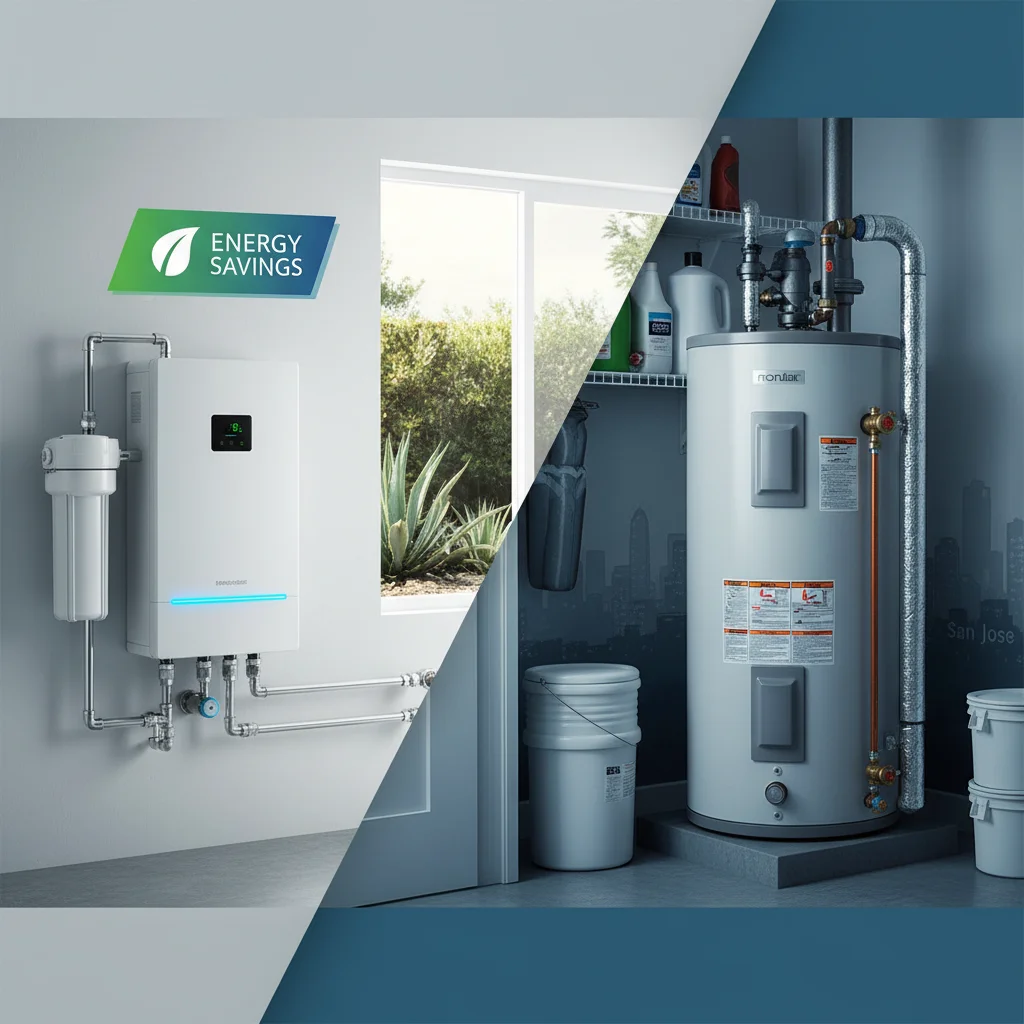
San Jose homeowners replacing water heaters in 2026 can access up to $4,000 in combined federal tax credits and California rebates when upgrading to high-efficiency tankless models. The choice between tankless and traditional tank systems affects not just monthly energy bills—which differ by $20 to $45 per month in a typical San Jose household—but also rebate eligibility, installation complexity, and long-term savings over the system's 20-year lifespan. Natural gas prices in the Bay Area averaged $2.18 per therm in 2026, making the efficiency gap between old 0.58 EF tank heaters and new 0.96 UEF tankless units worth roughly $360 annually.
What Are the Rebate-Eligible Specs for Tankless Water Heaters in San Jose?
Tankless water heaters qualify for California rebates when rated at 0.90 Uniform Energy Factor or higher and certified by ENERGY STAR for residential use. The 2026 federal tax credit covers gas tankless models meeting 0.95 UEF minimum and electric heat pump water heaters rated 3.3 UEF or higher. San Jose Municipal Water customers access $500 rebates through the BayREN Water Upgrade California program for qualifying installations.
Most rebate-eligible tankless units carry flow rates of 6.5 to 9.5 gallons per minute and feature electronic ignition systems that eliminate standing pilot lights. Condensing models that capture exhaust heat to preheat incoming water typically exceed 0.94 UEF and qualify for maximum incentives. And installation must include recirculation pumps or demand systems to minimize water waste during the startup period. But electric tankless heaters rarely meet rebate thresholds in San Jose due to California's 2026 building codes favoring heat pump water heaters for electric applications.
The federal Residential Clean Energy Credit (Section 25D) ended for expenditures made after December 31, 2025, and the IRS treats an expenditure as made when installation is completed (IRS FS-2025-05). Federal tax credits for this work have ended, but state, local and utility rebates may still apply; check what is available at your address with the DuloCore rebate calculator. So a $3,200 tankless water heater installation generates a $960 federal tax credit when the system meets ENERGY STAR criteria. PG&E residential customers purchasing natural gas tankless heaters through participating contractors receive instant rebates of $300 to $500 at the point of sale.
San Jose sits in Climate Zone 3 under California Title 24 building codes, which mandate minimum 0.82 UEF ratings for replacement water heaters in single-family homes. Or homeowners upgrading from electric resistance tank heaters to heat pump water heaters access $2,000 to $3,800 in combined federal and state incentives under the 2026 California Energy Commission rebate programs.
The federal Energy Efficient Home Improvement Credit (Section 25C) ended for property placed in service after December 31, 2025 (IRS FS-2025-05).
How Do I Calculate the ROI and Payback Period for a Tankless Water Heater Upgrade?
San Jose tankless water heater ROI calculations compare total installation costs minus rebates against annual energy savings over the system's expected 20-year lifespan. A typical upgrade from a 0.60 EF tank heater to a 0.94 UEF tankless unit saves $312 to $396 per year in natural gas costs at 2026 Bay Area rates. The simple payback period averages 7.2 to 9.8 years when factoring $4,500 installation costs and $1,460 in combined federal and utility rebates.
The rebate calculator shows that households using 65 gallons of hot water daily see faster payback than smaller households using 40 gallons per day. And homes with solar panels offsetting natural gas costs experience extended payback periods of 11 to 14 years since the baseline energy expense starts lower. But tankless systems eliminate standby heat loss—the 10% to 20% of energy wasted keeping tank water hot when nobody's using it—which accelerates ROI in San Jose's mild climate where ambient garage temperatures average 62°F year-round.
Total cost of ownership over 20 years includes one replacement at year 18 to 20 for tankless units versus two replacements at years 10 and 20 for traditional tank heaters. Or the lifecycle cost advantage reaches $3,800 to $5,200 when accounting for avoided replacement expenses, reduced water heating bills, and higher home resale values. San Jose properties with tankless water heaters sell for 1.3% to 2.1% more than comparable homes with standard tank systems according to 2025 Bay Area real estate data.
Commercial properties and multi-family buildings see different economics—a 199,000 BTU commercial tankless heater serving a duplex costs $6,800 installed but saves $840 annually in gas costs when replacing two separate 50-gallon tank heaters. So the payback period drops to 5.4 years after applying available commercial rebates.
What Are the Total Installation Costs and Available Incentives for San Jose Residents?
San Jose tankless water heater installations range from $3,800 to $6,500 including equipment, labor, permits, and required upgrades to gas lines or electrical systems. The national average for mid-range condensing tankless units reaches $4,200 compared to $1,800 for standard 50-gallon tank replacements. But installation complexity varies—homes built before 1985 often need gas line upgrades from ½-inch to ¾-inch diameter to supply adequate fuel flow, adding $800 to $1,400 to project costs.
The 2026 federal tax credit covers 30% of total project costs up to $600 for qualifying ENERGY STAR certified tankless water heaters when included with other home efficiency improvements under the energy tax credits program. And California's Tech Clean California initiative provides $1,000 rebates for natural gas tankless heaters rated 0.92 UEF or higher installed in single-family homes. Or San Jose residents replacing electric resistance tank heaters with heat pump water heaters access $2,000 federal credits plus $500 to $2,000 state rebates depending on household income.
PG&E territory customers—which includes most of San Jose—receive automatic $300 rebates through the Energy Upgrade California program when contractors submit installation documentation within 60 days. So total available incentives reach $1,900 to $2,600 for standard residential installations and $3,500 to $4,600 for low-income households under 80% Area Median Income thresholds.
Permit fees in San Jose average $180 to $240 for water heater replacements requiring mechanical and plumbing inspections. And condensing tankless units need dedicated PVC exhaust venting that costs $400 to $900 installed, while non-condensing models use standard metal B-vent chimneys compatible with existing infrastructure. But outdoor installations eliminate venting costs entirely—a popular option in San Jose's frost-free climate where freeze protection extends down to 28°F.
"Water heating accounts for about 18% of energy consumed in homes, making it the second-largest energy expense." — Department of Energy
How Does a Tankless Water Heater Compare to Tank, Heat Pump, and Hybrid Alternatives?
Tankless water heaters deliver endless hot water at flow rates of 6.5 to 9.5 gallons per minute compared to 40 to 80-gallon storage capacity limits in traditional tank systems. The efficiency gap between 0.94 UEF tankless units and 0.62 EF standard tanks translates to $324 annual savings for San Jose households using 64 gallons of hot water daily. And tankless systems occupy 80% less floor space than tank heaters, measuring 28 inches tall by 18 inches wide versus 60-inch-tall tanks requiring 16 square feet of garage space.
Heat pump water heaters achieve 3.4 to 3.8 UEF ratings—the highest efficiency of any residential water heating technology—by extracting heat from ambient air rather than burning fuel. But heat pump units cost $1,800 to $2,400 installed compared to $4,200 for tankless systems. Or hybrid water heaters combine heat pump technology with electric resistance backup elements, delivering 3.2 UEF efficiency at $2,600 to $3,400 installed.
The heat pump rebates program offers $2,000 to $3,800 for qualifying installations, making heat pump water heaters the lowest net-cost option after incentives. So San Jose homeowners prioritizing maximum efficiency and minimum upfront cost after rebates choose heat pump models over tankless systems. But tankless heaters win in high-demand scenarios—a family of five running simultaneous showers exhausts a 50-gallon heat pump tank in 18 minutes while a 9.5 GPM tankless unit supplies continuous hot water indefinitely.
Recovery time separates tank-based systems from tankless flow-through designs. And a 50-gallon electric heat pump water heater needs 90 to 120 minutes to reheat after full depletion while tankless units provide instant temperature recovery. But heat pump water heaters produce 3.5 times more hot water per kilowatt-hour than electric tankless models at San Jose's $0.38 per kWh electricity rates.
Maintenance requirements differ substantially—tankless heaters need annual descaling in San Jose's moderately hard water (7 to 10 grains per gallon) while heat pump and tank systems require only biennial anode rod inspections. Or the 20-year tankless lifespan exceeds the 12-year average for standard tanks and 15-year expectancy for heat pump models.
What's the Timeline for Rebate Applications and When Will I See Savings?
San Jose tankless water heater rebate applications process within 6 to 8 weeks from installation completion for state and utility programs. Form 5695 only covers qualifying work completed by December 31, 2025 and claimed on a 2025 return; the federal 25C and 25D credits ended after that date (IRS FS-2025-05). And PG&E instant rebates deduct from the contractor's invoice at the time of installation, providing immediate savings without application paperwork.
BayREN Water Upgrade California rebates require contractors to submit installation certificates, equipment specification sheets, and proof of purchase within 60 days of project completion. So homeowners receive $500 checks in the mail approximately 10 weeks after their tankless water heater goes into service. But the Tech Clean California program processes applications within 4 to 6 weeks when contractors use the online portal and include digital photos of installed equipment with model numbers visible.
Energy bill savings appear immediately—the first natural gas statement after tankless installation shows reduced therms consumed compared to the same billing period in prior years. And San Jose households typically notice $24 to $38 monthly reductions in PG&E gas charges when replacing 12-year-old tank heaters with new condensing tankless models. Or the cumulative 12-month savings reach $312 to $396 before accounting for any rebate payments.
Tax credit timing depends on filing schedules—homeowners installing tankless heaters in January 2026 claim the credit on their April 2027 tax return, while December 2026 installations wait until April 2028. So the effective payback period extends by 4 to 16 months depending on installation date relative to tax filing deadlines. But quarterly estimated tax payers reduce withholding immediately to capture the credit throughout the year rather than waiting for annual refunds.
Which Tankless Models Qualify for California's Energy Rebate Programs?
ENERGY STAR certified tankless water heaters meeting 0.90 UEF minimum ratings qualify for California rebate programs in 2026. The Rinnai RU199iN achieves 0.96 UEF with 11 gallons per minute flow capacity at $2,800 retail and appears on approved equipment lists for BayREN and PG&E rebates. And Navien NPE-240A condensing units rated 0.97 UEF deliver 10.1 GPM at $2,400 while qualifying for maximum federal tax credits.
Noritz NRC1111 models achieve 0.93 UEF at 11.1 GPM and cost $2,600 installed, meeting California Title 24 requirements for replacement water heaters in Climate Zone 3. Or Rheem RTG-95DVLN direct vent tankless heaters reach 0.94 UEF at 9.5 GPM and integrate with existing Rheem smart home systems for remote monitoring and temperature control. But Bosch Tronic 3000 electric tankless models achieve only 0.89 UEF and miss California rebate thresholds despite ENERGY STAR certification.
The California Energy Commission maintains a searchable database of qualifying appliances at the Modernized Appliance Efficiency Database System showing 47 tankless water heater models eligible for state rebates as of March 2026. And contractors licensed by the Contractors State License Board access real-time rebate availability through the Energy Upgrade California contractor portal before submitting customer quotes.
Condensing tankless heaters dominate qualifying model lists since non-condensing units rarely exceed 0.85 UEF ratings. So San Jose installations prioritizing maximum rebates focus on condensing technology despite $400 to $600 higher equipment costs compared to non-condensing alternatives. The federal Energy Efficient Home Improvement Credit (Section 25C) ended for property placed in service after December 31, 2025 (IRS FS-2025-05).
Official Sources
- ENERGY STAR Federal Tax Credits — Federal incentives for energy-efficient water heaters (note: the federal 25C credit ended for property placed in service after December 31, 2025)
- Department of Energy Water Heating Guide — Comprehensive efficiency ratings, costs, and technology comparisons
- DSIRE California Incentives — Database of state and utility rebate programs by ZIP code
Frequently Asked Questions
What is the difference between a tankless and tank water heater?
Tankless water heaters heat water on demand as it flows through the unit, while tank heaters store 40 to 80 gallons of preheated water. Tankless systems deliver endless hot water at 6.5 to 9.5 gallons per minute but require higher gas flow rates—199,000 BTU input versus 40,000 BTU for standard tanks. And tankless units achieve 0.94 UEF efficiency compared to 0.62 EF for conventional tanks, saving $312 to $396 annually in San Jose natural gas costs.
How much can you save with a tankless water heater in San Jose?
San Jose households save $24 to $38 monthly on natural gas bills when upgrading from standard 0.60 EF tank heaters to 0.94 UEF tankless systems. The annual savings reach $312 to $396 at 2026 Bay Area natural gas rates of $2.18 per therm. And combined federal tax credits plus California rebates total $1,460 to $2,600, reducing net installation costs from $4,500 to $2,900 for qualifying systems.
Are tankless water heaters eligible for rebates in San Jose?
San Jose tankless water heaters qualify for $300 to $500 PG&E rebates, $1,000 California Tech Clean California incentives, and 30% federal tax credits up to $600 when rated 0.90 UEF or higher. BayREN Water Upgrade California provides additional $500 rebates for Municipal Water customers. And low-income households under 80% Area Median Income access supplemental $800 to $1,500 state incentives through the California Energy Commission programs.
How long does a tankless water heater last compared to a traditional tank?
Tankless water heaters last 18 to 22 years in San Jose's moderately hard water conditions compared to 10 to 13 years for traditional tank systems. The extended lifespan eliminates one replacement cycle over 20 years, saving $1,800 to $2,400 in avoided equipment and installation costs. But tankless units require annual descaling maintenance costing $120 to $180 while tanks need only biennial anode rod replacements at $80 per service.
What is the installation cost difference between tankless and tank water heaters?
Tankless water heater installations cost $3,800 to $6,500 in San Jose compared to $1,600 to $2,400 for standard tank replacements. The $2,200 to $4,100 premium covers condensing technology, gas line upgrades from ½-inch to ¾-inch diameter, and dedicated PVC exhaust venting. But federal tax credits covering 30% of tankless installation costs plus $1,000 to $1,500 California rebates reduce the net price difference to $800 to $1,900 after incentives.
Ready to see your exact savings? Use our free rebate calculator to find every available incentive for your San Jose address and get contractor quotes for qualifying tankless water heater installations.
Updated on April 14, 2026. Fact-checked by DuloCore Editors. About our research team.
Check your California water heater rebate eligibility — see the programs you qualify for and the dollar amounts on our California water heater rebate finder.