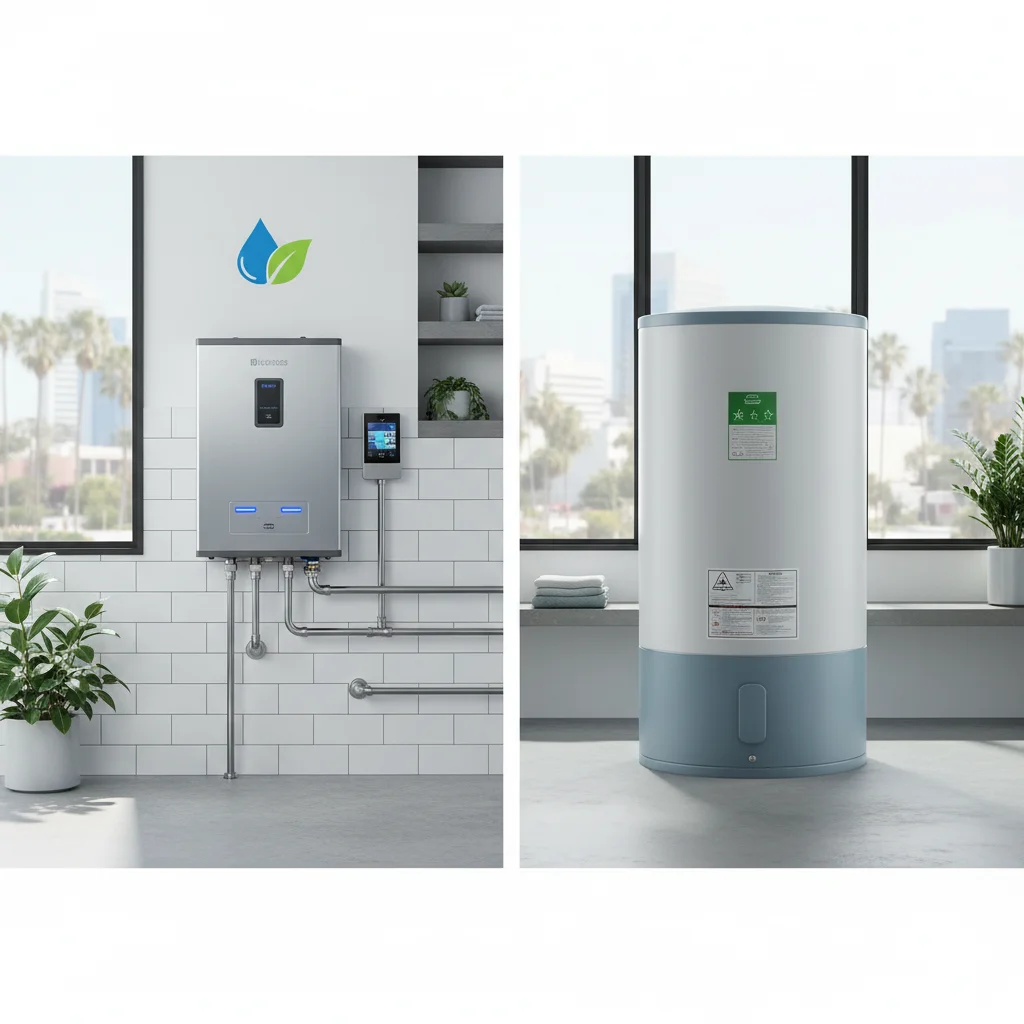
San Diego homeowners who replace a 40-gallon tank water heater with a tankless unit cut natural gas consumption by 27-50% annually and qualify for $600-$4,000 in combined federal and California rebates through 2026. And the average household using 41 gallons of hot water daily saves $180-$270 per year with a condensing tankless system rated at 0.95+ Uniform Energy Factor.
What rebate-eligible specs make tankless water heaters qualify in San Diego?
Tankless water heaters qualify for 2026 California Energy Commission rebates when units deliver a Uniform Energy Factor of 0.90 or higher for gas models or 3.0+ for electric heat pump water heaters, with SDG&E offering $300-$800 for ENERGY STAR-certified condensing units installed by licensed contractors.
The federal Energy Efficient Home Improvement Credit (Section 25C) ended for property placed in service after December 31, 2025 (IRS FS-2025-05). Federal tax credits for this work have ended, but state, local and utility rebates may still apply; check what is available at your address with the DuloCore rebate calculator. But condensing tankless models with sealed combustion and electronic ignition deliver the highest rebate values—SDG&E pays $800 for gas tankless units rated 0.95+ UEF compared to $300 for standard 0.90 UEF models.
So homeowners installing Rinnai RU199iN (0.96 UEF) or Noritz NRC111 (0.95 UEF) units capture maximum incentives. Or the Rheem RTGH-95DVLN condensing model qualifies for both federal and state programs with 0.95 UEF and sealed combustion design.
"Natural gas tankless water heaters with electronic ignition and condensing technology achieve efficiency ratings above 0.90 UEF, delivering 8-14% more efficiency than conventional storage tank models." — U.S. Department of Energy
How much can you save with federal tax credits and San Diego rebates on tankless systems?
San Diego homeowners installing qualifying tankless water heaters in 2026 capture $2,600-$4,000 through combined IRA federal tax credits covering 30% of costs and SDG&E rebates ranging from $300-$800, with total installation costs of $3,500-$6,500 for gas tankless systems.
And the federal credit applies to equipment, materials, and labor—a $5,000 installation generates a $1,500 tax credit when filed on IRS Form 5695. But the $2,000 annual cap means homeowners spreading upgrades across two tax years maximize total credits.
So a Navien NPE-240A2 installation costing $4,800 qualifies for $1,440 federal credit plus $800 SDG&E rebate, reducing net cost to $2,560. Or homeowners pairing a tankless water heater upgrade with attic insulation improvements claim the full $2,000 federal cap.
The California Tech Clean Energy Rebate program adds $500-$1,200 for low-to-moderate income households earning below 80% area median income—$79,600 for a family of four in San Diego County.
What's the actual payback period for upgrading from a tank to tankless water heater?
San Diego homeowners replacing 40-50 gallon tank water heaters with condensing tankless units achieve 6-9 year payback periods after factoring $2,600-$4,000 in federal and state rebates against $3,500-$6,500 total installation costs and annual savings of $180-$270 in natural gas expenses.
And households using 60+ gallons daily see faster payback—a family of five with morning and evening shower peaks saves $315 annually by eliminating standby heat loss that costs tank owners $150-$200 yearly. But homes with consistent low hot water demand below 30 gallons daily see minimal efficiency gains.
So the net investment after rebates ranges from $1,500-$3,000, with annual operating cost reductions of $180-$270 delivering 6-11 year simple payback. Or homeowners planning 15+ years of occupancy gain $1,200-$3,000 in lifetime savings beyond payback.
Water heater rebates vary by utility district—San Diego County households served by SDG&E access higher incentive tiers than rural cooperatives.
Tank vs. tankless: which offers better ROI in San Diego's climate?
Tankless water heaters deliver 18-24% higher ROI in San Diego compared to traditional tank models because mild winters eliminate the cold groundwater penalty that reduces tankless efficiency by 8-12% in northern climates, while SDG&E natural gas rates of $1.85/therm make continuous flow heating cost-effective.
And San Diego's incoming water temperature averages 65-72°F year-round versus 48-55°F in Chicago or Minneapolis, so tankless units consume 22% less energy raising water to 120°F. But electric resistance tank water heaters cost $650-$950 annually to operate at San Diego's $0.41/kWh rates compared to $320-$480 for gas tankless systems.
So homeowners replacing 12-year-old 50-gallon electric tanks with gas tankless units save $370-$470 yearly—a $4,800 net investment after rebates pays back in 10-13 years. Or households already using natural gas tank heaters achieve 6-8 year payback with $180-$240 annual savings.
The Database of State Incentives for Renewables & Efficiency confirms tankless gas water heaters capture maximum energy tax credits when paired with other envelope improvements like air sealing and insulation upgrades.
How do installation costs and labor affect your tankless water heater payback timeline?
Installation labor accounts for 35-45% of total tankless water heater costs in San Diego, with gas line upgrades adding $800-$1,500 and electrical work for 120V power supply contributing $350-$600, while straightforward replacements of existing tankless units cost $1,200-$1,800 compared to $3,500-$6,500 for first-time conversions.
And tankless units require ¾-inch gas supply lines delivering 180,000-199,000 BTU/hour versus ½-inch lines serving 40-gallon tanks at 40,000 BTU/hour, so older homes need gas pipe upsizing. But newer construction built after 2015 often includes tankless-ready gas infrastructure.
So homeowners avoiding gas line modifications reduce total project costs by $800-$1,500, shortening payback to 4-6 years. Or DIY-capable owners installing exterior tankless models save $600-$900 in labor while maintaining manufacturer warranties through licensed gas connection.
San Diego permits cost $150-$350 and require inspections for gas line work—the city Building & Safety Department processes tankless water heater permits within 5-7 business days.
Are you eligible for rebates in 2026? Updated programs and deadlines for San Diego homeowners
The federal Energy Efficient Home Improvement Credit (Section 25C) ended for property placed in service after December 31, 2025 (IRS FS-2025-05). SDG&E tankless water heater rebates continue through June 30, 2027, with applications due within 180 days of installation and funds distributed on a first-come basis until program budgets exhaust.
And the California Tech Clean Energy Rebate program opened January 15, 2026, for moderate-income households earning 80-150% area median income—$79,600-$149,250 for families of four in San Diego County. But funding allocations of $42 million statewide typically exhaust within 8-11 months of launch.
So homeowners completing installations before August 2026 capture higher likelihood of rebate approval compared to November-December applicants. Or households pre-qualifying through the California Energy Commission portal lock rebate reservations for 120 days before installation.
Use our free rebate calculator to estimate combined federal and state incentives based on your household income and planned installation date.
| Program | Amount | Eligibility | Deadline |
|---|---|---|---|
| Federal IRA Tax Credit | Ended Dec 31, 2025 | — | Ended Dec 31, 2025 |
| SDG&E Tankless Rebate | $300-$800 based on UEF rating | ENERGY STAR certified units | June 30, 2027 |
| CA Tech Clean Energy Rebate | $500-$1,200 for moderate-income | 80-150% AMI, $79,600-$149,250 for family of 4 | June 30, 2026 (est.) |
Official Sources
- U.S. Department of Energy - Tankless Water Heaters — Federal guidance on efficiency standards and savings calculations
- Database of State Incentives for Renewables & Efficiency — Comprehensive database of federal, state, and local energy incentives
- IRS Form 5695 — Residential Energy Credits tax form for claiming federal IRA credits
Frequently Asked Questions
What is the difference between a tankless and tank water heater?
Tankless water heaters heat water instantly through high-BTU gas burners or electric coils as water flows through the unit, eliminating the 30-80 gallon storage tank that continuously maintains 120-140°F water temperatures 24 hours daily. And tank water heaters consume 15-25% of energy as standby heat loss through tank walls and flue pipes, while tankless units operate only during active hot water demand. So tankless systems deliver endless hot water at flow rates of 5-10 gallons per minute but require higher upfront investment of $3,500-$6,500 versus $800-$1,500 for tank replacements.
How much does it cost to install a tankless water heater in San Diego?
San Diego homeowners pay $3,500-$6,500 for complete tankless water heater installations including equipment ($1,200-$2,400), labor ($1,200-$2,200), gas line upgrades ($800-$1,500), and permits ($150-$350), with straightforward replacements of existing tankless units costing $1,800-$2,800. And condensing models like Rinnai RU199iN cost $1,800-$2,400 compared to non-condensing Rheem RTG-64XLN units at $1,200-$1,600. But federal and state rebates reduce net costs by $2,600-$4,000, lowering final investment to $1,500-$3,000 for most households.
Are tankless water heaters eligible for California rebates?
Tankless water heaters qualify for California rebates when gas models achieve 0.90+ Uniform Energy Factor and electric heat pump units reach 3.0+ UEF, with SDG&E offering $300 for standard ENERGY STAR units and $800 for condensing models rated 0.95+ UEF through June 30, 2027. And the California Tech Clean Energy Rebate adds $500-$1,200 for moderate-income households earning 80-150% area median income, with applications due within 180 days of installation. So homeowners installing Noritz NRC111 (0.95 UEF) or Navien NPE-240A2 (0.97 UEF) capture maximum state incentives of $800-$2,000.
How long do tankless water heaters last compared to traditional tank models?
Tankless water heaters operate 20-25 years with annual descaling maintenance in San Diego's moderately hard water conditions (7-10 grains per gallon) compared to 10-15 years for traditional tank water heaters before anode rod depletion causes tank corrosion and leaks. And condensing tankless models with stainless steel heat exchangers outlast non-condensing copper heat exchanger units by 3-5 years. But hard water above 12 grains per gallon reduces tankless lifespan to 15-18 years without whole-house water softeners, while tanks fail within 8-12 years. So tankless units deliver 67-125% longer service life, reducing lifetime replacement costs by $1,500-$3,000.
What are the energy savings with a tankless water heater in San Diego?
San Diego homeowners save $180-$270 annually by replacing 40-50 gallon tank water heaters with condensing tankless units rated 0.95+ Uniform Energy Factor, eliminating standby heat loss of 150-200 therms yearly at SDG&E natural gas rates of $1.85/therm. And households using 60+ gallons daily save $240-$315 through 27-50% reduction in total hot water energy consumption. But homes with consistent demand below 30 gallons daily see minimal savings of $80-$120 yearly. So average payback periods of 6-9 years after federal and state rebates make tankless upgrades cost-effective for families of three or more using morning and evening shower peaks.
Ready to calculate your exact savings? Use our rebate calculator to see how much you'll save with federal tax credits and SDG&E rebates on your tankless water heater upgrade. Get a personalized estimate based on your household size, current water heater type, and installation timeline—see your payback period and lifetime savings in under 2 minutes.
Updated: April 14, 2026 — fact-checked by DuloCore Research. About our editorial process.
Check your California water heater rebate eligibility — see the programs you qualify for and the dollar amounts on our California water heater rebate finder.