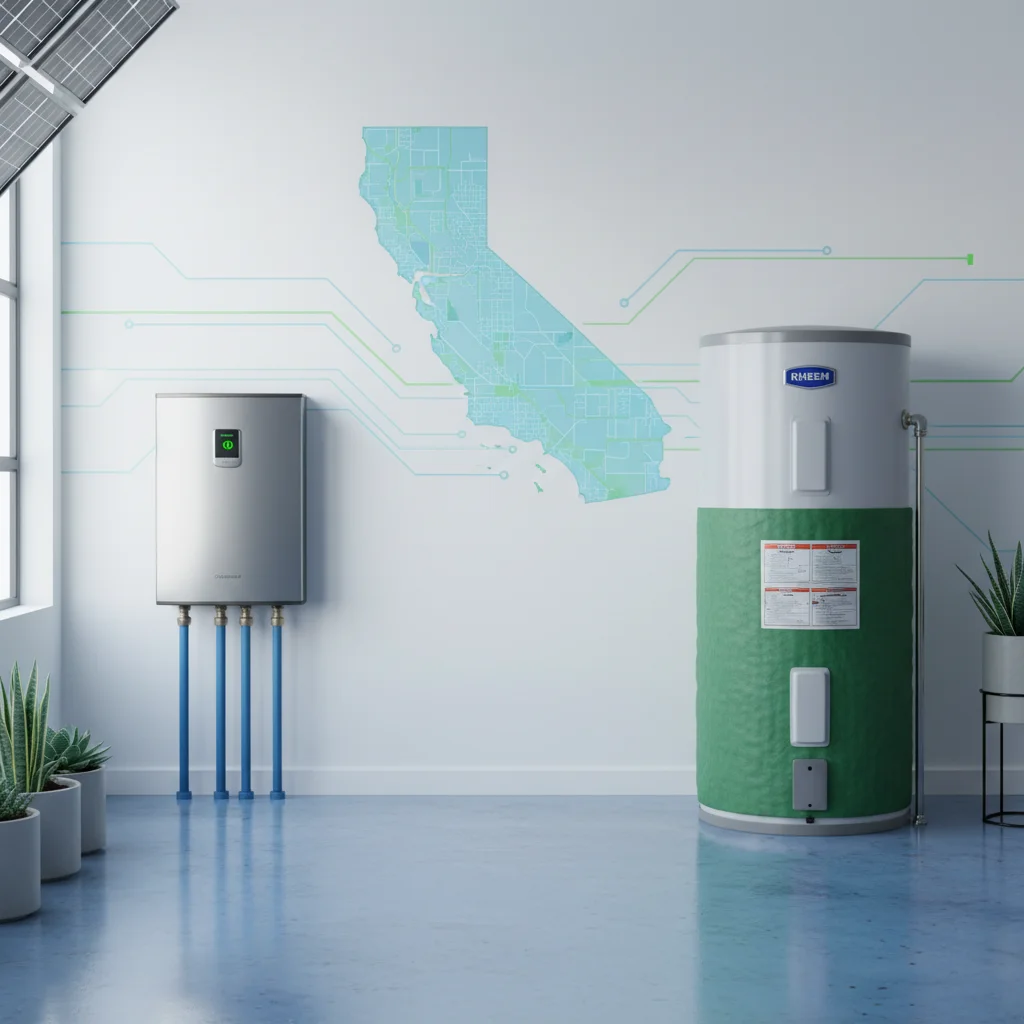
Riverside homeowners spent an average of $547 on water heating in 2025—nearly 18% of their annual utility bills. And with California's Title 24 energy code tightening in 2026, traditional tank water heaters face stricter efficiency requirements that make retrofitting older homes more expensive. The state's push toward electrification, combined with federal IRA rebates worth up to $1,750 per household, has shifted the economics of water heater replacement dramatically.
Which Tankless Water Heaters Qualify for Riverside Rebates in 2026?
Riverside homeowners qualify for tankless water heater rebates through Southern California Edison's Energy Efficiency Rebate Program and federal IRA tax credits. Tankless gas models must achieve a Uniform Energy Factor (UEF) of 0.87 or higher, while electric heat pump water heaters require a UEF of 3.3 or higher. Brands including Rinnai, Navien, Rheem, and A.O. Smith meet these thresholds for 2026 rebates.
Southern California Edison offers $150 rebates for qualifying tankless gas water heaters installed in single-family homes. And the federal High-Efficiency Electric Home Rebate (HEEHRA) provides up to $1,750 for heat pump water heaters if household income falls below 150% of the area median—$132,450 for a family of four in Riverside County. But gas tankless models don't qualify for federal rebates, only state and utility incentives.
The Energy Star certification database lists 247 tankless gas models and 89 heat pump water heaters that meet California's 2026 standards. Rinnai's RU199iN achieves a UEF of 0.93, while Rheem's ProTerra Hybrid heat pump reaches 4.0 UEF—both exceeding minimum requirements. So homeowners who choose electric models access significantly larger rebate amounts compared to gas tankless units.
"Heat pump water heaters can save a household of four approximately $550 per year on electric bills compared to standard electric resistance water heaters." — U.S. Department of Energy
California's Self-Generation Incentive Program (SGIP) doesn't cover standalone water heaters but pairs with solar installations for an additional $200-$400 credit when bundled. And Title 24 compliance requires tankless models in new construction or major renovations, making rebate-eligible units the default choice rather than an upgrade.
What's the Actual ROI and Payback Period for Switching to Tankless in Riverside?
Riverside homeowners see payback periods of 6-9 years for tankless gas models and 4-7 years for heat pump water heaters when accounting for 2026 rebates and energy savings. Gas tankless units cost $2,800-$4,500 installed, while traditional 50-gallon tanks cost $1,400-$2,200. But annual operating costs drop from $547 for tanks to $380 for tankless gas and $210 for heat pump models.
The $150 SCE rebate reduces gas tankless installation costs to $2,650-$4,350 upfront. And heat pump models, despite $3,500-$5,000 installed costs, drop to $1,750-$3,250 after federal rebates. So electric models achieve faster payback despite higher purchase prices.
A family of four using 64 gallons of hot water daily saves $167 annually with tankless gas or $337 with heat pump models. Over a 20-year lifespan for tankless units versus 10-13 years for tanks, lifetime savings reach $3,340 for gas tankless and $6,740 for heat pump—accounting for one tank replacement at year 12.
Natural gas prices in Riverside averaged $1.43 per therm in 2025, while electricity cost $0.31 per kWh. And California's tiered rate structure penalizes high usage, making heat pump water heaters particularly cost-effective for households in Tier 3 or higher. But homes without 240-volt electrical capacity face $800-$1,500 panel upgrade costs that extend payback periods by 2-3 years.
The calculation shifts for households replacing failed tanks urgently. Emergency replacements eliminate the option to wait for rebate processing, but SCE processes applications within 4-6 weeks and issues checks within 30 days of approval. So contractors often install first and submit documentation immediately afterward.
Check your potential savings with our rebate calculator to model your specific usage and rebate eligibility.
How Do Tankless vs Tank Water Heaters Perform in Riverside's Climate Zone?
Riverside sits in California Climate Zone 10, with summer temperatures exceeding 100°F and winter lows near 40°F. Tankless water heaters maintain efficiency across this range, while traditional tanks experience 10-15% standby heat loss during winter months. And groundwater temperatures average 62°F in summer and 56°F in winter—impacting flow rates for both systems.
Gas tankless models deliver 7-10 gallons per minute at a 70°F temperature rise, sufficient for two simultaneous showers in Riverside's moderate climate. But winter groundwater drops to 56°F, requiring larger temperature rises that reduce flow to 5-7 GPM. So households running dishwashers, washing machines, and showers simultaneously may experience insufficient hot water during December-February.
Tank water heaters store 40-80 gallons preheated to 120°F, providing consistent output regardless of groundwater temperature. And recovery rates of 40-60 gallons per hour handle peak demand spikes better than tankless models in climate zones with high usage variation. But standby losses in Riverside's hot summers waste 1.2-1.8 kWh daily even when no hot water is drawn.
Heat pump water heaters perform optimally in ambient temperatures of 50-90°F, matching Riverside's climate profile 9 months annually. And garage installations—common in Southern California—provide ideal conditions year-round. But heat pumps require 1,000 cubic feet of air space, making small indoor closets unsuitable without ducting modifications.
"In warm climates, heat pump water heaters can be two to three times more energy efficient than conventional electric resistance water heaters." — Energy Star
The desert-influenced climate creates calcium carbonate buildup in tank models 30% faster than coastal regions. And tankless units require annual descaling maintenance costing $150-$250 to prevent mineral accumulation that degrades heat exchangers. So water hardness (Riverside averages 210 PPM) factors into long-term maintenance costs regardless of system type.
What Installation and Eligibility Requirements Must You Meet to Get Riverside Rebates?
Southern California Edison requires installation by a licensed contractor with a C-36 plumbing or C-20 HVAC license. Homeowners must submit SCE's Water Heater Rebate Application within 90 days of installation, including proof of purchase, contractor license verification, and equipment specifications showing UEF ratings. And properties must have an active SCE residential account at the service address.
Federal HEEHRA rebates require household income verification through tax returns or paystubs showing earnings below 150% area median income ($132,450 for a family of four in Riverside County). And applications process through California's Energy Upgrade California program, not directly through the IRS. So homeowners apply to approved contractors who pre-qualify rebates before installation.
Gas tankless installations require 3/4-inch gas lines and Category III stainless steel venting—upgrades costing $800-$1,500 in homes with 1/2-inch lines or masonry chimneys. And permits from Riverside's Building & Safety Department cost $175-$350 depending on system type. But permit fees qualify for rebate reimbursement under SCE's program guidelines.
Heat pump water heaters need dedicated 30-amp circuits and 240-volt electrical service. And installations in conditioned spaces require condensate drains connected to existing plumbing—adding $200-$400 to installation costs. So garage or basement installations avoid these requirements while maintaining optimal performance.
Title 24 compliance mandates insulation on all hot water pipes within 3 feet of the water heater. And 2026 code requires earthquake strapping rated for 0.4g lateral force in Riverside's seismic zone. But contractors include these upgrades in standard installation quotes, and permit inspectors verify compliance before final approval.
For detailed eligibility rules and income thresholds, visit the California Energy Upgrade Program guidelines.
How Much Will You Save with Rebate-Eligible Tankless Models vs Traditional Tanks?
Riverside homeowners installing gas tankless models save $2,840-$3,340 over 20 years compared to traditional tanks when including the $150 SCE rebate. Heat pump water heaters save $5,490-$6,740 over the same period with the $1,750 federal rebate applied. And avoided replacement costs add $1,400-$2,200 in year 12 when the original tank would fail.
The comparison assumes natural gas at $1.43 per therm and electricity at $0.31 per kWh—Riverside's 2025 average rates. A 50-gallon tank costs $547 annually to operate, while a tankless gas unit costs $380 and a heat pump costs $210. So annual savings of $167 for gas tankless and $337 for heat pump accumulate over the equipment's lifespan.
| System Type | Installed Cost | After Rebates | Annual Operating Cost | 20-Year Total Cost | Total Savings vs Tank |
|---|---|---|---|---|---|
| Traditional Tank | $1,800 | $1,800 | $547 | $14,740 | — |
| Tankless Gas | $3,500 | $3,350 | $380 | $10,950 | $3,790 |
| Heat Pump | $4,500 | $2,750 | $210 | $7,000 | $7,740 |
But households in Southern California Edison's High Usage Rate (Tier 3+) see electricity costs rise to $0.42 per kWh, increasing heat pump operating costs to $285 annually. And natural gas rates climb 3-5% annually on average, while electricity rates have risen 8% annually since 2020. So projecting future savings requires assuming rate escalation that favors electrification.
Maintenance costs offset some savings: tankless gas units require annual descaling ($150-$250), while tanks need anode rod replacement every 3-5 years ($120-$180). And heat pump compressors fail at 10-12 years, requiring $600-$900 replacements. So total cost of ownership includes these expenses beyond energy bills.
Water usage patterns determine actual savings. Households using less than 40 gallons daily see smaller absolute savings—$90-$120 annually with tankless gas. And homes with municipal water heater rental programs paying $18-$25 monthly face different economics than purchase scenarios. But rental programs rarely offer tankless or heat pump options, limiting long-term flexibility.
Learn more about related incentives for heat pump rebates and energy tax credits available in 2026.
What's the Rebate Application Process and Deadline for Riverside Homeowners?
Southern California Edison's rebate applications open immediately after installation and close 90 days from the purchase date. Homeowners submit the Water Heater Rebate Application online through SCE's Business Rebates & Incentives portal, uploading proof of purchase, contractor license verification, and equipment specification sheets showing UEF ratings. And SCE processes applications within 4-6 weeks, issuing rebate checks within 30 days of approval.
Federal HEEHRA rebates follow a two-step process: pre-qualification through approved contractors before installation, then final documentation submission within 30 days of project completion. And California's Energy Upgrade California program maintains a contractor directory at energyupgradeca.org. So homeowners verify contractor participation before signing installation contracts.
Required documentation includes:
- Itemized invoice showing equipment model numbers and installation date
- Contractor's C-36 or C-20 license number and insurance certificate
- Manufacturer's specification sheet with UEF rating highlighted
- Building permit and final inspection approval from Riverside Building & Safety
- For HEEHRA: tax returns or paystubs verifying income eligibility
The federal program allocates $4.5 billion nationally but distributes funds through state agencies on a first-come basis. And California received $476 million in 2026, covering approximately 272,000 heat pump water heater rebates statewide. So early applicants secure funding before state budgets exhaust mid-year.
SCE rebates have no annual cap but require installation between January 1, 2026, and December 31, 2026, for current program year funding. And HEEHRA rebates continue through 2032 under IRA provisions but face annual state budget approvals that may reduce per-unit amounts after 2027. But confirmed 2026 allocations guarantee $1,750 rebates for eligible applicants this year.
Denied applications—typically due to missing documentation or non-qualifying equipment—allow resubmission within 30 days. And SCE provides rejection reasons with specific instructions for correction. So homeowners resolving issues within the 90-day window retain eligibility despite initial denials.
For comprehensive details on water heater rebates and application procedures, review the complete guide.
Official Sources
- U.S. Department of Energy - Energy Saver — Federal energy efficiency guidance and residential rebate programs including HEEHRA
- Energy Star Water Heater Directory — Certified product database with UEF ratings and rebate-eligible models
- DSIRE USA — Database of state and utility energy incentives including California and SCE rebates
Frequently Asked Questions
What is the difference between a tankless and tank water heater?
Tankless water heaters heat water on-demand using gas burners or electric heating elements as water flows through the unit, eliminating standby heat loss from stored water. Traditional tank water heaters store 40-80 gallons of preheated water maintained at 120°F continuously. Tankless models measure 20x28x10 inches and mount on walls, while tanks require 24-36 inches of floor space. And tankless units last 20+ years compared to 10-13 years for tanks, but cost $2,000-$3,000 more upfront.
How much money can you save with a tankless water heater in Riverside?
Riverside homeowners save $167 annually with tankless gas models and $337 annually with heat pump water heaters compared to traditional 50-gallon tanks. Over a 20-year lifespan, total savings reach $3,340 for gas tankless and $6,740 for heat pump models when including the $150 SCE rebate and $1,750 federal HEEHRA rebate respectively. And avoided tank replacement costs in year 12 add $1,400-$2,200 in savings. But actual results depend on household water usage—families using 64+ gallons daily see maximum savings.
Are tankless water heaters eligible for rebates in Riverside?
Yes, Southern California Edison offers $150 rebates for gas tankless water heaters with UEF ratings of 0.87 or higher. And heat pump water heaters qualify for federal HEEHRA rebates worth $1,750 for households earning below 150% area median income ($132,450 for a family of four in Riverside County). But traditional gas tankless models don't qualify for federal rebates—only state and utility incentives. And installations must use licensed C-36 or C-20 contractors to meet rebate requirements.
How long does it take to install a tankless water heater?
Professional installation of a tankless water heater takes 6-10 hours for gas models and 4-8 hours for electric heat pump units. Gas installations requiring 3/4-inch gas line upgrades or Category III venting modifications add 3-5 hours. And heat pump installations needing electrical panel upgrades or dedicated 240-volt circuits extend timelines by 4-6 hours. But most contractors complete standard replacements in one day, with permit inspections scheduled within 3-5 business days through Riverside's Building & Safety Department.
What is the lifespan of a tankless water heater compared to a traditional tank?
Tankless water heaters last 20-25 years with annual maintenance, while traditional tank models last 10-13 years before rust perforation or element failure. Gas tankless units require descaling every 12 months in Riverside due to 210 PPM water hardness, costing $150-$250 per service. And heat pump water heaters last 15-18 years but need compressor replacement at 10-12 years ($600-$900). So tankless models avoid 1-2 full replacements compared to tanks over equivalent timeframes, saving $2,800-$4,400 in future equipment costs.
Ready to calculate your exact savings? Use our free rebate calculator to estimate your utility bill reduction, available rebates, and payback period based on your household size and current water heater type. Get personalized results in under 2 minutes.
Last updated April 14, 2026 — reviewed by DuloCore Editorial. About our authors.
Check your California water heater rebate eligibility — see the programs you qualify for and the dollar amounts on our California water heater rebate finder.