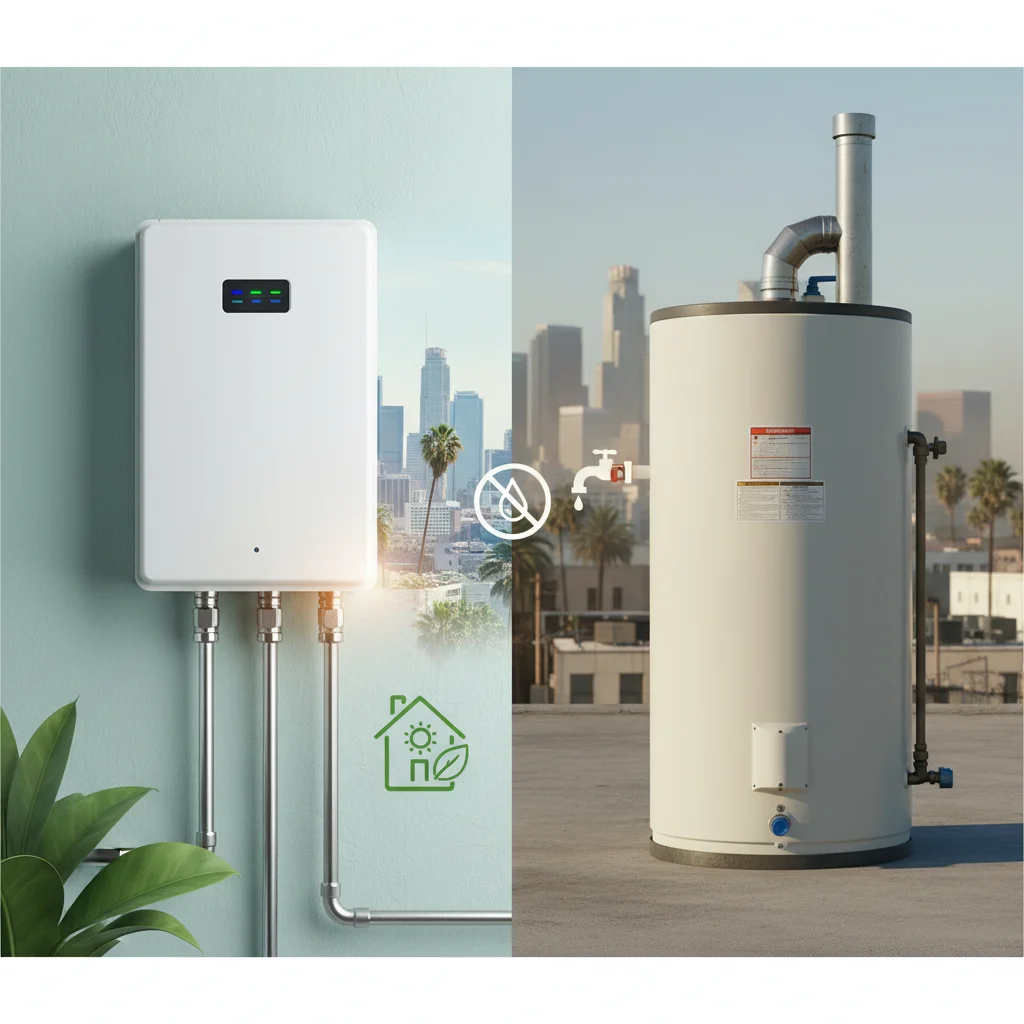
Los Angeles homeowners spend an average of $450 annually heating water with traditional tank systems, while tankless units cut that figure by 24-34% depending on household size and usage patterns. The city's Mediterranean climate and tiered electricity rates from LADWP and Southern California Edison make water heater selection a financial decision with measurable consequences for monthly utility bills, property resale value, and eligibility for state and federal rebates totaling up to $4,000 in 2026.
What's the Real ROI and Payback Period for Tankless Water Heaters in Los Angeles?
Tankless water heaters in Los Angeles deliver an ROI of 108-143% over 20 years, with payback periods ranging from 6-12 years depending on natural gas rates and household hot water consumption. Homes using more than 41 gallons of hot water daily see payback in 6-8 years, while smaller households take 10-12 years.
The math depends on baseline costs. Traditional 50-gallon tank heaters cost $1,200-$1,800 installed, with annual operating costs of $450-$550. Tankless units cost $2,500-$4,500 installed but reduce annual operating costs to $300-$360. The $1,300-$2,700 upfront premium gets recovered through $150-$190 annual savings, plus tankless systems last 20+ years versus 10-12 years for tanks.
And Los Angeles's natural gas rates of $1.30-$1.80 per therm make gas-fired tankless units more cost-effective than electric models. But homes without existing gas lines face $1,500-$3,000 in additional installation costs for gas line runs, extending payback periods to 12-15 years. Electric tankless units avoid gas line costs but consume 15-27 kW, increasing electrical panel upgrade expenses by $1,200-$2,500 in older homes with 100-amp service.
"ENERGY STAR certified water heaters use 10-50% less energy than standard models, depending on the technology." — ENERGY STAR Water Heaters
California's Self-Generation Incentive Program (SGIP) offers $300-$500 rebates for ENERGY STAR certified tankless gas water heaters, reducing net costs to $2,000-$4,000. The federal Energy Efficient Home Improvement Credit (Section 25C) ended for property placed in service after December 31, 2025 (IRS FS-2025-05). Federal tax credits for this work have ended, but state, local and utility rebates may still apply; check what is available at your address with the DuloCore rebate calculator. Use our free rebate calculator to estimate your total savings with available incentives.
How Does Los Angeles's Climate Zone Affect Tankless vs Tank Water Heater Performance?
Los Angeles spans California climate zones 6, 8, 9, and 10, where incoming groundwater temperatures range from 58°F in winter to 68°F in summer—warmer than most U.S. cities and ideal for tankless efficiency. Tankless units maintain consistent output because they don't store and reheat water overnight, eliminating the 10-20% standby heat loss that tanks experience in unconditioned garages and attics.
Climate zone 10 (coastal areas like Santa Monica and Malibu) sees groundwater temperatures at 62-68°F year-round, allowing tankless heaters to deliver 5-8 gallons per minute (GPM) with only a 40°F temperature rise. Inland zones 8 and 9 (San Fernando Valley, Pasadena) experience groundwater as low as 58°F in winter, requiring tankless units to heat water through a 52°F rise, reducing flow rates to 4-6 GPM.
Tank water heaters perform consistently across all LA climate zones because they pre-heat and store 40-50 gallons, making them less sensitive to inlet temperature fluctuations. But tanks in unconditioned spaces lose 0.5-1.5°F per hour, costing $45-$75 annually in wasted energy. So homes with water heaters in garages or outdoor closets benefit most from tankless conversion.
And Los Angeles's mild winters mean tankless units never face the freezing temperatures that cause performance drops in northern climates. Tankless systems maintain 99% efficiency year-round in LA, versus 85-90% in climates where inlet water drops below 45°F.
Which Water Heater Type Lasts Longer and What's the True Lifespan Comparison?
Tankless water heaters last 20-25 years with annual descaling maintenance, while traditional tank heaters fail after 10-12 years due to sediment buildup and anode rod corrosion. Los Angeles's water hardness ranges from 120-350 ppm (parts per million), accelerating mineral accumulation inside tank heaters and requiring tankless units to be flushed every 12-18 months.
Tank heaters fail when sediment hardens at the bottom, reducing heating efficiency by 15-25% and eventually cracking the steel tank lining. Anode rods—sacrificial metal bars that attract corrosive elements—disintegrate after 5-7 years in LA's moderately hard water, leaving the tank vulnerable to rust perforation. And once a tank leaks, the entire unit requires replacement at $1,200-$1,800.
Tankless systems avoid tank corrosion entirely because they heat water on-demand through stainless steel or copper heat exchangers. But LA's hard water deposits calcium carbonate scale on heat exchanger coils, reducing flow rates by 10-20% annually if not flushed. Professional descaling costs $150-$250 per service, totaling $3,000-$5,000 over a 20-year lifespan versus $12,000-$18,000 for replacing two tank heaters in the same period.
So the total cost of ownership favors tankless systems by $4,000-$8,000 over 20 years when accounting for replacement cycles. Homes with water hardness above 180 ppm (common in San Fernando Valley and eastern LA County) benefit most from whole-house water softeners ($800-$1,500 installed) that extend tankless lifespan to 25+ years and reduce descaling frequency to every 24 months.
What Are the Upfront Costs and Long-Term Savings for Each System in LA?
Traditional tank water heaters in Los Angeles cost $1,200-$1,800 installed for 40-50 gallon gas models, or $900-$1,400 for electric units. Tankless systems cost $2,500-$4,500 installed for whole-house gas models, or $1,500-$3,000 for electric point-of-use units. The $1,300-$2,700 premium for tankless translates to $150-$190 annual savings on utility bills, creating a 6-12 year payback depending on hot water usage and local energy rates.
| System Type | Installed Cost | Annual Operating Cost | 20-Year Total Cost | Lifespan |
|---|---|---|---|---|
| Tank (Gas) | $1,200-$1,800 | $450-$550 | $20,200-$29,800 | 10-12 years (2 replacements) |
| Tank (Electric) | $900-$1,400 | $500-$600 | $19,900-$25,400 | 10-12 years (2 replacements) |
| Tankless (Gas) | $2,500-$4,500 | $300-$360 | $8,500-$11,700 | 20-25 years |
| Tankless (Electric) | $1,500-$3,000 | $350-$420 | $8,500-$11,400 | 20-25 years |
Long-term savings favor tankless by $8,700-$18,100 over 20 years. But upfront cost barriers deter 68% of LA homeowners from converting, according to California Energy Commission data. And homes without existing gas lines face $1,500-$3,000 in additional plumbing costs, extending payback to 12-15 years.
Southern California Edison and LADWP customers on Time-of-Use (TOU) rates save an additional 15-22% by programming tankless heaters to avoid peak hours (4-9 PM). But tank heaters heat water during off-peak hours (midnight-6 AM), then rely on insulation to maintain temperature, making them equally cost-effective on TOU plans.
For detailed information on available incentives, see our guide on water heater rebates.
How Do Federal Tax Credits and California Rebates Apply to Your Water Heater Choice?
The federal Energy Efficient Home Improvement Credit (Section 25C) ended for property placed in service after December 31, 2025 (IRS FS-2025-05). California's TECH Clean California initiative offers point-of-sale rebates of $300-$500 for gas tankless units and $1,000-$1,500 for electric heat pump water heaters installed by participating contractors.
The federal Energy Efficient Home Improvement Credit (Section 25C) ended for property placed in service after December 31, 2025 (IRS FS-2025-05). But the $600 annual cap covers all residential energy improvements combined—including heat pump rebates and insulation upgrades—so homeowners making multiple improvements in one year may exceed the limit.
TECH Clean California rebates require contractor pre-approval and product pre-qualification through the program portal. Participating contractors include A.O. Smith, Bradford White, and Rheem dealers registered with the program. And rebates are applied at the point of sale, reducing the customer's invoice rather than requiring post-purchase reimbursement.
But not all tankless heaters qualify. Gas tankless models need UEF ≥ 0.87 (most condensing models), while electric tankless units need UEF ≥ 2.0 (heat pump models only). Traditional electric resistance tankless heaters with UEF of 0.93-0.96 don't qualify for federal credits, though they may receive state rebates.
Low-income households earning 80% or less of Area Median Income qualify for additional rebates of up to $1,750 under California's CARE program. And multifamily properties with 5+ units qualify for separate incentive tiers through the California Energy Commission's Multifamily Building Enhancement Program.
For more details on claiming federal incentives, see our article on energy tax credits.
Tankless vs Tank: Installation Timeline, Costs, and Process in Los Angeles
Tankless water heater installations in Los Angeles take 4-8 hours for gas conversions and 3-6 hours for electric models, compared to 2-4 hours for tank replacements. The extended timeline covers gas line sizing verification, electrical panel load calculations, venting upgrades, and permit inspections required by Los Angeles Department of Building and Safety (LADBS).
Gas tankless installations require Category III or IV stainless steel venting rated for 140-180°F flue temperatures, replacing the single-wall vent pipe used on tank heaters. Venting upgrades cost $300-$800 depending on run length and wall penetrations. And gas line sizing must support 150,000-199,000 BTU/hour input rates—50% higher than tank heaters—requiring new 3/4" or 1" black iron pipe in homes with existing 1/2" lines.
Electric tankless units draw 15-27 kW, requiring dedicated 60-100 amp circuits. Homes with 100-amp main service panels need upgrades to 150-200 amps, costing $1,200-$2,500 including utility meter replacement and LADBS inspection. And ground fault circuit interrupter (GFCI) protection is mandatory for all electric water heaters installed after 2020, adding $150-$250 to installation costs.
LADBS permit fees range from $150-$400 depending on project scope, and inspections add 1-3 days to the timeline. Contractors must submit permit applications 5-10 business days before installation, then schedule rough-in and final inspections. But most licensed plumbers handle permitting as part of installation contracts, so homeowners don't interact with LADBS directly.
So total installation costs break down as: equipment ($1,200-$2,800), labor ($600-$1,200), venting/gas line upgrades ($300-$800), electrical upgrades ($0-$2,500), and permits ($150-$400). Tank heater replacements cost $1,200-$1,800 because they reuse existing venting, gas lines, and electrical circuits.
Official Sources
- ENERGY STAR Water Heaters — Federal efficiency standards and certified product database
- U.S. Department of Energy - Save Energy, Save Money — Inflation Reduction Act tax credits and rebate programs (note: the federal 25C credit ended for property placed in service after December 31, 2025)
- DSIRE USA — Comprehensive database of state and utility rebate programs for California homeowners
Frequently Asked Questions
What is the difference between a tankless and tank water heater?
Tankless water heaters heat water on-demand using gas burners or electric coils as water flows through the unit, while tank heaters store 40-50 gallons of pre-heated water in an insulated tank. Tankless systems deliver endless hot water at 5-8 gallons per minute but cost $2,500-$4,500 installed. Tank heaters cost $1,200-$1,800 installed but run out of hot water after 40-50 gallons. And tankless units last 20-25 years versus 10-12 years for tanks.
How much money can you save with a tankless water heater in Los Angeles?
Tankless water heaters in Los Angeles save $150-$190 annually on utility bills compared to traditional tank heaters, totaling $3,000-$4,750 over a 25-year lifespan. Homes using more than 41 gallons of hot water daily save closer to $190 per year, while smaller households save $150. And federal IRA tax credits of up to $600 plus California TECH Clean rebates of $300-$500 reduce net installation costs by $900-$1,100.
Are tankless water heaters eligible for California rebates?
Yes. Gas tankless water heaters with Uniform Energy Factor (UEF) ratings of 0.87 or higher qualify for $300-$500 rebates through California's TECH Clean California program in 2026. Electric heat pump water heaters receive $1,000-$1,500 rebates. The federal Energy Efficient Home Improvement Credit (Section 25C) ended for property placed in service after December 31, 2025 (IRS FS-2025-05). Low-income households earning 80% or less of Area Median Income qualify for additional CARE rebates of up to $1,750.
How long does it take to install a tankless water heater?
Tankless water heater installations in Los Angeles take 4-8 hours for gas models and 3-6 hours for electric units, plus 1-3 days for permit inspections. Gas conversions require venting upgrades ($300-$800) and gas line sizing verification. Electric models need dedicated 60-100 amp circuits, and homes with 100-amp service require panel upgrades to 150-200 amps ($1,200-$2,500). Los Angeles Department of Building and Safety permits cost $150-$400 and require rough-in and final inspections.
What is the lifespan of a tankless water heater vs a traditional tank?
Tankless water heaters last 20-25 years with annual descaling maintenance, while traditional tank heaters fail after 10-12 years due to anode rod corrosion and sediment buildup. Los Angeles's water hardness of 120-350 ppm requires tankless units to be flushed every 12-18 months ($150-$250 per service). Tank heaters need anode rod replacement every 5-7 years ($200-$300), but most homeowners skip this maintenance, leading to premature failure. So homeowners replace 2 tank heaters for every 1 tankless system over 20 years.
Ready to see how much you can save? Use our free rebate calculator to estimate your total costs, annual savings, and available federal and California incentives based on your specific home and hot water usage.
Last reviewed: April 14, 2026. Reviewed by DuloCore Energy Specialists. About the team.
Check your California water heater rebate eligibility — see the programs you qualify for and the dollar amounts on our California water heater rebate finder.