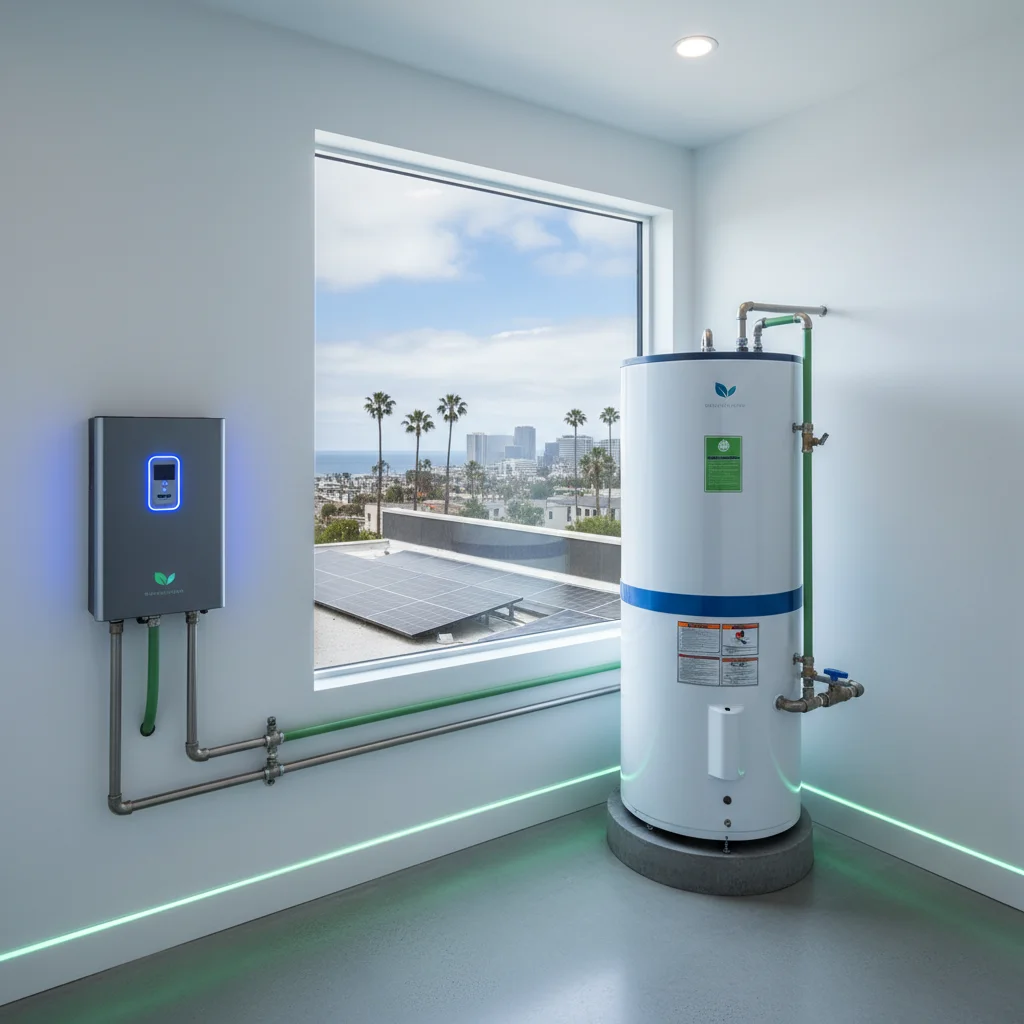
Long Beach homeowners spend an average of $500-$800 annually heating water with traditional tank systems — nearly 20% of total household energy costs. And with California's escalating energy rates hitting $0.34 per kWh in 2026, that expense keeps climbing. But tankless water heaters cut energy consumption by 24-34% compared to conventional storage tanks, translating to $120-$200 in annual savings for typical Long Beach households.
What's the ROI and Payback Period for Tankless Water Heaters in Long Beach?
Tankless water heaters in Long Beach deliver a payback period of 8-12 years based on 2026 installation costs of $3,200-$5,500 and annual energy savings of $150-$250. Federal IRA tax credits covering 30% of equipment costs reduce the payback window to 6-9 years. Natural gas models achieve faster ROI than electric units due to Long Beach's tiered electricity pricing structure.
The math behind payback calculations depends on three variables: upfront installation cost minus rebates, annual energy savings, and system longevity. A $4,000 tankless system with a $1,200 federal tax credit costs $2,800 net. And if that system saves $180 annually compared to a tank heater, the payback period lands at 15.5 years. But that calculation ignores maintenance costs — tank heaters require sediment flushing every 6-12 months at $150-$300 per service, while tankless units need descaling every 2-3 years at $200-$350.
So the true ROI calculation must account for differential maintenance expenses. Tank water heaters cost $25-$50 monthly in maintenance over their 10-12 year lifespan, totaling $3,000-$7,200. Tankless systems require $100-$175 annually, accumulating to $2,000-$3,500 over 20-25 years. The maintenance differential adds another layer of savings that compounds over time.
"Tankless water heaters can be 8%-34% more energy efficient than conventional storage tank water heaters, with the highest efficiency gains in homes using 41 gallons or less of hot water daily." — U.S. Department of Energy
How Much Can You Save Monthly on Energy Bills with a Tankless System?
Tankless water heaters save Long Beach households $12-$21 monthly on energy bills in 2026, based on Southern California Edison's tiered rate structure and natural gas pricing from SoCalGas at $2.18 per therm. Three-person households using 60 gallons daily see larger savings of $18-$25 monthly compared to single occupants using 30 gallons who save $8-$14 monthly.
Monthly savings scale directly with hot water demand. A family running multiple showers, dishwashers, and laundry loads pushes usage to 80-100 gallons daily, where tankless efficiency delivers $22-$28 monthly savings. But a single resident working full-time with minimal hot water needs sees diminished returns of $10-$16 monthly.
The key driver is standby heat loss — traditional tanks constantly reheat 40-50 gallons even when nobody's home, wasting 10-20% of total energy consumption. Tankless units eliminate this waste entirely by heating water only on-demand. And in Long Beach's mild coastal climate where inlet water temperatures average 58-62°F year-round, tankless heaters require less energy per gallon than systems in colder regions heating 35-40°F groundwater.
Or consider summer versus winter performance. Tank systems maintain 120-140°F storage temperatures regardless of demand, while tankless units modulate output based on inlet temperature and flow rate. This adaptive heating reduces summer energy consumption by 30-40% compared to winter months, compounding annual savings for Long Beach households.
Calculate your specific savings with our rebate calculator based on household size and current energy rates.
Tankless vs Tank Water Heater: Total Cost of Ownership Comparison
The 20-year total cost of ownership for tankless water heaters in Long Beach ranges from $6,800-$9,200 compared to $11,400-$14,800 for tank systems, factoring in installation, energy, maintenance, and replacement expenses. Tankless units avoid the two-replacement cycle that tank heaters require over 20 years, eliminating one $1,800-$2,800 installation cost.
| Cost Component | Tankless Water Heater | Tank Water Heater | Difference |
|---|---|---|---|
| Initial Installation | $3,200-$5,500 | $1,200-$2,400 | +$2,000-$3,100 |
| Federal Tax Credit (30%) | -$960-$1,650 | -$360-$720 | -$600-$930 |
| Net Installation Cost | $2,240-$3,850 | $840-$1,680 | +$1,400-$2,170 |
| 20-Year Energy Costs | $3,600-$5,400 | $7,200-$10,800 | -$3,600-$5,400 |
| 20-Year Maintenance | $2,000-$3,500 | $3,000-$7,200 | -$1,000-$3,700 |
| Replacement Unit (Year 12) | $0 | $1,200-$2,400 | -$1,200-$2,400 |
| Total 20-Year Cost | $7,840-$12,750 | $12,240-$22,080 | -$4,400-$9,330 |
The replacement cycle drives substantial cost divergence. Tank water heaters last 10-13 years on average, requiring full replacement around year 12 at $1,800-$2,800 including labor. Tankless systems operate 18-25 years with proper maintenance, spanning two tank system lifespans. And each avoided replacement eliminates installation labor, permitting fees, and disposal costs totaling $800-$1,200 beyond equipment price.
But upfront affordability matters for budget-constrained households. A $1,500 tank installation versus $4,500 tankless system creates a $3,000 cash flow barrier. So renters, short-term homeowners, or those prioritizing liquidity may choose tank systems despite higher lifetime costs.
How Long Does It Take to Recoup Your Tankless Water Heater Investment?
Tankless water heater investment recovery in Long Beach takes 6-9 years after federal tax credits, based on $2,800-$4,200 net installation costs and $180-$250 annual energy savings. Households using 80+ gallons daily recoup costs in 5-7 years, while low-usage single occupants face 10-14 year payback periods due to reduced savings potential.
The break-even calculation shifts dramatically with usage patterns. A four-person household with teenagers taking 15-minute showers, running dishwashers twice daily, and doing 8-10 laundry loads weekly hits 90-110 gallons daily. And at that consumption level, annual savings reach $240-$280, driving payback down to 6-8 years. Or a retired couple using 35-40 gallons daily sees only $120-$160 annual savings, extending payback to 11-15 years.
Natural gas versus electric installations also alter payback timelines. Gas tankless units cost $3,800-$5,500 installed but leverage SoCalGas rates at $2.18 per therm — 40% cheaper than electric equivalent heating at $0.34 per kWh. So gas systems recoup investments 2-3 years faster than electric models despite higher upfront costs.
"For homes that use 41 gallons or less of hot water daily, demand water heaters can be 24%-34% more energy efficient than conventional storage tank water heaters. They can be 8%-14% more energy efficient for homes that use a lot of hot water — around 86 gallons per day." — Energy.gov Energy Saver
And energy tax credits available through 2032 accelerate payback by reducing net installation costs by 30%.
Are There Long Beach or California Rebates to Reduce Tankless Installation Costs?
Long Beach homeowners access $300-$500 rebates from Southern California Edison and SoCalGas for ENERGY STAR certified tankless water heaters in 2026, reducing net installation costs to $2,700-$5,000. Federal IRA tax credits provide an additional 30% refund on equipment and labor costs up to $600 annually, and California's Tech Clean California initiative offers $1,000-$2,000 for moderate-income households replacing gas tank heaters with electric heat pump water heaters.
Southern California Edison's 2026 Residential Equipment Rebates program offers $300-$400 for gas tankless models achieving 0.90+ Uniform Energy Factor ratings. SoCalGas Energy Savings Assistance Program provides $500 for income-qualified households replacing inefficient tank systems. And these utility rebates stack with federal tax credits, creating combined incentives of $1,200-$2,100.
But eligibility requirements vary by program. SCE rebates require professional installation by licensed contractors and AHRI certification verification. SoCalGas income thresholds cap participation at 200% of federal poverty guidelines — $29,160 for single persons or $60,000 for four-person households in 2026. Form 5695 only covers qualifying work completed by December 31, 2025 and claimed on a 2025 return; the federal 25C and 25D credits ended after that date (IRS FS-2025-05). Federal tax credits for this work have ended, but state, local and utility rebates may still apply; check what is available at your address with the DuloCore rebate calculator.
Tech Clean California specifically targets gas-to-electric conversions, excluding gas tankless replacements. So homeowners considering electric heat pump water heaters instead of gas tankless units access larger combined incentives of $1,600-$2,600 but face higher installation costs of $4,500-$6,500 due to electrical panel upgrades.
Check current water heater rebates availability through DSIRE database or utility portals before purchasing equipment.
Tank Water Heater Replacement Timeline: When Does Payback Period Matter Most?
Tank water heater replacement urgency peaks at 8-10 years of service when failure rates jump from 5% annually to 25-40%, and delaying replacement past 12 years risks catastrophic leaks causing $2,000-$8,000 in water damage. Homeowners facing imminent tank failure prioritize reliability over payback period, making tankless systems with 20-25 year lifespans strategically valuable despite 8-12 year ROI timelines.
The replacement decision framework depends on remaining useful life. A 6-year-old tank with minor sediment buildup can operate another 4-6 years with maintenance, making payback calculations relevant. But a 11-year-old tank showing rust staining, temperature fluctuations, or rumbling noises faces 40-60% failure probability within 24 months. And emergency replacements forfeit time for rebate research, contractor bidding, or equipment comparison.
So proactive replacement at year 9-10 maximizes rebate access and installation flexibility. Homeowners schedule work during contractor off-seasons (May-September) for 10-15% discounts and secure utility rebate funding before annual allocations exhaust. Or waiting until failure forces emergency replacement at premium pricing without rebate application time.
And for homeowners planning to sell within 5-7 years, tankless installations boost home valuations by $1,200-$2,500 according to 2026 Long Beach real estate data. Buyers prioritize energy efficiency and low maintenance systems, viewing tankless heaters as premium upgrades similar to heat pump rebates for HVAC modernization.
Official Sources
- U.S. Department of Energy — Tankless Water Heaters — Federal guidance on efficiency ratings, sizing, and energy savings calculations
- DSIRE — California Incentives — Comprehensive database of state, local, and utility rebate programs updated quarterly
- IRS Energy Incentives — Official federal tax credit information and Form 5695 filing instructions (note: the federal 25C and 25D credits ended for projects completed after December 31, 2025)
Frequently Asked Questions
What is the difference between a tankless and tank water heater?
Tankless water heaters heat water on-demand using high-powered gas burners or electric coils, eliminating the 40-50 gallon storage tank that conventional systems maintain at 120-140°F continuously. Tank heaters store pre-heated water and replenish the reservoir as hot water depletes, causing standby heat loss of 10-20% of total energy consumption. And tankless units deliver endless hot water but require higher flow rates of 5-8 gallons per minute compared to tank systems' 3-4 gallon capacity, necessitating multiple units for simultaneous showers in large homes.
How much can you save with a tankless water heater in Long Beach?
Long Beach homeowners save $150-$250 annually with tankless water heaters compared to conventional tank systems based on 2026 energy rates — $0.34 per kWh for electricity and $2.18 per therm for natural gas. Three-person households using 60 gallons daily see $180-$220 annual savings, while five-person families consuming 90+ gallons save $220-$280 annually. And over a 20-year ownership period, total energy savings reach $3,600-$5,400 compared to tank heaters requiring two replacement cycles.
Are tankless water heaters eligible for rebates in Long Beach?
Tankless water heaters qualify for $300-$500 from Southern California Edison and SoCalGas in 2026, plus 30% federal IRA tax credits capped at $600 annually for equipment and installation costs. ENERGY STAR certified models with 0.90+ Uniform Energy Factor ratings receive the highest rebate tiers. And Tech Clean California offers $1,000-$2,000 for moderate-income households switching from gas tank to electric heat pump water heaters, though these incentives exclude gas tankless installations.
How long does a tankless water heater last compared to a traditional tank?
Tankless water heaters operate 18-25 years with biennial descaling maintenance compared to 10-13 years for conventional tank systems requiring annual sediment flushing. The extended lifespan eliminates one replacement cycle over 20 years, saving $1,800-$2,800 in installation costs and $800-$1,200 in labor fees. And tankless units maintain consistent efficiency throughout their service life, while tank heaters degrade 15-25% in efficiency after year 8 due to mineral accumulation on heating elements.
What is the installation cost difference between tankless and tank water heaters?
Tankless water heater installation in Long Beach costs $3,200-$5,500 in 2026 compared to $1,200-$2,400 for conventional tank replacements, creating a $2,000-$3,100 upfront cost differential. Gas tankless units require upgraded gas lines and venting systems adding $800-$1,500 to base equipment costs of $1,000-$1,800. And electric tankless heaters demand 150-200 amp electrical service with dedicated circuits, potentially requiring $1,200-$2,500 in panel upgrades for homes with existing 100-amp service.
Ready to calculate your water heater savings? Use our free rebate calculator to compare tankless versus tank costs based on your household size, current energy bills, and available Long Beach rebates. Get personalized payback timelines and total cost of ownership projections in under 2 minutes.
Last updated: April 14, 2026. Reviewed by the DuloCore Editorial Team. About our authors.
Check your California water heater rebate eligibility — see the programs you qualify for and the dollar amounts on our California water heater rebate finder.