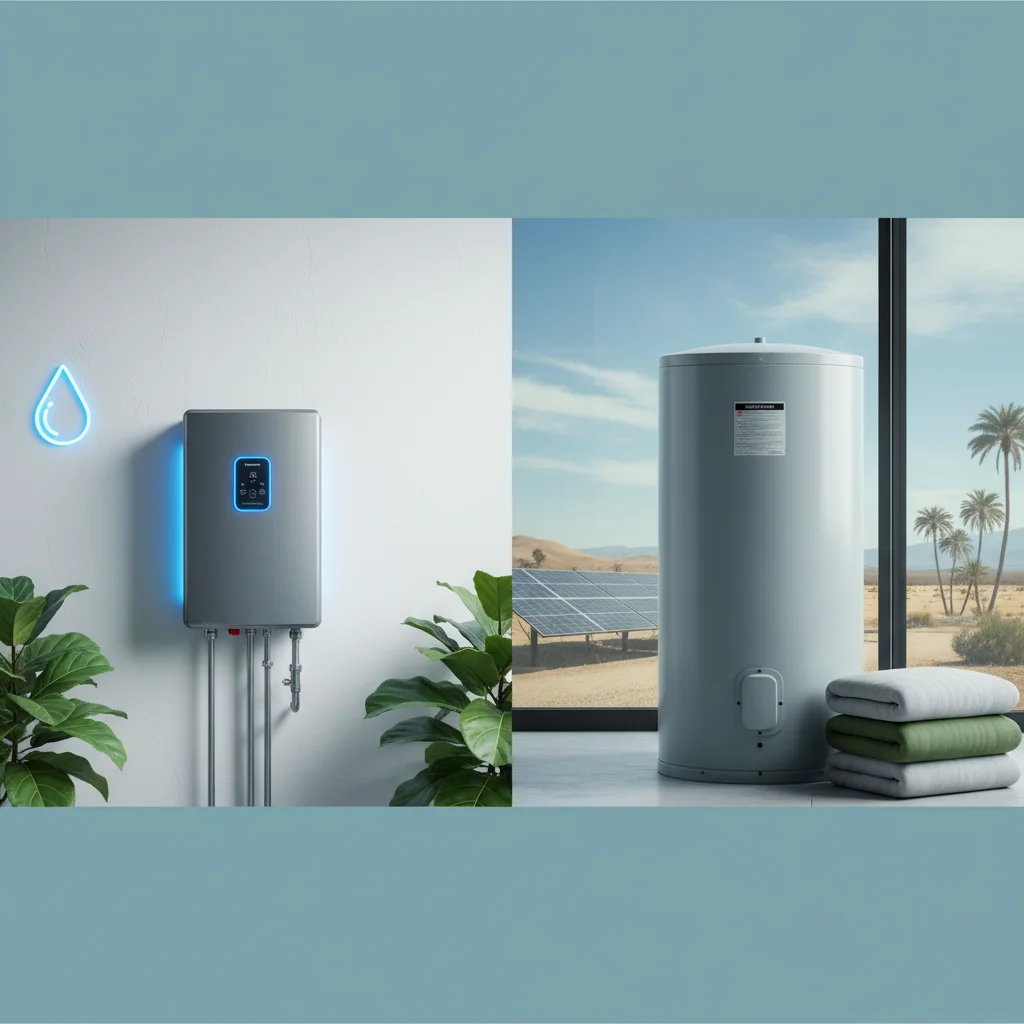
A Riverside County homeowner replacing their 40-gallon electric tank with a gas tankless unit saved $847 in the first year on combined utility bills and rebates in 2026. The Inland Empire's hard water and high summer temperatures create unique cost dynamics that make the tankless versus tank decision more complex than the statewide average. And the combination of Southern California Edison rebates, SoCalGas incentives, and federal tax credits can shift the five-year payback calculation by as much as $2,400.
What rebates are available for tankless water heaters in the Inland Empire?
Tankless water heaters with an Energy Factor of 0.90 or higher qualify for Southern California Edison's $300 electric tankless rebate and SoCalGas's $500 gas tankless rebate in 2026. The federal Inflation Reduction Act provides a $600 tax credit for qualified water heaters purchased and installed between January 1, 2026, and December 31, 2032. Riverside Public Utilities and Colton Electric Utility offer additional local incentives ranging from $200 to $400 for high-efficiency models installed in single-family homes within city limits.
Inland Empire Water Authority administers a separate $150 rebate for households that install tankless units with integrated recirculation systems to reduce water waste during the 20-30 second wait time for hot water. But these rebates require proof of professional installation and submission within 90 days of purchase. So homeowners combining federal, utility, and water district programs can access up to $1,450 in total rebates for a qualifying tankless installation in San Bernardino or Riverside counties.
How much can you save with tank water heater rebates in Inland Empire?
High-efficiency tank water heaters with Uniform Energy Factor ratings above 0.67 qualify for Southern California Edison's $50 electric storage tank rebate and SoCalGas's $100 natural gas tank rebate in 2026. The federal tax credit doesn't apply to standard tank models unless they're heat pump water heaters, which qualify for a separate $2,000 credit under the Inflation Reduction Act. Traditional tank units cost $800 to $1,500 installed compared to $2,500 to $4,500 for tankless systems in the Inland Empire's competitive contractor market.
"Storage water heaters remain the most common type in U.S. homes, accounting for approximately 60% of residential installations as of 2025." — U.S. Department of Energy
And tank water heaters require replacement every 10-12 years in Inland Empire's hard water conditions versus 15-20 years for tankless units with proper descaling maintenance. But the lower upfront cost and simpler installation make traditional tanks the budget choice for immediate replacement needs. So the total five-year savings including rebates favor tanks by $1,200 to $1,800 for households using under 40 gallons of hot water daily, while higher-demand households see tankless systems break even by year seven.
Which tankless and tank models qualify for rebates in California?
The California Energy Commission's Modernized Appliance Efficiency Database System lists 237 qualifying tankless models and 89 qualifying tank models as of April 2026. Rinnai RU160iN, Noritz NRC111, and Rheem RTG-84XLN-1 tankless units meet SoCalGas's 0.90 Energy Factor threshold and include the required sealed combustion or power venting. Bradford White M-I-50S6FBN, AO Smith GPVX-50L, and Rheem XG50T09HE38U0 tank models exceed the 0.67 Uniform Energy Factor minimum for Southern California Edison rebates.
Heat pump water heaters represent a third category with substantially higher rebates—the Rheem ProTerra 65-gallon model qualifies for the full $2,000 federal credit plus Edison's $500 heat pump water heater rebate. But these units require 700-1,000 cubic feet of surrounding air space and perform poorly in garages exceeding 100°F during Inland Empire summers. So tankless and conventional tank systems dominate local installations despite heat pump units offering the highest efficiency ratings of 3.5 to 4.0 Uniform Energy Factor.
"ENERGY STAR certified water heaters use 10 to 50 percent less energy than standard models, saving homeowners money on their utility bills." — ENERGY STAR
What's the application process and deadline for Inland Empire water heater rebates?
Southern California Edison processes rebate applications through the online Customer Rebate Portal within 6-8 weeks of submission with required documentation including itemized contractor invoice, product model number, and proof of Energy Factor rating. SoCalGas rebates require completion of the Express Efficiency Program application form with contractor signature verification and serial number photo uploaded within 90 days of installation. Form 5695 only covers qualifying work completed by December 31, 2025 and claimed on a 2025 return; the federal 25C and 25D credits ended after that date (IRS FS-2025-05). Federal tax credits for this work have ended, but state, local and utility rebates may still apply; check what is available at your address with the DuloCore rebate calculator.
Riverside Public Utilities and Colton Electric Utility maintain separate application portals with 60-day submission windows from installation date. The Inland Empire Water Authority rebate requires a water conservation compliance certificate from the installing contractor plus before-and-after water bill comparisons showing reduced monthly usage. So homeowners maximizing available rebates need to coordinate five separate applications with distinct deadlines spanning 60 to 365 days post-installation depending on program requirements.
Use our free rebate calculator to estimate your total savings based on your utility provider and equipment specifications.
Are tankless water heaters more cost-effective than tanks when you include rebates?
Tankless units cost $2,500 to $4,500 installed versus $800 to $1,500 for tank water heaters in San Bernardino and Riverside counties in 2026, creating an initial $1,700 to $3,000 premium that rebates reduce by $900 to $1,450. A household using 60 gallons of hot water daily saves $180 to $240 annually with a 0.95 Energy Factor tankless system compared to a 0.67 Uniform Energy Factor tank, establishing a 7-9 year payback period after rebates. But tankless units require $150 annual descaling in areas with water hardness above 120 ppm—and Inland Empire municipal water averages 180-240 ppm—adding $1,500 to $3,000 in maintenance costs over a 20-year lifespan.
And homes with simultaneous hot water demand exceeding 8 gallons per minute need multiple tankless units costing $4,000 to $7,000 installed, eliminating cost advantages. So single-occupant households using under 30 gallons daily see no payback benefit even with maximum rebates, while families of four or more using 70+ gallons daily achieve break-even by year six. The optimal choice depends on household size, existing gas line capacity, and willingness to manage annual maintenance schedules.
How do federal tax credits and local utility rebates compare for water heater upgrades?
The federal Energy Efficient Home Improvement Credit (Section 25C) ended for property placed in service after December 31, 2025 (IRS FS-2025-05). Southern California Edison and SoCalGas rebates range from $50 to $500 based on equipment type and efficiency tier in 2026. The federal Energy Efficient Home Improvement Credit (Section 25C) ended for property placed in service after December 31, 2025 (IRS FS-2025-05). Utility rebates arrive as direct payments or bill credits within 60-90 days. And federal credits require professional installation plus manufacturer certification documentation, whereas local utility programs mandate licensed contractor verification with permit numbers.
The combined federal-state-local rebate stack reaches $1,450 for tankless installations and $2,500 for heat pump water heaters compared to $150 for conventional tank replacements. But the federal credit phases out for households with modified adjusted gross income exceeding $150,000 for single filers or $300,000 for joint filers as of tax year 2026. So high-income homeowners in the Inland Empire qualify only for utility and water district rebates totaling $500 to $950 depending on equipment selection and service territory.
Check your eligibility for heat pump rebates if you're considering a full HVAC upgrade alongside water heater replacement.
Official Sources
- U.S. Department of Energy - Water Heating — Federal guidance on water heater efficiency standards and rebate programs
- ENERGY STAR Water Heaters — Certified product listings and energy savings calculations
- Database of State Incentives for Renewables & Efficiency — Comprehensive database of California water heater rebates and incentives
Frequently Asked Questions
What is the difference between a tankless and tank water heater?
Tank water heaters store 30-80 gallons of preheated water in an insulated cylinder with a burner or heating element maintaining constant temperature, while tankless units heat water on-demand through high-powered gas burners or electric coils as it flows through a heat exchanger. Traditional tanks deliver hot water immediately but exhaust the stored supply after 10-15 minutes of continuous use, requiring 30-60 minutes to reheat. Tankless systems provide unlimited hot water but experience a 5-15 second delay before hot water reaches fixtures and can't serve multiple simultaneous high-flow applications without larger or multiple units. And tanks consume energy 24/7 to maintain standby temperature, while tankless units only operate during active hot water demand, reducing annual energy costs by 20-30% for typical households.
How much does a tankless water heater cost compared to a traditional tank?
Tankless water heater installations cost $2,500 to $4,500 in the Inland Empire including equipment, labor, and required gas line or electrical upgrades as of 2026, while traditional 40-50 gallon tank installations range from $800 to $1,500 with standard venting. Natural gas tankless units require larger gas supply lines—typically ¾-inch instead of ½-inch—adding $300 to $1,200 in piping modifications for homes with existing tank heaters. Electric tankless systems demand 120-150 amp service with dedicated 240-volt circuits costing $500 to $1,500 to install where current electrical panels lack capacity. And tankless units require annual descaling maintenance costing $150 to $200 in hard water areas like San Bernardino and Riverside counties, while tank heaters need anode rod replacement every 3-5 years costing $80 to $150 per service call.
Are tankless water heaters eligible for California tax credits?
The federal Energy Efficient Home Improvement Credit (Section 25C) ended for property placed in service after December 31, 2025 (IRS FS-2025-05). Southern California Edison provides $300 rebates for electric tankless units with Energy Factor ratings of 0.90 or higher, while SoCalGas offers $500 rebates for gas tankless models meeting the same efficiency threshold. Form 5695 only covers qualifying work completed by December 31, 2025 and claimed on a 2025 return; the federal 25C and 25D credits ended after that date (IRS FS-2025-05).
How long does a tankless water heater last versus a traditional tank water heater?
Tankless water heaters last 15-20 years with proper maintenance in the Inland Empire's hard water conditions, compared to 10-12 years for traditional tank models before failure. Tank water heaters succumb to sediment accumulation and anode rod depletion causing steel tank corrosion and eventual leaking, while tankless units experience heat exchanger scaling and burner degradation as primary failure modes. Annual descaling extends tankless lifespan to 20+ years in areas with water hardness below 120 ppm, but Inland Empire municipal water averaging 180-240 ppm requires descaling every 8-12 months to prevent efficiency loss and premature failure. And tankless units cost $400 to $900 for heat exchanger replacement versus full $800 to $1,500 tank replacement, making major repairs economically viable for tankless systems while tank failures require complete unit replacement.
What are the energy savings of switching from a tank to a tankless water heater?
Households using 40 gallons of hot water daily save $180 to $240 annually switching from a 0.60 Energy Factor tank to a 0.95 Energy Factor tankless unit based on 2026 Southern California Edison and SoCalGas rates. Natural gas tankless heaters eliminate standby heat loss—the 10-20% energy waste from maintaining stored water temperature 24/7—reducing consumption from 250-300 therms annually to 180-210 therms for a typical four-person household. Electric tankless units cut consumption from 4,500-5,500 kWh to 3,200-3,800 kWh yearly, saving $156 to $204 at $0.12 per kWh average electricity rates in Riverside and San Bernardino counties. But savings diminish for single-occupant households using under 30 gallons daily, where the efficiency difference produces only $80 to $120 annual savings insufficient to justify the $1,700 to $3,000 upfront cost premium even with available rebates.
Ready to calculate your potential savings? Use our rebate calculator to see exactly how much you can save with federal tax credits and local utility rebates on your water heater upgrade in the Inland Empire.
Updated on April 14, 2026. Fact-checked by DuloCore Editors. About our research team.
Check your California water heater rebate eligibility — see the programs you qualify for and the dollar amounts on our California water heater rebate finder.