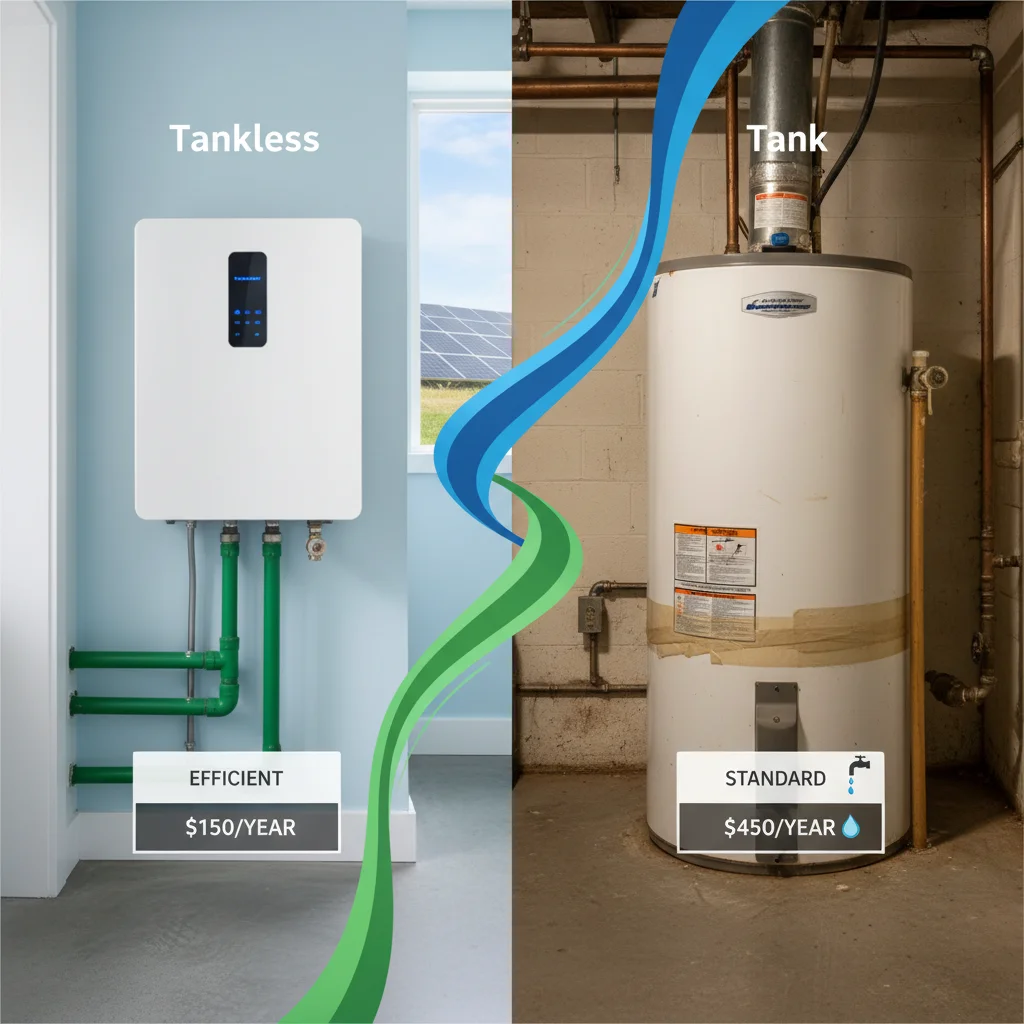
Water heaters account for roughly 18% of a home's total energy consumption—and the type you install determines whether you're locking in $300 annual energy bills or $600. Homeowners replacing aging tank models in 2026 face a stark upfront cost divide: $800–$1,500 for a traditional tank versus $1,800–$3,500 for a tankless unit. But federal tax credits and utility rebates can erase nearly 30% of that gap overnight.
What Are the Upfront Costs for Tankless vs Tank Water Heaters?
Traditional tank water heaters range from $800 to $1,500 installed for a 40–50 gallon electric or gas model, while tankless units cost $1,800 to $3,500 installed depending on fuel type and flow rate capacity. Installation complexity drives the premium: tankless systems often require electrical panel upgrades, new gas lines, or venting modifications that tank replacements avoid.
Electric tankless models start around $500 for the unit alone, but installation adds $1,000–$2,000 for a 200-amp panel upgrade if your home runs on 150 amps or less. Gas tankless units need dedicated venting—category III stainless steel costs $300–$800—and larger gas line diameter to support instantaneous burner demand. And most municipal codes require a recirculation pump ($200–$500) to meet California's 2026 plumbing efficiency mandates for hot water delivery time.
Tank heaters drop into existing infrastructure with minimal modification. A 50-gallon electric replacement takes two hours and reuses the existing 240V circuit. Gas tanks swap onto the same flue vent and gas stub. So upfront simplicity favors tanks by $1,000–$2,000 for homes built before 2010.
But tankless units qualify for federal energy tax credits worth 30% of installed cost—up to $600 for Energy Star–certified models under the IRA framework running through 2032. So a $3,000 tankless install drops to $2,400 after the credit, narrowing the tank-versus-tankless price gap to $900.
Which Water Heater Types Qualify for Rebates and Tax Credits in 2026?
The federal Energy Efficient Home Improvement Credit (Section 25C) ended for property placed in service after December 31, 2025 (IRS FS-2025-05). Federal tax credits for this work have ended, but state, local and utility rebates may still apply; check what is available at your address with the DuloCore rebate calculator. Traditional storage tank heaters—electric resistance or standard gas—do not qualify unless they integrate heat pump technology.
California's TECH Clean California program offers point-of-sale rebates up to $1,800 for heat pump water heaters installed in income-qualified households, stacking with the federal credit for combined savings reaching $2,400. Pacific Gas & Electric and Southern California Edison add another $200–$500 for Energy Star tankless gas models through 2026 demand response programs. But these utility incentives expire quarterly as budgets deplete—applications submitted after July often hit waitlists.
And water heater rebates hinge on professional installation with permit documentation. DIY installs forfeit both federal and state incentives. So factor in licensed contractor labor ($75–$150 per hour) when calculating total rebate-adjusted cost.
Storage tank models without heat pump components generate zero federal credits. A $1,200 electric tank remains $1,200. A $3,000 heat pump hybrid tank drops to $2,100 after the 30% credit, making it cheaper than a tankless gas unit post-incentive. Heat pump water heaters deliver UEF ratings up to 4.0—four times the energy output per dollar spent on electricity—while standard electric tanks sit at UEF 0.90.
How Long Does It Take to Break Even on a Tankless Water Heater Investment?
Payback periods for tankless water heaters range from 6 to 12 years depending on household size, fuel costs, and usage patterns. A family of four using 64 gallons of hot water daily saves $180–$300 annually switching from a 50-gallon electric tank (UEF 0.92) to a tankless electric model (UEF 0.96), assuming $0.28 per kWh electricity rates common in California's Tier 2 pricing.
Gas tankless models save $120–$200 per year versus standard gas tanks in regions with $2.50+ per therm natural gas costs. But homes with solar panels or time-of-use electric rates below $0.15 per kWh see faster payback on electric tankless or heat pump models—often 5–7 years—because they eliminate standby heat loss entirely.
Use our free rebate calculator to model your specific payback timeline based on local utility rates and available incentives.
The $1,500 cost premium for tankless after federal credits divides by $250 annual savings equals a six-year breakeven. So homeowners planning to stay in their residence past 2032 recoup the investment and bank savings for the remaining 10+ year lifespan. And tankless units last 20 years on average versus 12 years for tanks, extending the total savings window.
Households using less than 40 gallons daily—singles or couples—stretch payback to 10–12 years because tankless efficiency gains shrink at low flow rates. Tank models waste less standby energy when they're rarely depleted. But multi-generational homes or families with teenagers see payback in 4–6 years due to constant hot water demand and eliminated recovery wait times.
How Does Your Climate Zone Affect Water Heater Efficiency and Payback Period?
Cold incoming groundwater temperatures in California Climate Zones 1 and 16 (mountain and high desert regions) force water heaters to work harder, extending payback periods by 20–30% compared to coastal Zone 6 installations. A tankless gas unit in Big Bear (Zone 16, 42°F groundwater) consumes 15% more fuel annually than the same model in San Diego (Zone 7, 58°F groundwater) to reach 120°F output temperature.
Heat pump water heaters suffer in unconditioned garage installations where ambient air drops below 45°F for extended winter months—their compressors cycle less efficiently, and backup resistance elements activate more frequently. So Zone 16 homeowners installing heat pump models in unheated spaces see UEF ratings drop from 3.75 to 2.8 effective performance, eroding savings by $90–$140 per year.
And tankless units in freezing climates require freeze protection kits ($150–$250) with active circulation or drain-down valves to prevent burst heat exchangers during cold snaps. Coastal zones skip this expense entirely.
But desert zones 14 and 15 deliver the fastest payback for solar-paired electric tankless systems. Phoenix-area homeowners with net metering agreements generate daytime solar credits that offset evening hot water loads, cutting effective electricity costs to $0.03–$0.06 per kWh. So a $2,800 electric tankless install pays back in 3–4 years versus 8–10 years for grid-dependent households.
Coastal temperate zones see the slowest payback on tankless conversions—mild 62°F groundwater and minimal heating demand mean annual savings hover around $140 for gas models. But the same zones maximize heat pump efficiency, delivering $320+ annual savings and 4–5 year payback periods when paired with heat pump rebates.
Tankless vs Tank: Which Offers Better ROI for Your Home?
Return on investment for tankless water heaters ranges from 110% to 180% over a 20-year lifespan for households using 60+ gallons daily, while tank models deliver 90–120% ROI for low-usage homes under 40 gallons per day. The tipping point sits at 50 gallons daily consumption: above that threshold, tankless units recoup their premium and generate net savings; below it, tanks win on total cost of ownership.
High-efficiency gas tankless models (UEF 0.96) installed in large households (4+ people) return $3,200–$4,800 in cumulative savings over 20 years after subtracting the initial cost premium and factoring in one mid-life descaling service ($200). Standard gas tanks return $1,800–$2,400 over 24 years (two 12-year units), but require double the labor for replacement installations.
And heat pump hybrid tanks deliver the highest ROI for moderate-use households—130–160% over 15 years—because they combine lower upfront costs ($2,100 after credits) with tankless-level efficiency (UEF 3.75) while avoiding complex installation upgrades.
Resale value tilts toward tankless in premium markets. California home appraisals add $800–$1,500 to assessed value for Energy Star tankless systems, but zero premium for standard tanks. So homeowners selling within 5 years of installation recover 40–60% of their tankless investment through higher sale prices even before reaching energy payback.
But rental properties favor tanks. Landlords prioritize low upfront cost and simple tenant-proof operation. A $900 tank replacement every 10 years beats a $2,400 tankless install when tenant turnover prevents landlords from capturing long-term energy savings.
What Rebate Eligibility Specs Do You Need to Meet?
Federal tax credit eligibility requires tankless gas water heaters to achieve a Uniform Energy Factor (UEF) of 0.95 or higher, while electric heat pump models must hit UEF 3.75 minimum under Energy Star certification verified through the ENERGY STAR Product Finder database. Form 5695 only covers qualifying work completed by December 31, 2025 and claimed on a 2025 return; the federal 25C and 25D credits ended after that date (IRS FS-2025-05).
California TECH Clean California rebates mandate installation by a participating contractor enrolled in the program database—homeowners cannot claim rebates for self-installed units or non-enrolled installers even if the equipment meets UEF thresholds. And installations must include a permit from the local building department with inspection signoff before rebate applications process.
Electric tankless models require dedicated 240V circuits with appropriately sized breakers—typically 40–60 amps for whole-house units—and installations failing electrical inspection lose rebate eligibility. Gas models need proper venting with manufacturer-specified materials (usually stainless steel Category III or PVC for condensing models) and combustion air supply meeting California Mechanical Code Section 701.
And some utility rebates cap eligibility at household income thresholds. PG&E's Enhanced Rebate tier adds $1,000 to standard offers but requires income below 80% Area Median Income (AMI)—$85,000 for a family of four in most Bay Area counties. So higher-income households receive only the base $200–$500 rebate regardless of equipment efficiency.
Official Sources
- ENERGY SAVER - U.S. Department of Energy — Federal guidance on water heater efficiency standards and tax credit eligibility requirements (note: the federal 25C and 25D credits ended for projects completed after December 31, 2025)
- Database of State Incentives for Renewables & Efficiency — Searchable database of California utility rebates and state-level water heater incentive programs
Frequently Asked Questions
Are tankless water heaters more expensive than tank water heaters?
Tankless water heaters cost $1,800–$3,500 installed compared to $800–$1,500 for traditional tank models in 2026. The premium stems from installation complexity: tankless units often require electrical panel upgrades ($1,000–$2,000), new venting ($300–$800), or gas line modifications. But federal tax credits worth 30% (up to $600) reduce the effective price gap to $900–$1,500 for Energy Star–certified models.
What is the cost difference between tankless and tank water heaters over 10 years?
A tankless gas water heater costs $2,400 upfront (after federal credit) plus $1,800 in energy expenses over 10 years, totaling $4,200. A standard gas tank costs $1,200 installed plus $3,200 in energy, equaling $4,400 total. So tankless saves $200 over a decade for moderate-use households. High-use families (4+ people) see tankless savings reach $800–$1,200 over the same period.
Do tankless water heaters qualify for the 30% federal tax credit?
The federal Energy Efficient Home Improvement Credit (Section 25C) ended for property placed in service after December 31, 2025 (IRS FS-2025-05). Standard electric resistance tankless units do not qualify. Form 5695 only covers qualifying work completed by December 31, 2025 and claimed on a 2025 return; the federal 25C and 25D credits ended after that date (IRS FS-2025-05). (Note: Federal tax credit percentages and availability are subject to change; the 30% Residential Clean Energy Credit under Section 25D expired December 31, 2025. Verify current incentives at energy.gov.)
How much can you save with a tankless water heater?
Annual savings range from $120 to $300 depending on household size, fuel type, and local utility rates. A family of four using 64 gallons daily saves $250 per year switching from an electric tank to an electric tankless model in California's high-rate regions ($0.28+ per kWh). Gas tankless models save $180 annually versus gas tanks when natural gas exceeds $2.50 per therm.
What are the installation costs for a tankless water heater compared to a traditional tank?
Tankless installation costs $1,200–$2,500 for labor and materials (venting, gas line, electrical panel upgrades) versus $300–$600 for tank replacements that reuse existing connections. Homes built before 2010 typically need electrical panel upgrades to support electric tankless demand, adding $1,000–$2,000. Gas tankless units require Category III stainless steel venting ($300–$800) instead of the standard B-vent used by tanks.
Ready to calculate your water heater savings? Use our free rebate calculator to compare tankless and tank options with 2026 federal credits, California utility rebates, and your specific energy rates. Get a personalized payback timeline and total cost of ownership analysis in under two minutes.
Last updated April 14, 2026 — reviewed by DuloCore Editorial. About our authors.
Check your California water heater rebate eligibility — see the programs you qualify for and the dollar amounts on our California water heater rebate finder.