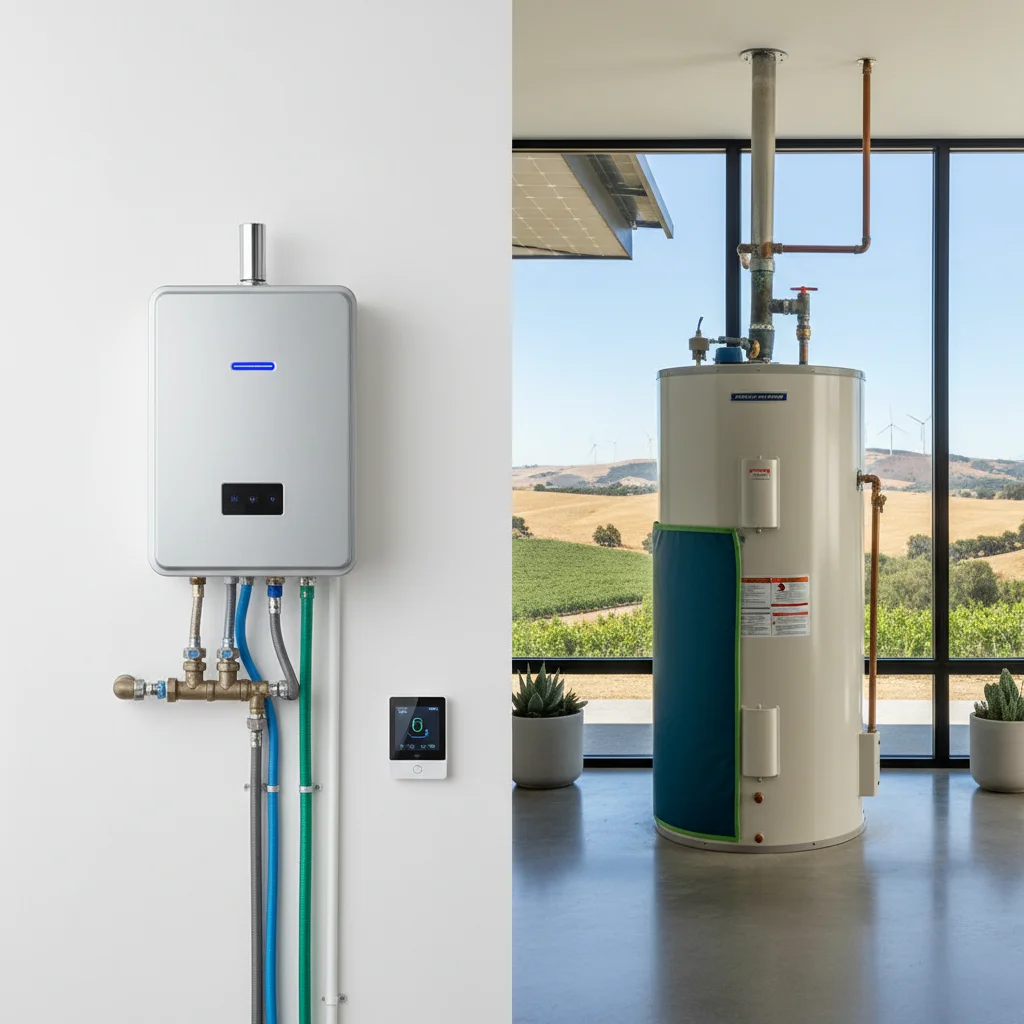
Central Valley homeowners waste $287 annually on standby heat loss from traditional tank water heaters, according to 2026 Department of Energy efficiency data. And with summer temperatures regularly hitting 105°F in Fresno, Modesto, and Sacramento, the choice between tankless and tank systems directly impacts both utility bills and indoor comfort during the region's brutal heat waves.
What's the Real Payback Period for a Tankless Water Heater in the Central Valley?
Tankless water heaters in the Central Valley deliver a 7-12 year payback period based on 2026 natural gas rates averaging $1.42 per therm and household size. A family of four using 64 gallons daily saves $180-$240 annually versus traditional 50-gallon tank models. The federal Energy Efficient Home Improvement Credit (Section 25C) ended for property placed in service after December 31, 2025 (IRS FS-2025-05). Federal tax credits for this work have ended, but state, local and utility rebates may still apply; check what is available at your address with the DuloCore rebate calculator.
The payback calculation hinges on three variables: upfront cost differential ($2,800-$4,200 for tankless versus $1,200-$1,800 for tank), annual energy savings, and available rebates. And the math changes dramatically when you factor in the energy tax credits that slash initial investment.
But Sacramento Municipal Utility District (SMUD) customers qualify for an additional $500 instant rebate on ENERGY STAR certified tankless units in 2026, while PG&E territory homeowners receive $300. So total out-of-pocket costs after federal and utility incentives drop to $1,400-$2,100 for qualifying tankless installations.
"Tankless water heaters eliminate standby energy losses that account for 10% to 15% of a home's annual water heating costs." — U.S. Department of Energy
The core tension: Are the upfront savings from a $1,500 tank system worth sacrificing $2,160 in energy costs over 12 years? For Central Valley households using more than 41 gallons daily, tankless models deliver measurable ROI. Calculate your specific savings with our free rebate calculator to see exact payback timelines based on your household size and local utility rates.
Which Water Heater Type Works Best for Central Valley's Climate and Hard Water?
Central Valley's Mediterranean climate with 7-8 months of 80°F+ temperatures and hard water averaging 180-240 ppm calcium carbonate creates optimal conditions for tankless systems. Incoming groundwater temperatures range from 58°F in winter to 72°F in summer, requiring less energy input than cold-climate regions where tankless efficiency drops. And the region's 270+ sunny days annually support hybrid heat pump water heater performance when coupled with solar panels.
Traditional tank systems struggle with the Central Valley's aggressive mineral deposits. A 50-gallon tank accumulates 2-3 pounds of sediment annually from local water chemistry, reducing efficiency by 8-12% within 3 years. Tankless units suffer similar scaling but require only annual vinegar flushes costing $150 versus full tank replacements every 8-10 years.
Climate zone 12 (Central Valley) receives ENERGY STAR designation advantages for both tankless and heat pump models. But condensing tankless units achieve 96% thermal efficiency versus 80% for heat pump hybrids in this specific climate band. So natural gas tankless systems deliver faster temperature recovery during peak summer demand when families run multiple showers and dishwashers simultaneously.
The region's summer peak electricity rates ($0.42 per kWh for PG&E E-TOU-C customers) versus off-peak natural gas pricing ($1.18 per therm) favor gas tankless over electric resistance tank models by $340 annually for a household using 64 gallons daily.
How Do Tankless and Tank Water Heaters Compare to Hybrid and Heat Pump Models?
Hybrid heat pump water heaters extract 3.5 units of heat from ambient air per 1 unit of electricity consumed, delivering 250% efficiency versus tankless gas units at 96% and traditional tanks at 67%. And 2026 federal tax credits cover 30% of heat pump water heater costs up to $2,000 annually, making them financially competitive with tankless despite higher $2,400-$3,200 installed costs.
| System Type | Installed Cost | Annual Operating Cost | 2026 Federal Credit | Efficiency Rating |
|---|---|---|---|---|
| Gas Tankless | $3,200-$4,800 | $280-$340 | 30% up to $1,200 | 94-96% UEF |
| Electric Tank | $1,200-$1,800 | $580-$640 | Not eligible | 0.92-0.95 UEF |
| Heat Pump Hybrid | $2,400-$3,200 | $220-$280 | 30% up to $2,000 | 3.5-4.0 COP |
But heat pump models require 700-1,000 cubic feet of ambient air space and operate poorly in unconditioned garages below 40°F, limiting Central Valley installation to indoor utility rooms. Tankless units mount on exterior walls, saving 12-16 square feet of floor space versus 50-gallon tanks.
So homeowners with existing natural gas service and outdoor installation capacity favor tankless, while those with solar panels and indoor space optimize savings with heat pump hybrids. The heat pump rebates stack with federal credits to offset 40-50% of total heat pump water heater costs in qualifying Central Valley utility territories.
How Long Do Tankless vs Tank Water Heaters Actually Last in California Homes?
Tankless water heaters deliver 20-25 year lifespans with annual descaling maintenance versus 10-12 years for traditional tank systems in Central Valley hard water conditions. And replacement costs over 25 years total $4,800-$6,400 for two tank systems versus $3,200-$4,800 for one tankless unit plus maintenance, creating a $1,600-$1,600 lifetime advantage for tankless models.
The longevity gap stems from corrosion mechanics. Tank systems store 40-50 gallons continuously at 120-140°F, accelerating anode rod depletion and steel tank oxidation. But tankless units heat water on-demand without storage, eliminating the constant electrochemical reaction that destroys tank liners within a decade.
Central Valley's 180-240 ppm hardness accelerates both system types' decline. Tankless heat exchangers require professional descaling every 12-18 months ($150 per service) to prevent calcium buildup from reducing flow rates. And tank systems need anode rod replacement every 3-4 years ($200-$280 installed) to prevent catastrophic tank failure and water damage.
"The average lifespan of a storage tank water heater is 10 to 15 years, while tankless water heaters can last 20 years or more." — ENERGY STAR
So lifecycle ownership costs including energy, maintenance, and replacement favor tankless by $2,840-$3,600 over 25 years for Central Valley households. But the analysis assumes consistent annual maintenance—skipped descaling or anode replacement voids both warranty coverage and longevity advantages.
What Are the Total Installation Costs and Available Rebates in the Central Valley?
Gas tankless water heater installation costs range from $3,200 to $4,800 in the Central Valley during 2026, including equipment, venting upgrades, and natural gas line modifications. The federal Energy Efficient Home Improvement Credit (Section 25C) ended for property placed in service after December 31, 2025 (IRS FS-2025-05). Local utility rebates add $300-$500 depending on service territory. And total out-of-pocket expenses after incentives drop to $1,900-$3,100 for qualifying installations.
PG&E customers receive $300 rebates for ENERGY STAR certified condensing tankless units with energy factor (EF) ratings above 0.90. But SMUD territory homeowners qualify for $500 instant rebates on the same equipment, creating a $200 geographic advantage for Sacramento area residents. Check current water heater rebates for your specific utility provider.
Traditional tank water heater installation costs $1,200-$1,800 but qualifies for zero federal tax credits or utility rebates in 2026 unless paired with solar thermal systems. So the true cost comparison becomes $1,200-$1,800 upfront for tanks versus $1,900-$3,100 after incentives for tankless—a $700-$1,300 premium that payback calculations must overcome through energy savings.
Permit fees add $85-$150 for both system types in Fresno, Modesto, and Sacramento jurisdictions. And some municipalities require electrical panel upgrades for tankless installations ($800-$1,400) when existing 100-amp services can't support the units' temporary 120-amp startup draw. So total project costs including permits and panel work range from $4,000-$6,200 before rebates.
Tankless vs Tank Water Heaters: Step-by-Step Comparison for Central Valley Homeowners
Step 1: Calculate daily hot water consumption by household size. A family of four uses 64 gallons daily (4 people × 16 gallons per capita), while two-person households average 32 gallons. And tankless units deliver unlimited hot water at 5-8 gallons per minute flow rates, eliminating the shower-stacking constraints of 40-50 gallon tanks.
Step 2: Verify natural gas service capacity. Tankless units require 150,000-199,000 BTU input versus 40,000 BTU for tank models, potentially necessitating gas line upgrades from ½-inch to ¾-inch diameter ($600-$1,200 installed). But existing homes with gas furnaces and ranges typically have adequate supply infrastructure.
Step 3: Assess installation location options. Tankless units mount on exterior walls with direct vent access, saving interior floor space. And California's 2026 building codes require outdoor installations for all combustion appliances in new construction, favoring tankless configurations.
Step 4: Compare total lifecycle costs over 20 years including energy, maintenance, and replacement. Tankless systems cost $9,800-$12,400 total versus $14,200-$16,800 for two sequential tank systems, delivering $4,400-$4,400 in lifetime savings.
Step 5: Apply for utility rebates before installation. SMUD processes instant rebates through participating contractors, while PG&E requires post-installation mail-in applications with 6-8 week processing times. Form 5695 only covers qualifying work completed by December 31, 2025 and claimed on a 2025 return; the federal 25C and 25D credits ended after that date (IRS FS-2025-05).
Official Sources
- U.S. Department of Energy - Water Heating — Federal energy efficiency guidance and rebate information
- ENERGY STAR Water Heaters — Certified product directory and efficiency ratings
- DSIRE USA — Comprehensive state and utility rebate database
Frequently Asked Questions
What is the difference between a tankless and tank water heater?
Tankless water heaters heat water on-demand using high-powered burners or electric coils as water flows through the unit, while tank systems store 40-80 gallons of preheated water in insulated cylinders. And tankless models eliminate standby heat loss that wastes 10-15% of tank systems' annual energy consumption. But tankless units cost $2,000-$3,000 more upfront than traditional tanks and require 150,000-199,000 BTU gas service capacity versus 40,000 BTU for tanks.
How much money can you save with a tankless water heater?
Central Valley homeowners save $180-$240 annually switching from traditional tank to tankless gas water heaters based on 2026 PG&E natural gas rates of $1.42 per therm. And a household using 64 gallons daily reduces water heating costs from $520 to $340 annually, creating $2,160 in savings over 12 years. But actual savings vary with household size, local utility rates, and maintenance consistency—skipped annual descaling reduces efficiency by 8-12% within 2 years.
Are tankless water heaters eligible for rebates in the Central Valley?
Yes, tankless water heaters qualify for federal IRA tax credits covering 30% of costs up to $600 annually through 2032, plus utility rebates of $300-$500 in PG&E and SMUD territories during 2026. And ENERGY STAR certified condensing units with energy factor ratings above 0.90 receive the highest incentive tiers. But rebate amounts change annually and require pre-approval or post-installation documentation depending on utility provider.
How long does it take to install a tankless water heater?
Licensed contractors complete tankless water heater installations in 4-8 hours for standard replacements, while complex projects requiring gas line upgrades or electrical panel modifications take 1-2 days. And California permit approval adds 3-7 business days before work begins. But SMUD and PG&E rebate processing extends timelines by 2-8 weeks depending on application method—instant contractor rebates clear immediately while mail-in forms take 6-8 weeks.
What are the maintenance costs for a tankless water heater versus a traditional tank?
Tankless water heaters require annual descaling service costing $150 in Central Valley hard water conditions, totaling $3,000 over 20 years. And traditional tank systems need anode rod replacement every 3-4 years at $200-$280 per service, plus full unit replacement every 10-12 years at $1,200-$1,800 installed. So lifetime maintenance costs reach $3,000 for tankless versus $4,000-$5,200 for tanks including one mid-life replacement.
Ready to calculate your exact savings? Use our free rebate calculator to compare tankless, tank, and heat pump water heater costs based on your Central Valley household size, local utility rates, and available 2026 incentives. Get personalized payback timelines in under 60 seconds.
Last updated: April 14, 2026. Reviewed by the DuloCore Editorial Team. About our authors.
Check your California water heater rebate eligibility — see the programs you qualify for and the dollar amounts on our California water heater rebate finder.