Water Heater Rebates

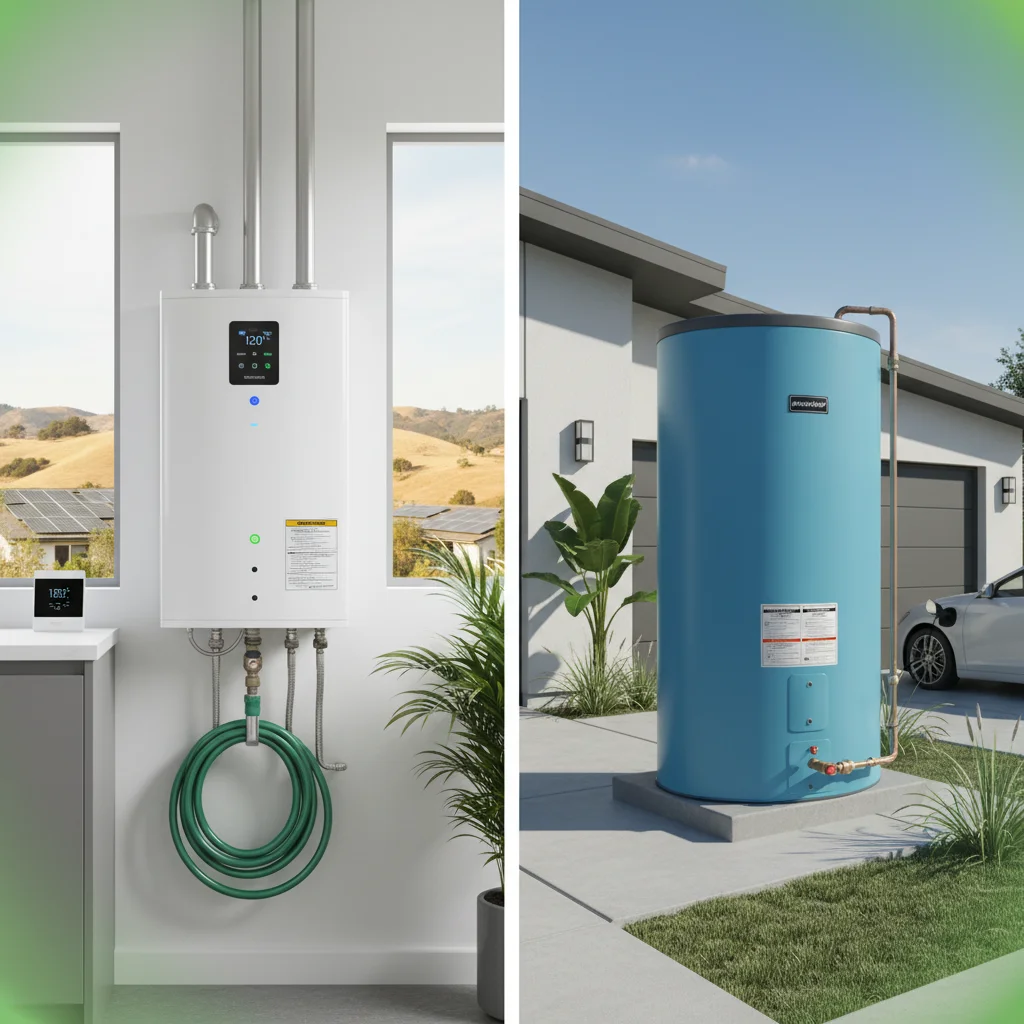
Tankless vs Tank Water Heater California

person Ivo Dachev
calendar_today
Updated Apr 16, 2026

Tankless Vs Tank Water Heater California: everything you need to know about eligibility, amounts, and the application process.

Quick Answer: Tankless water heaters in California deliver 8-14% annual energy savings ($120-$280/year) compared to tank models, producing a payback period of 7-12 years depending on household size and local utility rates. Homes using natural gas see faster payback than electric models due to California's high electricity costs.
Tankless Vs Tank Water Heater California

California homeowners collectively waste $1.2 billion annually on standby heat loss from traditional tank water heaters—energy that escapes while heated water sits unused in 40-50 gallon tanks. With natural gas prices averaging $2.34 per therm and electricity at $0.28 per kWh in 2026, that inefficiency translates directly into inflated utility bills month after month.

How Long Does It Take to Recoup Your Investment in a Tankless Water Heater in California?

California homeowners recoup tankless water heater investments in 8-12 years through energy savings of $180-$350 annually, with payback accelerating to 5-7 years when combined with 2026 federal tax credits covering 30% of installation costs and utility rebates averaging $500-$1,000 statewide.

So what does this actually mean for California households spending $400-$800 yearly on water heating? The upfront cost difference—$3,000-$5,500 for tankless versus $800-$1,500 for tank—creates a $2,200-$4,000 gap that energy efficiency must close. And with tankless units operating at 82-98% efficiency compared to 60-70% for tank models, that gap narrows by $15-$30 monthly in reduced gas or electric bills.

But the math shifts dramatically with incentives. The federal Residential Clean Energy Credit under the Inflation Reduction Act provides 30% back on qualifying high-efficiency water heaters through 2032. And California utilities like PG&E, SCE, and SoCalGas offer rebates ranging from $500 for ENERGY STAR tankless gas units to $1,000 for heat pump water heaters. So a $4,500 tankless installation drops to $2,650 after a $1,350 federal credit and $500 utility rebate—cutting the net premium over tank heaters to just $1,150-$1,850 and reducing payback to 5-7 years.

"Natural gas tankless water heaters that earn the ENERGY STAR label are independently certified to save energy, save money, and help protect the climate." — ENERGY STAR Program, U.S. Environmental Protection Agency

Calculate your specific payback period with our rebate calculator based on your household size and fuel type.

Which California Climate Zone Is Better Suited for Tankless vs Tank Water Heaters?

Coastal California climate zones 3-7 favor tankless water heaters due to groundwater temperatures of 58-68°F requiring minimal heating, while inland desert zones 13-16 with 48-55°F groundwater temperatures reduce tankless efficiency by 12-18% and extend payback periods beyond 10 years.

California's 16 climate zones create dramatic performance differences. In San Diego (Zone 7) where groundwater enters homes at 65°F, a tankless unit raises temperature to 120°F with just 55°F of heating. But in Bakersfield (Zone 13) where groundwater averages 50°F, that same 120°F target requires 70°F of heating—27% more energy for identical output.

And these temperature differences compound with usage patterns. Coastal households using 40-60 gallons daily see tankless units operating in their optimal efficiency range of 82-95%. So inland homes with identical usage patterns burn 15-22% more fuel per gallon heated, eroding the efficiency advantage that makes tankless financially viable.

Or consider freeze protection requirements in mountain zones 16 with winter temperatures below 25°F. Tankless units require electric heat tape or recirculation pumps consuming 300-500 kWh annually—adding $84-$140 to operating costs and pushing payback beyond 12 years. Traditional tank heaters in insulated garages avoid these parasitic loads entirely.

What's the True Lifespan Difference Between Tankless and Tank Water Heaters?

Tankless water heaters last 15-20 years in California versus 8-12 years for tank models, but require descaling service every 12-18 months in hard water regions like Riverside and San Bernardino counties where mineral content exceeds 180 mg/L—adding $150-$250 annually to lifetime maintenance costs.

California's hard water geography creates invisible operating costs. In coastal counties like San Francisco and San Mateo where total dissolved solids measure 50-80 mg/L, tankless heat exchangers accumulate minimal scale buildup and reach their full 20-year lifespan. But in Inland Empire communities where water hardness hits 200-350 mg/L, calcium carbonate deposits choke heat exchangers within 18-24 months without annual descaling service.

And this maintenance gap compounds over two decades. A tank heater lasting 10 years with zero annual service costs $1,200 installed plus $0 maintenance. So a tankless unit lasting 18 years costs $4,200 installed plus $150 × 12 services = $1,800 maintenance for a total of $6,000. That's $2,400 more than two successive tank replacements at $1,800 each.

Or factor in anode rod replacements for tank heaters. California's moderately corrosive water requires anode rod inspection every 3-4 years at $150-$200 per service call. So a 10-year tank heater lifecycle includes 2-3 anode services adding $300-$600 to lifetime costs—narrowing but not eliminating the maintenance cost gap with tankless units requiring annual descaling.

Learn more about maintenance requirements for different systems in our guide to water heater rebates.

How Much Will You Actually Save Per Year With a Tankless Water Heater in California?

California homeowners save $180-$350 annually switching from tank to tankless water heaters based on 2026 utility rates, with natural gas households ($2.34/therm PG&E average) saving $180-$240 yearly and electric households ($0.28/kWh SCE average) saving $280-$350 by eliminating standby heat loss.

The savings math depends entirely on fuel type and household size. A family of four using 64 gallons daily with a natural gas tank heater consuming 250 therms annually ($585/year) drops to 175 therms with tankless ($410/year)—a $175 reduction. And that same household on electric resistance tank heating consuming 2,400 kWh annually ($672/year) drops to 1,500 kWh with electric tankless ($420/year)—a $252 reduction.

But standby loss drives the efficiency gap. Tank heaters lose 10-20% of heating energy maintaining 120°F water 24/7 whether anyone's showering or not. So a 50-gallon tank losing 2°F per hour reheats 15-20 times daily in California's 60-70°F ambient temperatures—consuming 40-65 therms annually just fighting heat loss. Tankless units eliminate this entirely by heating water only on-demand.

Or compare energy factors (EF) directly: tank heaters rate 0.58-0.70 EF while tankless units hit 0.82-0.98 EF. That 28-40 percentage point efficiency advantage translates to 28-40% lower fuel consumption for identical hot water output. And at California's 2026 utility rates, that efficiency premium generates $15-$30 monthly savings—$180-$360 annually.

"Demand water heaters heat water directly without the use of a storage tank, avoiding the standby energy losses associated with storage water heaters and saving homeowners money." — U.S. Department of Energy, Energy Saver Program

Are You Eligible for California Tax Credits or Rebates When Upgrading to Tankless?

California homeowners qualify for federal tax credits covering 30% of tankless water heater costs through 2032 under the Inflation Reduction Act, plus utility rebates of $500-$1,000 from PG&E, SCE, SDG&E, and SoCalGas for ENERGY STAR-certified natural gas or heat pump water heater installations in 2026.

Federal eligibility requires an ENERGY STAR certification and installation as a primary residence improvement. The 30% tax credit applies to equipment and labor costs up to qualified amounts—typically $2,000-$3,000 for tankless installations, generating $600-$900 in credits claimed on IRS Form 5695 with your 2026 tax return. And this credit applies per installation, not per lifetime, allowing multiple claims across different properties or future replacements.

California utility programs add immediate point-of-sale rebates. PG&E offers $500 for ENERGY STAR natural gas tankless units with 0.90+ energy factor and $1,000 for heat pump water heaters. SCE provides $800 for electric heat pump water heaters meeting ENERGY STAR specifications. And SoCalGas delivers $400-$500 for qualifying natural gas tankless installations. But these rebates require pre-approval through utility websites and installation by licensed contractors providing proof of equipment specifications.

Or combine federal and state incentives for maximum savings. A $4,500 ENERGY STAR tankless installation generates a $1,350 federal credit (30% of $4,500) plus a $500 PG&E rebate—reducing net cost to $2,650 and cutting payback period from 10-12 years to 5-7 years based on $250 annual energy savings.

Check current rebate availability and federal tax credit details on energy tax credits or compare with heat pump rebates for alternative high-efficiency water heating options.

Tankless vs Tank: A Side-by-Side Comparison for California Homeowners

Feature Tank Water Heater Tankless Water Heater
Upfront Cost $800-$1,500 installed $3,000-$5,500 installed
Lifespan 8-12 years 15-20 years
Energy Efficiency 60-70% (EF 0.58-0.70) 82-98% (EF 0.82-0.98)
Annual Energy Cost $585 gas / $672 electric $410 gas / $420 electric
Annual Savings $175-$252
Maintenance Anode rod every 3-4 years ($150-$200) Descaling annually in hard water areas ($150-$250)
Federal Tax Credit Not eligible for standard tank models 30% of cost (up to $600-$900)
California Rebates $0 $500-$1,000 (utility-dependent)
Payback Period 5-12 years (incentive-dependent)
Space Required 2-3 sq ft floor space 0.5 sq ft wall-mounted

This comparison assumes natural gas fuel, 64 gallons daily usage, 2026 PG&E rates ($2.34/therm), and moderate water hardness. Electric rates and higher usage volumes shift savings higher for tankless installations. And coastal climate zones with 60°F+ groundwater temperatures favor tankless efficiency while inland desert zones reduce performance by 12-18%.

Official Sources

Frequently Asked Questions

Are tankless water heaters more efficient than traditional tank water heaters?

Tankless water heaters operate at 82-98% efficiency (energy factor 0.82-0.98) compared to 60-70% for traditional tank models, eliminating standby heat loss that consumes 40-65 therms annually maintaining 120°F water 24/7. This 28-40 percentage point efficiency advantage reduces fuel consumption by 28-40% for identical hot water output in California households.

How much money can you save with a tankless water heater in California?

California homeowners save $180-$350 annually with tankless water heaters based on 2026 utility rates, with natural gas households ($2.34/therm average) saving $180-$240 yearly and electric households ($0.28/kWh average) saving $280-$350. A family of four using 64 gallons daily reduces annual costs from $585 to $410 on natural gas or $672 to $420 on electricity.

What rebates are available for installing a tankless water heater in California?

California utilities offer $500-$1,000 rebates for ENERGY STAR tankless water heaters in 2026, with PG&E providing $500 for natural gas units (0.90+ EF) and $1,000 for heat pump models, SCE offering $800 for electric heat pumps, and SoCalGas delivering $400-$500 for qualifying installations. Federal tax credits cover an additional 30% of installation costs through 2032.

How long does a tankless water heater last compared to a tank water heater?

Tankless water heaters last 15-20 years versus 8-12 years for tank models in California conditions, but require annual descaling service in hard water regions (180+ mg/L mineral content) adding $150-$250 yearly to maintenance costs. Tank heaters require anode rod replacement every 3-4 years at $150-$200 per service for comparable corrosion protection.

Can you get a tax credit for replacing a tank water heater with a tankless model in California?

California homeowners receive 30% federal tax credits under the Inflation Reduction Act for ENERGY STAR tankless water heater installations through 2032, generating $600-$900 credits on typical $3,000-$4,500 installations claimed via IRS Form 5695 on 2026 tax returns. This credit applies to equipment and labor costs for primary residence improvements only.


Ready to Calculate Your Savings?

Find out exactly how much you'll save by switching to a tankless water heater. Our free rebate calculator shows your personalized payback period, annual savings, and available incentives based on your location, household size, and current fuel type.

Calculate My Savings Now →


Updated on April 14, 2026. Fact-checked by DuloCore Editors. About our research team.

rebates 2026 water-heater california

Find Your Rebates

Use our calculator to see how much you can save on your home improvement project.

Calculate My Savings