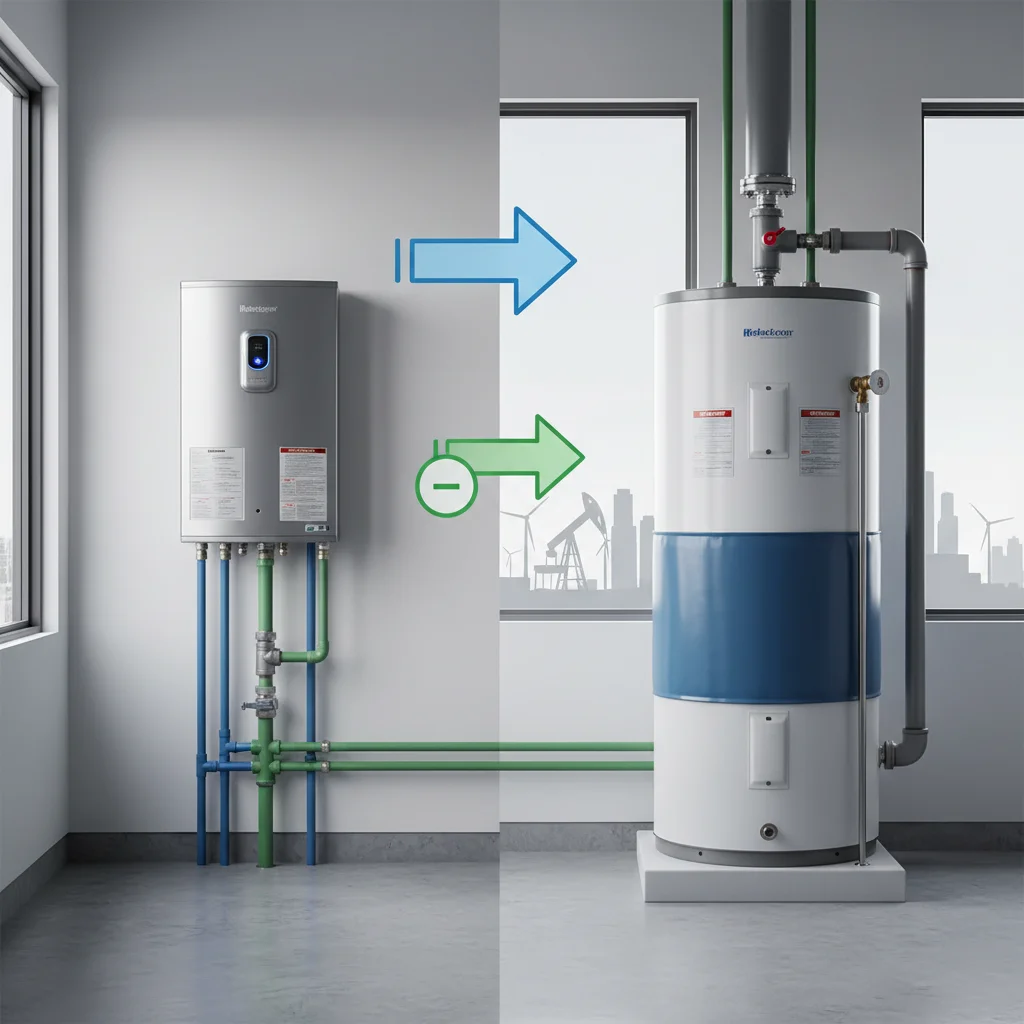
Bakersfield homeowners who replace a 50-gallon tank water heater with a tankless system save $125-$175 annually on energy bills, but the upfront cost difference of $2,800-$4,200 means the payback period stretches to 16-33 years without rebates. And with the Inflation Reduction Act offering up to $600 for qualifying electric heat pump water heaters in 2026, the economic calculation has shifted dramatically. So the choice isn't just about tank versus tankless—it's about which system qualifies for federal tax credits, state rebates, and utility incentives that can cut installation costs by 30-50%.
What's the actual cost difference between tankless and tank water heaters in Bakersfield?
Tank water heaters cost $800-$1,500 for the unit plus $300-$500 for installation, totaling $1,100-$2,000. Tankless systems run $1,500-$3,000 for the unit and $1,200-$2,700 for installation—including gas line upgrades and venting modifications—bringing the total to $2,700-$5,700. That's a $1,600-$3,700 premium for tankless. But tankless units use 24-34% less energy than storage tanks, saving $125-$175 per year on a typical Bakersfield household's $500 annual water heating bill. Without rebates, the breakeven point hits 16-33 years. And most tankless warranties expire at 15 years, so the ROI depends entirely on incentive stacking.
Which water heater type qualifies you for Bakersfield or California rebates?
The Inflation Reduction Act provides a $600 tax credit for electric heat pump water heaters installed in 2026, but excludes gas tankless units. Low-to-moderate income households earning below 150% of area median income ($111,450 for a family of four in Kern County) can claim up to $1,750 through the Home Efficiency Rebate program for heat pump water heaters. PG&E offers $300-$500 rebates for qualified gas tankless models with energy factors above 0.90, and Southern California Edison provides $400-$800 for electric heat pump units. But gas tankless systems don't qualify for federal tax credits—only utility rebates. So the total incentive package for a $2,800 electric heat pump water heater can reach $2,100-$2,350, while a $3,200 gas tankless unit maxes out at $300-$500. Use our free rebate calculator to find your exact savings based on income and system type.
"Heat pump water heaters can save a household of four approximately $330 per year on electric bills compared to a standard electric water heater." — U.S. Department of Energy
How long does it take to install a tankless vs. tank water heater in Bakersfield homes?
Tank water heater replacement takes 2-4 hours when swapping a similar-capacity unit with existing connections. Tankless installations require 6-10 hours because contractors must upgrade gas lines from ½-inch to ¾-inch for units rated above 180,000 BTU, install dedicated 120V outlets for ignition systems, and add Category III stainless steel venting. And Bakersfield building codes mandate earthquake straps for both tank and tankless units, adding 30-45 minutes to either install. So a Friday morning tank swap finishes by lunch. But a tankless job often spills into a second day when HVAC contractors discover undersized gas meters or permit delays. Expect 1-2 full days for tankless versus 3-5 hours for tank replacements in homes built before 2000.
What are the long-term energy savings and ROI for tankless water heaters in Bakersfield's climate?
Bakersfield's 2,635 cooling degree days and mild winters (average low of 47°F in January) mean water heaters don't work as hard as in cold climates. A tank heater loses 10-20% of its energy to standby heat loss—water sitting in the tank cooling down overnight. Tankless units eliminate standby loss entirely, reducing energy use by 24-34% for households using 41 gallons or less daily. That translates to $125-$175 saved per year. But factor in the $2,800-$4,200 upfront premium, and the simple payback stretches to 16-33 years. And if a household qualifies for the $2,350 maximum rebate stack on an electric heat pump water heater, the net cost drops to $450-$1,050—payback in just 3-8 years. So ROI depends entirely on rebate eligibility.
"For homes that use 41 gallons or less of hot water daily, demand water heaters can be 24%–34% more energy efficient than conventional storage tank water heaters." — ENERGY STAR
Tankless vs. tank water heaters: Which one is right for your Bakersfield home size and usage?
Households using more than 86 gallons of hot water per day see tankless efficiency drop to 8-14% savings because continuous high-volume demand negates standby loss advantages. A family of four averaging two showers, one dishwasher cycle, and one laundry load consumes 60-80 gallons daily—well within tankless efficiency range. But homes with three teenagers showering back-to-back plus simultaneous laundry and dishwasher use can hit 120+ gallons, where a 50-gallon tank with a 40-gallon first-hour rating may outperform a single tankless unit rated at 6-7 gallons per minute. So tankless works best for 1-3 person households or homes with staggered hot water use. Larger families often need two tankless units installed in parallel, adding $3,000-$4,500 to the cost. And at that price point, a single high-efficiency tank with a 0.67 energy factor costs $1,200-$1,800 and performs just as well.
What are the maintenance costs and lifespan differences between these systems?
Tank water heaters last 10-12 years and require annual anode rod inspections ($80-$120) plus tank flushing ($100-$150) to prevent sediment buildup. Tankless units last 15-20 years but demand annual descaling ($150-$250) in Bakersfield's hard water areas (250-300 mg/L calcium carbonate). And tankless burners, ignition systems, and flow sensors cost $200-$600 to replace when they fail—typically around year 8-10. So over a 20-year period, a tank system requires two full replacements at $1,100-$2,000 each ($2,200-$4,000 total) plus $1,800-$3,000 in maintenance. A single tankless unit costs $2,700-$5,700 upfront, $3,000-$5,000 in maintenance, and $400-$1,200 in part replacements—totaling $6,100-$11,900. But the tankless system's 15-20 year lifespan means one installation versus two tank swaps. So lifetime costs favor tankless by $2,100-$3,900 if the unit reaches year 18-20. And if it fails at year 12, the tank system wins.
Official Sources
- U.S. Department of Energy - Energy Saver — Federal energy efficiency guidance and rebate information for water heaters
- ENERGY STAR Water Heaters — Certified product listings and efficiency comparisons
- DSIRE USA — Database of state and utility rebate programs updated for 2026
Frequently Asked Questions
What is the difference between a tankless and tank water heater?
Tank water heaters store 30-80 gallons of hot water in an insulated tank and maintain temperature 24/7 using gas burners or electric elements. Tankless systems heat water on-demand as it flows through copper heat exchangers, eliminating standby energy loss but requiring larger gas lines and electrical upgrades. Tank heaters cost $1,100-$2,000 installed and last 10-12 years. Tankless units cost $2,700-$5,700 installed and last 15-20 years. And tankless systems deliver endless hot water at 5-10 gallons per minute, while tanks provide a fixed supply that regenerates in 30-60 minutes.
How much can you save with a tankless water heater in Bakersfield?
Tankless water heaters save $125-$175 annually on energy bills compared to 50-gallon tank heaters in Bakersfield. That's a 24-34% reduction on the typical $500 yearly water heating cost. But the $2,800-$4,200 upfront premium means payback takes 16-33 years without rebates. Households earning below $111,450 for a family of four can claim up to $2,350 in combined federal and utility rebates for electric heat pump water heaters, cutting net cost to $450-$1,050 and reducing payback to 3-8 years.
Are tankless water heaters eligible for rebates in Bakersfield?
Gas tankless water heaters qualify for PG&E rebates of $300-$500 but don't receive federal tax credits in 2026. Electric heat pump water heaters—a type of tankless system—qualify for the $600 Inflation Reduction Act tax credit plus $300-$800 utility rebates from Southern California Edison. Low-income households earning below 150% of area median income ($111,450 for four people in Kern County) can claim an additional $1,750 through California's Home Efficiency Rebate program. So gas tankless systems max out at $500 in rebates, while electric heat pump units can reach $2,350 total.
How long does it take to install a tankless water heater?
Tankless water heater installations take 6-10 hours in Bakersfield homes, often spanning two days when gas line upgrades or permit inspections are required. Contractors must upsize gas lines from ½-inch to ¾-inch for units rated above 180,000 BTU, install Category III stainless steel venting, and add dedicated 120V electrical outlets. And Bakersfield building codes mandate earthquake straps and expansion tanks on all installations. Compare that to 2-4 hours for tank water heater swaps with existing connections. So plan for a full day minimum, and expect two-day installs in pre-2000 homes with undersized gas meters.
What is the lifespan of a tankless water heater compared to a traditional tank?
Tankless water heaters last 15-20 years with annual descaling maintenance, while tank heaters last 10-12 years with periodic anode rod replacements. So a tankless unit installed in 2026 operates through 2041-2046, while a tank heater needs replacement by 2036-2038. But tankless systems require more frequent repairs—burner assemblies and flow sensors cost $200-$600 to replace around year 8-10. And Bakersfield's hard water (250-300 mg/L calcium carbonate) accelerates scale buildup, shortening lifespan to 12-15 years without proper maintenance. So actual lifespan depends on annual descaling, which costs $150-$250 per visit.
Ready to calculate your water heater rebate savings? Bakersfield homeowners can claim up to $2,350 in combined federal and utility incentives for qualifying systems in 2026. Use our rebate calculator to find your exact savings based on income, system type, and installation costs—then connect with pre-screened local contractors who specialize in rebate-eligible water heater installations. The calculator takes 60 seconds and shows your net cost after all incentives.
Updated on April 14, 2026. Fact-checked by DuloCore Editors. About our research team.
Check your California water heater rebate eligibility — see the programs you qualify for and the dollar amounts on our California water heater rebate finder.