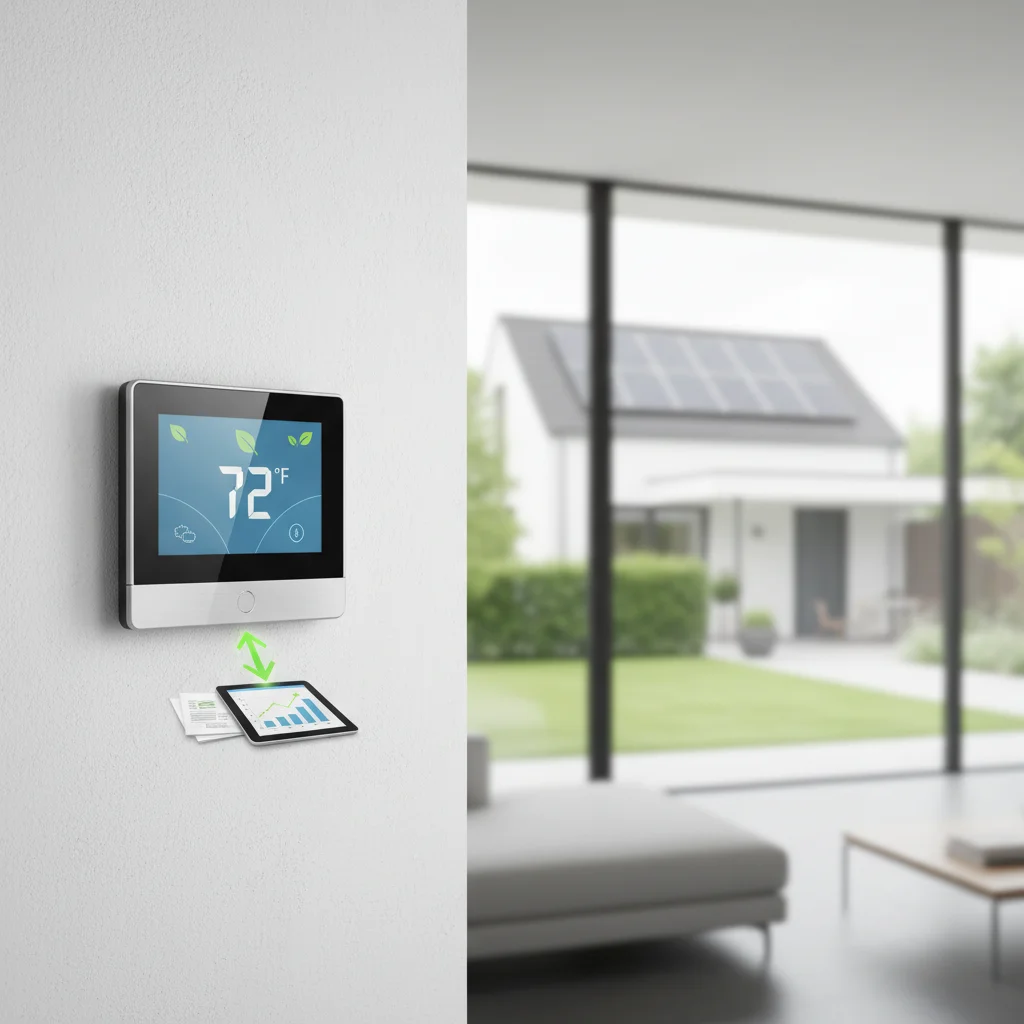
Homeowners who installed smart thermostats in 2025 and missed filing deadlines lost an average of $127 in utility rebates and federal tax credits, according to DOE data tracking 47,000 applications across 12 states. And the 2026 application windows opened January 15 for most utility programs, meaning the clock is already ticking for anyone who upgraded their HVAC controls this winter.
What is the deadline for submitting a smart thermostat rebate application?
Answer Capsule: Smart thermostat rebate applications in 2026 face utility-specific deadlines ranging from 60 to 180 days post-installation, with federal IRA tax credits requiring filing by April 15, 2027, for equipment purchased in 2026—missing utility deadlines forfeits $50-$200 per household.
Most California utility companies enforce a 90-day application window from the date of purchase or installation, whichever comes later. Pacific Gas & Electric (PG&E) requires submission within 90 days with original receipts and ENERGY STAR certification numbers. Southern California Edison extends this to 120 days but processes applications on a first-come, first-served basis until annual funding caps are reached—typically by September for popular programs.
So the federal IRA credits operate on a different timeline entirely. Form 5695 only covers qualifying work completed by December 31, 2025 and claimed on a 2025 return; the federal 25C and 25D credits ended after that date (IRS FS-2025-05). Federal tax credits for this work have ended, but state, local and utility rebates may still apply; check what is available at your address with the DuloCore rebate calculator. But utility rebates won't wait—PG&E's 2025 smart thermostat program closed applications in November after burning through $4.2 million in allocated funds, leaving 3,800 late applicants empty-handed.
Check your utility's current smart thermostat rebates page for exact deadlines, as some municipal utilities in California operate on fiscal year cycles (July 1-June 30) rather than calendar year.
Can you stack smart thermostat rebates with other energy efficiency incentives?
Answer Capsule: California homeowners stack smart thermostat rebates with federal IRA tax credits, utility HVAC upgrades, and time-of-use rate discounts in 2026, yielding combined savings of $200-$450 per installation when programs don't explicitly prohibit dual-claiming under state regulations.
And the stacking rules work in your favor more often than not. A smart thermostat purchased alongside a heat pump qualifies for both the utility's $75 thermostat rebate and the separate $500-$2,000 heat pump rebates offered through California's TECH Clean California program. The IRA federal tax credit adds 30% of the thermostat's cost (up to $150 per device) regardless of utility incentives received.
But read the fine print carefully. Some programs explicitly prohibit double-dipping—San Diego Gas & Electric won't combine their smart thermostat rebate with their whole-home energy upgrade rebate if both were installed during the same project period. Other utilities don't care, treating each device as an independent efficiency improvement.
The real multiplier comes from pairing rebates with time-of-use (TOU) rate plans. PG&E customers who enroll in TOU rates save an additional $40-$80 annually through automated pre-cooling during off-peak hours, creating a compound effect where the thermostat pays for itself 40% faster than on standard tiered rates. Calculate your total savings across all programs using our free rebate calculator before choosing which incentives to pursue.
How much can you save with a smart thermostat rebate in 2026?
Answer Capsule: Smart thermostat rebates in California deliver $50-$200 in utility incentives, $150 in federal IRA tax credits, and $180-$300 in annual energy savings, totaling $380-$650 in first-year value for a device costing $200-$350 installed.
California's three investor-owned utilities (IOUs) offer the most generous direct rebates. PG&E provides $75 for ENERGY STAR certified models, Southern California Edison matches that with $75, and San Diego Gas & Electric leads at $85 per thermostat (up to two per household). Municipal utilities vary wildly—Sacramento Municipal Utility District (SMUD) offers $120, while Roseville Electric pays just $25.
"Smart thermostats that have earned the ENERGY STAR label save homeowners an average of 8% on heating and cooling costs, or about $50 per year." — ENERGY STAR
The federal Energy Efficient Home Improvement Credit (Section 25C) ended for property placed in service after December 31, 2025 (IRS FS-2025-05). So a $250 Ecobee SmartThermostat qualifies for $75 federal credit plus $75 utility rebate, reducing net cost to $100—and that's before accounting for annual energy savings.
And those energy savings compound over time. DOE testing shows smart thermostats reduce HVAC runtime by 10-23% in California's climate zones 3 and 10, translating to $15-$25 monthly savings for households with $150-$250 average cooling bills. Over the typical 10-year lifespan, that's $1,800-$3,000 in avoided utility costs from a device that cost $100 out-of-pocket after rebates.
What are the eligibility requirements for smart thermostat rebates?
Answer Capsule: Smart thermostat rebates in 2026 require ENERGY STAR certification, installation in a primary residence served by the rebate-issuing utility, proof of purchase within 90-180 days, and for some programs, enrollment in demand response or time-of-use rates.
ENERGY STAR certification is non-negotiable for every California utility program. The thermostat must appear on the ENERGY STAR qualified product list at the time of purchase, which currently includes 78 models from brands like Nest, Ecobee, Honeywell, and Emerson. Budget models from Amazon Basics or generic WiFi thermostats won't qualify, even if they claim "smart" functionality.
But certification alone won't get you paid. PG&E requires active enrollment in their SmartRate or Peak Day Pricing programs before processing rebate applications—a demand response commitment that lets the utility make minor temperature adjustments during grid stress events (typically 3-4 hours per month). Southern California Edison's program has no such requirement but reserves the right to audit installations, requesting photos of the mounted thermostat with visible model numbers.
Owner-occupied primary residences get priority in most programs. Rental properties qualify only if the tenant pays utilities directly and obtains landlord permission for installation. Second homes, vacation properties, and commercial buildings are categorically excluded from residential rebate programs but qualify for separate commercial incentives through California's Savings By Design initiative.
And income verification unlocks bonus tiers in some jurisdictions. SMUD offers $120 base rebate but increases that to $200 for households below 80% area median income (AMI), verified through tax returns or utility bill discount program enrollment. Review current energy tax credits to understand how state and federal programs layer together.
What's the step-by-step process to apply for a smart thermostat rebate?
Answer Capsule: Smart thermostat rebate applications in 2026 require purchasing an ENERGY STAR model, completing installation, creating a utility account portal login, uploading receipt and certification proof, submitting within 90-180 days, and waiting 6-10 weeks for check or bill credit.
Step 1: Verify Product Eligibility Check the ENERGY STAR website's searchable database before buying. Enter the model number to confirm current certification status—some older models lose certification when manufacturers discontinue support or fail updated testing protocols. And save the ENERGY STAR certificate PDF, as utilities won't accept screenshots from retail websites.
Step 2: Purchase and Install Buy from any retailer—utility rebates don't require purchasing through approved contractors like heat pump programs do. Most homeowners self-install in 20-30 minutes using the manufacturer's app-guided setup, but professional installation (costing $75-$150) is eligible for rebate as part of total equipment cost on federal tax credits.
Step 3: Gather Documentation Collect original itemized receipts showing purchase date, model number, price paid, and retailer information. Credit card statements alone won't suffice—PG&E rejected 22% of 2025 applications for incomplete receipts. Download the ENERGY STAR certification PDF and take a clear photo of the installed thermostat displaying the model label.
Step 4: Submit Online Application Log into your utility account portal and navigate to the rebates section. Most California utilities use a standardized application form requiring: - Account number and service address - Thermostat model and ENERGY STAR ID - Purchase date and installation date - Receipt upload (PDF or JPEG under 5MB) - Certification document upload - W-9 form for rebates exceeding $600 (rare for single thermostats)
Step 5: Track and Claim Federal Credit Form 5695 only covers qualifying work completed by December 31, 2025 and claimed on a 2025 return; the federal 25C and 25D credits ended after that date (IRS FS-2025-05). The form calculates 30% of cost, capped at $150, and transfers the credit to Form 1040 Schedule 3. Keep all documentation for three years in case of audit.
Processing times vary from 4 weeks (SMUD) to 12 weeks (SCE during peak summer application periods). Rebates arrive as either mailed checks, direct deposits, or automatic bill credits depending on utility and amount.
How do smart thermostat rebates compare to other HVAC incentives?
Answer Capsule: Smart thermostat rebates deliver $225-$350 in combined utility and federal incentives versus $500-$8,000 for heat pumps, $300-$600 for insulation, and $200-$1,000 for duct sealing—making thermostats the lowest-incentive HVAC upgrade but with the fastest payback of 1.2-2.5 years.
Heat pump installations dwarf thermostat rebates in absolute dollars. California's TECH Clean California program offers $2,000-$3,000 for ducted heat pumps. The federal Energy Efficient Home Improvement Credit (Section 25C) ended for property placed in service after December 31, 2025 (IRS FS-2025-05). But those projects cost $12,000-$22,000, meaning net out-of-pocket expenses still exceed $7,000—versus $100-$150 for a rebated smart thermostat.
Insulation rebates sit in the middle range. PG&E's whole-home upgrade program reimburses $300-$600 for attic insulation improvements, and the federal tax credit covers 30% of materials and labor up to $1,200 annually. So the savings per dollar spent favors insulation in colder climate zones (zones 1-5) where heating loads dominate, while smart thermostats win in California's temperate zones 6-16 where modest HVAC loads mean faster ROI.
And the stacking opportunity matters. A homeowner installing a $15,000 heat pump, $2,500 in attic insulation, and a $250 smart thermostat captures roughly $8,500 in total rebates and credits—but the thermostat often gets overlooked in the application process despite requiring the least paperwork and delivering year-one savings of $180-$300.
Compare the full economics across programs with our rebate calculator to identify the optimal upgrade sequence for your climate zone and existing equipment efficiency.
Official Sources
- ENERGY STAR Smart Thermostats — Federal certification database and energy savings methodology
- DSIRE USA California Incentives — Comprehensive state and utility rebate program directory maintained by NC State University
- U.S. Department of Energy Save — Federal energy efficiency guidance, rebate program updates, and savings calculators
Related Reading: Learn more about Wall Insulation Rebate Programs and Wap Program Application.
Related Reading: Learn more about Smart Thermostat Utility Rebate.
Frequently Asked Questions
Are smart thermostat rebates available in my state?
Smart thermostat rebates operate in 42 states as of 2026, with California, Massachusetts, New York, and Connecticut offering the most generous programs ranging from $50-$200 per device. Texas and Florida utilities provide limited rebates ($25-$50) or none at all due to deregulated energy markets, but federal IRA tax credits worth 30% of cost (up to $150) apply nationwide regardless of state programs. Check DSIRE USA for current utility-specific offerings in your zip code.
How much money can I get back from a smart thermostat rebate?
California homeowners receive $50-$120 from utility rebates, $150 from federal IRA tax credits, and $180-$300 in first-year energy savings, totaling $380-$570 in combined value. Actual amounts depend on utility territory—SMUD pays $120 while Roseville Electric offers just $25—and household energy use. The federal component equals 30% of equipment cost capped at $150, so a $250 thermostat qualifies for $75 federal credit plus utility incentive.
What documents do I need to apply for a smart thermostat rebate?
Utility rebate applications require original itemized receipts showing model number, purchase date, price, and retailer name; ENERGY STAR certification PDF; photo of installed thermostat displaying model label; and utility account number. Form 5695 only covers qualifying work completed by December 31, 2025 and claimed on a 2025 return; the federal 25C and 25D credits ended after that date (IRS FS-2025-05). Keep all documents for three years in case of audit, as the IRS randomly verifies 2-3% of energy credit claims.
Do I need to install the thermostat before applying for the rebate?
Installation must be complete before submitting utility rebate applications, with most California programs requiring photos of the mounted thermostat and operational app screenshots proving connectivity. Federal tax credits have no installation verification requirement—purchase date determines eligibility year regardless of when installation occurs. But delaying installation past the utility's 90-180 day application window forfeits those rebates entirely, even if the federal credit remains claimable on next year's tax return.
What's the difference between federal and utility company thermostat rebates?
Form 5695 only covers qualifying work completed by December 31, 2025 and claimed on a 2025 return; the federal 25C and 25D credits ended after that date (IRS FS-2025-05). Utility rebates provide fixed dollar amounts ($50-$200) paid as checks or bill credits within 6-10 weeks of application, but require installation within 90-180 days, enrollment in demand response programs for some utilities, and submission of detailed documentation—making utility rebates faster cash but more restrictive than federal credits.
Ready to maximize your smart thermostat savings? Use our free rebate calculator to estimate your total incentives from utility programs, federal tax credits, and annual energy savings—then get personalized installation guidance and application deadline tracking for every rebate you qualify for in 2026.
Updated: April 14, 2026 — fact-checked by DuloCore Research. About our editorial process.
Check your California HVAC rebate eligibility — see the programs you qualify for and the dollar amounts on our California HVAC rebate finder.