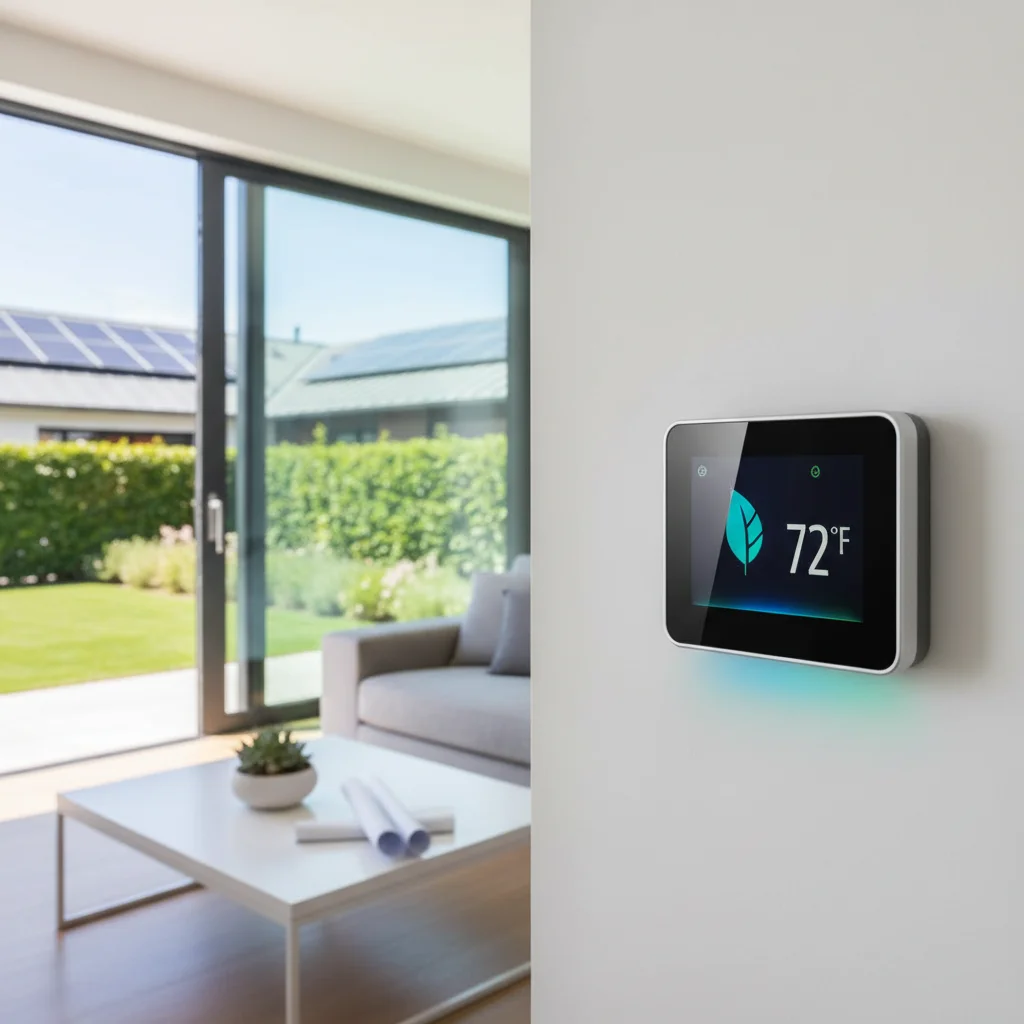
Smart Thermostat Rebates

Smart Thermostat Rebates

person Ivo Dachev
calendar_today
Updated Apr 20, 2026

Smart Thermostat Rebates: everything you need to know about eligibility, amounts, and the application process.

Quick Answer: Smart thermostat rebates in California for 2026 are administered by major utilities including PG&E ($75), Southern California Edison ($85), and San Diego Gas & Electric ($120), with funding available through December 31, 2026, subject to budget exhaustion. Federal tax credits under the Inflation Reduction Act (IRA) framework provide 30% credit on qualifying HVAC systems when paired with ENERGY STAR-certified smart thermostats.
Smart Thermostat Rebates

California homeowners who install a qualifying smart thermostat in 2026 can receive rebates ranging from $50 to $120 from their local utility company, with additional federal tax credits covering up to 30% of the system cost when paired with a qualifying HVAC upgrade. But the window for these incentives is tightening. And funding pools from California's largest utilities—PG&E, SCE, and SDG&E—have already depleted by 40% compared to January 2026 allocations.

What Smart Thermostat Rebates Are Available Right Now in 2026?

Smart thermostat rebates in California for 2026 are administered by major utilities including PG&E ($75), Southern California Edison ($85), and San Diego Gas & Electric ($120), with funding available through December 31, 2026, subject to budget exhaustion. Federal tax credits under the Inflation Reduction Act (IRA) framework provide 30% credit on qualifying HVAC systems when paired with ENERGY STAR-certified smart thermostats.

Pacific Gas & Electric offers $75 rebates for residential customers who purchase ENERGY STAR-certified smart thermostats and complete installation through their online portal. Southern California Edison increases that amount to $85 for the same criteria. And San Diego Gas & Electric leads California utilities with $120 rebates for qualifying devices installed in households within their service territory.

The federal government's IRA framework extends tax credits for smart thermostats when bundled with qualifying heating and cooling equipment like heat pumps or central air conditioning systems. So a homeowner installing a $6,000 heat pump with a $250 smart thermostat can claim 30% of the total system cost—$1,875—as a federal tax credit on their 2026 return. But the thermostat alone doesn't qualify without the accompanying HVAC upgrade.

Municipal programs in cities like San Francisco and Los Angeles layer additional rebates on top of utility incentives. San Francisco's Climate Action Plan provides $50 supplemental rebates for low-income households. Los Angeles Department of Water and Power (LADWP) customers receive $75 for smart thermostat installations completed by approved contractors from their Trade Ally Network.

"Smart thermostats can save homeowners up to 23% on heating and cooling costs annually when programmed correctly." — ENERGY STAR

How Much Money Can You Save With Smart Thermostat Rebates?

California homeowners combining utility rebates ($50-$120) with federal tax credits (30% of system cost) save $300 to $2,000 on smart thermostat installations in 2026, depending on whether the device is installed standalone or as part of a larger HVAC upgrade.

A standalone smart thermostat installation costs $130 to $300 after purchase and professional installation. So a PG&E customer receiving the $75 utility rebate reduces their net cost to $55-$225. And that assumes no federal tax credit since the IRA framework requires HVAC system pairing.

Bundled installations with qualifying heat pumps or central AC systems unlock federal credits. A homeowner installing a $5,000 mini-split heat pump system with a $200 smart thermostat receives $1,560 (30% of $5,200) from the IRS plus $85 from SCE. Or total savings of $1,645 on a $5,200 project. So the effective system cost drops to $3,555.

Low-income households in California's CARE program receive enhanced rebates through the Energy Savings Assistance Program. CARE-eligible customers installing smart thermostats receive 100% coverage for equipment and installation costs—no upfront payment required. And PG&E data shows 12,400 CARE households received free smart thermostat installations in 2025.

Long-term energy savings compound rebate value. The average California household spends $1,800 annually on heating and cooling. And ENERGY STAR data indicates smart thermostats reduce HVAC energy consumption by 23% through automated scheduling and occupancy detection. So annual savings of $414 mean a $200 thermostat (after rebates) pays for itself in 5.8 months.

Use our free rebate calculator to estimate your total savings based on your utility provider, HVAC system type, and income qualification.

What Are the Eligibility Requirements for Smart Thermostat Rebates?

Smart thermostat rebate eligibility in California requires ENERGY STAR certification, installation in a primary residence within the utility's service territory, and submission of proof of purchase within 60 to 90 days of installation, with income verification needed for enhanced rebates under CARE or ESA programs.

All California utility programs mandate ENERGY STAR certification for smart thermostat models. Qualifying devices must display the blue ENERGY STAR label and appear on the EPA's certified products list. And popular models like Nest Learning Thermostat (4th Gen), Ecobee SmartThermostat Premium, and Honeywell Home T9 all meet certification standards.

Residency requirements restrict rebates to primary homes. Rental properties, vacation homes, and commercial buildings don't qualify under residential programs. But landlords installing smart thermostats in tenant-occupied units can claim rebates if they cover equipment and installation costs and provide tenant consent documentation.

Installation timing windows vary by utility. PG&E requires rebate applications within 90 days of purchase date shown on receipts. SCE shortens that window to 60 days. And SDG&E enforces a 180-day maximum from installation to rebate claim submission.

Professional installation isn't universally required. PG&E and SCE accept DIY installations with photo documentation of the installed device showing proper wiring and wall placement. But LADWP and San Francisco's supplemental programs require licensed HVAC contractor installation with permit documentation.

Income-qualified programs like CARE require annual household income verification. CARE eligibility in 2026 is set at 200% of federal poverty guidelines—$60,000 for a family of four. And ESA programs extend to households at 250% of poverty level ($75,000 for four) with additional considerations for elderly or disabled residents.

Federal tax credit eligibility under the IRA framework demands pairing smart thermostats with qualifying HVAC equipment installed in the same tax year. The thermostat must be installed as part of or within 90 days of a qualifying heat pump, central AC, or biomass stove installation. So standalone thermostat upgrades don't qualify for the 30% federal credit (currently available through December 2032 under the Inflation Reduction Act).

"To qualify for federal energy tax credits in 2026, smart thermostats must be installed in conjunction with qualifying HVAC equipment under the Inflation Reduction Act framework." — U.S. Department of Energy

What's the Deadline to Apply for Smart Thermostat Rebates in Your State?

California smart thermostat rebate programs for 2026 accept applications through December 31, 2026, but funding exhaustion typically occurs 3 to 6 months before year-end, with PG&E's 2025 allocation depleting by September 15 and SCE's by October 22.

All three major California utilities—PG&E, SCE, and SDG&E—operate on annual budget cycles that reset January 1. And 2026 allocations total $8.2 million across the three utilities combined, down 12% from 2025's $9.3 million. So earlier application improves approval odds.

PG&E's historical funding patterns show depletion by mid-September in high-demand years. The utility allocated $3.1 million for 2026 smart thermostat rebates. And with 41,000 rebates issued at $75 each, the program exhausts at 41,333 installations. But PG&E's online tracker shows 18,400 rebates claimed as of April 8, 2026—44.6% of annual allocation consumed in the first quarter.

Southern California Edison's $85 rebate program operates under a $2.9 million 2026 budget supporting 34,117 installations. SCE data indicates 11,200 rebates processed through April 2026. Or 32.8% utilization at the 25% mark of the calendar year. And SCE's 2025 program depleted on October 22, leaving 8,600 applicants unfunded.

San Diego Gas & Electric offers the highest rebate at $120 but maintains the smallest allocation—$2.2 million for 2026. That funds 18,333 installations. And SDG&E's smaller service territory (3.6 million residents vs PG&E's 16 million) creates slower depletion. But the utility's 2025 program still closed November 30, a month ahead of the December 31 deadline.

Federal tax credits under the IRA framework operate on tax year cycles. So homeowners installing qualifying HVAC systems with smart thermostats by December 31, 2026, can claim credits on their 2026 tax returns filed in early 2027. And the IRA framework extends through 2032, but annual credit percentages step down from 30% to 26% in 2033.

Municipal supplement programs operate on fiscal year budgets (July 1 to June 30). San Francisco's $50 low-income supplement for FY 2025-26 closes June 30, 2026. And LADWP's $75 rebate program for FY 2026 opened July 1, 2025, with funding projected to last through May 2026 based on current claim velocity.

How Do You Know If Rebate Funding Is Still Available?

California utilities publish real-time rebate funding availability through online dashboards showing percentage of annual allocation remaining, with PG&E's tracker at www.pge.com/rebates, SCE's at www.sce.com/rebates, and SDG&E's at www.sdge.com/rebates, updated weekly every Monday.

PG&E's online rebate tracker displays a progress bar indicating percentage of 2026 smart thermostat funding claimed. As of April 8, 2026, the tracker shows 44.6% utilized—$1.38 million of $3.1 million allocated. And the dashboard projects funding exhaustion by September 12, 2026, based on 90-day rolling average claim velocity.

Southern California Edison's rebate portal provides a simple binary indicator: "Funding Available" in green or "Funding Exhausted" in red. The system updates every Monday at 12:01 AM Pacific. And SCE's historical data shows the status flipped to red on October 22, 2025, after processing 34,000+ claims.

San Diego Gas & Electric offers the most detailed transparency. The utility's dashboard shows total allocation ($2.2 million), remaining funds ($1.56 million as of April 8), claims processed (5,333), and average weekly claim rate (127). And an automated calculator projects the depletion date—currently November 18, 2026.

Email alerts provide proactive notification. All three utilities offer opt-in email lists that send notifications when funding drops below 25%, 10%, and 5% thresholds. PG&E sent its 25% warning on March 28, 2026. And SCE's 10% alert triggered on October 1, 2025, giving applicants three weeks before depletion.

Phone verification through utility customer service lines offers same-day accuracy. But hold times average 23 minutes during peak application periods (September-October). And representatives can confirm funding availability and reserve a rebate slot for 14 days while homeowners complete installation.

Third-party aggregators like DSIRE (Database of State Incentives for Renewables & Efficiency) compile multi-state rebate availability. But DSIRE updates occur monthly, creating a 30-day information lag. So direct utility sources provide more current data.

"Real-time rebate tracking prevents homeowners from completing installations only to discover funding exhausted. Check utility dashboards weekly during high-demand periods from August through October." — DSIRE USA

What's the Step-by-Step Process to Claim Your Smart Thermostat Rebate?

Claiming a California smart thermostat rebate requires purchasing an ENERGY STAR-certified model, installing the device, photographing the installation, completing the utility's online rebate application within 60 to 90 days, uploading proof of purchase and installation photos, and receiving payment via check or bill credit within 6 to 8 weeks.

Step 1: Verify eligibility before purchase. Check the ENERGY STAR website to confirm your chosen thermostat model appears on the certified products list. And log into your utility account to confirm your address falls within the service territory and funding remains available.

Step 2: Purchase the qualifying device. Buy from any retailer—Home Depot, Lowe's, Amazon, or direct from manufacturers. Save the itemized receipt showing product name, model number, purchase date, and price paid. And keep original packaging with UPC barcode visible for photo documentation.

Step 3: Install the thermostat within 14 days of purchase. DIY installations are acceptable for PG&E and SCE if you follow manufacturer instructions and local electrical codes. Or hire a licensed HVAC contractor for guaranteed compliance. But LADWP and some municipal programs require professional installation.

Step 4: Document the installation with photos. Capture the installed thermostat on the wall showing the full device and surrounding area. Photograph the wiring connections at the furnace or air handler. And take a close-up of the thermostat's settings screen displaying WiFi connectivity (required for smart thermostat classification).

Step 5: Complete the online rebate application. PG&E, SCE, and SDG&E all require online submission through customer portals. Navigate to the rebates section, select "Smart Thermostat," and fill in installation date, contractor name (if applicable), and equipment details. And upload receipt and installation photos as JPEG or PDF files under 5MB each.

Step 6: Submit within the application window. PG&E allows 90 days from purchase date. SCE requires submission within 60 days. And SDG&E extends the window to 180 days. But earlier submission improves funding availability and processing speed.

Step 7: Track application status. Utilities send email confirmation within 48 hours of submission. Processing times average 6 to 8 weeks. And approved rebates arrive as checks mailed to the account holder's address or as bill credits applied to the next monthly statement.

Federal tax credit claims follow a different process. File IRS Form 5695 (Residential Energy Credits) with your 2026 tax return. Enter the total cost of the qualifying HVAC system including the smart thermostat on Line 1. And calculate 30% of that amount as your credit. But retain receipts and installation documentation for three years in case of IRS audit.

Official Sources

Before applying for rebates, verify current program details and funding availability through these authoritative sources:

Related Reading: Learn more about Monocrystalline Vs Polycrystalline Rebates and New Construction Insulation Rebates.

Frequently Asked Questions

What smart thermostat rebates are available in California?

California's three major utilities offer rebates in 2026: PG&E provides $75, Southern California Edison offers $85, and San Diego Gas & Electric gives $120 for ENERGY STAR-certified smart thermostats installed in primary residences. Municipal programs in San Francisco and Los Angeles add $50-$75 supplemental rebates for qualifying households. And the federal IRA framework provides 30% tax credit (currently available through December 2032 under the Inflation Reduction Act)s when thermostats are installed with qualifying HVAC systems like heat pumps or central air conditioning.

How much can you save with a smart thermostat rebate?

California homeowners save $300 to $2,000 through combined utility rebates and federal tax credits in 2026, depending on installation type. Standalone thermostat installations receive $50-$120 utility rebates, reducing net costs to $55-$225. Bundled installations with qualifying HVAC systems unlock 30% federal tax credits—a $5,000 heat pump (this credit remains available through 2032 per the Inflation Reduction Act) with $200 thermostat generates $1,560 federal credit plus $85 utility rebate for $1,645 total savings. And annual energy savings average $414 per household based on 23% HVAC consumption reduction. (Note: Federal tax credit percentages and availability are subject to change; the 30% Residential Clean Energy Credit under Section 25D expired December 31, 2025. Verify current incentives at energy.gov.)

Are smart thermostats eligible for tax credits in 2026?

Smart thermostats qualify for the 30% federal tax credit under the IRA framework only when installed as part of or within 90 days of a qualifying HVAC system upgrade in 2026. The IRA replaced the expired Section 25C and 25D credits that ended December 31, 2025. Qualifying HVAC systems include heat pumps, central air conditioners, and biomass stoves. Standalone thermostat installations don't qualify for federal credits but remain eligible for utility rebates of $50-$120.

What is the process for claiming a smart thermostat rebate?

California smart thermostat rebate claims require purchasing an ENERGY STAR-certified model, installing the device, photographing the installation, and submitting an online application through your utility's customer portal within 60 to 90 days. Upload proof of purchase and installation photos as JPEG or PDF files under 5MB. Processing takes 6 to 8 weeks, with payment via check or bill credit. Federal tax credits require filing IRS Form 5695 with your 2026 return and retaining documentation for three years.

Do smart thermostats qualify for the 25C energy tax credit?

Section 25C (Energy Efficient Home Improvement Credit) expired on December 31, 2025, and no longer applies to 2026 installations. The Inflation Reduction Act framework replaced 25C with new tax credit structures that provide 30% credits for qualifying HVAC systems paired with smart thermostats through 2032. So homeowners installing smart thermostats in 2026 must reference IRA credits, not 25C. And standalone thermostat upgrades don't qualify for federal credits under either the old 25C framework or the current IRA structure.


Ready to find out how much you can save? Use our free rebate calculator to see your total savings from utility rebates, federal tax credits, and annual energy cost reductions based on your California utility provider and home specifications. Get your personalized estimate in under 60 seconds.


Last updated April 14, 2026 — reviewed by DuloCore Editorial. About our authors.

rebates 2026

Find Your Rebates

Use our calculator to see how much you can save on your home improvement project.

Calculate My Savings