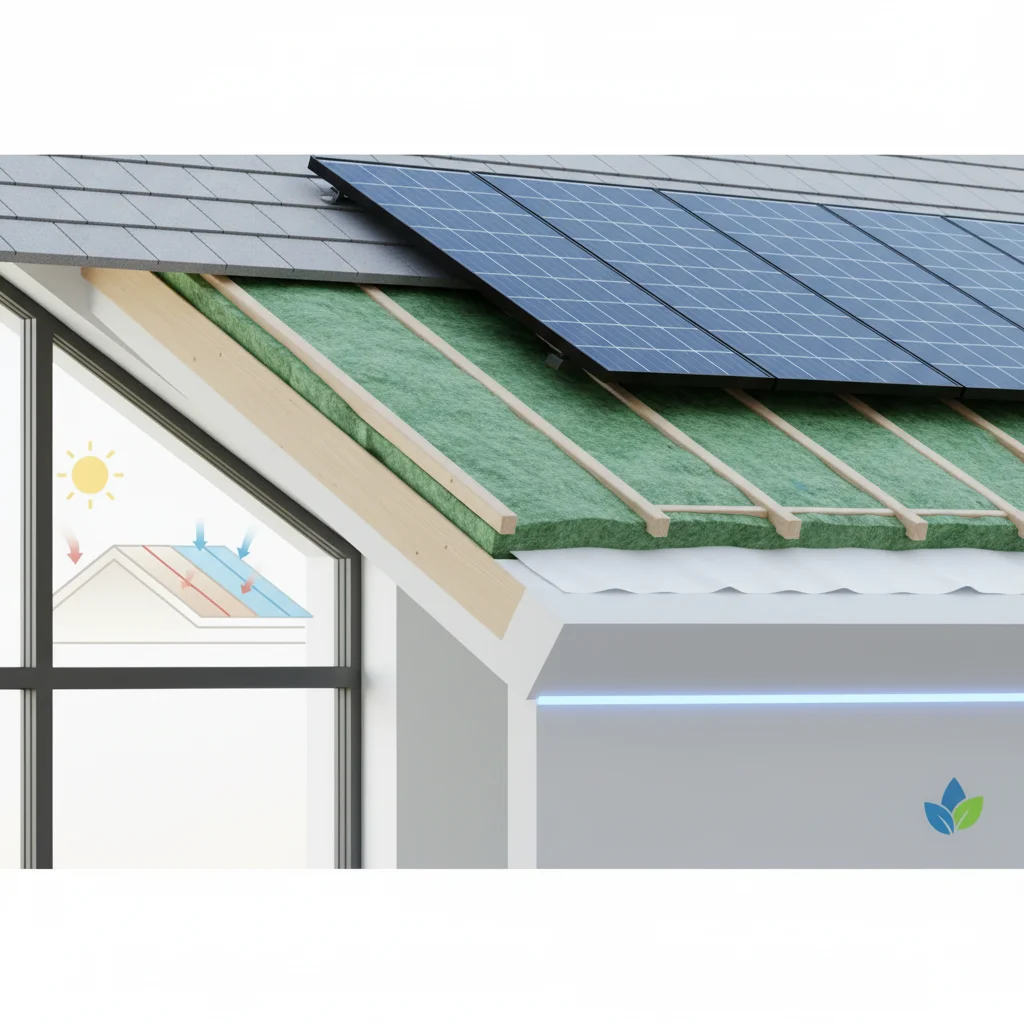
California homeowners spend an average of $2,800 to $8,500 on roof insulation in 2026, but federal tax credits and state rebates can cut that cost by 30% to 50%. The difference between a $3,000 project and a $6,000 one often comes down to material choice, roof size, and whether the installer includes air sealing—a step that doubles energy savings but adds $800 to $1,500 to the bill.
How Much Does Roof Insulation Cost by Material Type?
Roof insulation in California costs $1.50 to $4.50 per square foot installed in 2026, with spray foam at the high end ($3.50-$4.50), fiberglass batts at the low end ($1.50-$2.50), and rigid foam boards in between ($2.00-$3.50). Labor accounts for 40% to 60% of total project cost.
Spray polyurethane foam delivers R-6 to R-7 per inch and creates an air barrier, which is why it costs $4,200 to $9,000 for a 1,500-square-foot roof deck. But that air-sealing property saves 15% to 25% more energy than batts alone. Fiberglass batts cost $2,250 to $3,750 for the same roof but require separate air sealing to hit the same performance. Rigid foam boards—polyisocyanurate or XPS—run $3,000 to $5,250 and offer R-5 to R-6.5 per inch with moderate air resistance. And removal of old insulation adds $1 to $2 per square foot if the roof deck has damaged or compressed material. So a full tear-out and spray foam upgrade on a 2,000-square-foot roof can hit $12,000 before rebates.
What Rebate and Tax Credit Programs Can Help Pay for Roof Insulation?
The federal Energy Efficient Home Improvement Credit (Section 25C) ended for property placed in service after December 31, 2025 (IRS FS-2025-05). California's TECH Clean California program offers $250 to $500 rebates for attic and roof insulation when paired with heat pump installation. Low-income households qualify for $4,000 to $8,000 through the federal Home Efficiency Rebates program.
California utility companies—PG&E, SCE, SDG&E, and SoCalGas—pay $0.10 to $0.30 per square foot for insulation upgrades that meet Title 24 energy code standards. But those rebates require a Home Energy Score assessment ($150-$300) and verification by a certified rater. The federal tax credit applies to materials and labor, covers spray foam, batts, and rigid boards, and stacks with utility rebates. And the Home Efficiency Rebates program, funded by the IRA, targets homes using 80% or more area median income thresholds and requires 20% to 35% whole-home energy reduction. So a $6,000 roof insulation project paired with a heat pump and air sealing can net $1,800 in federal tax credit, $500 in TECH rebates, and $300 in utility incentives—cutting out-of-pocket cost to $3,400. Check your exact savings with our free rebate calculator.
Which Roof Insulation Types Qualify for Federal and State Rebates?
The federal Energy Efficient Home Improvement Credit (Section 25C) ended for property placed in service after December 31, 2025 (IRS FS-2025-05). Federal tax credits for this work have ended, but state, local and utility rebates may still apply; check what is available at your address with the DuloCore rebate calculator. California TECH rebates require R-30 minimum in Climate Zone 1 (coastal) and R-38 in zones 10-16 (inland and mountain).
The IRS requires insulation to meet International Energy Conservation Code (IECC) standards, which specify R-values by climate zone. California Title 24 mandates R-30 to R-49 for roof decks depending on location, so any professionally installed product hitting those targets qualifies. Spray foam needs a manufacturer's certificate stating R-value per inch and fire rating. Batts and rolls must carry an ENERGY STAR label or equivalent third-party certification. And reflective barriers or radiant foils alone don't qualify unless paired with mass insulation like foam or batts. Utility rebates require Home Energy Score verification, which measures actual R-value after installation using thermal imaging or blower door tests. So a DIY fiberglass batt project won't get utility rebates, but it still qualifies for the federal tax credit if materials meet code.
How Long Does Roof Insulation Last and What Affects Its Lifespan?
Spray foam lasts 80 to 100 years, fiberglass batts last 25 to 40 years, and rigid foam boards last 50 to 75 years in California's dry climate when properly installed. Moisture intrusion, roof leaks, and compression from foot traffic cut lifespan by 30% to 60%.
Closed-cell spray foam resists water and maintains R-value for decades, which is why builders warranty it for 50+ years. Open-cell foam absorbs moisture and degrades faster in humid climates, but California's low humidity extends its life to 60 to 80 years. Fiberglass batts lose 15% to 25% of R-value over 20 years if exposed to moisture or compressed by stored items. And rigid foam boards degrade from UV exposure if left uncovered, but when sandwiched between roof decking and shingles, they hold R-value for 75 years. Roof leaks are the top killer—a single drip can saturate 50 square feet of fiberglass in six months, cutting R-value from R-30 to R-12. So annual roof inspections and immediate leak repair are critical. For more on insulation longevity, see our guide to insulation rebates.
What's the ROI Timeline for Roof Insulation Investment?
California homeowners see 5 to 12-year payback periods on roof insulation, with coastal zones (1-6) at 10 to 12 years due to mild weather and inland zones (10-16) at 5 to 7 years where summer cooling and winter heating loads are higher. A $5,000 spray foam project saves $400 to $800 annually in energy costs.
The math: a 1,500-square-foot home in Fresno (Climate Zone 13) with R-13 fiberglass in the roof deck spends $1,800 annually on cooling and $600 on heating. Upgrading to R-38 spray foam cuts cooling costs by 30% ($540) and heating by 25% ($150), yielding $690 in annual savings. After $1,500 in federal tax credit and $400 in utility rebates, net cost is $3,100, so payback is 4.5 years. But a similar home in San Francisco (Climate Zone 3) saves only $280 annually due to mild summers, pushing payback to 11 years. And homes with heat pumps see faster ROI because insulation reduces both heating and cooling runtime—adding a heat pump and roof insulation together can drop payback to 3 to 5 years. Learn more about stacking rebates in our heat pump rebates article.
"Attic insulation improvements can reduce heating and cooling costs by 10% to 50% depending on existing R-value and climate zone." — ENERGY STAR Insulation Guide
How Do Roof Insulation Costs Compare to Attic Insulation?
Roof deck insulation costs $3,000 to $8,500 for a 1,500-square-foot home, while attic floor insulation costs $1,500 to $3,500 for the same area in 2026. Roof insulation creates conditioned attic space, which is required for ductwork but costs 60% to 100% more than insulating the attic floor.
Attic floor insulation—blown-in cellulose or fiberglass batts between ceiling joists—is cheaper because it covers less area and requires no air sealing of the roof deck. But it leaves the attic unconditioned, so HVAC ducts in the attic lose 20% to 40% of heating and cooling energy. Roof deck insulation brings the attic inside the thermal envelope, cutting duct losses to near zero. That matters in California, where 75% of homes have attic ductwork. So a $5,000 roof insulation project saves an additional $300 to $600 annually compared to $2,500 in attic floor insulation that saves $400 to $700—net annual advantage of $100 to $200 for roof insulation after accounting for higher upfront cost. And homes with vaulted ceilings or cathedral roofs have no attic floor, so roof deck insulation is the only option. California's Title 24 code allows either approach but requires R-38 minimum for attic floors and R-30 to R-49 for roof decks depending on climate zone.
Official Sources
- ENERGY STAR Insulation Guide — Federal guidance on insulation R-values, materials, and energy savings by climate zone.
- IRS Energy Incentives for Individuals — Official tax credit amounts, eligibility, and filing requirements for home energy improvements. (note: the federal 25C and 25D credits ended for projects completed after December 31, 2025)
- DSIRE Database — Searchable directory of state, utility, and federal rebates for insulation and energy efficiency projects.
Related Reading: Learn more about Federal Insulation Rebate and Fiberglass Insulation Cost Per Square Foot.
Related Reading: Learn more about Blown In Insulation Cost and Doe Insulation Rebate Programs.
Related Reading: Learn more about Garage Insulation Cost.
Frequently Asked Questions
How much does roof insulation cost?
Roof insulation costs $1.50 to $4.50 per square foot installed in California in 2026, with total project costs ranging from $2,800 for fiberglass batts on a small roof to $8,500 for spray foam on a 2,000-square-foot roof deck. Labor, removal of old insulation, and air sealing add $800 to $2,000 to base material costs.
What factors affect the price of roof insulation?
Material type, roof size, roof pitch, accessibility, and whether old insulation needs removal drive cost variation. Spray foam costs $3.50 to $4.50 per square foot, fiberglass batts cost $1.50 to $2.50, and rigid foam costs $2.00 to $3.50. Steep roofs (8:12 pitch or higher) add 15% to 25% to labor costs, and attic access requiring scaffolding or lifts adds $500 to $1,200.
Are roof insulation costs tax deductible?
The federal Energy Efficient Home Improvement Credit (Section 25C) ended for property placed in service after December 31, 2025 (IRS FS-2025-05). The credit covers materials and labor but requires the insulation to meet ENERGY STAR or IECC standards. Learn more about eligibility on our energy tax credits page.
How long does roof insulation last?
Spray foam lasts 80 to 100 years, fiberglass batts last 25 to 40 years, and rigid foam boards last 50 to 75 years in California. Moisture intrusion from roof leaks, compression from stored items, or UV exposure cuts lifespan by 30% to 60%, so annual roof inspections and immediate leak repair extend insulation life.
What's the difference between roof insulation and attic insulation?
Roof insulation is installed on the underside of the roof deck and creates conditioned attic space, while attic insulation is installed on the attic floor between ceiling joists and leaves the attic unconditioned. Roof insulation costs 60% to 100% more but eliminates 20% to 40% energy loss from attic ductwork, making it cost-effective for homes with HVAC systems in the attic.
Ready to see how much you can save? Use our free rebate calculator to find federal tax credits, California utility rebates, and TECH Clean California incentives for your roof insulation project. Get your personalized savings estimate in under 60 seconds.
Last updated April 14, 2026 — reviewed by DuloCore Editorial. About our authors.
Check your California insulation rebate eligibility — see the programs you qualify for and the dollar amounts on our California insulation rebate finder.