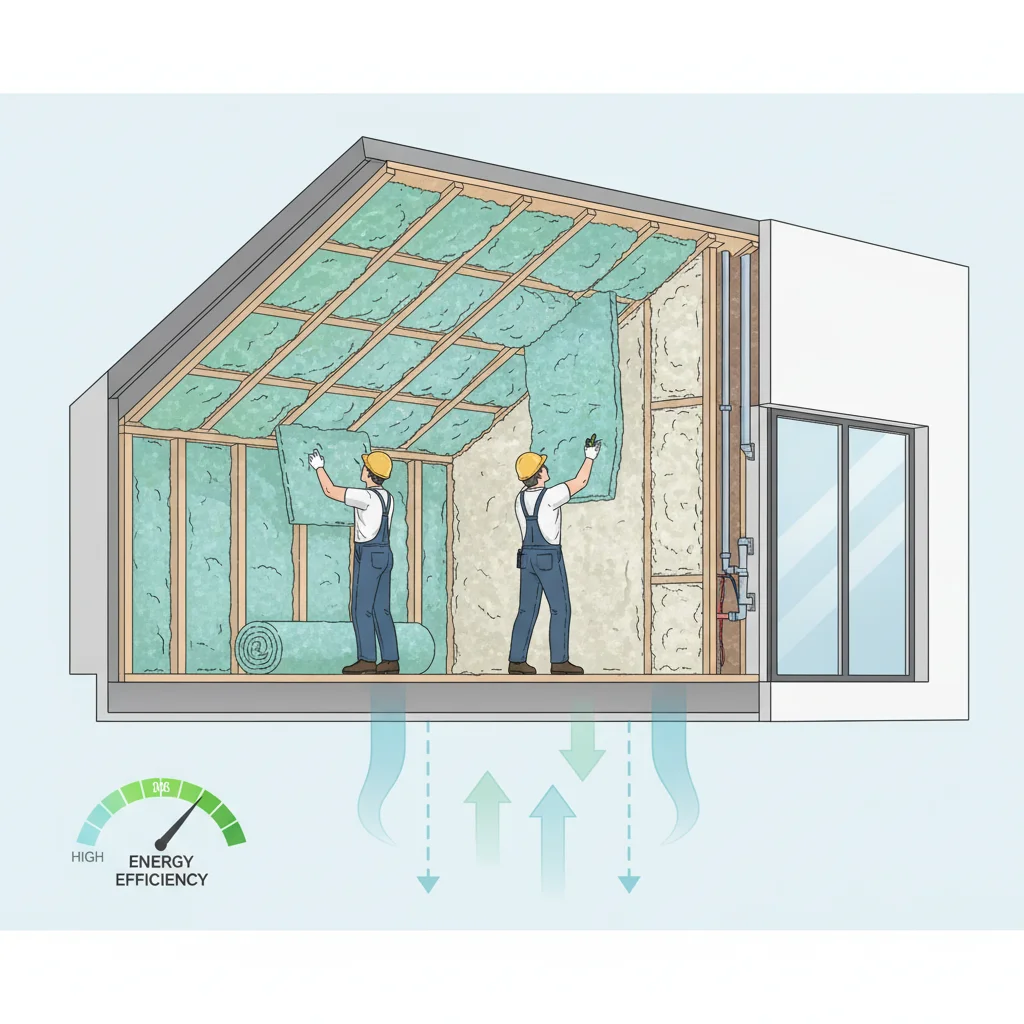
Homeowners installing fiberglass insulation in 2026 spend between $0.64 and $1.19 per square foot for materials alone, but total project costs reach $1.50 to $3.50 per square foot when labor, vapor barriers, and attic prep are included. And that's before factoring in federal tax credits that reduce net costs by 30% for qualifying installations.
How Much Does Fiberglass Insulation Cost Per Square Foot in 2026?
Fiberglass insulation costs $0.64 to $1.19 per square foot for materials in 2026, with R-13 batts at the low end and R-38 blown-in at the high end. Professional installation adds $0.86 to $2.31 per square foot for labor, bringing total project costs to $1.50 to $3.50 per square foot depending on R-value, installation method, and attic accessibility.
Blown-in fiberglass runs $0.90 to $1.19 per square foot for materials because it requires specialized equipment and achieves higher R-values per inch than batts. Batt insulation costs $0.64 to $0.95 per square foot but demands more labor in irregularly shaped spaces. So a 1,500-square-foot attic insulated to R-38 with blown-in fiberglass costs $2,250 to $5,250 total, while the same space insulated with R-30 batts costs $1,800 to $4,200. The federal Energy Efficient Home Improvement Credit (Section 25C) ended for property placed in service after December 31, 2025 (IRS FS-2025-05). Federal tax credits for this work have ended, but state, local and utility rebates may still apply; check what is available at your address with the DuloCore rebate calculator.
R-value determines material costs more than any other factor. R-13 batts cost $0.64 per square foot, R-19 batts cost $0.78 per square foot, R-30 batts cost $0.90 per square foot, and R-38 blown-in costs $1.19 per square foot. And climate zone dictates minimum R-value requirements—Zone 1 (Southern California) requires R-30 in attics, while Zone 6 (Northern California mountains) requires R-49.
Which Fiberglass Insulation Brands Qualify for Federal Tax Credits and Rebates?
The federal Energy Efficient Home Improvement Credit (Section 25C) ended for property placed in service after December 31, 2025 (IRS FS-2025-05). Owens Corning, Johns Manville, and CertainTeed produce certified products that consistently meet federal standards.
The IRA framework requires insulation to be part of a whole-home energy project that includes at least one other qualifying improvement like heat pump installation, window replacement, or electrical panel upgrades. And the $1,200 annual credit limit for insulation alone increases to $3,200 when combined with heat pump rebates and electrical work. So strategic bundling maximizes federal benefits.
California's TECH Clean California program offers additional $500 to $2,000 rebates for attic insulation when paired with heat pump HVAC installations in 2026. But the program requires pre-approval and certified contractor installation using products listed in the TECH equipment database. Owens Corning ProPink, Johns Manville Climate Pro, and CertainTeed Sustainable Insulation all appear on approved product lists.
"Insulation improvements must be installed in or on a taxpayer's principal residence located in the United States and meet the prescriptive criteria established by the 2021 International Energy Conservation Code." — IRS Energy Incentives for Individuals
What's the Installation Cost for Fiberglass Insulation and How Long Does It Take?
Professional installation adds $0.86 to $2.31 per square foot to fiberglass insulation projects in 2026, with blown-in methods costing 40% to 60% more than batt installation due to equipment rental and specialized labor. A 1,200-square-foot attic takes 6 to 10 hours for batt installation at $1,032 to $2,772 labor cost, or 4 to 6 hours for blown-in at $1,440 to $3,600 labor cost.
Attic accessibility drives labor costs more than any other factor. Easily accessible attics with 36+ inches of headroom cost $0.86 to $1.20 per square foot for labor, while crawl-space attics with less than 24 inches of clearance cost $1.80 to $2.31 per square foot because installers work on their stomachs. And obstacle removal adds $200 to $500—old insulation removal costs $0.80 to $1.20 per square foot, ductwork relocation costs $300 to $800, and vapor barrier installation adds $0.15 to $0.25 per square foot.
Project timelines vary by method and crew size. Two-person crews install R-30 batts in 1,200-square-foot attics in 6 to 8 hours, while blown-in crews complete the same space in 4 to 5 hours. But batt installation requires no cleanup, while blown-in methods demand 1 to 2 hours of dust containment and equipment removal. Use our free rebate calculator to estimate total project costs with federal and state incentives.
How Quickly Will Fiberglass Insulation Pay for Itself Through Energy Savings?
Fiberglass insulation installed in 2026 pays for itself in 3 to 7 years through reduced heating and cooling costs, with California homeowners saving $400 to $1,200 annually depending on climate zone, existing insulation levels, and HVAC efficiency. Northern California homes in Zone 6 see the fastest payback at 3 to 4 years, while Southern California Zone 1 homes reach breakeven in 6 to 7 years.
Upgrading from R-11 to R-38 in a 1,500-square-foot attic saves $840 to $1,200 annually in heating and cooling costs for Zone 6 homes, based on $0.28 per kWh electricity rates and 3,200 heating degree days. So a $4,200 project with 30% federal tax credit ($2,940 net cost) pays for itself in 2.5 to 3.5 years. And Zone 1 homes save $400 to $600 annually with the same upgrade, reaching breakeven in 4.9 to 7.4 years.
Energy savings compound when fiberglass insulation pairs with other efficiency upgrades. Homes that combine R-38 attic insulation with heat pump HVAC replacement save 35% to 45% on annual energy costs—$1,680 to $2,520 annually for typical California homes. But standalone insulation upgrades save 18% to 25%, or $720 to $1,200 annually.
"Proper insulation can reduce heating and cooling costs by up to 20%, making it one of the most cost-effective home energy upgrades available." — DOE Energy Saver
Is Fiberglass Insulation Right for Your Climate Zone and Home Type?
Fiberglass insulation performs optimally in California's dry climate zones 1 through 6, with batts suited for new construction and attic retrofits, while blown-in fiberglass works best for irregularly shaped spaces, wall cavities, and homes built before 1980. But moisture-prone areas like coastal Zone 1 homes and crawl spaces require vapor barriers to prevent mold growth and maintain R-value over 30+ year lifespans.
Climate zone dictates minimum R-value requirements under 2021 IECC code. Zone 1 (coastal Southern California) requires R-30 in attics and R-13 in walls, Zone 3 (Central Valley) requires R-38 in attics and R-15 in walls, and Zone 6 (mountain regions) requires R-49 in attics and R-21 in walls. And fiberglass maintains rated R-value in temperatures from -60°F to 180°F, making it suitable for all California climate extremes.
Home age determines installation method. Houses built after 2000 typically use batt insulation in accessible attic spaces with standard joist spacing, while homes built before 1980 benefit from blown-in fiberglass that fills irregular cavities and bypasses knob-and-tube wiring. And manufactured homes require special installation techniques—batts must be secured with wire mesh or staples because bottom-up installation prevents sagging.
| Climate Zone | Minimum Attic R-Value | Annual Heating Cost Savings | Recommended Installation Method |
|---|---|---|---|
| Zone 1 (Coastal) | R-30 | $400-$600 | Batts with vapor barrier |
| Zone 3 (Central Valley) | R-38 | $600-$900 | Blown-in or batts |
| Zone 6 (Mountain) | R-49 | $840-$1,200 | Blown-in for maximum coverage |
How Does Fiberglass Insulation Compare to Cellulose, Spray Foam, and Mineral Wool?
Fiberglass costs 30% to 50% less than spray foam and 15% to 25% less than cellulose per square foot in 2026, with materials running $0.64 to $1.19 per square foot versus cellulose at $0.80 to $1.40, mineral wool at $1.20 to $2.10, and spray foam at $1.50 to $3.50. But cellulose achieves 10% to 15% better air sealing, spray foam provides 2x the R-value per inch, and mineral wool offers superior fire resistance.
R-value per inch separates insulation types. Fiberglass batts deliver R-3.2 to R-4.3 per inch, cellulose delivers R-3.5 to R-3.8 per inch, mineral wool delivers R-4.0 to R-4.3 per inch, and closed-cell spray foam delivers R-6.0 to R-7.0 per inch. So achieving R-38 in an attic requires 11.5 inches of fiberglass, 10.5 inches of cellulose, 9.5 inches of mineral wool, or 6 inches of spray foam.
Installation requirements differ dramatically. Fiberglass and mineral wool work for DIY projects with basic safety equipment, cellulose requires specialized blowing equipment but no certifications, and spray foam demands professional installation with respirators and environmental controls. And fiberglass projects take 6 to 10 hours for 1,200-square-foot attics, while spray foam takes 4 to 6 hours but costs $3,000 to $6,000 more.
Learn more about federal incentives for all insulation types in our guide to energy tax credits.
How Long Does Fiberglass Insulation Last and What Maintenance Does It Need?
Fiberglass insulation lasts 80 to 100 years in dry, undisturbed attics and wall cavities with zero maintenance required, but moisture exposure, rodent damage, and compression reduce effective lifespan to 15 to 25 years in crawl spaces, basements, and areas lacking vapor barriers. Annual visual inspections cost $0 to $150 when bundled with HVAC maintenance and identify settling, water damage, and pest intrusion before R-value degrades.
Material quality determines longevity. Owens Corning and Johns Manville fiberglass products manufactured after 2010 use formaldehyde-free binders that resist breakdown for 100+ years, while pre-2005 products degrade 20% to 30% faster due to binder chemistry. And proper installation prevents 90% of premature failures—batts installed with compression lose 50% of R-value immediately, while blown-in insulation settles 2% to 4% in the first year then stabilizes.
Maintenance requirements are minimal but critical. Annual attic inspections identify roof leaks before water saturates insulation and causes mold—wet fiberglass loses 40% to 60% of R-value and must be replaced at $2.50 to $4.00 per square foot. And rodent prevention costs $300 to $800 for screen installation at attic vents but prevents $1,200 to $3,000 in insulation replacement when mice nest in batts.
For comprehensive information on insulation incentives, see our guide to insulation rebates.
Official Sources
- IRS Energy Incentives for Individuals — Federal tax credit eligibility and requirements for insulation and energy efficiency upgrades (note: the federal 25C and 25D credits ended for projects completed after December 31, 2025)
- DOE Energy Saver — Comprehensive guidance on insulation types, R-values, and installation best practices
- DSIRE USA — Database of state and utility rebate programs for home energy efficiency improvements
Frequently Asked Questions
How much does fiberglass insulation cost per square foot?
Fiberglass insulation costs $0.64 to $1.19 per square foot for materials in 2026, with total installed costs of $1.50 to $3.50 per square foot including labor. R-13 batts cost $0.64 per square foot, R-19 batts cost $0.78 per square foot, R-30 batts cost $0.90 per square foot, and R-38 blown-in costs $1.19 per square foot. Professional installation adds $0.86 to $2.31 per square foot depending on attic accessibility.
What factors affect the price of fiberglass insulation installation?
R-value drives material costs, with R-13 at $0.64 per square foot and R-38 at $1.19 per square foot. Attic accessibility determines labor costs—easily accessible attics cost $0.86 to $1.20 per square foot for labor, while crawl-space attics cost $1.80 to $2.31 per square foot. And additional work like old insulation removal ($0.80 to $1.20 per square foot), vapor barrier installation ($0.15 to $0.25 per square foot), and ductwork relocation ($300 to $800) increases total project costs.
Is fiberglass insulation cheaper than other insulation types?
Fiberglass costs 30% to 50% less than spray foam and 15% to 25% less than cellulose per square foot in 2026. Fiberglass runs $0.64 to $1.19 per square foot for materials, cellulose costs $0.80 to $1.40 per square foot, mineral wool costs $1.20 to $2.10 per square foot, and spray foam costs $1.50 to $3.50 per square foot. But spray foam delivers 2x the R-value per inch, reducing total material volume needed.
Do I qualify for rebates on fiberglass insulation costs?
The federal Energy Efficient Home Improvement Credit (Section 25C) ended for property placed in service after December 31, 2025 (IRS FS-2025-05). The credit covers up to $1,200 annually for insulation alone or $3,200 when combined with heat pump and electrical upgrades. California's TECH Clean California program offers additional $500 to $2,000 rebates when insulation pairs with heat pump installations. Check your eligibility with our rebate calculator.
How long does fiberglass insulation last and is it worth the cost?
Fiberglass insulation lasts 80 to 100 years in dry, undisturbed spaces with zero maintenance required, delivering 3 to 7 year payback periods through $400 to $1,200 annual energy savings. Northern California Zone 6 homes see the fastest payback at 3 to 4 years, while Southern California Zone 1 homes reach breakeven in 6 to 7 years. And the 30% federal tax credit reduces net costs, shortening payback periods by 1 to 2 years.
Ready to maximize your insulation savings? Use our free rebate calculator to find federal tax credits, state rebates, and utility incentives available for your home in 2026. Calculate your personalized savings in under 2 minutes.
Last reviewed: April 14, 2026. Reviewed by DuloCore Energy Specialists. About the team.
Check your California insulation rebate eligibility — see the programs you qualify for and the dollar amounts on our California insulation rebate finder.