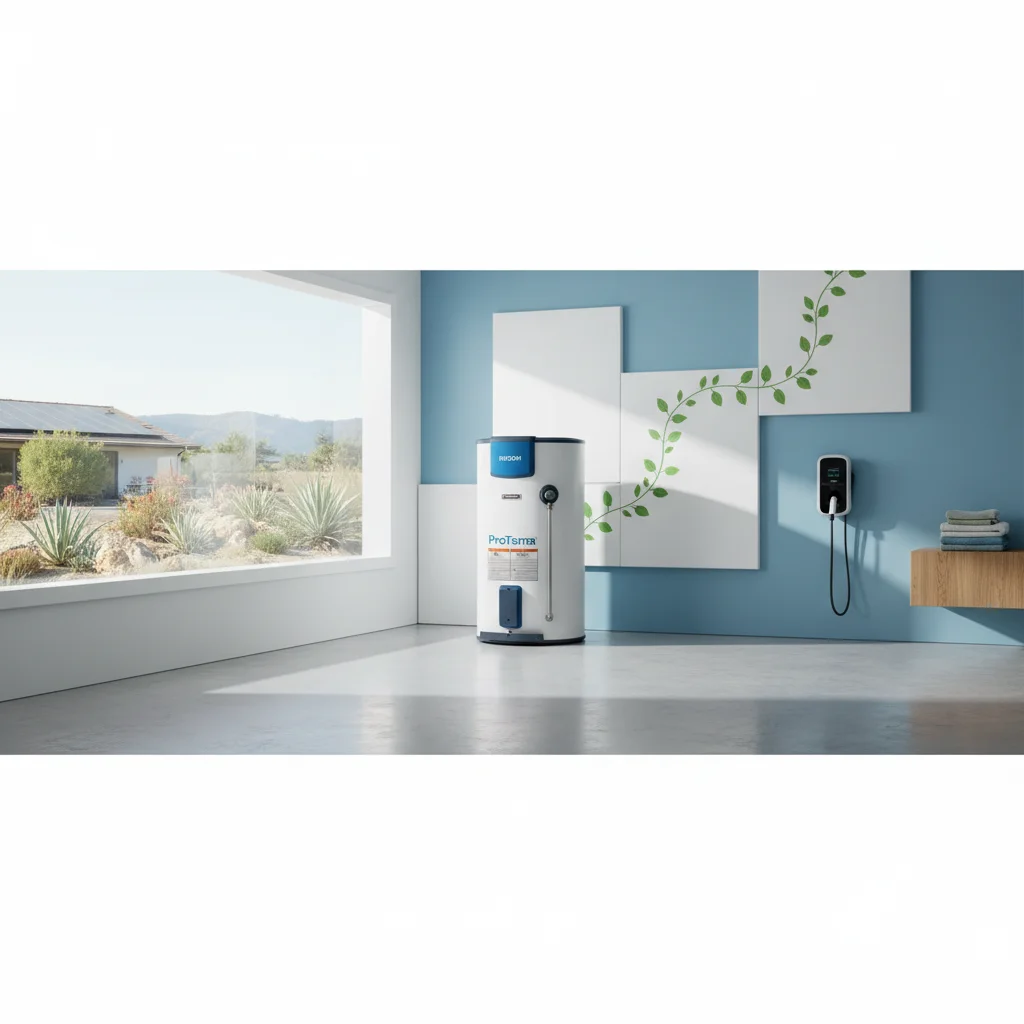
Editorial disclosure: DuloCore operates as an independent resource. Brand names appear for identification only. We do not receive paid compensation, commission, or affiliate revenue from any manufacturer mentioned in this article. Product recommendations reflect independent research against public specifications and energy-efficiency ratings. This disclosure is provided in accordance with FTC Endorsement Guides (16 CFR Part 255).
California homeowners replaced over 180,000 water heaters in 2025, and most left $1,200 to $4,000 in combined rebates unclaimed. Rheem-branded heat pump water heaters qualify for federal tax credits, state utility rebates, and local incentives that stack to cover 40-60% of installation costs. But funding windows close fast, and pre-approval requirements vary by utility district.
What Are the Current Rheem Water Heater Rebates Available in California?
Rheem heat pump water heaters qualify for the federal Residential Energy Efficiency Tax Credit (30% of costs up to $2,000), California utility rebates ranging from $800 to $3,000, and local air quality district incentives between $500 and $1,500 as of 2026.
The federal Energy Efficient Home Improvement Credit (Section 25C) ended for property placed in service after December 31, 2025 (IRS FS-2025-05). Federal tax credits for this work have ended, but state, local and utility rebates may still apply; check what is available at your address with the DuloCore rebate calculator. And the IRS allows homeowners to claim 30% of equipment and installation costs up to a $2,000 annual cap. Rheem's Prestige Hybrid and ProTerra models meet the Uniform Energy Factor (UEF) threshold of 2.0 or higher required for qualification.
California's three investor-owned utilities—Pacific Gas & Electric, Southern California Edison, and San Diego Gas & Electric—offer instant rebates between $800 and $3,000 depending on tank size and technology tier. So a 50-gallon heat pump unit installed in PG&E territory receives $1,800, while an 80-gallon model with grid connectivity qualifies for $3,000. Municipal utilities like Los Angeles Department of Water and Power and Sacramento Municipal Utility District run parallel programs with rebates from $1,000 to $2,500.
Bay Area and South Coast air quality management districts provide $500 to $1,500 for replacing natural gas water heaters with electric heat pump models. But these incentives require proof of gas appliance retirement and certified contractor installation.
"Heat pump water heaters use up to 63% less energy than standard electric resistance models and qualify for multiple stacked incentives." — U.S. Department of Energy
What Is the Deadline for Applying for Rheem Water Heater Rebates in California?
Federal tax credits have no application deadline beyond the December 31 tax year, utility rebates operate on rolling first-come funding until exhausted (typically July-October), and air district programs set quarterly application windows with specific close dates in March, June, September, and December 2026.
The IRS processes Residential Energy Efficiency credits on annual tax returns filed between January and April of the following year. So installations completed in 2026 appear on returns filed in early 2027. And amended returns can claim credits for the prior three tax years if original filings missed the deduction.
PG&E's Advanced Water Heating Program reopens funding quarterly but closed early in Q2 2025 after receiving 8,400 applications in 11 weeks. Southern California Edison maintains year-round availability but reduces rebate amounts by 30% once annual budget hits 75% utilization. San Diego Gas & Electric imposes a 45-day application window after installation with quarterly budget resets.
Municipal utilities set fiscal-year budgets that typically deplete between August and October. LADWP's 2026 allocation of $4.2 million funded 1,680 rebates before suspending new applications on September 12, 2025. SMUD maintains a waitlist system when funding pauses and processes applications in submission order when budgets renew.
Air district programs operate on strict quarterly cycles. Bay Area AQMD accepts applications during 30-day windows ending March 31, June 30, September 30, and December 31. South Coast AQMD runs 45-day periods with higher rebate amounts in Q1 and Q4 to incentivize off-peak installation scheduling.
How Do Rheem Rebates Stack With Other California Incentive Programs?
Federal tax credits, state utility rebates, and local air district incentives combine without reduction, allowing homeowners to claim $4,300 to $6,500 total for a single Rheem heat pump water heater installation valued at $3,500 to $6,000 in 2026.
California explicitly allows incentive stacking across jurisdictional levels. The federal 30% credit calculates from gross equipment and labor costs before state or local rebates apply. And utility rebates subtract from the final customer payment but don't reduce the federal tax basis. So a $5,000 installation minus $2,000 utility rebate still qualifies for a $1,500 federal credit (30% of $5,000).
Air quality district rebates require gas appliance retirement, creating a separate eligibility pathway that doesn't conflict with utility programs. Bay Area AQMD's $1,000 fuel-switching incentive combines with PG&E's $1,800 heat pump rebate and the $1,500 federal credit for $4,300 total on a $4,200 installed system—a net gain of $100.
But stacking rules prohibit combining utility rebates from multiple providers. Homeowners in territories served by both an investor-owned utility and a community choice aggregator must choose one program path. And low-income qualifications unlock higher rebate tiers that replace rather than stack with standard amounts.
Check your exact stacking potential with a rebate calculator that accounts for ZIP code, income level, and equipment specifications.
Which Utility Companies Offer Rheem Water Heater Rebates in California?
Pacific Gas & Electric ($800-$3,000), Southern California Edison ($1,200-$2,800), San Diego Gas & Electric ($1,000-$2,500), Sacramento Municipal Utility District ($1,500-$2,400), and Los Angeles Department of Water and Power ($1,000-$2,000) provide Rheem heat pump water heater rebates with amounts varying by tank capacity, efficiency tier, and grid connectivity features in 2026.
PG&E's tiered structure awards $800 for basic 50-gallon units, $1,800 for 50-gallon models with UEF ≥3.0, and $3,000 for 80-gallon grid-interactive units that enable utility demand response control. Southern California Edison offers $1,200 base rebates with $800 adders for ENERGY STAR Most Efficient designation and $800 more for CTA-2045 communication ports.
San Diego Gas & Electric separates programs by building type: $1,000-$1,500 for single-family homes and $2,000-$2,500 for multifamily properties with 5+ units. And the utility requires EnergySavvy platform pre-qualification that verifies equipment model numbers against approved product lists updated monthly.
Municipal utilities index rebates to customer rate class. SMUD's residential tier provides $1,500 for 50-gallon and $2,400 for 80-gallon units, while low-income Medical Equipment Baseline customers receive $3,000 flat regardless of tank size. LADWP's tiered structure starts at $1,000 and increases by $500 for each UEF point above 3.0.
Smaller municipal providers—Alameda Municipal Power, Azusa Light & Water, Burbank Water & Power, Glendale Water & Power, Pasadena Water & Power, and Riverside Public Utilities—run rebate programs between $500 and $1,800 with simpler single-tier structures and shorter processing times of 4-6 weeks versus 8-12 weeks for major utilities.
For comprehensive coverage of similar incentives, see our guide to heat pump rebates.
How Long Does It Take to Receive Your Rheem Rebate After Approval?
Federal tax credits appear as reduced tax liability or increased refunds within 21 days of IRS e-filing, utility rebates process in 6-12 weeks from application submission, and air district payments arrive 8-16 weeks after approval depending on quarterly disbursement cycles in 2026.
The IRS directly reduces tax owed or increases refund amounts when processing annual returns. Electronic filers receive refunds within 21 days, while paper filers wait 6-8 weeks. And the Residential Energy Efficiency credit applies before calculating remaining tax liability, maximizing cash-back potential for homeowners with modest tax bills.
PG&E processes instant rebates at point of sale through participating contractors, crediting customer accounts within 10 business days and paying contractors within 45 days. Applications submitted through the online portal require manual review and take 8-10 weeks from submission to check issuance. Southern California Edison's average timeline sits at 9 weeks, with 15% of applications requiring additional documentation that extends processing to 14 weeks.
San Diego Gas & Electric commits to 6-week processing for complete applications but reports actual median times of 11 weeks due to verification backlogs. SMUD offers the fastest municipal utility turnaround at 4-6 weeks, while LADWP averages 10-12 weeks with seasonal spikes to 16 weeks during peak application periods from July to September.
Air district rebates operate on quarterly payment batches. Bay Area AQMD approves applications within 30 days but disburses payments only in January, April, July, and October. So a February application approved in March waits until April for payment. South Coast AQMD processes continuously but still averages 12-14 weeks from submission to check deposit.
Do You Need Pre-Approval Before Installing a Rheem Water Heater for Rebates?
Federal tax credits require no pre-approval and apply retroactively to purchases made anytime during the tax year, Southern California Edison and San Diego Gas & Electric mandate pre-approval through online portals before installation begins, while PG&E, SMUD, and LADWP accept post-installation applications within 90-180 days of project completion in 2026.
The IRS allows homeowners to claim Residential Energy Efficiency credits for any qualifying equipment purchased between January 1 and December 31 of the tax year. And no registration, pre-qualification, or advance notification requirements exist. Form 5695 only covers qualifying work completed by December 31, 2025 and claimed on a 2025 return; the federal 25C and 25D credits ended after that date (IRS FS-2025-05).
Southern California Edison requires pre-approval through the Energy Upgrade California Home Upgrade platform. Contractors submit project details, equipment specifications, and customer information before installation. And the utility issues a reservation number valid for 120 days. Installations completed without pre-approval forfeit rebate eligibility with no retroactive exceptions.
San Diego Gas & Electric operates similarly through the EnergySavvy portal, requiring contractor account registration and project pre-qualification. The utility approves or denies applications within 5 business days based on equipment eligibility and customer account standing. But approved reservations extend for 180 days and allow one 90-day extension request.
PG&E's Advanced Water Heating Program accepts applications up to 90 days post-installation for instant rebates processed through contractors and up to 180 days for direct customer applications. SMUD allows 180-day retroactive filing with no pre-approval needed. LADWP requires application within 120 days of installation but doesn't mandate advance registration.
Air district programs universally require pre-approval with site inspections. Bay Area AQMD conducts pre-installation verification of existing gas water heater operation and post-installation confirmation of electric heat pump unit. South Coast AQMD accepts applications up to 30 days before installation but requires final inspection within 45 days of completion.
Learn more about federal incentive structures in our energy tax credits overview.
Official Sources
- U.S. Department of Energy - Energy Saver — Federal guidance on energy-efficient appliances, rebates, and tax credits for residential upgrades. (note: the federal 25C and 25D credits ended for projects completed after December 31, 2025)
- Database of State Incentives for Renewables & Efficiency — Comprehensive state and utility program directory with California rebate details and eligibility requirements.
- Internal Revenue Service - Energy Incentives for Individuals — Official federal tax credit rules, filing requirements, and qualifying equipment standards through 2032. (note: the federal 25C and 25D credits ended for projects completed after December 31, 2025)
Frequently Asked Questions
What rebates are available for Rheem water heaters in California?
Rheem heat pump water heaters qualify for federal tax credits up to $2,000 (30% of costs), California utility rebates from $800 to $3,000, and local air district incentives between $500 and $1,500 in 2026. And these programs stack without reduction, allowing total incentives of $4,300 to $6,500 for qualifying installations. Specific amounts vary by utility territory, equipment model, and income level.
How much can I save with a California water heater rebate?
Combined federal, state, and local incentives cover 40-60% of Rheem heat pump water heater installation costs in California during 2026. A typical $5,000 project receives $1,500 federal credit, $1,800 utility rebate, and $1,000 air district payment for $4,300 total—reducing net cost to $700. But exact savings depend on equipment tier, utility provider, and eligibility for low-income enhanced rebates that reach $8,000 in some jurisdictions.
Am I eligible for Rheem water heater rebates in California?
California homeowners installing Rheem heat pump water heaters with UEF ratings of 2.0 or higher qualify for federal tax credits if they owe income tax and for utility rebates if they're customers of participating providers. And renters qualify if they pay utility bills directly and obtain property owner consent. Low-income households earning below 80% area median income access enhanced rebate tiers 50-100% higher than standard amounts.
What is the process for claiming a water heater rebate in California?
Form 5695 only covers qualifying work completed by December 31, 2025 and claimed on a 2025 return; the federal 25C and 25D credits ended after that date (IRS FS-2025-05). Utility rebates need online applications through provider portals with contractor invoices, equipment specifications, and installation photos submitted within 90-180 days of completion. And air district programs mandate pre-approval applications, pre-installation inspections, and post-completion verifications before quarterly payment disbursement.
When do Rheem water heater rebates expire in California?
The federal Energy Efficient Home Improvement Credit (Section 25C) ended for property placed in service after December 31, 2025 (IRS FS-2025-05). Utility programs operate on annual fiscal budgets that typically deplete between July and October 2026 based on 2025 patterns. And air district incentives run quarterly application cycles with specific windows closing March 31, June 30, September 30, and December 31. So early application maximizes funding availability and reduces wait times.
Ready to see your total savings? Use our free rebate calculator to get instant estimates based on your ZIP code, income level, and equipment choice. Calculate your combined federal, utility, and local incentives in under 60 seconds.
Updated: April 14, 2026 — fact-checked by DuloCore Research. About our editorial process.
Check your California water heater rebate eligibility — see the programs you qualify for and the dollar amounts on our California water heater rebate finder.