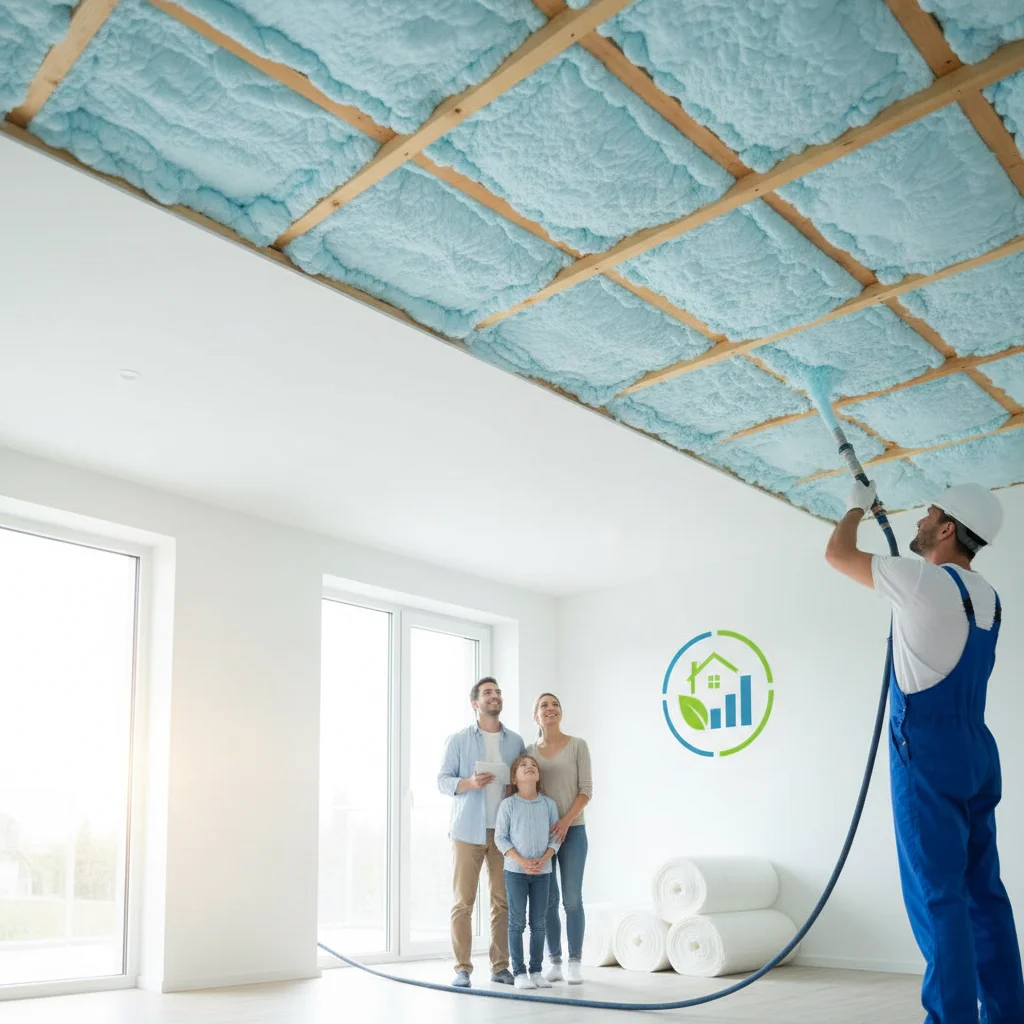
Homeowners leave $1.2 billion in insulation rebates unclaimed every year because they don't know the eligibility requirements or how to apply. The federal government and California utilities offer rebates ranging from $1,200 to $8,000 for attic, wall, and crawl space insulation upgrades in 2026. And these rebates stack with federal tax credits that cover 30% of installation costs through 2032. But the application windows close fast, and missing one piece of documentation disqualifies your entire claim.
What Are the Income Limits for Insulation Rebates in 2026?
Federal insulation rebates in 2026 use area median income (AMI) thresholds to determine eligibility and rebate amounts. Households earning up to 80% of AMI qualify for rebates covering 50% of project costs up to $1,600. Households earning 80-150% of AMI receive rebates covering 30% of costs up to $800. California utilities add supplemental rebates of $400-$1,200 for qualified participants regardless of federal income tiers.
Federal insulation rebates through the Inflation Reduction Act's Home Energy Rebates program target low- and moderate-income households. The 80% AMI threshold varies by county. In Los Angeles County, 80% AMI for a family of four equals $76,800 in 2026. In San Francisco County, the same household qualifies at $102,400. And in rural counties like Imperial, the threshold drops to $58,400.
So homeowners earning above 150% of AMI don't qualify for federal Home Energy Rebates. The federal Energy Efficient Home Improvement Credit (Section 25C) ended for property placed in service after December 31, 2025 (IRS FS-2025-05). Federal tax credits for this work have ended, but state, local and utility rebates may still apply; check what is available at your address with the DuloCore rebate calculator. No income limits apply to this tax credit. California utility programs like PG&E's Energy Savings Assistance Program serve households at or below 200% of federal poverty level, which equals $62,000 for a family of four in 2026.
"The Home Energy Rebates program prioritizes households spending more than 6% of gross income on energy costs, with enhanced rebates for those at or below 80% AMI." — U.S. Department of Energy
But income verification requirements differ by program. Federal rebates require tax returns from the most recent filing year. California utility rebates accept pay stubs, benefit award letters, or tax returns. And documentation must show total household income from all sources including wages, self-employment, Social Security, and investment income.
Which Types of Insulation Qualify for Rebates and Incentive Programs?
Attic insulation, wall insulation, and floor insulation qualify for federal rebates when they meet or exceed Energy Star installation standards. The insulation must achieve minimum R-values of R-49 for attics, R-13 for walls, and R-19 for floors in California climate zones. Air sealing work performed alongside insulation upgrades adds $200-$600 to total rebate amounts. Spray foam, blown-in fiberglass, and batt insulation all qualify if installed by certified contractors.
Federal rebates cover insulation materials and installation labor costs. So homeowners can't claim rebates for DIY insulation projects. The contractor must hold active licensing in California and provide documentation of Energy Star partnership certification. And the insulation must be installed in primary residences, not rental properties or vacation homes.
Specific insulation types yield different thermal performance and costs. Spray foam insulation delivers R-6.5 per inch and creates an air barrier, costing $1.50-$3.00 per square foot installed. Blown-in fiberglass provides R-2.5 per inch at $0.80-$1.50 per square foot. Rigid foam boards offer R-5 per inch for $1.00-$2.00 per square foot. But all types qualify equally for rebates if they achieve the required R-value for the application.
California building code requires minimum insulation levels for all new construction and major renovations. So rebates apply only to insulation exceeding code minimums. In Climate Zone 3 (coastal areas), code requires R-38 attic insulation. Upgrading to R-49 qualifies for rebates. In Climate Zone 13 (inland valleys), code requires R-30. Upgrading to R-49 yields larger energy savings and higher rebate eligibility.
Air sealing and weatherization work must accompany insulation upgrades to qualify for maximum rebate amounts. Programs require blower door testing before and after installation to verify air leakage reduction of at least 15%. And contractors must seal ductwork in unconditioned spaces when adding attic insulation to prevent conditioned air loss.
What Documentation Do You Need to Prove Eligibility for an Insulation Rebate?
Applicants must submit contractor invoices showing itemized costs, Energy Star certification proof, blower door test results, and income verification documents to claim insulation rebates. Federal programs require completed IRS Form 1040 from the previous tax year. California utility programs accept last two pay stubs or benefit award letters. Missing any required document causes automatic application denial regardless of project completion quality.
The contractor invoice must break down material costs separately from labor costs. So lump-sum bids don't satisfy documentation requirements. The invoice must list R-values achieved in each insulation location and total square footage covered. And it must include the contractor's license number, Energy Star partnership ID, and installation completion date.
Blower door test reports document air leakage rates before and after insulation work. The pre-installation test establishes baseline air changes per hour (ACH). The post-installation test proves the upgrade reduced ACH by at least 15%. Testing must be performed by certified Building Performance Institute (BPI) or Residential Energy Services Network (RESNET) professionals using calibrated equipment.
Income verification documents vary by household composition and income sources. W-2 employees submit two consecutive pay stubs showing year-to-date earnings. Self-employed applicants provide Schedule C from the most recent tax return. Retirees submit Social Security benefit statements and any pension or IRA distribution records. And households receiving government benefits provide current award letters showing monthly benefit amounts.
Photo documentation of completed work strengthens applications but isn't universally required. Programs request before and after photos of insulation installation, especially in attics and crawl spaces. Photos must show R-value measurement at multiple locations and proper coverage without gaps or compression.
What Are the Deadline Dates for Applying to Insulation Rebate Programs?
California's Home Energy Rebates program accepts applications through December 31, 2030, or until program funds are exhausted. PG&E's Energy Savings Assistance program operates year-round with rolling enrollment and 45-day application windows after project completion. The federal Energy Efficient Home Improvement Credit (Section 25C) ended for property placed in service after December 31, 2025 (IRS FS-2025-05).
Program funding operates on a first-come, first-served basis. So early applicants in each program year receive priority processing. California allocated $176 million for Home Energy Rebates in 2026. At current application rates of $8.2 million monthly, funding could be exhausted by August 2027. And once funds are depleted, the program closes regardless of the official end date.
Application deadlines differ from installation deadlines. The federal Energy Efficient Home Improvement Credit (Section 25C) ended for property placed in service after December 31, 2025 (IRS FS-2025-05). But taxpayers can file amended returns within three years to claim missed credits. So an insulation upgrade completed in March 2026 can be claimed on tax returns filed in April 2027, and the credit can be added to amended returns through April 2030.
Utility rebate programs impose stricter deadlines. Applications must be submitted within 90 days of project completion for most California utilities. SoCalGas requires submission within 60 days. And late applications receive automatic denial with no appeal process. Contractors often submit applications on behalf of homeowners to ensure deadline compliance.
Seasonal installation timing affects rebate availability. Insulation contractors operate at peak capacity during spring and fall months. Summer and winter installations often qualify for contractor discounts of 10-20%. But rebate funds deplete faster during high-volume seasons, creating a trade-off between lower installation costs and rebate availability.
How Much Can You Save With Insulation Rebates and Tax Credits?
The average California homeowner receives $3,200 in combined rebates and tax credits for a comprehensive attic and wall insulation upgrade costing $6,500. Federal Home Energy Rebates provide $1,600 for households under 80% AMI or $800 for households at 80-150% AMI. The federal Energy Efficient Home Improvement Credit (Section 25C) ended for property placed in service after December 31, 2025 (IRS FS-2025-05). California utility rebates contribute $400-$800 depending on provider and climate zone.
A typical 1,500-square-foot home insulation project breaks down as follows: Attic insulation upgrade from R-19 to R-49 costs $2,100 for materials and labor. Wall insulation adding R-13 to uninsulated walls costs $3,200. Air sealing and duct sealing add $1,200. Total project cost reaches $6,500 before rebates.
For a household at 75% AMI, federal rebates cover 50% of costs up to $1,600, yielding the maximum $1,600 rebate. Remaining costs of $4,900 qualify for the 30% tax credit (this federal credit ended for property placed in service after December 31, 2025), providing $1,200 (the annual maximum). PG&E adds a $600 rebate for the air sealing component. Total rebates and credits equal $3,400, reducing net cost to $3,100 and creating a 52% discount.
So annual energy savings from this upgrade average $780 in California's Central Valley climate zone. The 4-year payback period makes insulation one of the fastest-ROI home energy improvements. And heating and cooling energy use drops by 25-30% after proper insulation and air sealing.
But savings vary significantly by climate zone and existing insulation levels. Homes with zero attic insulation see energy cost reductions of 40-50% after upgrading to R-49. Homes upgrading from R-19 to R-49 see smaller reductions of 15-20%. Coastal climate zones with mild temperatures see annual savings of $300-$500. Inland valley and mountain zones see savings of $800-$1,200 annually.
Stacking federal rebates with utility incentives requires careful program coordination. Some utility programs prohibit combining their rebates with federal Home Energy Rebates. Others allow stacking but reduce their rebate amounts proportionally. And contractors must document all incentive sources on invoices to prevent duplicate claims.
What's the Step-by-Step Process to Claim Your Insulation Rebate?
Homeowners must complete a home energy audit, obtain contractor quotes, apply for rebate pre-approval, complete installation with a certified contractor, submit documentation within 90 days, and wait 6-8 weeks for rebate payment. Federal programs require pre-approval before work begins. California utility programs accept post-installation applications but prioritize pre-approved projects when funds run low.
Step 1: Schedule a home energy audit through your utility provider or a certified BPI auditor. The audit costs $100-$300 but is often free for households under 200% of federal poverty level. Auditors identify insulation gaps, recommend R-value upgrades, and estimate energy savings. And they provide written reports required for rebate applications.
Step 2: Obtain quotes from at least three licensed contractors holding Energy Star partnership certification. Quotes must itemize insulation type, R-values, square footage, labor costs, and total project price. Contractors should identify all applicable rebate programs and assist with application preparation. And they must provide proof of liability insurance and workers' compensation coverage.
Step 3: Submit rebate pre-approval applications through program websites or contractor portals. Federal applications require uploading income documentation, audit reports, and contractor quotes. Pre-approval responses arrive within 2-3 weeks. And approved amounts are reserved from program budgets for 120 days.
Step 4: Complete installation with the approved contractor during the reservation period. Contractors must perform blower door testing before and after work. They must install insulation meeting or exceeding specified R-values. And they must provide itemized invoices, product specification sheets, and installation photos.
Step 5: Submit final documentation within 90 days of installation completion. Upload contractor invoices, blower door test reports, installation photos, and any additional program-specific forms. Form 5695 only covers qualifying work completed by December 31, 2025 and claimed on a 2025 return; the federal 25C and 25D credits ended after that date (IRS FS-2025-05). And utility rebates require online portal submissions with PDF documentation.
Step 6: Track application status through program portals. Processing times average 6-8 weeks for utility rebates and 10-12 weeks for federal rebates. Rebates arrive as checks mailed to the property address or direct deposits to designated bank accounts. And incomplete applications receive deficiency notices requiring corrections within 30 days.
Use our free rebate calculator to estimate your total savings from all available insulation rebates and tax credits based on your income, location, and project scope.
Official Sources
- U.S. Department of Energy - Save Energy, Save Money — Federal guidance on home energy rebates, tax credits, and efficiency programs (note: the federal 25C and 25D credits ended for projects completed after December 31, 2025)
- DSIRE - Database of State Incentives for Renewables & Efficiency — Comprehensive database of state and utility rebate programs
Related Reading: Learn more about Best Insulation Types For Rebate Eligibility and Doe Insulation Rebate Programs.
Frequently Asked Questions
What Insulation Types Qualify for Rebates?
Attic insulation, wall insulation, floor insulation, and basement insulation all qualify for federal and California rebates when they meet Energy Star installation standards. Spray foam, blown-in fiberglass, blown-in cellulose, batt insulation, and rigid foam boards qualify equally if installed by certified contractors achieving required R-values. Air sealing performed alongside insulation adds $200-$600 to rebate amounts. But DIY installations don't qualify for any rebate programs.
How Much Money Can You Get From Insulation Rebates?
Federal Home Energy Rebates provide $800-$1,600 depending on household income. The federal Energy Efficient Home Improvement Credit (Section 25C) ended for property placed in service after December 31, 2025 (IRS FS-2025-05). California utility rebates contribute $400-$1,200 based on provider and project scope. And total combined rebates and credits range from $2,000-$4,000 for comprehensive whole-home insulation upgrades costing $6,000-$8,000. Households under 80% AMI receive the highest rebate percentages.
Do You Need a Contractor to Install Insulation for Rebates?
All federal and California utility rebate programs require installation by licensed contractors holding Energy Star partnership certification. DIY insulation projects don't qualify for any rebates. Contractors must provide itemized invoices, perform blower door testing, and guarantee installation quality. And they must carry liability insurance and workers' compensation coverage. Homeowners can't claim rebates by hiring unlicensed handymen or performing work themselves.
What Is the Deadline to Apply for Insulation Rebates?
Federal Home Energy Rebates accept applications through December 31, 2030, or until funds are exhausted. California utility rebates require submission within 60-90 days after installation completion depending on provider. Federal tax credits require filing by April 15 following the installation year. And late applications receive automatic denial with no extensions or appeals. Contractors typically submit applications immediately after project completion to ensure deadline compliance.
Are Insulation Rebates the Same in Every State?
Insulation rebates vary significantly by state, utility territory, and climate zone. California offers some of the nation's highest rebate amounts at $1,200-$3,200 for comprehensive projects. Texas rebates range from $200-$600. And Florida provides minimal rebates of $100-$300. Federal programs operate nationwide but prioritize low-income households in high energy cost areas. State tax credits exist in 23 states including California, Oregon, and New York with varying credit amounts and eligibility rules.
Ready to claim your insulation rebates? Use our rebate calculator to find every available incentive for your home, income level, and project scope. Get your personalized rebate estimate in under 60 seconds and download a complete application checklist for your area.
Last updated April 14, 2026 — reviewed by DuloCore Editorial. About our authors.
Check your California insulation rebate eligibility — see the programs you qualify for and the dollar amounts on our California insulation rebate finder.