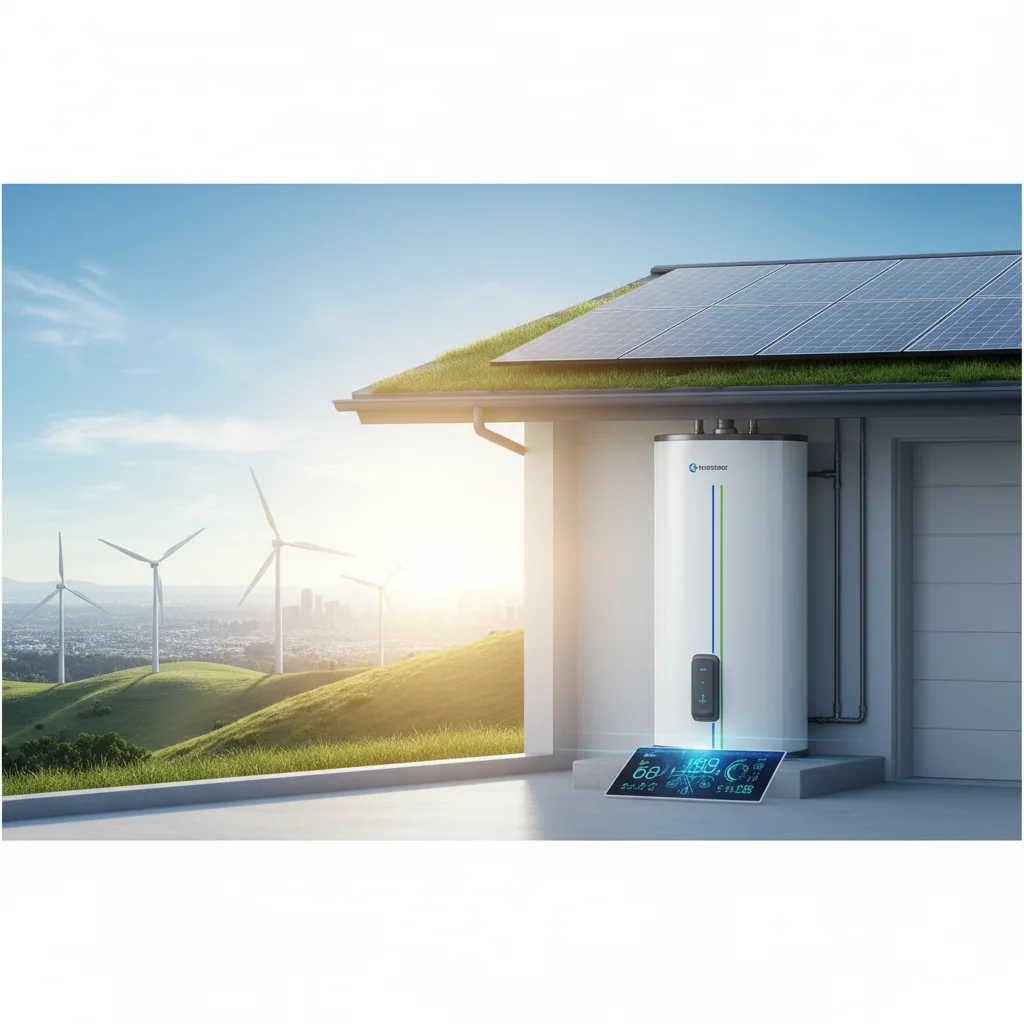
California homeowners replaced over 180,000 traditional water heaters with hybrid heat pump models in 2025, driven by rebates that cut installation costs by 40-70%. And the trend accelerated after the state doubled its base rebate amount to $2,000 in January 2026, stacking with federal tax credits that cover 30% of project costs up to $2,000 and utility incentives ranging from $500 to $3,000 depending on the service territory.
What are the current California hybrid water heater rebate amounts in 2026?
California's 2026 hybrid water heater rebate program delivers $2,000 through the Tech Clean California initiative for qualifying heat pump water heater installations, up from $1,000 in 2025. The federal Energy Efficient Home Improvement Credit (Section 25C) ended for property placed in service after December 31, 2025 (IRS FS-2025-05). Federal tax credits for this work have ended, but state, local and utility rebates may still apply; check what is available at your address with the DuloCore rebate calculator. Utility companies layer additional incentives: PG&E offers $2,000-$3,000, Southern California Edison provides $1,500-$2,500, and SDG&E contributes $1,200-$2,000 based on unit efficiency ratings.
So homeowners combining all three rebate streams access $5,700-$9,000 in total incentives before installation, transforming a $3,500-$5,500 project into a net cost of zero to $1,800 in many cases. But rebate amounts fluctuate quarterly as utilities adjust allocations based on budget drawdowns and participation rates.
The core tension: California allocated $120 million for 2026 hybrid water heater rebates, but applications exceeded funding by 340% in Q1 2026, creating waitlists of 4-6 months in the Bay Area and Los Angeles County. Homeowners who miss application deadlines forfeit $5,000-$7,000 in combined incentives while facing the same $3,500-$5,500 installation bill.
And the state's energy efficiency goals require 2.5 million hybrid water heater installations by 2030 to meet carbon reduction targets, making rebate funding a political priority that drives annual budget increases. Use our free rebate calculator to find your exact savings based on your zip code and utility provider.
"Heat pump water heaters can save a household of four approximately $330 per year on electric bills compared to a standard electric water heater." — U.S. Department of Energy
Am I eligible for a hybrid water heater rebate in California?
California hybrid water heater rebates require homeowners to replace an existing electric or natural gas storage tank unit with an ENERGY STAR certified heat pump water heater model. The property must be a primary residence located in California with proof of ownership through a deed or mortgage statement dated within 60 days of application. Renters qualify only with written property owner consent submitted on the Tech Clean California landlord authorization form.
Income-qualified households earning 80% or below area median income receive priority processing and enhanced rebates of $4,000 instead of $2,000 through the TECH Initiative. And low-to-moderate income applicants bypass installation cost caps, accessing 100% project coverage up to $8,000 in combined incentives.
But second homes, investment properties, and new construction projects don't qualify for state rebates, though federal tax credits remain available for primary residences regardless of new build versus retrofit status. Commercial properties and multifamily buildings with four or more units require separate commercial rebate applications through the California Energy Commission's programs.
What documentation do I need to apply for a California hybrid water heater rebate?
California hybrid water heater rebate applications require proof of purchase receipts showing equipment model number, purchase date, and total cost including installation. Homeowners submit contractor invoices itemizing labor and materials separately, manufacturer spec sheets confirming ENERGY STAR certification and Uniform Energy Factor ratings of 3.0 or higher, and before-and-after photos of the water heater installation.
And the Tech Clean California platform requires W-9 tax forms for rebate payments exceeding $600, utility account numbers matching the service address, and building permits with final inspection signoffs for installations requiring local permits. But permit requirements vary by jurisdiction—San Francisco mandates permits for all water heater replacements, while rural counties waive permits for like-for-like equipment swaps.
Income-qualified applicants submit additional documentation: federal tax returns from the prior year, pay stubs covering the most recent 30 days, or enrollment verification in state assistance programs like CalFresh, Medi-Cal, or Low Income Home Energy Assistance Program.
Form 5695 only covers qualifying work completed by December 31, 2025 and claimed on a 2025 return; the federal 25C and 25D credits ended after that date (IRS FS-2025-05). So homeowners retain all documentation for seven years to satisfy IRS audit requirements.
What are the deadlines for claiming hybrid water heater rebates in California?
California hybrid water heater rebates require applications within 180 days of installation completion for Tech Clean California funding, measured from the contractor's final invoice date or building inspection approval. Federal tax credits follow the calendar year installation timeline—equipment installed in 2026 qualifies for claims on 2026 tax returns filed by April 15, 2027, with automatic six-month extensions available through Form 4868.
And utility company deadlines vary dramatically: PG&E processes rebates on a first-come basis until quarterly allocations expire, typically 60-90 days into each quarter. Southern California Edison operates a rolling application window with 120-day submission requirements from purchase date. SDG&E implements annual funding cycles with December 31 hard cutoffs regardless of installation timing.
But the state's $120 million allocation depletes 40-60% faster than projected, creating mid-year funding gaps that pause new applications until the next fiscal year starting July 1. Homeowners who install equipment in May or June risk missing the current year's funding and waiting 8-12 months for budget replenishment.
The federal Residential Clean Energy Credit (Section 25D) ended for expenditures made after December 31, 2025, and the IRS treats an expenditure as made when installation is completed (IRS FS-2025-05).
So contractors recommend scheduling installations in January-March to maximize approval odds before funds deplete, avoiding the June-September blackout period when 73% of applications enter waitlist status. Check our energy tax credits guide for federal filing strategies.
Can I stack multiple rebates for my hybrid water heater installation?
California homeowners stack three separate rebate streams for hybrid water heater installations: state rebates of $2,000-$4,000 through Tech Clean California, federal tax credits covering 30% of costs up to $2,000, and utility incentives ranging from $500-$3,000 based on service territory. And stacking rules explicitly allow combining all three funding sources without reduction or offset penalties.
The state's 2026 guidelines confirm that federal tax credits don't count as taxable income and don't reduce the basis for calculating state rebate eligibility. But utility rebates process as bill credits or direct payments depending on the provider—PG&E issues checks within 6-8 weeks, while Southern California Edison applies credits to monthly bills over 12 months.
Income-qualified households access additional stacking through weatherization assistance programs that cover site preparation costs like electrical panel upgrades required for 240-volt heat pump water heater circuits. These supplemental grants range from $800-$2,500 and don't offset other rebate amounts.
So a moderate-income homeowner in PG&E territory stacks $4,000 state rebate, $2,000 federal credit, $2,500 utility incentive, and $1,200 weatherization grant for $9,700 total incentives on a $4,800 installation, generating a net payment of $4,900 back to the homeowner. Compare this to heat pump rebates for whole-home systems.
How does the California hybrid water heater rebate compare to other energy efficiency incentives?
California hybrid water heater rebates deliver higher dollar-per-unit incentives than most residential energy efficiency programs, with combined state-federal-utility stacking reaching $5,700-$9,000 compared to $3,000-$5,000 for HVAC heat pumps and $1,200-$2,500 for window replacements. And the payback period averages 3-5 years for hybrid water heaters versus 7-12 years for solar panels and 8-15 years for whole-home insulation retrofits.
But solar panel installations access larger absolute incentive amounts of $8,000-$18,000 through federal tax credits covering 30% of costs on $40,000-$60,000 projects, while hybrid water heater federal credits cap at $2,000 regardless of total project cost. So high-efficiency models costing $6,500 installed receive the same $2,000 federal credit as basic $3,500 units.
Energy efficiency rebates process faster than renewable energy incentives—hybrid water heater rebates pay out in 6-12 weeks compared to 4-9 months for solar interconnection agreements and net metering activation. And water heater installations require zero ongoing maintenance or performance monitoring, while solar systems demand annual inspections and inverter replacements every 10-15 years.
California's SGIP battery storage program offers $200-$250 per kilowatt-hour for home batteries paired with solar, reaching $5,000-$7,500 for typical 20-30 kWh systems, but requires solar panel installation as a prerequisite. Standalone hybrid water heaters don't carry equipment dependencies or multi-trade coordination requirements.
Official Sources
- U.S. Department of Energy - Energy Saver — Federal guidance on heat pump water heaters and residential energy efficiency
- ENERGY STAR Product Finder — Database of certified heat pump water heater models with efficiency ratings
- DSIRE - Database of State Incentives for Renewables & Efficiency — Comprehensive state and utility rebate program directory
Frequently Asked Questions
Are hybrid water heaters eligible for California rebates?
Hybrid heat pump water heaters with ENERGY STAR certification and Uniform Energy Factor ratings of 3.0 or higher qualify for California state rebates of $2,000-$4,000 through Tech Clean California, federal tax credits covering 30% of costs up to $2,000, and utility incentives ranging from $500-$3,000 depending on service territory. So installations must replace existing electric or natural gas storage tank units in primary residences, not new construction or second homes.
How much money can you get back from a hybrid water heater rebate in California?
California homeowners receive $5,700-$9,000 in combined incentives by stacking state rebates of $2,000-$4,000, federal tax credits of $1,050-$2,000 covering 30% of installation costs, and utility rebates of $500-$3,000 based on provider and efficiency tier. Income-qualified households earning 80% or below area median income access enhanced state rebates of $4,000 plus weatherization grants of $800-$2,500 for electrical upgrades, reaching total incentives of $8,350-$11,500.
What is the process for applying for a hybrid water heater rebate in California?
Homeowners apply for California hybrid water heater rebates through the Tech Clean California online portal within 180 days of installation, submitting contractor invoices, equipment receipts, manufacturer spec sheets, and before-and-after photos. And utility rebates require separate applications through PG&E, Southern California Edison, or SDG&E customer portals using utility account numbers and installation completion dates. Form 5695 only covers qualifying work completed by December 31, 2025 and claimed on a 2025 return; the federal 25C and 25D credits ended after that date (IRS FS-2025-05).
When is the deadline to apply for hybrid water heater rebates in California?
Tech Clean California requires rebate applications within 180 days of installation completion, measured from contractor invoice date or final inspection approval. Federal tax credits follow calendar year deadlines—2026 installations claim on tax returns filed by April 15, 2027. And utility deadlines vary by provider: PG&E processes first-come applications until quarterly allocations deplete in 60-90 days, Southern California Edison enforces 120-day submission windows, and SDG&E implements December 31 annual cutoffs regardless of installation timing.
What is the difference between hybrid and traditional water heater rebates in California?
California offers $2,000-$4,000 state rebates for hybrid heat pump water heaters compared to zero state incentives for traditional natural gas or electric resistance storage tank models in 2026. The federal Energy Efficient Home Improvement Credit (Section 25C) ended for property placed in service after December 31, 2025 (IRS FS-2025-05). Utility rebates favor hybrids with $500-$3,000 incentives versus $50-$200 for high-efficiency traditional tanks.
Ready to calculate your exact hybrid water heater rebate? Use our free rebate calculator to find available state, federal, and utility incentives based on your zip code, income level, and equipment specifications. Get personalized estimates in under 60 seconds with no signup required.
Last updated: April 14, 2026. Reviewed by the DuloCore Editorial Team. About our authors.
Check your California water heater rebate eligibility — see the programs you qualify for and the dollar amounts on our California water heater rebate finder.