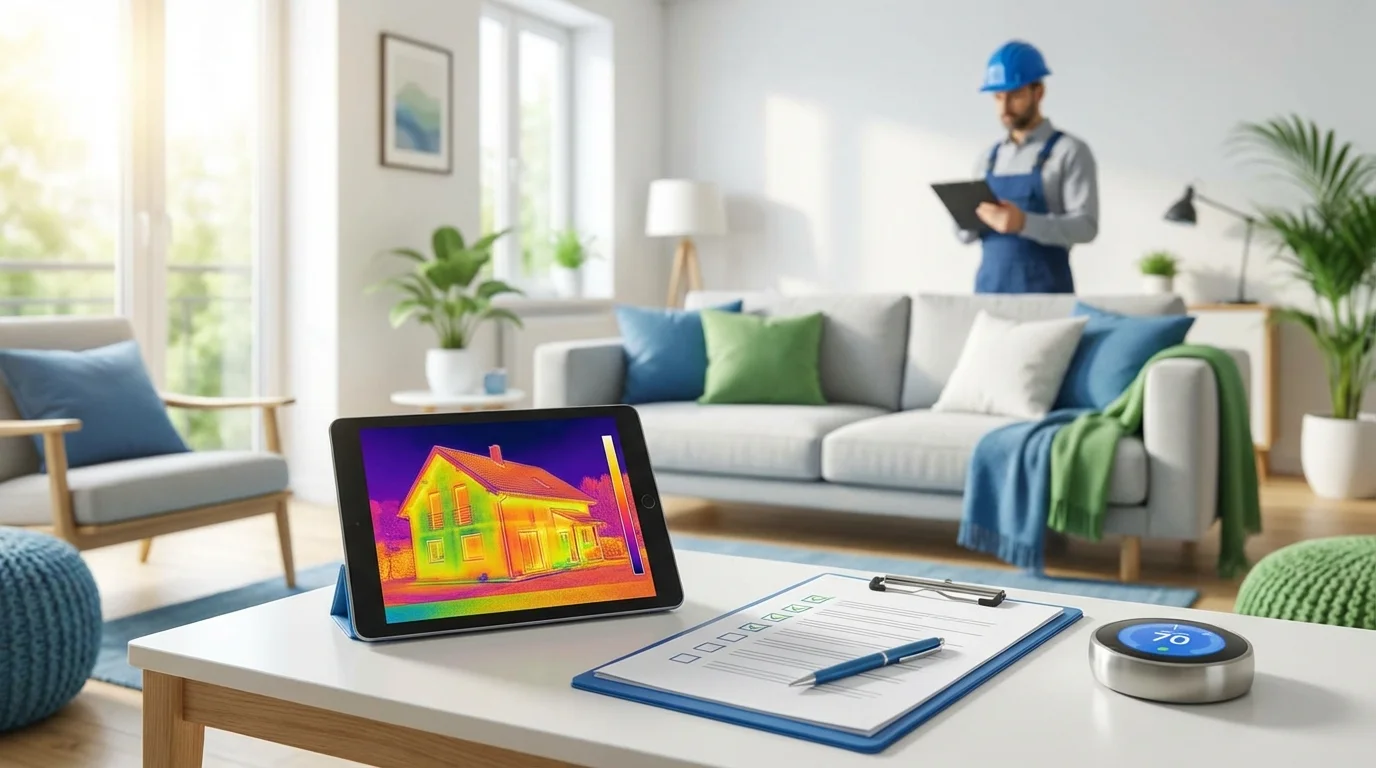
Heating and cooling account for nearly 50% of the average U.S. household's energy bill, a cost that often hides correctable inefficiencies. So ignoring the performance of your HVAC system is like leaving a window open all winter. But a professional energy audit identifies exactly where that money is leaking out, pinpointing issues from duct leaks to improper refrigerant levels that inflate utility costs by up to 30% annually. This checklist breaks down what to expect from an audit and how to turn its findings into thousands of dollars in savings through targeted upgrades and rebates.
What is the Typical Cost of an HVAC Energy Audit and What Does it Include?
A professional HVAC energy audit is a diagnostic service that costs between $250 and $650 in 2026. This assessment includes a blower door test to measure air leakage, duct blaster tests to identify leaks, and a thermographic scan to find insulation gaps, providing a comprehensive report on system efficiency.
An HVAC-specific energy audit goes far beyond a simple tune-up. So the auditor performs a series of diagnostic tests to quantify energy loss and system performance. And these include a static pressure test to check airflow, a combustion analysis for gas furnaces, and a refrigerant charge check for air conditioners and heat pumps. The final report details equipment efficiency ratings (SEER2, HSPF2, AFUE), identifies leaks that can account for 20-30% of energy loss, and recommends specific repairs or upgrades. But the cost varies based on home size and the complexity of the HVAC system. Many utility companies offer discounted or even free audits as part of their energy conservation programs, a crucial first step before claiming rebates for new equipment. A complete home energy audit provides an even broader view of your home's performance. The goal is to create a data-driven plan for improvements.
How Can I Identify Rebate-Eligible HVAC Upgrades, Brands, and Efficiency Ratings?
Rebate-eligible HVAC upgrades are identified by their ENERGY STAR certification and specific efficiency ratings like SEER2, EER2, and HSPF2. Brands such as Mitsubishi, Bosch, and Carrier frequently offer qualifying high-efficiency models for 2026 federal and state incentive programs, which require meeting minimum performance tiers.
To qualify for 2026 rebates, HVAC equipment must meet stringent efficiency standards set by federal and state programs. For air conditioners, this means a SEER2 (Seasonal Energy Efficiency Ratio 2) rating of 16.0 or higher. And for heat pumps, the requirement is often a HSPF2 (Heating Seasonal Performance Factor 2) of 9.0 or more. Brands like Trane, Lennox, and Daikin consistently manufacture models that meet these tiers. Homeowners can find specific qualifying model numbers on the ENERGY STAR website or through state energy office databases.
"ENERGY STAR certified central air conditioners are, on average, 14% more efficient than standard models." — ENERGY STAR
So after an audit, the report will recommend units that meet these specs. And you can use our free rebate calculator to see which local and federal incentives apply to specific models, often saving up to $8,000 on installation.
What are the Installation Costs and ROI Payback Periods for Recommended HVAC Improvements?
High-efficiency HVAC installation costs range from $8,000 for a central air conditioner to over $25,000 for a geothermal system in 2026. The return on investment (ROI) payback period for these improvements is typically 5 to 10 years, accelerated by federal tax credits and local rebates.
The upfront cost of an energy-efficient HVAC system is higher than a standard unit. But the long-term savings create a clear payback timeline. For example, installing a $12,000 high-efficiency heat pump that qualifies for a $2,000 federal tax credit and $1,500 in utility rebates brings the net cost to $8,500. So if this new system saves the homeowner $100 per month ($1,200 annually) on energy bills, the payback period is just over 7 years. Geothermal systems, while costing $25,000+, benefit from a 30% federal credit (this federal credit ended for expenditures made after December 31, 2025) under the IRA, drastically shortening their 10-15 year ROI. An audit provides precise savings projections based on your home's specific energy loss profile, clarifying the financial case for the investment in available energy tax credits. And these calculations are essential for making an informed decision.
Which Energy-Efficient HVAC Alternatives are Best for My Climate Zone and How Do They Compare?
The best energy-efficient HVAC alternative depends on your climate zone, with cold-climate heat pumps (HSPF2 > 9.5) excelling in the North and high-efficiency AC units (SEER2 > 16) suiting the South. Geothermal systems offer the highest efficiency (400-600%) and are effective in all climates for 2026.
Choosing the right HVAC system is climate-dependent. In colder regions (Zones 5-7), cold-climate air-source heat pumps are now highly effective, maintaining efficiency down to 5°F or lower. But they offer both heating and cooling in one unit, making them ideal for replacing traditional furnaces and central air conditioners. In warmer, humid climates (Zones 1-4), a variable-speed air conditioner with a high SEER2 rating paired with a dehumidifier is often the most cost-effective solution. Geothermal heat pumps represent the top tier of efficiency in any zone. And they use the stable temperature of the earth to transfer heat, reducing energy consumption by up to 70% compared to standard systems. The audit report will model the annual operating costs for each suitable option. Many homeowners are now exploring heat pump rebates to offset the installation cost.
| Program / System | 2026 Federal Tax Credit (IRA) | Typical Utility Rebate | Climate Zone Suitability |
|---|---|---|---|
| Air-Source Heat Pump | 30% of cost, up to $2,000 | $500 - $2,500 | All Zones (Cold-Climate models for North) |
| Geothermal Heat Pump | 30% of cost, no cap | $2,000 - $10,000 | All Zones |
| High-Efficiency AC | $600 | $100 - $500 | Best for Hot/Mixed-Humid Zones |
What Lifespan and Maintenance Requirements Can I Expect from Energy-Saving HVAC Systems?
Modern energy-saving HVAC systems, like heat pumps and high-efficiency furnaces, have an expected lifespan of 15 to 20 years. Annual professional maintenance, costing $100-$300, is required to preserve efficiency, validate warranties, and prevent premature failure, ensuring the system reaches its full operational life.
High-efficiency HVAC systems are built to last, but their longevity depends on proper maintenance. So homeowners must commit to an annual service plan. And this service includes cleaning coils, checking refrigerant levels, testing electrical connections, and lubricating motors. Forgetting this yearly check-up can reduce a system's efficiency by 5-15% and often voids the manufacturer's 10-year parts warranty.
"A well-maintained heating and cooling system can last for 15 years or more, but a neglected system can fail in 10 years or less." — U.S. Department of Energy
Additionally, homeowners should change air filters every 30-90 days, depending on the filter type and household conditions like pets or smoking. This simple task prevents airflow restriction, which is a primary cause of system strain and failure. But proper care ensures the unit delivers its promised energy savings for its entire 15-20 year lifespan.
Official Sources
- ENERGY STAR — A U.S. Environmental Protection Agency program providing credible, objective information on energy-efficient products and practices.
- DSIRE (Database of State Incentives for Renewables & Efficiency) — The most comprehensive source of information on incentives and policies that support renewables and energy efficiency in the United States.
- IRS Energy Credits for Individuals — Official guidance from the Internal Revenue Service on federal tax credits available for home energy improvements. (note: the federal 25C and 25D credits ended for projects completed after December 31, 2025)
Related Reading: Learn more about Humidity Control Energy Audit and Hvac Maintenance Energy Savings.
Related Reading: Learn more about Boiler Energy Audit Inspection and Building Envelope Energy Audit.
Related Reading: Learn more about Building Envelope Energy Audit and Building Science Energy Audit.
Frequently Asked Questions
What does an HVAC energy audit checklist typically cover?
An HVAC energy audit checklist covers a comprehensive inspection of the entire heating and cooling system. So this includes checking the thermostat's calibration, inspecting ductwork for leaks (which can waste up to 30% of conditioned air), testing airflow, and measuring the efficiency of the furnace, air conditioner, or heat pump. And it also involves a combustion safety test for gas appliances and a refrigerant level check to ensure optimal performance. The final report provides a prioritized list of recommended actions.
How long does an HVAC energy audit usually take to complete?
A comprehensive HVAC energy audit typically takes between 2 to 4 hours to complete for an average-sized single-family home (around 2,000 square feet). The duration depends on the complexity of the system, the size of the house, and the accessibility of the ductwork and equipment. So homes with multiple systems or extensive, hard-to-reach ducts will be on the longer end of that 4-hour estimate.
What is the average cost of an HVAC energy audit?
The average cost of a professional HVAC energy audit in 2026 ranges from $250 to $650. The price varies based on the location, the size of the home, and the level of detail involved in the testing. But some utility companies offer subsidized audits for as little as $100 or even provide them for free to encourage energy efficiency, so it's always worth checking with your local provider first.
What should I do to prepare for an HVAC energy audit?
To prepare for an HVAC energy audit, ensure the technician has clear access to the furnace, air handler, condenser unit, and any attic or crawlspace areas containing ductwork. And collect your last 12 months of utility bills, as this data helps the auditor benchmark your home's energy consumption. Finally, make a list of any known issues, such as rooms that are difficult to heat or cool or unusual noises from the system.
What are the potential savings from addressing issues found in an HVAC energy audit?
Addressing issues found in an HVAC energy audit can lead to energy savings of 20% to 40% on heating and cooling costs. For the average U.S. household, this translates to annual savings of $400 to $800. Sealing ductwork alone can save up to $400 per year, while upgrading to a high-efficiency ENERGY STAR certified system can reduce energy use by over 20%, compounding the savings from basic repairs.
Last updated: April 14, 2026. Reviewed by the DuloCore Editorial Team. About our authors.
Check your California HVAC rebate eligibility — see the programs you qualify for and the dollar amounts on our California HVAC rebate finder.