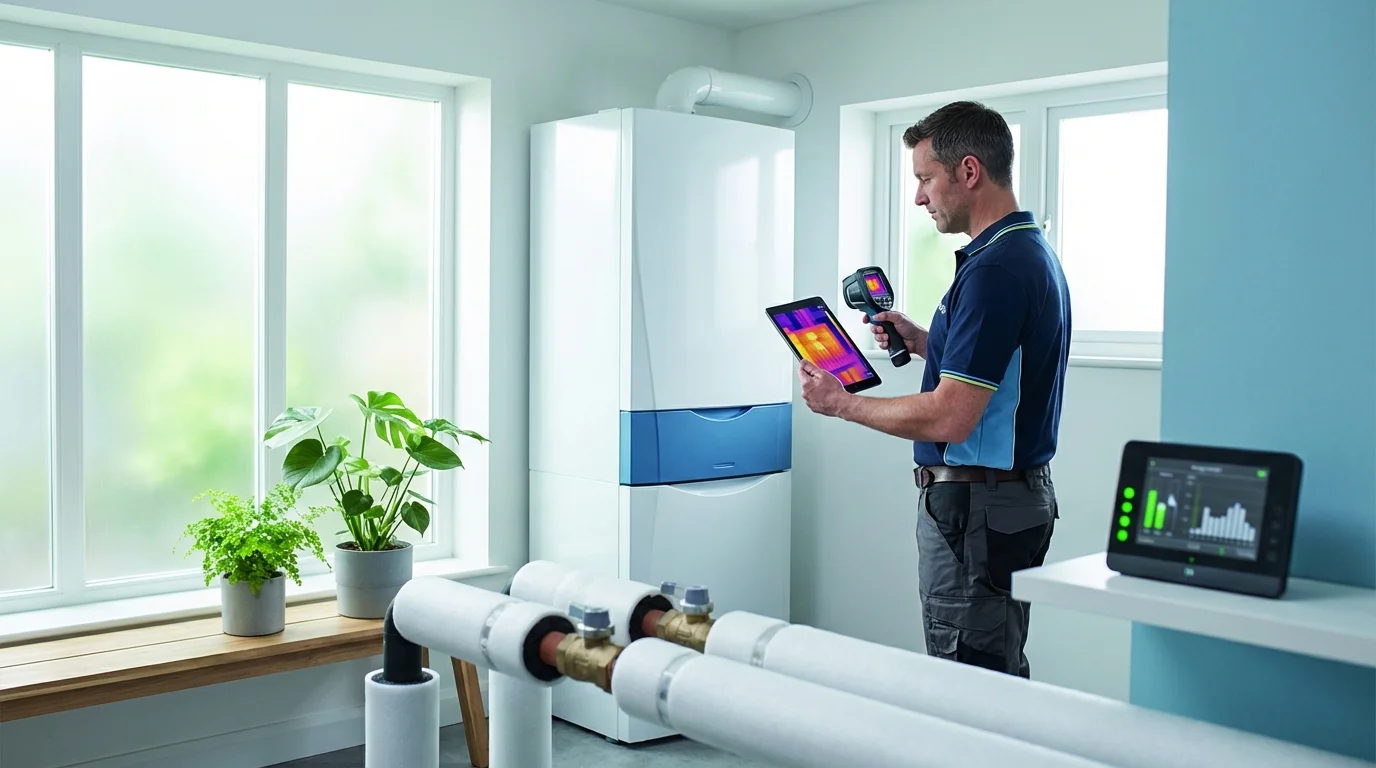
A staggering 40% of a home's heating energy is wasted through an inefficient, uninspected boiler system. This silent drain on your finances happens daily, with outdated equipment and poor calibration turning fuel into wasted heat and higher utility bills. So the pressure to optimize home energy use has never been greater, as both utility costs and climate concerns escalate in 2026.
What Boiler Energy Audit Rebates and Incentives Are Available in My State or Through My Utility?
A boiler energy audit inspection rebate is a financial incentive offered by states, utilities, or federal bodies to homeowners for assessing their boiler's efficiency. These 2026 programs provide direct cash rebates, bill credits, or tax credits, often covering $100 to $500 of the inspection cost, to encourage energy conservation and equipment upgrades.
State and utility programs offer the most direct financial incentives for completing a boiler energy audit inspection. For example, programs like NYSERDA in New York or Mass Save in Massachusetts provide rebates that cover between 50% and 100% of the audit cost, often capped at around $250. And these programs are designed as gateways; completing an audit is frequently a prerequisite for unlocking much larger rebates on new equipment, such as high-efficiency boiler replacements or conversions. So verifying your local utility provider's 2026 offerings is the first step. Many programs are funded on an annual basis and can run out. But federal programs, while less direct for audits alone, support the upgrades identified by an inspection through broad energy tax credits. The key is to check the Database of State Incentives for Renewables & Efficiency (DSIRE) for a comprehensive list of local opportunities.
Do My Boiler Equipment and Household Income Qualify for Energy Audit Programs?
Boiler energy audit program eligibility in 2026 depends on equipment age, fuel type, and household income relative to the Area Median Income (AMI). Qualification typically requires the boiler to be over 10 years old or have an AFUE rating below 85%, with income-based programs offering 100% cost coverage for households under 80% AMI.
Eligibility criteria for boiler audit rebates are specific and vary by program administrator. Most programs require the boiler to be a primary heating source and often specify fuel types, such as natural gas, propane, or oil. And some incentives are tiered based on income. For instance, a household at 80% of the Area Median Income (AMI) may qualify for a no-cost audit, while a household at 120% AMI receives a 50% rebate. So the age and efficiency of your current system are critical factors; boilers older than 15 years or with an Annual Fuel Utilization Efficiency (AFUE) rating below 85% are almost always eligible. But documentation is non-negotiable. Homeowners must provide proof of ownership and recent utility bills to begin the qualification process for a comprehensive home energy audit.
"A home energy assessment, also known as a home energy audit, can help you understand the whole picture of your home’s energy use." — U.S. Department of Energy
What is the Application Process, Key Deadlines, and Funding Status for Boiler Audit Rebates?
The 2026 application process for boiler audit rebates involves pre-authorization from the utility, completion of the audit by a certified technician, and submission of an invoice and application form. Most programs have a rolling deadline, but funding is limited and typically exhausted by Q4, requiring submission within 90 days of the inspection.
The application process is a multi-step verification sequence. First, homeowners must find a certified contractor through their utility's online portal and get pre-approval for the audit. After the inspection, the contractor provides a detailed report and an itemized invoice. And this paperwork must be submitted through the program's online portal or via mail, typically within 60-90 days of the service date. But funding status is a critical, time-sensitive variable. These programs operate on a first-come, first-served basis with annual budgets that often run out by October or November. So waiting until winter to schedule an audit risks finding the program's funds for 2026 are already depleted. Proactive scheduling in the spring or summer ensures access to available rebate pools before the fall rush.
What Are the Contractor Requirements and Can I Stack Multiple Boiler Audit Rebates?
Contractor requirements mandate that boiler energy audits be performed by technicians with specific certifications, such as Building Performance Institute (BPI) credentials. Rebate stacking rules for 2026 generally prohibit combining two utility rebates for the same audit but often permit pairing a utility rebate with a broader federal energy tax credit.
You can't just hire any HVAC technician. Utility and state programs maintain a list of approved, certified contractors. These professionals must carry credentials from organizations like the Building Performance Institute (BPI), which ensures they follow standardized testing protocols for combustion safety and efficiency analysis. And using a non-certified contractor will result in an automatic denial of your rebate application. Stacking, or combining, incentives has strict rules. A homeowner typically cannot claim a rebate from both their electric and gas utility for the same audit. But it is often permissible to use a utility rebate for the initial audit and then apply for separate state or federal incentives for the resulting upgrades, like new insulation or heat pump rebates. Always confirm stacking rules in the program's terms and conditions before proceeding. Use our free rebate calculator to find all the incentives you qualify for.
Boiler Audit Rebate Program Comparison (2026)
| Program Name | Rebate Amount | Key Eligibility | Application Deadline |
|---|---|---|---|
| NYSERDA Comfort Home | Up to $500 | NY Resident, BPI-certified audit | Rolling, funds permitting |
| Mass Save Home Energy Assessment | No-cost assessment | MA utility customer, all incomes | Rolling, schedule online |
| PG&E Home Energy Checkup | No-cost online/phone audit | PG&E customer, CA | Rolling, self-service |
Official Sources
- DSIRE (Database of State Incentives for Renewables & Efficiency) — The most comprehensive source for up-to-date information on state, local, utility, and federal incentives.
- ENERGY STAR Rebate Finder — An official U.S. government tool for finding rebates on ENERGY STAR certified products.
"DSIRE is the most comprehensive source of information on incentives and policies that support renewables and energy efficiency in the United States." — NC Clean Energy Technology Center
Related Reading: Learn more about Electricity Usage Audit By Appliance and Energy Audit Case Studies Residential.
Related Reading: Learn more about Ductwork Inspection Energy Audit.
Frequently Asked Questions About Boiler Energy Audit Inspections and Rebates
What makes my boiler eligible for an energy audit inspection for rebates?
Eligibility typically hinges on the boiler's age and efficiency rating. Most 2026 rebate programs require the unit to be at least 10-15 years old or have an AFUE (Annual Fuel Utilization Efficiency) rating below 85%. And the boiler must be the primary heating system for the home. So homeowners with newer, high-efficiency models (95% AFUE or higher) generally don't qualify for audit-specific rebates, as the potential savings are minimal.
How much does a professional boiler energy audit inspection typically cost?
A professional boiler energy audit inspection costs between $250 and $600 in 2026. The price depends on the home's size and the audit's complexity. A basic combustion analysis may be on the lower end, while a comprehensive audit including a blower door test to measure air leakage will be on the higher end. But many utility rebates are designed to cover $100 to $300 of this cost, effectively reducing the out-of-pocket expense by 50% or more.
What does a boiler energy audit inspection involve step-by-step?
The inspection involves several key steps. First, the technician performs a visual inspection of the boiler and its venting. Second, they conduct a combustion analysis using a specialized tool to measure gas levels like carbon monoxide and oxygen to determine safety and efficiency. Third, they test system controls and check for leaks. Finally, they often perform a blower door test on the house to identify air leaks that impact the boiler's performance, providing a report with a final efficiency score.
What are the key differences between a boiler energy audit and a standard maintenance check?
A standard maintenance check focuses on cleaning and basic operation—like cleaning burners and checking ignition—to ensure the unit runs reliably for the season. An energy audit is a diagnostic performance analysis. It uses calibrated tools to measure the boiler's combustion efficiency, safety, and heat distribution, providing a precise AFUE rating and identifying specific energy-wasting issues. So maintenance is about function, while an audit is about quantifiable efficiency.
Find and Calculate Your Boiler Rebates Now
Don't leave money on the table. A boiler energy audit is the first step to unlocking hundreds, or even thousands, of dollars in rebates and long-term energy savings. Use the DuloCore rebate calculator to instantly see which 2026 incentives you qualify for in your area.
Updated on April 14, 2026. Fact-checked by DuloCore Editors. About our research team.