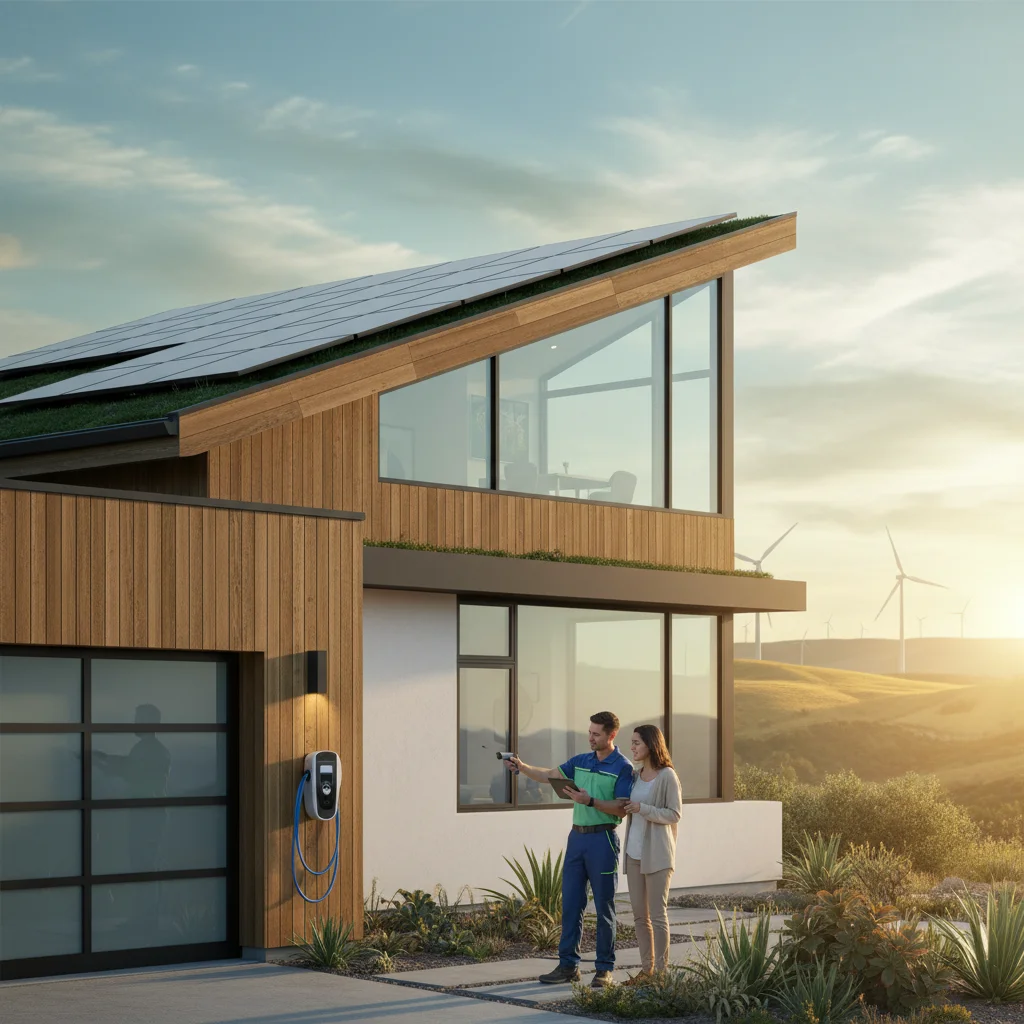
A California home energy audit that once cost homeowners $300-$500 out of pocket is now free for millions of residents through 2026 state and utility programs. And the state allocated $3.1 billion for energy efficiency programs this year—the largest single-year commitment in California history.
How Much Does a Home Energy Audit Cost in California?
California home energy audits in 2026 cost $0-$500 depending on income, utility provider, and program eligibility, with most homeowners qualifying for free audits through utility-sponsored programs administered by PG&E, SCE, SDG&E, and SoCalGas, funded by $3.1 billion in state efficiency allocations through December 31, 2026.
The pricing breaks down into three tiers. PG&E, Southern California Edison, and San Diego Gas & Electric offer no-cost audits for residential customers who schedule through their utility portals. Private energy assessors charge $300-$500 for comprehensive audits that include blower door testing, infrared thermal imaging, and combustion safety analysis. And California's Energy Savings Assistance Program provides free audits plus immediate weatherization upgrades for households earning up to 250% of federal poverty guidelines—$36,450 for a single person or $75,300 for a family of four in 2026.
So the real question isn't cost—it's which program delivers the most value. Utility-sponsored audits typically focus on low-cost improvements like LED bulbs and weatherstripping. Private assessors provide detailed reports required for heat pump rebates and federal energy tax credits. But income-qualified programs combine free audits with same-day installations of insulation, duct sealing, and HVAC tune-ups worth $2,000-$4,000.
"California's investor-owned utilities will invest $3.1 billion in energy efficiency programs in 2026, with residential energy assessments as the primary gateway to rebates and incentives." — California Public Utilities Commission
What's the Budget for California's Energy Audit Programs and How Much Funding Is Available?
California energy audit programs in 2026 operate on a $3.1 billion annual budget split among PG&E ($1.2 billion), Southern California Edison ($1.1 billion), San Diego Gas & Electric ($430 million), and SoCalGas ($370 million), with $892 million specifically allocated for residential assessments and an estimated $340 million remaining as of April 2026.
The California Public Utilities Commission approves three-year funding cycles for investor-owned utilities. PG&E allocated $411 million for residential energy assessments in 2026, with $287 million remaining after serving 128,000 households through March. Southern California Edison budgeted $298 million for audits, with $194 million available after completing 89,000 assessments. San Diego Gas & Electric set aside $97 million, retaining $71 million after 22,000 audits. And SoCalGas designated $86 million for natural gas efficiency assessments, with $58 million unspent.
But these allocations operate on a first-come, first-served basis with no program extensions. PG&E exhausted its 2025 audit budget by October 15, creating a three-month waitlist that carried into January 2026. Southern California Edison projects its 2026 residential assessment funds will last through November based on current demand of 7,400 audits per month.
The funding gap matters for rebate eligibility. Most California efficiency rebates—including the $3,000 heat pump incentive and $1,500 insulation rebate—require a certified energy audit completed within 12 months of the upgrade. And homeowners who delay scheduling until Q4 risk missing both the audit window and the rebate application deadline.
"Energy efficiency program budgets are allocated annually with no carryover provisions—unused funds return to ratepayers rather than extending into subsequent years." — Database of State Incentives for Renewables & Efficiency
Who Qualifies for Free or Low-Cost Energy Audits Based on Income Levels?
California residents qualify for free energy audits through the Energy Savings Assistance Program at household incomes up to 250% of federal poverty level ($36,450 for one person, $75,300 for four people in 2026), while moderate-income households earning 250%-400% FPL ($36,451-$58,320 for one, $75,301-$120,480 for four) receive audits at $50-$150 through the California Alternate Rates for Energy program administered by utilities.
Income verification requires one of three documents: most recent federal tax return, two consecutive pay stubs, or current benefits statement from CalFresh, Medi-Cal, SSI, or Lifeline. PG&E processes verification within 5-7 business days through its online portal. Southern California Edison accepts document uploads or in-person verification at 38 customer service centers statewide. San Diego Gas & Electric partners with 211 San Diego to pre-qualify applicants over the phone using verbal income attestation.
And the numbers matter significantly for total savings potential. Energy Savings Assistance Program participants receive free audits plus immediate installation of attic insulation (R-38), duct sealing, LED lighting, low-flow showerheads, and smart thermostats—upgrades valued at $2,000-$4,000 with zero out-of-pocket cost. CARE program participants pay $50-$150 for comprehensive audits but don't receive automatic weatherization upgrades.
So a family of four earning $74,000 annually qualifies for a free audit and $3,200 in weatherization improvements. But that same family earning $76,000—just $2,000 more—pays $100 for the audit and receives no automatic upgrades, creating a net difference of $3,300 in program value.
What Are the Deadlines for Applying to California Energy Audit Programs?
California energy audit programs in 2026 operate on rolling enrollment with no application deadlines, but funding exhaustion dates vary by utility: PG&E projects budget depletion by November 18, Southern California Edison by November 29, San Diego Gas & Electric by December 20, and SoCalGas by December 15 based on Q1 2026 utilization rates of 7,400, 6,200, 1,800, and 1,400 monthly audits respectively.
The timing creates a critical constraint for homeowners planning major efficiency upgrades. Most California rebate programs require energy audits completed within 12 months of the upgrade installation date. The federal Energy Efficient Home Improvement Credit (Section 25C) ended for property placed in service after December 31, 2025 (IRS FS-2025-05). Federal tax credits for this work have ended, but state, local and utility rebates may still apply; check what is available at your address with the DuloCore rebate calculator.
But the real deadline pressure comes from contractor scheduling. California certified Home Energy Raters—the professionals qualified to perform audits for rebate purposes—number approximately 2,100 statewide. And autumn months see 340% higher demand as homeowners rush to complete audits before year-end tax filing deadlines. PG&E's contractor network reported 4-6 week scheduling delays for new audit requests after October 1, 2025.
So homeowners planning heat pump installations, attic insulation upgrades, or window replacements that trigger rebate requirements should schedule audits by August to ensure completion before contractor backlogs peak. Use our free rebate calculator to estimate your total savings from combined utility rebates and federal tax credits.
How Do You Schedule an Audit and What's the Process from Start to Finish?
California home energy audit scheduling in 2026 starts with utility account verification through online portals (PG&E.com/energyaudit, SCE.com/residential/rebates-savings/energy-audit, SDGE.com/residential/savings-center/audit) or phone enrollment (PG&E 1-800-743-5000, SCE 1-800-736-4777, SDGE 1-800-411-7343), followed by 7-14 day contractor assignment, 2-3 hour on-site assessment, and final report delivery within 10 business days containing specific upgrade recommendations and rebate pre-qualification status.
The on-site visit follows a standardized protocol across all California utilities. Auditors conduct blower door testing to measure air leakage rates in cubic feet per minute at 50 pascals pressure difference. Infrared cameras identify thermal bridges and insulation gaps in walls, ceilings, and floors. Combustion analyzers test furnace and water heater efficiency and carbon monoxide levels. And duct pressurization testing reveals HVAC system leakage rates that affect heating and cooling efficiency.
Homeowners receive two deliverables: a printed assessment report with room-by-room findings and a prioritized upgrade list ranking improvements by cost-effectiveness, and a digital rebate roadmap showing exact incentive amounts for each recommended upgrade through utility programs, California state rebates, and federal tax credits. PG&E reports average savings recommendations of $1,847 annually for households completing top three audit-recommended upgrades.
And the data drives real decisions. An audit might reveal attic insulation at R-19 instead of the California Title 24 requirement of R-38, duct leakage of 28% (above the 15% threshold for rebate eligibility), and a 78% efficiency furnace that qualifies for replacement rebates. That combination unlocks $1,500 for insulation, $800 for duct sealing, and $3,000 for heat pump upgrade—$5,300 in available incentives identified through one $0-$500 audit.
How Do California Energy Audit Costs Compare to Federal Incentives and Tax Credits?
California energy audit costs of $0-$500 in 2026 unlock combined federal and state incentives worth $8,000-$25,000 for comprehensive home efficiency upgrades, with the Inflation Reduction Act providing 30% tax credits (maximum $1,200 annually for weatherization, unlimited for heat pumps and solar) and California utilities offering $3,000 heat pump rebates, $1,500 insulation rebates, and $2,000 HVAC system rebates through December 31, 2026.
The federal framework changed significantly on January 1, 2026 when the old Section 25C and 25D tax credits expired. The federal Energy Efficient Home Improvement Credit (Section 25C) ended for property placed in service after December 31, 2025 (IRS FS-2025-05).
But California adds state incentives that federal programs don't cover. The Tech Clean California program provides $3,000 point-of-sale rebates for heat pump installations in existing homes, stackable with the federal 30% tax credit (this federal credit ended for property placed in service after December 31, 2025). The Self-Generation Incentive Program offers $200-$850 per kilowatt-hour for battery storage systems paired with solar. And income-qualified households receive enhanced rebates: $4,000 for heat pumps, $8,000 for electrical service upgrades, and $1,600 for electric panel improvements.
So the audit investment math works like this: a homeowner pays $400 for a private energy assessment, installs $15,000 in recommended heat pump and insulation upgrades, claims $4,500 in federal tax credits (30% of heat pump cost), receives $4,500 in California utility rebates ($3,000 heat pump + $1,500 insulation), and nets $8,600 in total incentives against a $400 audit cost—a 21.5x return on the assessment investment.
Official Sources
- U.S. Department of Energy - Energy Saver — Federal energy efficiency guidance, home assessment resources, and current tax credit information (note: the federal 25C and 25D credits ended for projects completed after December 31, 2025)
- California Public Utilities Commission — State energy efficiency program budgets, utility allocations, and regulatory updates
- DSIRE - Database of State Incentives for Renewables & Efficiency — Comprehensive catalog of California and federal energy rebates, tax credits, and program deadlines (note: the federal 25C and 25D credits ended for projects completed after December 31, 2025)
Related Reading: Learn more about Building Science Energy Audit and Can I Do My Own Energy Audit.
Related Reading: Learn more about Diy Home Energy Audit and Diy Vs Professional Energy Audit Cost.
Frequently Asked Questions
How much does a home energy audit cost in California?
California home energy audits cost $0-$500 in 2026 depending on program eligibility. PG&E, Southern California Edison, and San Diego Gas & Electric provide free audits for all residential customers through utility-sponsored programs. Private certified energy raters charge $300-$500 for comprehensive assessments required for rebate applications. And income-qualified households earning up to 250% of federal poverty level ($75,300 for a family of four) receive free audits plus immediate weatherization upgrades worth $2,000-$4,000 through the Energy Savings Assistance Program.
What is included in a California home energy audit?
California energy audits include blower door testing measuring whole-house air leakage in cubic feet per minute, infrared thermal imaging identifying insulation gaps and thermal bridges, combustion safety analysis testing furnace and water heater carbon monoxide levels, duct pressurization testing revealing HVAC leakage rates, and room-by-room assessment of lighting, appliances, and building envelope performance. Homeowners receive a written report with prioritized upgrade recommendations ranked by cost-effectiveness and annual energy savings, plus rebate pre-qualification status for federal tax credits and California utility incentives.
Are home energy audits free in California?
California offers free home energy audits through three pathways in 2026: utility-sponsored programs for all PG&E, SCE, and SDGE residential customers with no income restrictions, the Energy Savings Assistance Program for households earning up to 250% of federal poverty level, and the California Alternate Rates for Energy program charging $50-$150 for moderate-income households earning 250%-400% FPL. And approximately 78% of California households qualify for $0-$150 audits based on utility service territory and income level, according to California Public Utilities Commission enrollment data.
How long does a California home energy audit take?
California home energy audits require 2-3 hours for on-site assessment depending on home size and complexity, with single-story homes under 2,000 square feet averaging 2 hours and multi-story homes over 3,000 square feet requiring 3-4 hours for complete blower door testing, infrared imaging, duct pressurization, and combustion analysis. Scheduling timeline spans 7-14 days from initial request to contractor assignment, followed by the on-site visit, and final report delivery within 10 business days. So total timeline from enrollment to receiving actionable recommendations runs 17-28 days for utility-sponsored audits.
Do I need a home energy audit to get California rebates?
California requires certified home energy audits for heat pump rebates ($3,000), insulation rebates ($1,500), duct sealing rebates ($800), and HVAC system rebates ($2,000) administered through investor-owned utilities in 2026, with audits completed within 12 months of upgrade installation date. And federal Inflation Reduction Act tax credits require energy assessments for projects claiming more than $1,200 in annual credits, with audit and installation occurring in the same calendar year. But LED lighting rebates, smart thermostat rebates, and appliance recycling incentives don't require pre-installation audits according to California Public Utilities Commission program rules.
Ready to see how much you can save? Use our free rebate calculator to discover your total eligible incentives from California utility programs and federal tax credits. Enter your zip code, planned upgrades, and household income to get a personalized savings estimate in 60 seconds—then schedule your no-cost energy audit to start unlocking thousands in available rebates.
Updated on April 14, 2026. Fact-checked by DuloCore Editors. About our research team.