Update (2026): The federal Energy Efficient Home Improvement Credit (Section 25C) expired December 31, 2025, following the passage of the OBBBA. Check state and local programs for current incentives.
The average U.S. household wastes 20% to 30% of its energy use due to drafts, air leaks, and outdated systems, a loss that directly inflates monthly utility bills. As homeowners face rising energy costs in 2026, understanding the source of this inefficiency is the first step toward accessing thousands in government-funded rebates. The decision to perform a self-assessment versus hiring a certified professional has immediate financial consequences.
What Are the True Costs and Benefits of a DIY vs. Professional Energy Audit?
A professional energy audit costs $300-$700 in 2026, unlocking access to up to $8,000 in rebates and a 15-30% energy bill reduction. But a DIY audit is free, using online checklists, yet often misses the specific data required for rebate applications, limiting savings to minor weatherization credits.
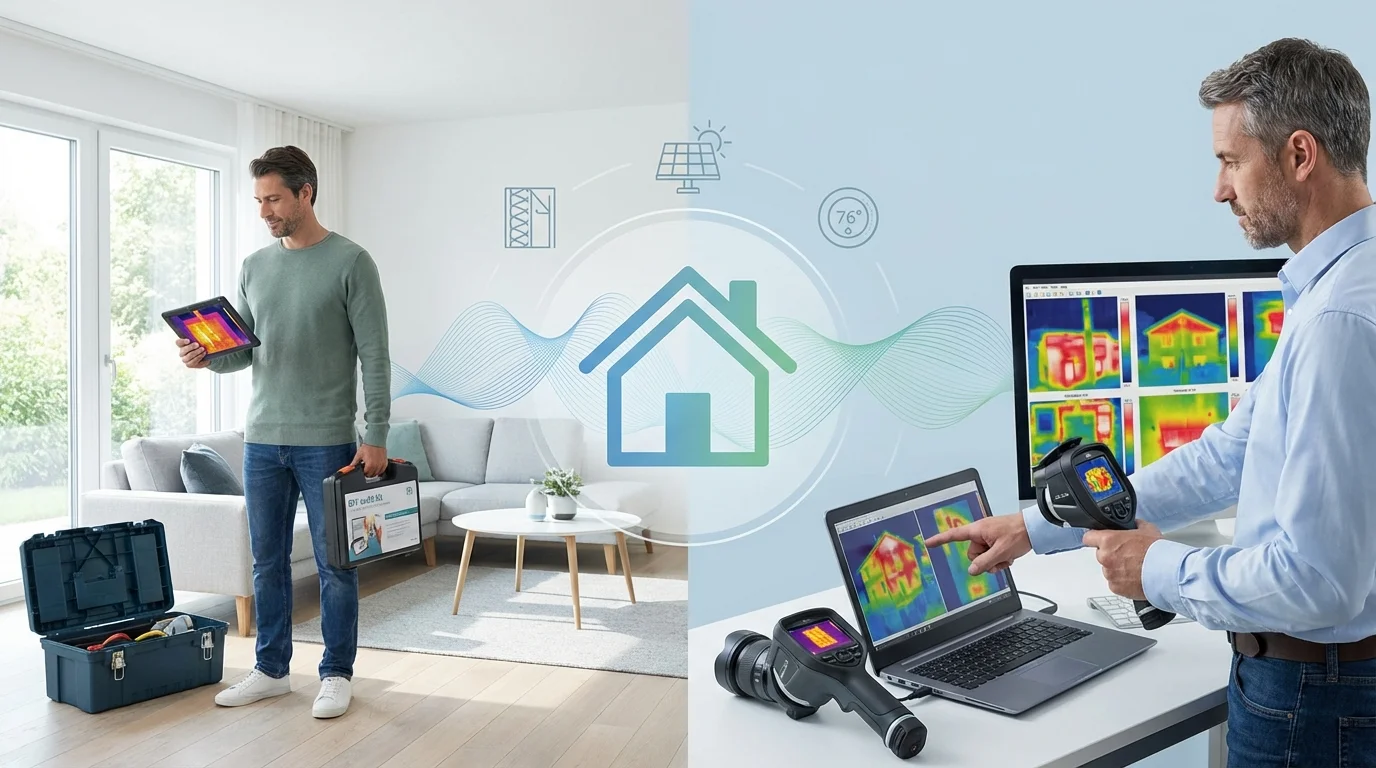
So the choice between a free DIY check and a $500 professional audit directly impacts a homeowner's ability to access up to $14,000 in federal rebates under the 2026 Inflation Reduction Act (IRA) programs. A professional audit provides the certified documentation—including blower door tests and infrared thermography—that most state and federal programs mandate as proof of energy savings. Without this verification, homeowners are ineligible for the highest-value incentives for insulation, air sealing, and high-efficiency HVAC upgrades. And a DIY approach, while costing nothing upfront, leaves an average of $5,200 in rebates on the table. A comprehensive home energy audit is the gateway to these funds.
How Can a Professional Energy Audit Unlock Significant Rebates and Incentives?
A professional energy audit provides the certified report required by 2026 federal programs, like the Home Efficiency Rebates, which offers up to $8,000 for projects achieving at least a 35% energy reduction. But a DIY audit lacks this BPI-certified documentation, disqualifying homeowners from these programs.
Many 2026 utility and state-level programs make a professional audit a prerequisite for participation. So this initial investment, typically between $300 and $700, is not just a diagnostic cost but a key to unlocking thousands in financial aid. The auditor’s report quantifies energy loss and models the savings from specific upgrades, which is precisely the data applications for energy tax credits require. For example, proving a 25% energy savings to qualify for a $4,000 rebate is impossible with a DIY checklist. The professional assessment provides the necessary baseline and post-project verification. And homeowners can use our free rebate calculator to estimate potential savings based on audit findings.
"A professional home energy audit (also known as a home energy assessment) will give you a thorough picture of where your home is losing energy and what you can do to save money." — U.S. Department of Energy
Who Qualifies for Energy Audit Rebates and How Do I Navigate the Application Process?
Qualification for 2026 energy audit rebates depends on income level and location, with many states offering free audits for households below 80% of the Area Median Income (AMI). But homeowners above 150% AMI typically pay the full audit cost of $300-$700, though it unlocks larger project rebates.
The application process starts by finding a state-approved or BPI-certified auditor. So homeowners must first check their state energy office's list of certified professionals. After the audit, the certified report is submitted alongside rebate applications for specific upgrades, such as insulation or new windows. For federal programs, this report serves as the primary evidence for eligibility. And many states streamline this process through a single online portal where the auditor uploads results directly. These programs often have specific income verification steps, requiring tax documents to confirm eligibility for low-income incentives for upgrades like heat pump rebates. The key is ensuring the audit is performed before any upgrade work begins.
| Feature | DIY Energy Audit | Professional Energy Audit |
|---|---|---|
| Upfront Cost | $0 - $50 (for tools) | $300 - $700 |
| Rebate Eligibility | Limited to basic material credits | Unlocks up to $14,000 in IRA & state rebates |
| Required Tools | Checklist, caulk gun, weatherstripping | Blower door, infrared camera, combustion analyzer |
| Accuracy | Subjective, misses 40-60% of air leaks | Quantitative, BPI-certified, legally defensible |
What Are the Key Deadlines, Funding Status, and Stacking Rules for Energy Efficiency Programs?
Federal IRA rebate programs for 2026 are funded through December 31, 2025, but state-level funding is allocated annually and often runs out by Q3 or Q4. So homeowners must apply early. Stacking rules permit combining federal tax credits with state or utility rebates for the same project.
Deadlines are critical. For instance, a state utility's $500 insulation rebate may have a December 31, 2026, deadline, while the federal tax credit for that same insulation is available through December 31, 2025. But homeowners cannot claim two different rebates for the full cost of one project; the total incentive value cannot exceed the project cost. For example, a homeowner can stack a $2,000 state rebate with a 30% federal tax credit on a $10,000 heat pump installation. And they must check the Database of State Incentives for Renewables & Efficiency (DSIRE) for specific 2026 program funding levels and application closing dates, as popular programs deplete funds quickly. (Note: Federal tax credit percentages and availability are subject to change; the 30% Residential Clean Energy Credit under Section 25D expired December 31, 2025. Verify current incentives at energy.gov.)
"Many state and utility programs are first-come, first-served, and funding for a given year can be exhausted before the official program end date." — DSIRE
What Should I Look for in a Certified Energy Auditor and What Are Their Requirements?
Homeowners must select an auditor with certifications from the Building Performance Institute (BPI) or the Residential Energy Services Network (RESNET) to qualify for 2026 rebates. But a general contractor without these credentials cannot provide the required documentation for federal or state energy programs.
A certified auditor is required to use specific diagnostic tools, including a blower door to measure air leakage and an infrared camera to identify insulation gaps. So their final report must include a prioritized list of recommended improvements, estimated costs, and projected energy savings, which forms the basis of any rebate application. The auditor must also perform a combustion safety test to ensure gas appliances operate safely after any air sealing work is completed. And before hiring, homeowners should verify the auditor’s certification number on the BPI or RESNET websites and confirm they carry liability insurance. The audit process typically takes 2-4 hours for a 2,000-square-foot home.
Official Sources
- ENERGY STAR Rebate Finder — A federal tool from the EPA to find local rebates and special offers on ENERGY STAR certified products.
- Database of State Incentives for Renewables & Efficiency (DSIRE) — A comprehensive source of information on state, local, utility, and federal incentives that promote renewable energy and energy efficiency.
Frequently Asked Questions
How much does a professional energy audit typically cost compared to a DIY assessment?
A professional energy audit in 2026 costs between $300 and $700. In contrast, a DIY assessment is free, though it may involve purchasing minor tools like a thermal leak detector for around $40. The professional cost covers specialized equipment like blower doors and infrared cameras, providing data required for high-value rebates.
Is a DIY energy audit accurate enough to qualify for home improvement rebates?
No, for most 2026 federal and state programs. Programs like the Home Efficiency Rebates require a BPI-certified audit report to document a minimum 20% energy savings. So a DIY assessment only qualifies for basic weatherization material credits, leaving an average of $5,200 in potential rebates unclaimed by not meeting documentation standards.
What are the hidden costs or time commitments of a DIY energy audit versus hiring a professional?
The hidden cost of a DIY audit is the forfeited rebate money, often thousands of dollars. The time commitment is also a factor, requiring 4-8 hours of research and inspection. A professional audit takes 2-4 hours of the homeowner's time for the on-site visit, and the auditor handles all the complex data analysis and reporting required for rebate applications.
Do professional energy audits offer more comprehensive results to maximize rebate potential?
Yes. Professional audits use diagnostic tools like blower doors to quantify air leakage rates (ACH50) and infrared cameras to pinpoint insulation voids. This data is essential for qualifying for performance-based rebates, which pay more for greater energy savings. A DIY audit cannot produce this quantitative data, capping rebate potential at lower, prescriptive levels.
Are there specific rebate programs that require a certified professional energy audit over a self-assessment?
Yes, the federal Home Efficiency Rebates program, which offers up to $8,000, explicitly requires a pre- and post-upgrade audit by a BPI-certified professional. Many 2026 state and utility programs, especially those offering over $1,000 for insulation or air sealing, also mandate a professional audit as a prerequisite for funding.
Unlock Your Home's Rebate Potential
Don't guess how much you can save. A professional energy audit is the first step. Use our free tool to see the rebates available in your area now.
Calculate Your SavingsUpdated: April 14, 2026 — fact-checked by DuloCore Research. About our editorial process.