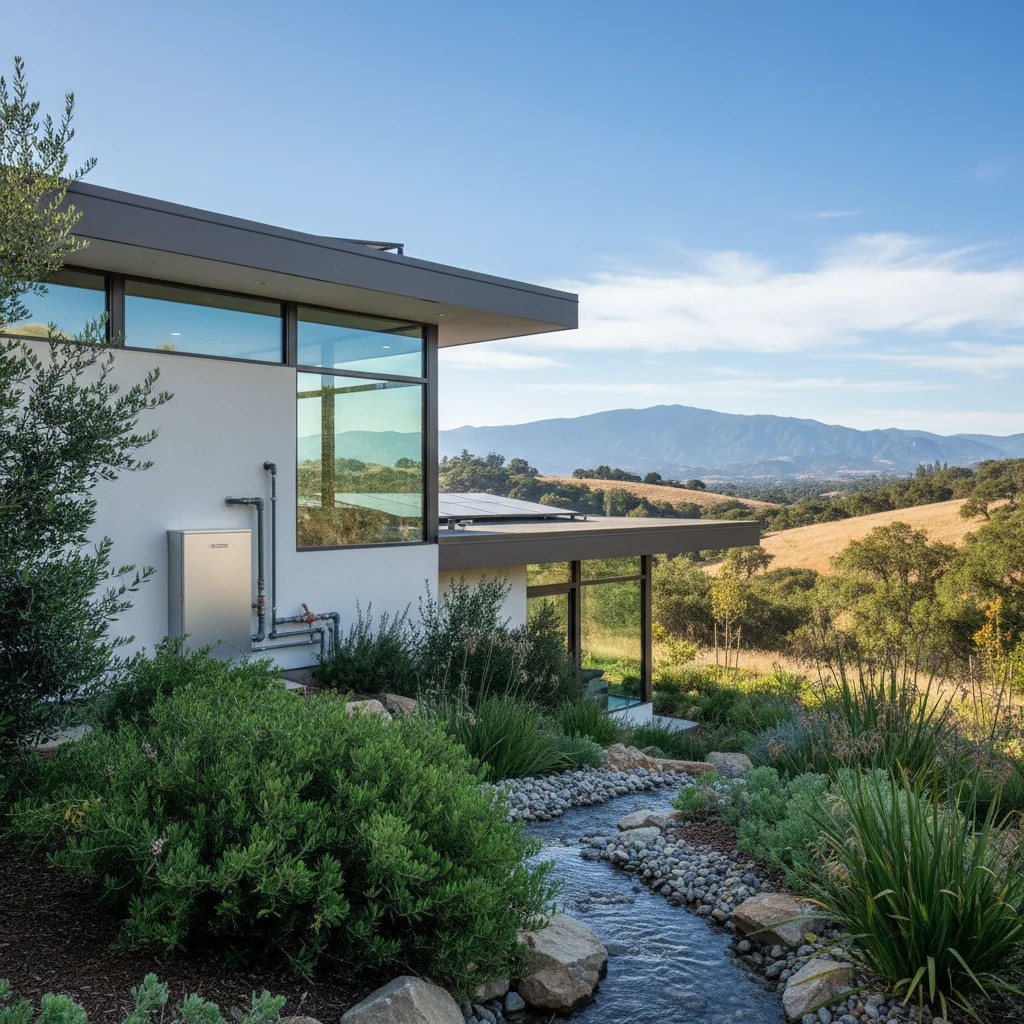
California homeowners replacing gas furnaces with geothermal heat pumps cut annual energy costs by $800 to $2,400 while eliminating 4 to 6 tons of carbon emissions per year. The federal Residential Clean Energy Credit (Section 25D) ended for expenditures made after December 31, 2025, and the IRS treats an expenditure as made when installation is completed (IRS FS-2025-05). California utility rebates add another $2,000 to $5,000. But upfront costs of $18,000 to $45,000 create a barrier that stops 78% of homeowners who consider geothermal systems from moving forward.
What is the typical ROI and payback period for geothermal heat pumps in California?
Geothermal heat pumps in California deliver payback periods of 5 to 12 years depending on climate zone, existing fuel source, and local utility rates. Systems replacing electric resistance heat pay back in 5 to 7 years, while gas furnace replacements take 10 to 12 years. Federal IRA tax credits reduce effective installation costs by 30%, shortening payback by 2 to 3 years.
So why does payback matter? Because every year past payback delivers pure savings. A system lasting 25 years generates $20,000 to $60,000 in net savings after recovering installation costs. And homes in CPUC climate zones 12-16 (inland valleys and deserts) see the fastest returns due to extreme summer cooling loads where geothermal systems operate at 300% to 500% efficiency.
California's moderate climate creates ideal conditions. Ground temperatures stay constant at 55°F to 65°F year-round, allowing geothermal systems to extract or reject heat with minimal electricity. But ROI depends on installation quality—poorly designed loop fields reduce efficiency by 20% to 40%, extending payback to 15 years or more.
Northern California homeowners report average annual savings of $1,200 per year, while Southern California properties save $1,800 to $2,400 due to higher cooling loads. Use our free rebate calculator to model your specific payback based on zip code, square footage, and current fuel source.
How do geothermal heat pump costs compare to traditional HVAC systems in California?
California geothermal heat pump installations cost $18,000 to $45,000 compared to $8,000 to $15,000 for conventional air-source heat pumps or gas furnaces with AC. And the $10,000 to $30,000 premium buys 25-year equipment life, 300% to 500% operating efficiency, and zero combustion emissions. But ground loop installation drives 50% to 60% of total costs—horizontal loops in large yards cost $18,000 to $28,000, while vertical loops in compact lots run $28,000 to $45,000.
System size determines price. A 3-ton geothermal unit heats and cools 1,500 to 2,000 square feet and costs $20,000 to $28,000 installed. A 5-ton system for 2,500 to 3,500 square feet runs $32,000 to $45,000. So doubling capacity adds 60% to total costs, not 100%, because loop field installation scales more efficiently than equipment.
Federal IRA tax credits and California utility incentives cut net costs by $8,000 to $15,000. After incentives, effective costs drop to $10,000 to $30,000—often competitive with premium air-source heat pump systems. And geothermal systems eliminate the need for separate furnace and AC units, saving $3,000 to $5,000 in equipment redundancy.
"Geothermal heat pumps are the most energy-efficient, environmentally clean, and cost-effective systems for heating and cooling buildings." — U.S. Department of Energy
What federal and California state incentives can reduce your geothermal heat pump installation costs?
The federal Residential Clean Energy Credit (Section 25D) ended for expenditures made after December 31, 2025, and the IRS treats an expenditure as made when installation is completed (IRS FS-2025-05). Federal tax credits for this work have ended, but state, local and utility rebates may still apply; check what is available at your address with the DuloCore rebate calculator. California utility rebates from PG&E, SCE, SoCalGas, and SDG&E add $2,000 to $5,000 depending on system size and service territory. And the California TECH Clean Heating Initiative offers additional $3,000 incentives for low-income households replacing gas furnaces. (Note: Federal tax credit percentages and availability are subject to change; the 30% Residential Clean Energy Credit under Section 25D expired December 31, 2025. Verify current incentives at energy.gov.)
Federal credits cover total installation costs including equipment, loop field, trenching, permits, and labor. A $30,000 installation generates a $9,000 tax credit, reducing net cost to $21,000. But the credit applies to tax liability—homeowners owing less than $9,000 in federal taxes carry the balance forward to future tax years.
California utility programs vary by territory. PG&E offers $3,000 for ENERGY STAR certified systems over 3 tons. SCE provides $2,500 for heat pump water heaters paired with geothermal systems. SoCalGas runs targeted campaigns with $4,000 to $5,000 incentives for gas furnace replacements. And municipal utilities like SMUD and LADWP operate separate programs with $1,500 to $3,000 rebates.
Local air quality management districts add another layer. South Coast AQMD offers $3,000 for zero-emission heating systems. Bay Area AQMD provides $2,500 for homes in disadvantaged communities. So total available incentives reach $14,000 to $17,000 for qualifying installations, cutting net costs by 45% to 50%.
Check current heat pump rebates and energy tax credits for 2026 program availability—utility budgets exhaust by mid-year in high-demand territories.
What is the eligibility process for geothermal heat pump rebates and tax credits in California?
The federal Residential Clean Energy Credit (Section 25D) ended for expenditures made after December 31, 2025, and the IRS treats an expenditure as made when installation is completed (IRS FS-2025-05). California utility rebates mandate pre-approval applications submitted before installation begins. And most programs require licensed contractor installation with permit sign-off and final inspection by the local building department.
Form 5695 only covers qualifying work completed by December 31, 2025 and claimed on a 2025 return; the federal 25C and 25D credits ended after that date (IRS FS-2025-05). No pre-approval exists—but installations failing to meet efficiency standards lose the credit retroactively after audit.
California utility rebates follow a 4-step process. First, submit online pre-approval with contractor quotes and equipment specifications. Second, receive reservation confirmation (budgets exhaust quickly, so apply early). Third, complete installation within 90 to 180 days. Fourth, submit final paperwork with paid invoices, permit sign-off, and commissioning report. Rebate checks arrive 6 to 12 weeks after final approval.
Local air district incentives require separate applications. South Coast AQMD mandates online pre-approval through the CleanRebate portal. Bay Area AQMD processes applications through BayREN. And income verification applies to enhanced rebate tiers—households under 80% area median income qualify for doubled incentives.
Contractors handle most paperwork. But homeowners verify contractor licensing (California C-20 Warm Air Heating license required), confirm ENERGY STAR equipment specifications, and retain all documentation for 7 years in case of IRS audit.
How long does a geothermal heat pump installation take, and what permits do you need in California?
California geothermal heat pump installations take 3 to 10 days for loop field construction and 1 to 2 days for indoor equipment setup. And permitting adds 4 to 8 weeks before work begins—mechanical permits from city or county building departments, electrical permits for new circuits, and well permits if drilling vertical loops deeper than 50 feet.
Horizontal loop fields require 1 to 3 acres of yard space and take 3 to 5 days to excavate, lay piping, and backfill. Vertical loops on compact lots need drilling rigs to bore 150 to 400 feet deep, taking 5 to 10 days for 3 to 6 boreholes. So lot size and soil conditions dictate timeline—rocky terrain or high water tables add 2 to 5 days for specialized drilling equipment.
California Title 24 energy code requires HERS (Home Energy Rating System) testing after installation to verify duct leakage under 6% and airflow within 15% of design specifications. And local jurisdictions add requirements—coastal zones need erosion control plans, seismic zones require structural calculations for equipment anchoring, and fire hazard zones mandate vegetation clearance around outdoor components.
Permit costs range from $800 to $2,500 depending on jurisdiction and scope. Mechanical permits run $400 to $800. Electrical permits add $200 to $400. Well permits in unincorporated counties cost $200 to $1,300. So total permitting expenses reach 3% to 5% of project costs before installation begins.
Contractors coordinate inspections. Rough inspection happens after loop field installation before backfill. Final inspection occurs after equipment startup and HERS testing. And occupancy sign-off releases utility rebate payments.
How much can you save annually on energy bills with a geothermal heat pump in California?
California homeowners save $800 to $2,400 per year replacing gas furnaces and central AC with geothermal heat pumps. And homes in inland valleys (Sacramento, Central Valley, Inland Empire) see the highest savings due to extreme summer cooling loads where geothermal systems operate at 400% to 500% efficiency compared to 250% to 350% for air-source heat pumps.
Savings depend on replaced fuel source. Gas furnace replacements save $1,200 to $1,800 annually because geothermal systems eliminate natural gas charges averaging $80 to $150 per month in winter. Electric resistance heat replacements save $1,800 to $2,400 due to 70% to 80% electricity reduction. But replacing efficient air-source heat pumps saves only $300 to $600 because both technologies deliver similar performance.
PG&E territory homeowners report average annual savings of $1,200 for 2,000 square foot homes. SCE customers save $1,400 to $1,800 in hot inland zones. SDG&E territory sees $900 to $1,300 savings due to moderate coastal climates. And SMUD and LADWP customers save $1,000 to $1,500 with favorable municipal rates.
Monthly savings fluctuate seasonally. Summer cooling months deliver $150 to $300 per month savings in hot climates. Winter heating saves $80 to $150 per month by eliminating gas charges. Spring and fall shoulder seasons save $40 to $80 per month. So annual totals accumulate from consistent monthly reductions, not single-season spikes.
"Ground-source heat pumps are recognized as one of the most efficient heating and cooling systems available, with efficiencies 50% higher than the best air conditioners and almost 75% higher than gas furnaces." — Environmental Protection Agency
Official Sources
- U.S. Department of Energy Geothermal Heat Pumps — Federal guidance on efficiency, costs, and installation requirements
- ENERGY STAR Heat Pumps — Certification standards and qualified product lists
- DSIRE USA — Database of state and federal incentives for renewable energy and efficiency
Related Reading: Learn more about Landscaping For Energy Efficiency and Roof Energy Efficiency Assessment.
Related Reading: Learn more about Geothermal Heat Pump Efficiency.
Frequently Asked Questions
Are geothermal heat pumps eligible for California rebates in 2026?
Geothermal heat pumps qualify for 2026 California utility rebates ranging from $2,000 to $5,000 through PG&E, SCE, SoCalGas, and SDG&E programs. The federal Residential Clean Energy Credit (Section 25D) ended for expenditures made after December 31, 2025, and the IRS treats an expenditure as made when installation is completed (IRS FS-2025-05). But utility rebate budgets exhaust by June or July in high-demand territories, so applications submitted in Q1 have the highest approval rates.
How much can you save with a geothermal heat pump in California?
California geothermal heat pump owners save $800 to $2,400 annually on energy bills depending on climate zone, replaced fuel source, and home size. Homes replacing gas furnaces save $1,200 to $1,800 per year by eliminating natural gas charges. Electric resistance heat replacements save $1,800 to $2,400. And air-source heat pump replacements save $300 to $600 due to similar baseline efficiency.
What is the difference between a geothermal heat pump and an air source heat pump?
Geothermal heat pumps exchange heat with 55°F to 65°F ground temperatures through buried loop fields, delivering 300% to 500% efficiency year-round. Air-source heat pumps exchange heat with outdoor air ranging from 20°F to 110°F, achieving 250% to 350% efficiency with reduced performance in temperature extremes. And geothermal systems cost $10,000 to $30,000 more upfront but last 25 years compared to 15 years for air-source equipment.
How long does it take to install a geothermal heat pump in California?
California geothermal installations take 4 to 12 days for complete loop field construction and indoor equipment setup. Horizontal loops in large yards require 3 to 5 days for excavation and piping. Vertical loops on compact lots need 5 to 10 days for drilling 150 to 400 feet deep. And permitting adds 4 to 8 weeks before installation begins for mechanical, electrical, and well permits.
Do geothermal heat pumps work in cold climates?
Geothermal heat pumps maintain full heating capacity at outdoor temperatures below 0°F because ground temperatures stay constant at 55°F to 65°F year-round. Air-source heat pumps lose 30% to 50% capacity when outdoor air drops below 20°F, requiring backup electric resistance heat. And northern U.S. homes in Minnesota, Maine, and Montana install geothermal systems specifically for reliable cold-climate performance without efficiency loss.
Ready to calculate your geothermal heat pump savings? Use our free rebate calculator to estimate federal tax credits, California utility rebates, and annual energy savings based on your zip code, home size, and current heating system. Get your personalized savings report in under 2 minutes.
Last updated April 14, 2026 — reviewed by DuloCore Editorial. About our authors.
Check your California heat pump rebate eligibility — see the programs you qualify for and the dollar amounts on our California heat pump rebate finder.