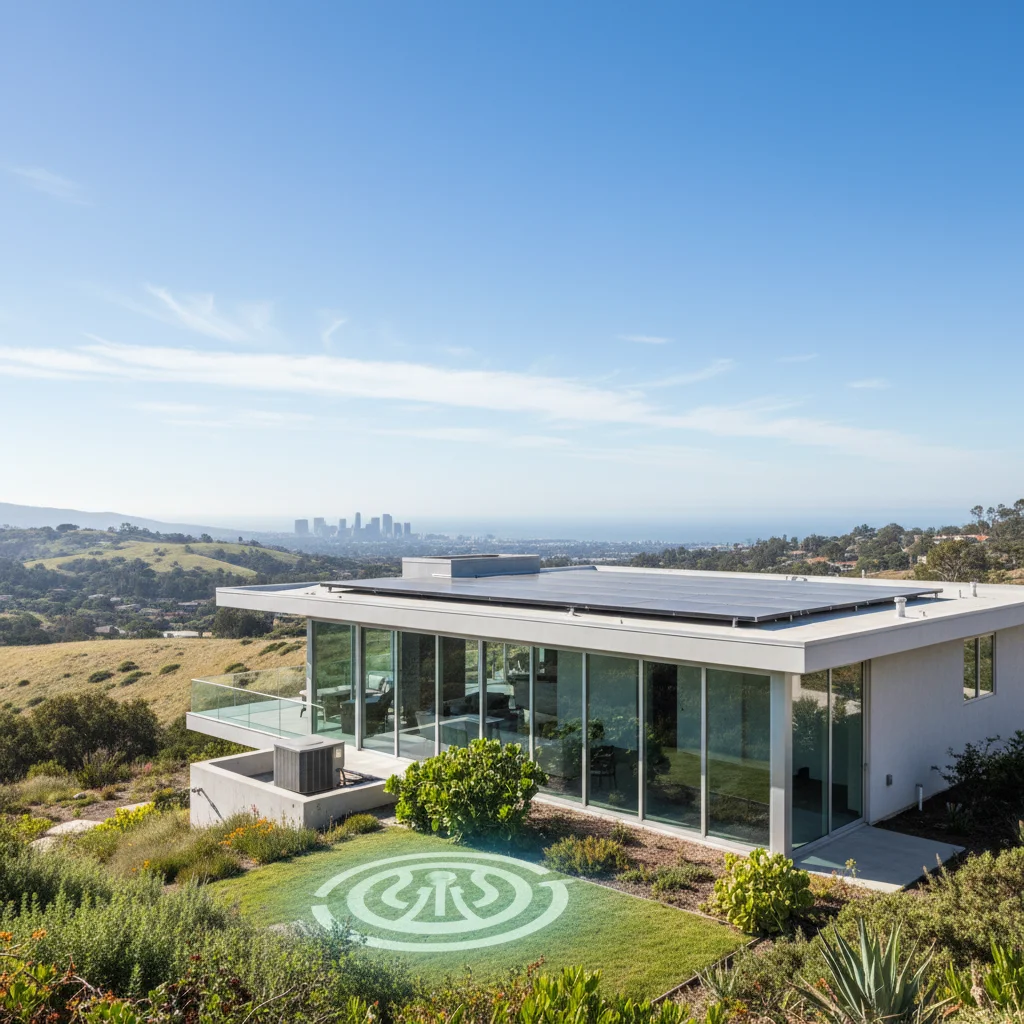
San Diego County homeowners spent $847 million on air conditioning in 2025, yet only 1,200 properties use geothermal systems that cut cooling costs by 65% year-round. The gap persists because most contractors don't install geothermal, leaving qualified technicians scattered across 18 municipalities with no central certification directory.
The federal Residential Clean Energy Credit (Section 25D) ended for expenditures made after December 31, 2025, and the IRS treats an expenditure as made when installation is completed (IRS FS-2025-05). Federal tax credits for this work have ended, but state, local and utility rebates may still apply; check what is available at your address with the DuloCore rebate calculator. Licensed C-20 warm air heating contractors handle the HVAC components while C-61 drilling contractors complete the ground loop portion.
What Does a Geothermal System Cost for San Diego Homes?
Complete geothermal installations in San Diego County range from $22,000 to $38,000 before incentives, with ground loop excavation accounting for 55% of the total. A 3-ton system serves a typical 1,800-square-foot home, while properties exceeding 2,500 square feet require 4-ton to 5-ton capacity at $32,000 to $38,000.
Horizontal loop installations cost $18,000 to $28,000 and work on lots with 1,200+ square feet of yard space. Vertical drilling reaches $25,000 to $38,000 but fits on 0.15-acre lots where horizontal trenching fails. And the federal geothermal tax credit reduces net costs by 30% through 2032, dropping a $28,000 system to $19,600 after the IRS credit.
Contractors charge $12,000 to $18,000 for the ground loop excavation, $8,000 to $14,000 for the heat pump unit and indoor components, plus $2,000 to $6,000 for permits and electrical upgrades. So a 4-ton system with vertical drilling in La Jolla or Del Mar reaches $35,000 before incentives, compared to $24,000 for a horizontal loop in Poway or Ramona.
| Component | Cost Range | Labor Share |
|---|---|---|
| Ground loop (horizontal) | $12,000-$18,000 | 60% |
| Ground loop (vertical) | $18,000-$25,000 | 65% |
| Heat pump unit | $6,000-$10,000 | 20% |
| Indoor installation | $2,000-$4,000 | 40% |
| Permits & electrical | $2,000-$6,000 | 50% |
Which Geothermal Systems Qualify for San Diego Rebates and Tax Credits?
The federal Residential Clean Energy Credit (Section 25D) ended for expenditures made after December 31, 2025, and the IRS treats an expenditure as made when installation is completed (IRS FS-2025-05). The IRS requires an Energy Efficiency Ratio (EER) of 17.1+ for open-loop systems or 16.1+ for closed-loop configurations, with a Coefficient of Performance (COP) of 3.3 or higher.
But San Diego Gas & Electric eliminated direct geothermal rebates in 2024, shifting funds to their heat pump rebate program that excludes ground-source systems. And the California Energy Commission's Self-Generation Incentive Program (SGIP) stopped accepting geothermal applications in 2023 after exhausting allocated funds.
So the federal credit stands as the primary incentive, delivering $6,600 to $11,400 in tax reductions on qualified systems. Form 5695 only covers qualifying work completed by December 31, 2025 and claimed on a 2025 return; the federal 25C and 25D credits ended after that date (IRS FS-2025-05). Or qualifying households access the Home Efficiency Rebates program starting in 2026, providing $8,000 for comprehensive electrification projects that include geothermal installations as a primary heating and cooling source.
How Efficient Are Geothermal Systems in San Diego's Climate Zone?
Geothermal heat pumps deliver 400% to 600% efficiency in Climate Zone 7, extracting 4 to 6 units of thermal energy for every unit of electricity consumed. San Diego's stable ground temperatures of 63°F to 67°F at 6-foot depths eliminate the performance losses that affect air-source systems during 90°F+ summer days.
And the region's mild winters eliminate the need for backup resistance heating that drains efficiency in cold climates. So a 3-ton geothermal system uses 2,400 to 3,200 kWh annually compared to 5,800 to 7,200 kWh for a conventional central air conditioner, saving $680 to $920 per year at SDG&E's 2026 average rate of $0.19 per kWh.
But coastal properties in Del Mar, Encinitas, and Carlsbad see lower savings of $480 to $620 annually because mild ocean breezes reduce baseline air conditioning demand. Inland homes in Escondido, Santee, and El Cajon capture the full efficiency advantage, with summer temperatures reaching 95°F to 105°F that force traditional AC units into low-efficiency operation while geothermal performance remains constant.
Visit our rebate calculator to estimate annual savings for your specific property and utility zone.
What's the Installation Process and Timeline for Geothermal Contractors in San Diego?
Installation spans 4 to 8 days across three phases: permitting (1-3 weeks), ground loop drilling or trenching (2-4 days), and HVAC system connection (1-2 days). San Diego County requires separate permits for drilling and HVAC work, with building departments in each municipality processing applications within 10 to 21 business days.
Contractors start with a thermal load calculation to determine system capacity, followed by soil conductivity testing that identifies optimal loop configuration. And horizontal installations require 1,200 to 2,400 square feet of accessible yard space for trenches 6 feet deep and 400 to 800 feet long, while vertical drilling reaches 150 to 400 feet on lots as small as 0.15 acres.
So the ground loop phase dominates the timeline, with drilling crews completing vertical boreholes in 2 to 3 days compared to 3 to 5 days for horizontal trenching that depends on soil composition. But rocky terrain in northern San Diego County extends excavation by 1 to 2 days, while sandy coastal soils accelerate trenching by 20% to 30%.
After ground loop completion, HVAC contractors connect the heat pump, install distribution ductwork or hydronic radiators, upgrade electrical panels to handle 30-amp to 60-amp circuits, and pressure-test the closed-loop system. Final inspections clear within 3 to 7 business days, with the system operational immediately after approval.
Required Permits and Timeline
- **Building permit**: 10-15 business days (most municipalities) - **Well/drilling permit**: 7-14 business days (County of San Diego) - **Electrical permit**: 5-10 business days (if panel upgrade needed) - **Final inspection**: 3-7 business days after contractor requests Processing times extend by 5 to 10 days during peak summer permitting season from June through August.How Long Does It Take to Recoup Your Investment with Geothermal Savings?
Payback periods range from 8 to 14 years in San Diego County, with inland properties recovering costs faster than coastal homes due to higher baseline cooling demand. A $28,000 system drops to $19,600 after the 30% federal credit (this federal credit ended for expenditures made after December 31, 2025), requiring 21 to 29 years to break even through energy savings alone at coastal locations with $680 annual savings.
But homes in Escondido, Santee, and Alpine see 10 to 14 year payback at $920 to $1,400 in annual savings, accelerated by avoided maintenance costs that add $180 to $280 per year compared to conventional HVAC systems requiring refrigerant recharges, compressor replacements, and outdoor coil cleaning.
So net present value calculations favor geothermal in properties where owners plan 15+ year residency, with cumulative 20-year savings reaching $18,400 to $28,000 before accounting for electricity rate increases that historically average 3.2% annually in SDG&E territory. And homes financed through the Property Assessed Clean Energy (PACE) program transfer the assessment to future buyers, eliminating the payback concern for sellers while delivering immediate cash flow benefits of $60 to $120 monthly through reduced utility bills exceeding loan payments.
Learn about available energy tax credits that stack with geothermal incentives to improve project economics.
Geothermal vs. Air Conditioning and Heat Pump Alternatives in San Diego
Geothermal systems cost $22,000 to $38,000 installed compared to $5,500 to $9,800 for ducted air-source heat pumps and $3,800 to $6,200 for traditional central air conditioning. But 25-year lifecycle costs favor geothermal at $38,000 to $52,000 total including installation, energy, and maintenance, while air-source heat pumps reach $42,000 to $58,000 and conventional AC systems hit $48,000 to $67,000.
And geothermal eliminates the outdoor condenser noise that generates complaints in high-density neighborhoods, with indoor-only equipment producing 38 to 46 decibels compared to 58 to 72 decibels from air-source compressors. So properties in Del Mar, La Jolla, and Coronado with strict noise ordinances gain compliance advantages alongside 65% energy reductions.
But air-source heat pumps qualify for separate federal credits up to $2,000 plus SDG&E rebates of $3,000 to $5,000 for SEER2 19+ models, closing the upfront cost gap to $8,400 to $14,600 after all incentives. Or ductless mini-split systems deliver 30% to 45% savings at $4,200 to $8,800 installed, providing a middle ground for homes without existing ductwork.
| System Type | Install Cost | After Incentives | Annual Energy Cost | 25-Year Total |
|---|---|---|---|---|
| Geothermal (4-ton) | $28,000 | $19,600 | $520-$680 | $38,000-$52,000 |
| Air-source heat pump | $7,200 | $2,200-$4,200 | $920-$1,240 | $42,000-$58,000 |
| Central AC (16 SEER) | $5,400 | $5,400 | $1,380-$1,820 | $48,000-$67,000 |
How Long Do Geothermal Systems Last and What Maintenance Do They Need?
Ground loops last 50 to 100 years when installed with high-density polyethylene (HDPE) pipe rated for direct burial, while heat pump units require replacement every 20 to 25 years. So total ownership across 50 years requires 2 to 3 heat pump replacements at $6,000 to $10,000 each, but the ground loop infrastructure remains functional through multiple equipment generations.
Annual maintenance costs $120 to $180 for filter replacements, refrigerant pressure checks, and electrical connection inspections performed by C-20 licensed HVAC contractors. And closed-loop systems eliminate the water chemistry monitoring, scale buildup, and groundwater depletion issues that affect open-loop configurations drawing from wells.
But manufacturers require professional service every 3 to 5 years to maintain warranty coverage, with inspections costing $220 to $380 including compressor testing, heat exchanger cleaning, and antifreeze concentration verification in systems using propylene glycol. So 25-year maintenance totals reach $4,200 to $6,800 compared to $8,400 to $12,200 for air-source heat pumps requiring outdoor coil cleaning, refrigerant recharges, and compressor replacements at 12 to 18 year intervals.
Official Sources
- DOE Geothermal Heat Pumps — Federal guidance on system design, efficiency standards, and installation best practices
- IRS Energy Incentives — Current tax credit amounts, qualification requirements, and form filing instructions (note: the federal 25C and 25D credits ended for projects completed after December 31, 2025)
- DSIRE California Database — Comprehensive state and utility incentive tracking updated monthly
Related Reading: Learn more about Geothermal Contractor San Jose.
Frequently Asked Questions
What qualifications do geothermal contractors in San Diego need to have?
California requires a C-20 Warm Air Heating, Ventilating, and Air Conditioning license for heat pump installation and a C-61 Limited Specialty (drilling) license for ground loop excavation. Contractors hold both licenses or partner with licensed drillers, verified through the California Contractors State License Board website. And International Ground Source Heat Pump Association (IGSHPA) certification indicates specialized training in loop design, thermal conductivity testing, and system sizing, though California doesn't mandate the credential for licensing.
How much does a geothermal system installation cost in San Diego?
Total installation costs range from $22,000 to $38,000 depending on system capacity, loop configuration, and property characteristics. Horizontal installations on lots with 1,200+ square feet of yard space cost $22,000 to $28,000, while vertical drilling on smaller lots reaches $28,000 to $38,000. And the 30% federal tax credit reduces net costs to $15,400 to $26,600 through December 31, 2032.
What rebates and incentives are available for geothermal systems in San Diego?
The federal Residential Clean Energy Credit (Section 25D) ended for expenditures made after December 31, 2025, and the IRS treats an expenditure as made when installation is completed (IRS FS-2025-05). San Diego Gas & Electric eliminated direct geothermal rebates in 2024, but qualifying low-income households access the Home Efficiency Rebates program starting in 2026 for up to $8,000 in direct rebates. Or Property Assessed Clean Energy (PACE) financing covers 100% of installation costs repaid through property tax assessments over 20 years at fixed interest rates of 6.9% to 8.5%.
How long does it take to install a geothermal heating and cooling system?
Physical installation requires 4 to 8 days split across ground loop excavation (2-4 days) and HVAC connection (1-2 days), with permitting adding 1 to 3 weeks before work begins. San Diego County building departments process combined drilling and HVAC permits in 10 to 21 business days, while final inspections clear within 3 to 7 days after contractor completion. And projects in coastal areas with rocky soil extend excavation by 1 to 2 days compared to inland properties with sandy loam composition.
What is the difference between geothermal and traditional air conditioning systems?
Geothermal systems transfer heat between buildings and stable ground temperatures of 63°F to 67°F using buried pipe loops, delivering 400% to 600% efficiency compared to 280% to 380% for air-source air conditioners. Traditional AC units exchange heat with outdoor air that reaches 95°F to 105°F in inland San Diego, forcing compressors into low-efficiency operation that geothermal systems avoid. And geothermal installations cost $22,000 to $38,000 versus $3,800 to $6,200 for central air, but deliver $680 to $1,400 in annual energy savings that offset the premium over 10 to 14 years.
Ready to calculate your geothermal savings? Use our free rebate calculator to estimate installation costs, available incentives, and annual energy savings for your San Diego property. Get personalized results in under 2 minutes with no email required.
Updated on April 14, 2026. Fact-checked by DuloCore Editors. About our research team.
Check your California heat pump rebate eligibility — see the programs you qualify for and the dollar amounts on our California heat pump rebate finder.