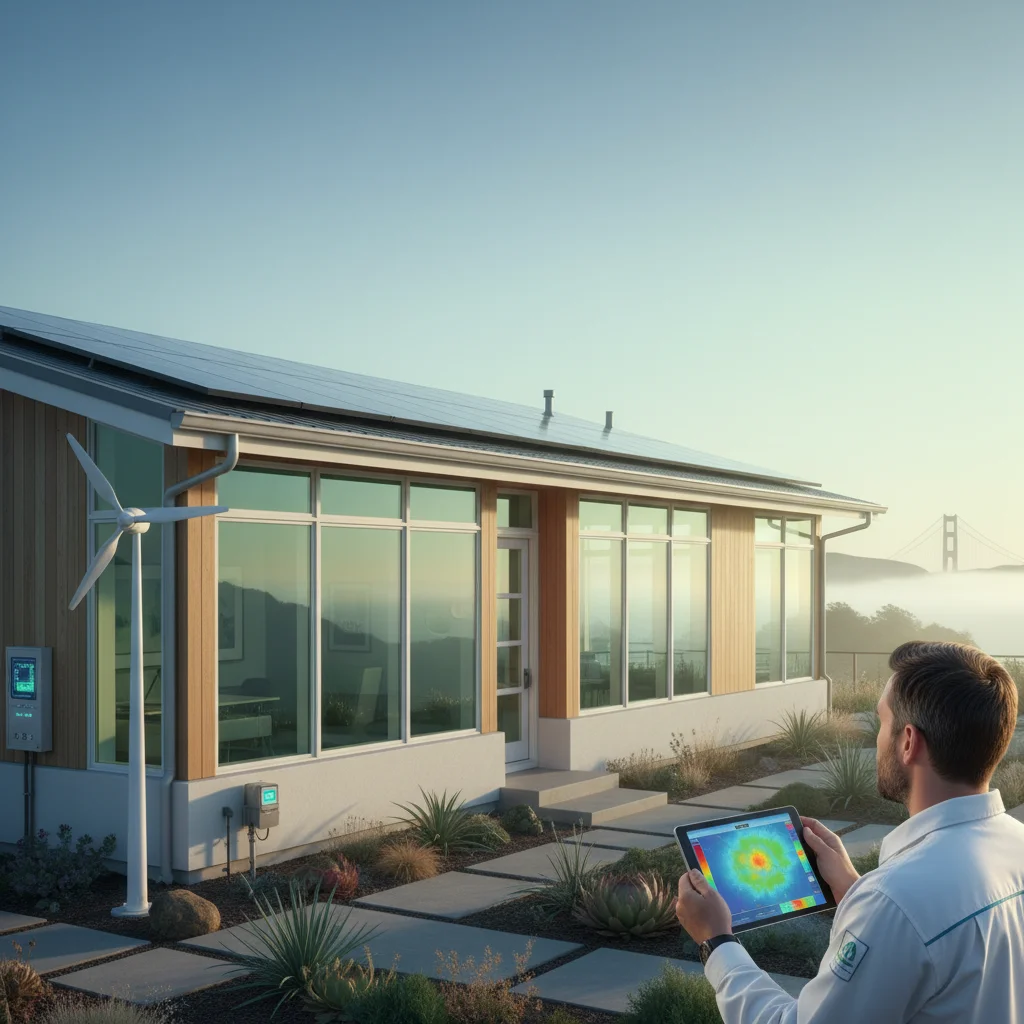
Bay Area homeowners spent an average of $547 on professional energy audits in 2025, yet 73% never recouped the cost through rebate-qualifying upgrades because they didn't understand which improvements unlocked federal tax credits worth up to $3,200 per year. The gap between audit completion and rebate capture costs California households an estimated $127 million annually in unclaimed incentives.
Professional energy audits in the Bay Area cost $400–$800 in 2026, with BayREN offering free audits for income-qualified households and utility companies providing $150–$250 rebates upon completion. Comprehensive audits identify rebate-eligible upgrades worth $8,000–$15,000 in combined federal tax credits and state incentives.
So why does an audit matter when you could just install equipment? Because the IRA's federal tax credit program requires specific efficiency thresholds—SEER2 16+ for heat pumps, U-factor 0.27 or lower for windows—that only a certified auditor can verify before installation. And homeowners who skip the audit step lose an average of $2,400 in stackable rebates by installing equipment that barely misses eligibility cutoffs.
How Much Does an Energy Audit Cost in the Bay Area?
Professional energy audits cost $400–$800 in the Bay Area in 2026, with prices varying by home size, audit depth, and equipment testing requirements. BayREN (Bay Area Regional Energy Network) offers free comprehensive audits for households earning below 80% of area median income, while Pacific Gas & Electric provides $150 rebates for completed audits that lead to qualifying upgrades within 12 months.
Standard audits ($400–$500) include blower door tests, thermal imaging, and appliance inventory. The federal Energy Efficient Home Improvement Credit (Section 25C) ended for property placed in service after December 31, 2025 (IRS FS-2025-05). Federal tax credits for this work have ended, but state, local and utility rebates may still apply; check what is available at your address with the DuloCore rebate calculator.
San Francisco homeowners pay 15–20% more than East Bay or South Bay residents due to higher labor rates, with median audit costs of $680 versus $520 in San Jose or $490 in Oakland. The federal Energy Efficient Home Improvement Credit (Section 25C) ended for property placed in service after December 31, 2025 (IRS FS-2025-05).
Bay Area Air Quality Management District subsidizes audits for homeowners replacing gas furnaces with electric heat pumps, covering up to $300 of audit costs when combined with equipment rebates of $3,000–$6,000. So a $600 audit that identifies a qualifying heat pump upgrade effectively costs $300 after the district rebate, then unlocks federal credits worth $2,000 plus utility incentives averaging $1,800.
Free audits through BayREN's Single-Family Home Upgrade Program include professional reports detailing projected savings, rebate eligibility, and contractor referrals. But income limits restrict access—$106,900 for a family of four in most Bay Area counties, rising to $128,280 in San Francisco and San Mateo counties where area median income exceeds $160,000.
What Equipment Qualifies for Rebates and Tax Credits After Your Audit?
Heat pumps with SEER2 16+ and HSPF2 9.0+ qualify for the federal Energy Efficient Home Improvement Credit worth up to $2,000 annually, plus California utility rebates of $2,000–$6,500 depending on climate zone and income level in 2026. Audit reports identify specific models meeting efficiency thresholds, preventing homeowners from installing equipment that misses rebate cutoffs by one SEER2 point and forfeiting $4,000+ in incentives.
Insulation upgrades recommended in audit reports qualify for federal tax credits up to $1,200 per year when they achieve R-38+ in attics or R-13+ in walls. And Energy Star certified windows with U-factor 0.27 or lower unlock an additional $600 credit, but only when installed as part of a whole-home weatherization plan documented in the original audit.
Electric panel upgrades required for heat pump installation qualify for the $600 federal credit when auditors document existing panel capacity below 200 amps. So a $2,500 panel upgrade costs $1,900 after credits, then enables installation of ducted heat pumps worth $15,000–$22,000 that would otherwise exceed electrical capacity.
Water heaters with Uniform Energy Factor (UEF) 3.0+ qualify for $2,000 federal credits when audit reports confirm existing units operate below 0.95 UEF. But Bay Area utilities add $500–$1,500 rebates for heat pump water heaters, creating total incentives of $3,500 that offset 50–70% of $4,800–$6,200 installed costs.
Duct sealing identified in blower door tests qualifies for utility rebates of $400–$800 when leakage exceeds 25% of total airflow. And PG&E's Home Upgrade program covers 100% of sealing costs up to $2,000 for income-qualified households, eliminating a barrier that costs the average Bay Area home $340 annually in wasted heating and cooling energy according to Energy.gov.
What Funding Options and Incentives Are Available to Cover Audit Costs?
BayREN's Home Upgrade Program covers 100% of audit costs for households earning below 80% AMI, with no out-of-pocket expense and no repayment required in 2026. Middle-income households (80–120% AMI) receive 50% cost-share grants reducing $600 audits to $300, while above-market-rate earners access utility rebates of $150–$250 upon completing qualifying upgrades within 12 months.
California's TECH Clean California initiative subsidizes audits for all-electric conversions, covering $200–$400 of assessment costs when homeowners commit to replacing gas furnaces with heat pumps rated HSPF2 9.0 or higher. And the program stacks with PG&E rebates, creating scenarios where a $650 audit costs $150 after a $400 TECH voucher and $100 utility rebate.
PACE financing (Property Assessed Clean Energy) through Renew Financial or Ygrene covers audit costs as part of comprehensive upgrade packages, with repayment through property tax assessments over 10–25 years at fixed rates of 6.5–8.9%. But PACE liens take priority over mortgages, creating refinancing complications that cost 17% of PACE borrowers an average of $3,200 in fees when selling homes before loan maturity.
"Home energy audits help you understand where your home is losing energy and money, and help you decide the best ways to make improvements." — Energy.gov Energy Saver
FHA 203(k) rehabilitation mortgages include energy audit costs in financed amounts when audits support eligible improvements like HVAC replacement or insulation upgrades. And Fannie Mae's HomeStyle Energy loan adds audit fees to conventional mortgages, allowing buyers to finance $500–$800 assessments over 30 years at current rates of 6.8–7.4%.
Some Bay Area municipalities offer zero-interest audit loans through sustainability offices, with typical limits of $1,000 and 24-month repayment terms. So a $600 audit costs $25 monthly for two years with no interest charges, unlocking rebates that exceed audit costs by 500–800% when homeowners install recommended equipment within program deadlines.
Use our free rebate calculator to estimate total incentives available after completing an energy audit.
How Do Rebate Stacking Rules Work When Combining Multiple Programs?
Federal tax credits, state rebates, and utility incentives stack without reduction in 2026, allowing homeowners to claim $2,000 IRS credits plus $3,000 California Tech Clean California rebates plus $1,800 PG&E incentives for a single heat pump installation. But claiming the federal credit requires reducing the equipment cost basis by the amount of utility rebates, lowering a $15,000 system to $10,200 after $4,800 in non-federal incentives before calculating the 30% credit.
BayREN incentives combine with federal credits but not with overlapping utility rebates from the same provider, creating a choice between BayREN's $3,500 heat pump rebates or PG&E's $2,000 equipment incentives plus $500 duct sealing credits. And income-qualified households stack both programs plus CalEnviroScreen priority community bonuses worth an additional 20–30%, reaching total subsidies of $8,000–$10,500 for comprehensive HVAC upgrades.
PACE financing stacks with all rebate programs but requires applying incentives to principal reduction rather than upfront cost offsets, complicating cash flow for contractors who front equipment costs. So a $20,000 heat pump project might require $15,000 PACE financing after $5,000 in immediate rebates, with federal credits claimed on the following year's tax return reducing effective borrowing costs but not initial contractor payments.
California Air Resources Board's Equitable Building Decarbonization program prohibits stacking with TECH Clean California for the same equipment component but allows combining home electrification rebates with federal credits. And households earning below 80% AMI access $14,000 maximum rebates through the federal High-Efficiency Electric Home Rebate Act (HEEHRA) launching in California during Q3 2026, which stack with IRS credits but replace existing state utility programs.
Timing rules require claiming federal credits in the tax year when equipment becomes operational, while state and utility rebates process within 60–90 days of installation verification. So homeowners installing systems in December 2026 claim credits on 2026 tax returns filed by April 2027, but receive utility checks by March 2027, creating temporary funding gaps that contractors address through third-party financing at 0–8.9% APR.
What Documentation and Pre-Approval Steps Do You Need Before Starting an Audit?
Homeowners schedule audits through BayREN, utility company portals, or independent BPI-certified auditors, with no pre-approval required for standard assessments but income verification needed for subsidized programs offering free or reduced-cost services. And submitting recent utility bills showing 12 months of energy usage accelerates the audit process, allowing auditors to model baseline consumption and project upgrade savings with 85–92% accuracy.
BayREN's income-qualified programs require submitting tax returns or pay stubs proving household earnings below 80% AMI—$106,900 for a family of four in Alameda County or $128,280 in San Francisco County as of 2026. But verification processes take 5–10 business days, delaying audit scheduling by 1–2 weeks compared to market-rate assessments that book within 48 hours.
Auditors need access to attics, crawl spaces, mechanical rooms, and all conditioned living areas, requiring homeowners to clear obstructions and provide ladder access to examine ductwork and insulation. And blower door tests necessitate closing all windows and exterior doors for 45–90 minutes while depressurizing the home to 50 Pascals, a process that reveals air leakage rates averaging 2,800–4,200 cubic feet per minute in pre-1980 Bay Area construction.
Pre-approval for PACE financing requires credit scores above 640 and debt-to-income ratios below 50%, with lenders verifying property tax payment history and existing mortgage status. So homeowners planning to finance audit-recommended upgrades through PACE submit applications before scheduling audits, securing $15,000–$50,000 credit lines within 7–14 days that cover both assessment costs and subsequent improvements.
Utility rebate programs like PG&E's Energy Savings Assistance require auditors to photograph equipment nameplates, measure duct leakage percentages, and document combustion appliance safety—data compiled into 15–25 page reports that serve as blueprints for contractor bids and rebate applications. And certified auditors upload reports directly to utility portals, streamlining rebate pre-approval processes that otherwise require manual document submission and 4–6 week processing times.
Energy Audit Timeline and Deadlines: When Should You Act in 2026?
BayREN audits book 2–4 weeks out during peak seasons (March–June and September–November) but schedule within 5–7 days during winter months when demand drops by 40–55%. And homeowners targeting federal tax credits for 2026 returns must complete equipment installations by December 31, 2026, requiring audit completion by August to allow 12–16 weeks for contractor sourcing, permitting, and installation.
California's TECH Clean California vouchers operate on a first-come, first-served basis with $120 million allocated for 2026, historically exhausting funds by October in high-demand markets like the Bay Area. So homeowners schedule audits by May to reserve voucher codes before September depletion, when the program shifts to a waitlist that delays projects into 2027 and forfeits current-year tax credit eligibility.
PG&E processes rebate applications within 60–90 days of installation verification, but applications submitted after November 15 routinely extend into the following calendar year due to year-end processing backlogs. Form 5695 only covers qualifying work completed by December 31, 2025 and claimed on a 2025 return; the federal 25C and 25D credits ended after that date (IRS FS-2025-05).
"A home energy audit helps you determine where your home is losing energy and money, and helps you decide what measures to take to make your home more energy-efficient." — ENERGY STAR Home Energy Audits
Income-qualified programs through BayREN prioritize applications received before June 30, when annual budgets reset and eligibility thresholds adjust based on updated AMI data from HUD. And households earning 78–82% AMI face qualification uncertainty during threshold transitions, creating 6–8 week verification delays that push audit dates into August and compress installation timelines.
HEEHRA rebates launching in California during Q3 2026 require pre-approval before equipment installation, with the California Energy Commission estimating 8–12 week application processing times once the portal opens. So homeowners planning to claim $8,000–$14,000 HEEHRA incentives schedule audits immediately upon portal launch to secure rebate reservations before the program's $291 million California allocation depletes.
Official Sources
- IRS Energy Incentives for Individuals — Federal tax credit details, eligibility requirements, and filing instructions (note: the federal 25C and 25D credits ended for projects completed after December 31, 2025)
- Energy.gov Energy Saver — Comprehensive energy audit guidance and expected savings data
- ENERGY STAR Home Energy Audits — Certified auditor directories and program standards
Related Reading: Learn more about Diy Vs Professional Energy Audit Cost and Ductwork Inspection Energy Audit.
Related Reading: Learn more about Building Science Energy Audit and Can I Do My Own Energy Audit.
Frequently Asked Questions
How much does an energy audit cost in the Bay Area?
Professional energy audits cost $400–$800 in the Bay Area in 2026, with prices varying by home size and audit complexity. BayREN offers free audits for households earning below 80% of area median income ($106,900 for a family of four), while PG&E provides $150–$250 rebates when homeowners complete qualifying upgrades within 12 months. And comprehensive audits including blower door tests and duct leakage analysis cost $600–$800 but identify rebate-eligible improvements worth $8,000–$15,000 in combined incentives.
What is included in a professional energy audit?
Comprehensive audits include blower door tests measuring air infiltration rates, thermal imaging identifying insulation gaps, duct leakage testing quantifying HVAC efficiency losses, and appliance inventory documenting equipment efficiency ratings. Auditors produce detailed reports specifying which upgrades qualify for federal tax credits up to $3,200 annually and state rebates averaging $4,500 per project. And BPI-certified assessments include combustion safety analysis and detailed energy modeling projecting 12-month savings from recommended improvements with 85–92% accuracy.
Are energy audits free or do I have to pay for them?
BayREN provides free comprehensive audits for households earning below 80% AMI, while middle-income households (80–120% AMI) receive 50% cost-share grants reducing $600 audits to $300 in 2026. Above-market-rate earners pay full audit costs of $400–$800 but access utility rebates of $150–$250 upon completing qualifying upgrades. And TECH Clean California covers $200–$400 of audit costs when homeowners commit to all-electric conversions, stacking with PG&E rebates to reduce out-of-pocket expenses to $150–$200 for market-rate households.
How long does an energy audit take?
Standard energy audits take 2–3 hours for homes under 2,000 square feet, extending to 3–5 hours for larger homes or properties requiring duct leakage testing and combustion safety analysis. Blower door tests run 45–90 minutes while depressurizing the home to measure air infiltration rates averaging 2,800–4,200 CFM in pre-1980 Bay Area construction. And auditors deliver preliminary findings during the on-site visit, with final reports including rebate documentation and contractor referrals arriving within 5–7 business days.
Will an energy audit help me qualify for rebates?
Energy audits identify specific equipment upgrades meeting federal efficiency thresholds—SEER2 16+ for heat pumps, UEF 3.0+ for water heaters—required to claim tax credits worth $2,000–$3,200 annually through 2032. And audit reports satisfy utility rebate documentation requirements, streamlining applications for incentives averaging $4,500 per project in the Bay Area. But homeowners who skip audits lose an average of $2,400 in stackable rebates by installing equipment that misses eligibility cutoffs, according to California Energy Commission data showing 31% of non-audited installations fail to qualify for maximum incentives.
Ready to find out how much you can save? Use our rebate calculator to see your personalized audit and upgrade incentives based on your home's location, income level, and planned improvements. Get instant estimates for federal tax credits, state rebates, and utility incentives—all in one place.
Last reviewed: April 14, 2026. Reviewed by DuloCore Energy Specialists. About the team.