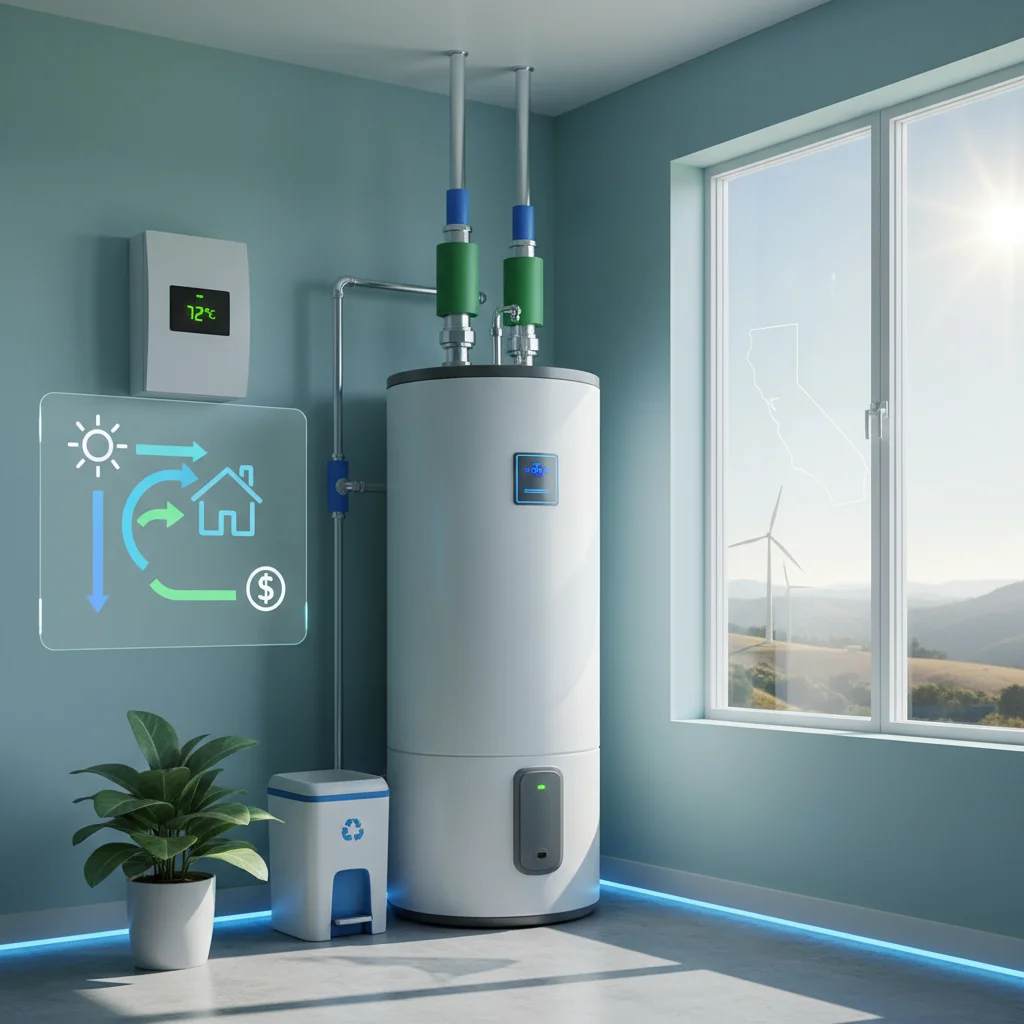
California homeowners who switched to electric heat pump water heaters in 2025 saved an average of $4,100 between state rebates, utility incentives, and federal tax credits—and that money landed in their accounts within 90 days. But the 2026 rebate landscape looks different. The federal home energy tax credits (Sections 25C and 25D) ended for projects completed after December 31, 2025 (IRS FS-2025-05). Federal tax credits for this work have ended, but state, local and utility rebates may still apply; check what is available at your address with the DuloCore rebate calculator. State budgets shifted. Utility programs changed their income tiers. And the documentation requirements got stricter.
What Electric Water Heater Rebates Are Available in California Right Now?
California electric water heater rebates in 2026 include three primary funding sources: the federal IRA residential clean energy credit covering 30% of equipment and installation costs up to $2,000, the California Tech Clean program offering $1,750-$4,270 based on household income, and utility-specific incentives ranging from $500 to $2,500 depending on service territory and energy efficiency tier.
So homeowners replacing a gas water heater with an electric heat pump model can access $3,000-$8,000 in total rebate value. And that's before calculating the $300-$550 annual energy savings from reduced water heating costs.
The federal Residential Clean Energy Credit (Section 25D) ended for expenditures made after December 31, 2025, and the IRS treats an expenditure as made when installation is completed (IRS FS-2025-05). The credit covers heat pump water heaters with a Uniform Energy Factor (UEF) of 2.0 or higher. Installation costs qualify. The maximum federal credit is $2,000 per household, regardless of how many qualifying improvements you make.
California's Tech Clean California program launched in 2024 and continues through 2026 with $285 million in funding. But the program operates on a first-come, first-served basis. Once regional allocation caps are reached, applications close until the next funding cycle. As of April 2026, Southern California regions show 67% of allocated funds already claimed.
"Heat pump water heaters use up to 60% less energy than conventional electric resistance models and can save households $330 per year on average." — U.S. Department of Energy
Utility rebates vary by provider. Pacific Gas & Electric offers $500-$1,500 for residential heat pump water heaters depending on tank size and UEF rating. Southern California Edison provides $750-$2,000. San Diego Gas & Electric caps rebates at $1,200. And municipal utilities like Sacramento Municipal Utility District (SMUD) offer $2,500 for qualifying low-income households.
How Much Money Can You Save With California's Electric Water Heater Rebates?
California electric water heater rebate savings in 2026 range from $3,000 to $8,770 depending on household income, utility territory, and equipment efficiency tier. Low-income households (earning 80% or less of area median income) qualify for maximum state rebates of $4,270 plus federal credits of $2,000 plus utility incentives averaging $1,500, totaling $7,770 in direct financial assistance.
Moderate-income households earning 80%-150% of area median income receive $2,750 from Tech Clean California, $2,000 from federal IRA credits, and $500-$2,500 from utilities. That's $5,250-$7,250 total. And households above 150% AMI still access $1,750 state rebates plus $2,000 federal credits plus utility incentives, totaling $4,250-$6,250.
But upfront equipment and installation costs matter. A qualifying heat pump water heater with professional installation runs $3,500-$6,000 in California. So low-income households installing a $5,000 system with $7,770 in rebates actually make $2,770 on the transaction. Moderate-income households installing the same system pay $0-$1,750 out of pocket after rebates. And higher-income households pay $750-$1,750 net cost.
And those are just the upfront savings. Annual operating cost reductions add $300-$550 per year for households replacing gas water heaters. Over a 15-year equipment lifespan, that's $4,500-$8,250 in energy savings—pushing total lifetime value to $7,500-$16,000.
Use our free rebate calculator to see exactly how much you'll save based on your household income, utility provider, and current water heater type.
What Are the Eligibility Requirements for California Electric Water Heater Rebates?
California electric water heater rebate eligibility in 2026 requires three core criteria: the equipment must be an ENERGY STAR certified heat pump water heater with UEF rating of 2.0 or higher, the installation must replace an existing gas or electric resistance water heater, and the property must be a single-family home, duplex, or manufactured home used as a primary residence.
Income thresholds determine rebate amounts. Low-income households earning ≤80% of area median income (AMI) qualify for maximum rebates. In Los Angeles County, that's $70,400 for a single-person household or $100,480 for a family of four. Moderate-income households earning 80%-150% AMI ($70,400-$132,000 for a four-person household in LA County) receive mid-tier rebates. And households above 150% AMI qualify for base rebates with no income cap.
But renters face additional barriers. Tech Clean California requires property owner approval and proof of residence. The federal IRA credit requires taxpayers to have sufficient tax liability to claim the credit—renters without mortgage interest deductions often can't use the full $2,000. So renters typically access only utility rebates unless their landlord participates in the installation and transfers rebate benefits.
"California's area median income thresholds are updated annually and vary by county. Applicants should verify current AMI limits before applying." — California Energy Commission
Additional eligibility rules include permit requirements (most jurisdictions require building permits for water heater replacement), electrical panel capacity (some homes need panel upgrades to support heat pump water heaters), and contractor licensing (installers must hold C-36 plumbing licenses in California). And all equipment must be purchased new—used or refurbished units don't qualify.
What Documentation Do You Need to Claim Your Electric Water Heater Rebate?
California electric water heater rebate applications in 2026 require four mandatory document categories: proof of purchase (itemized invoice showing equipment make, model, UEF rating, and purchase date), proof of installation (contractor invoice with C-36 license number, permit number, and installation date), proof of income (recent tax return or paystubs for income-tiered programs), and proof of residence (utility bill or property tax statement).
Tech Clean California applications use the online portal at techcleanca.com and require digital uploads. Form 5695 only covers qualifying work completed by December 31, 2025 and claimed on a 2025 return; the federal 25C and 25D credits ended after that date (IRS FS-2025-05). And utility rebates use provider-specific portals—PG&E uses the online rebate center, SCE uses the My Account portal, and SDG&E uses the Business & Rebates section.
But documentation timing matters. Tech Clean California requires pre-approval before equipment purchase for maximum rebates. Post-installation applications receive reduced amounts if funding remains available. Federal IRA credits can be claimed retroactively for up to three years. And utility rebates must be submitted within 90-180 days of installation depending on provider.
Photo documentation helps. Take pictures of the old water heater nameplate before removal, the new unit nameplate after installation, and the electrical panel showing the dedicated circuit. And keep the ENERGY STAR certification sheet that comes with the equipment—rebate processors verify UEF ratings against manufacturer specifications.
Missing documentation causes 34% of rebate application delays in California. So gather everything before starting the application. And make copies—some programs require original receipts, others accept digital scans, and you'll need your own records for tax filing.
What's the Deadline for Applying for California Electric Water Heater Rebates?
California electric water heater rebate deadlines in 2026 vary by program: Tech Clean California accepts applications on a rolling basis until regional funding is exhausted (Southern California regions show 67% depletion as of April 2026), utility rebates must be submitted within 90-180 days post-installation depending on provider, and federal IRA credits can be claimed on tax returns filed through April 15, 2029 for equipment installed in 2026.
Tech Clean California doesn't have a fixed deadline. The program runs until the $285 million budget depletes. But regional allocation caps exist. Southern California Edison territory receives $98 million, PG&E territory gets $112 million, and SDG&E territory receives $41 million. Once a region hits its cap, applications close until the next legislative funding cycle—which might not happen until 2027 or later.
And processing times matter. Tech Clean California rebates process in 45-90 days from application approval. So households applying in December 2026 might not receive payment until March 2027. Utility rebates process faster—30-60 days on average.
Pre-approval timelines add 14-21 days. So homeowners planning installation should start applications 6-8 weeks before equipment purchase. And track regional funding status monthly—Tech Clean California publishes depletion rates on their public dashboard.
Can You Stack Multiple Rebates for Your Electric Water Heater?
California electric water heater rebate stacking in 2026 is explicitly allowed: homeowners can combine federal IRA credits ($2,000 max), state Tech Clean California rebates ($1,750-$4,270), and utility provider incentives ($500-$2,500) for the same installation without penalty. Total stacked value ranges from $4,250 to $8,770 depending on income tier and utility territory.
But stacking rules have nuances. The federal IRA credit calculates on gross equipment and installation costs before applying state or utility rebates. So a $5,000 installation qualifies for the full 30% federal credit (this federal credit ended for property placed in service after December 31, 2025) ($1,500) even if state rebates reduce out-of-pocket costs to $0. And Tech Clean California explicitly permits combining their rebates with other incentive programs—the application form includes checkboxes for utility rebates and federal credits.
Some utility programs have restrictions. PG&E's energy efficiency rebates can't combine with certain other PG&E programs in the same calendar year—but federal and state programs aren't affected. SCE allows full stacking across all program types. And SDG&E caps total combined utility incentives at $10,000 per household per year across all energy upgrades—but single water heater installations rarely hit that ceiling.
Documentation for stacked rebates requires separate applications to each program. Submit the same purchase invoice and installation receipt to all three. And note which other programs you're applying to in each application—some require disclosure, others don't, but transparency prevents processing delays.
For homeowners installing multiple upgrades (water heater plus HVAC plus insulation), consider timing. Federal IRA credits cap at $3,200 per year for efficiency improvements. So spreading projects across two tax years might maximize federal benefits. Calculate your energy tax credits eligibility before committing to installation dates.
Official Sources
- U.S. Department of Energy - Energy Saver — Federal guidance on heat pump water heater efficiency, savings estimates, and rebate programs
- DSIRE USA — Comprehensive database of state incentives for renewables and efficiency, including California programs
- California Energy Commission — State-level energy programs, area median income thresholds, and Tech Clean California updates
Frequently Asked Questions
What are the current electric water heater rebates available in California?
California's 2026 electric water heater rebates include the federal IRA residential clean energy credit providing 30% of costs up to $2,000, Tech Clean California state rebates ranging from $1,750 to $4,270 based on income, and utility-specific incentives from $500 to $2,500. Total available rebates range from $4,250 to $8,770 when stacked. All programs require ENERGY STAR certified heat pump water heaters with UEF ratings of 2.0 or higher.
How much can I save with an electric water heater rebate in California?
California homeowners save $3,000-$8,770 in upfront rebates plus $300-$550 annually in reduced energy costs when switching to heat pump water heaters. Low-income households (≤80% AMI) qualify for maximum rebates of $7,770, often exceeding equipment costs. Over a 15-year equipment lifespan, total savings reach $7,500-$16,000 including energy cost reductions. Use a rebate calculator to estimate savings for your household income and utility provider.
Am I eligible for an electric water heater rebate in California?
Eligibility requires an ENERGY STAR certified heat pump water heater with UEF ≥2.0, installation in a primary residence (single-family home, duplex, or manufactured home), and replacement of an existing gas or electric resistance unit. Income tier determines rebate amounts: ≤80% AMI qualifies for $4,270 state rebates, 80%-150% AMI receives $2,750, and >150% AMI gets $1,750. Renters need property owner approval for Tech Clean California rebates.
What is the process for claiming an electric water heater rebate in California?
Apply for Tech Clean California pre-approval at techcleanca.com before purchasing equipment, submit proof of purchase and installation within 90-180 days to utility rebate portals, and claim federal IRA credits on IRS Form 5695 when filing annual tax returns. Required documentation includes itemized invoices, contractor C-36 license numbers, building permit numbers, proof of income (tax returns or paystubs), and proof of residence (utility bills). Processing takes 30-90 days for state and utility rebates.
What is the deadline for applying for electric water heater rebates in California?
Tech Clean California operates on a rolling basis until the $285 million budget depletes by region (Southern California shows 67% depletion as of April 2026). Utility rebates require submission within 90-180 days post-installation depending on provider. Federal IRA credits can be claimed on tax returns through April 15, 2029 for 2026 installations. Pre-approval applications take 14-21 days, so start the process 6-8 weeks before equipment purchase.
Ready to find out exactly how much you'll save? Use our free rebate calculator to get a personalized estimate based on your household income, utility provider, and current water heater type. Get your rebate breakdown in under 60 seconds.
Last reviewed: April 14, 2026. Reviewed by DuloCore Energy Specialists. About the team.
Check your California water heater rebate eligibility — see the programs you qualify for and the dollar amounts on our California water heater rebate finder.