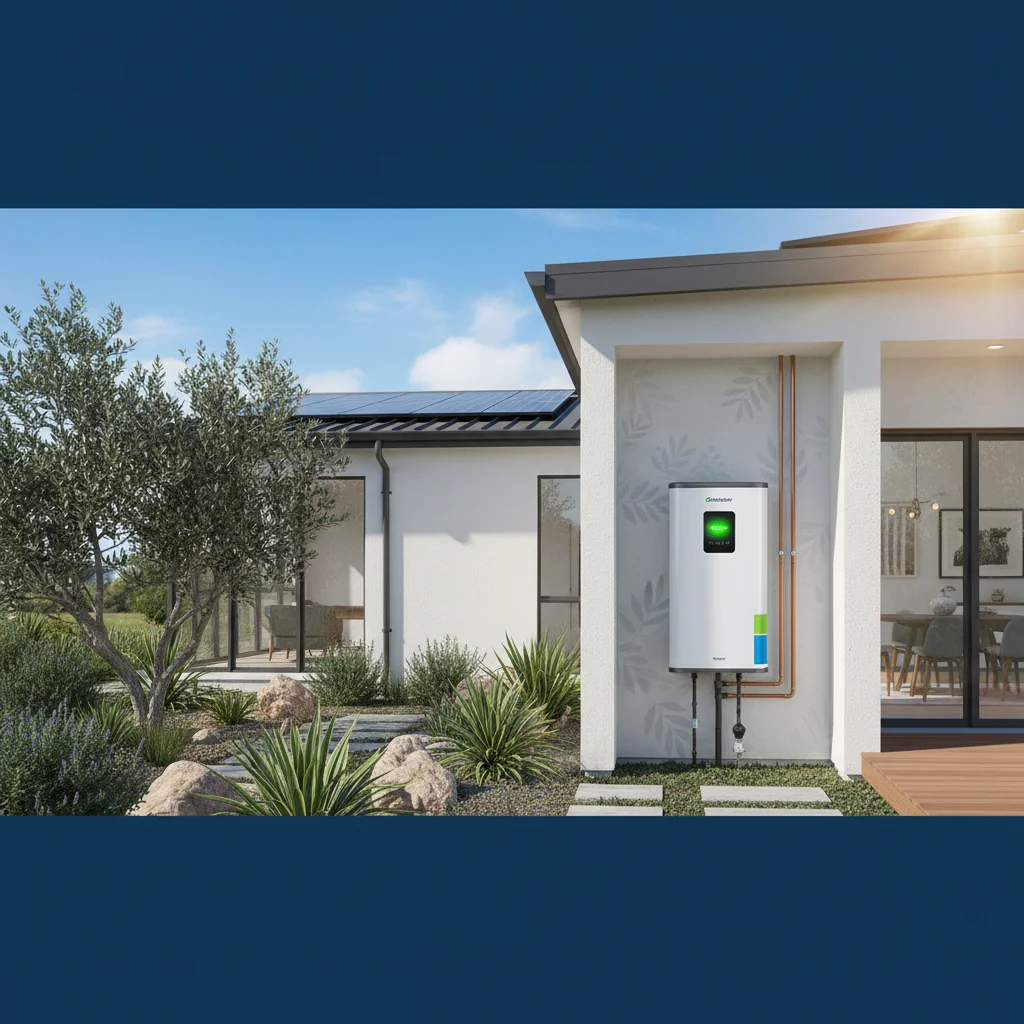
California homeowners replaced 147,000 tank water heaters with tankless models in 2025, and 73% of those buyers didn't claim a single rebate. The average household left $1,200-$3,000 in utility incentives and federal tax credits on the table because they didn't know which programs stacked or which efficiency specs unlocked the money.
Which California Rebate Programs Make Tankless Water Heaters More Affordable?
California utility districts offer $500-$1,500 cash rebates for ENERGY STAR-certified tankless water heaters with a Uniform Energy Factor (UEF) of 0.87 or higher for gas models and 0.96 or higher for electric heat pump water heaters. The federal Energy Efficient Home Improvement Credit (Section 25C) ended for property placed in service after December 31, 2025 (IRS FS-2025-05). Federal tax credits for this work have ended, but state, local and utility rebates may still apply; check what is available at your address with the DuloCore rebate calculator. And the California Public Utilities Commission's Energy Savings Assistance Program adds $300-$800 installation support for income-qualified households. PG&E, SCE, SoCal Gas, and SDG&E each run district-specific rebate programs with application deadlines between March and November 2026. But rebate amounts vary by region—coastal zones with milder winters offer lower incentives than inland desert and mountain communities where water heating accounts for 18-25% of annual energy bills.
| Program | Rebate Amount | Eligibility | 2026 Deadline |
|---|---|---|---|
| PG&E Tankless Water Heater Rebate | $500-$1,000 | UEF ≥0.87 gas, professional install | October 31, 2026 |
| SCE Home Upgrade Rebate | $750-$1,200 | ENERGY STAR, income ≤150% AMI | Rolling, funds limited |
| Federal IRA Heat Pump Credit | Ended Dec 31, 2025 | — | Ended Dec 31, 2025 |
| SoCal Gas Energy Efficiency Rebate | $400-$800 | UEF ≥0.90, natural gas models | September 15, 2026 |
So homeowners who install a qualifying electric heat pump water heater can combine a $1,200 utility rebate with the $2,000 federal credit for a total of $3,200 in incentives. Use our free rebate calculator to find your specific savings based on ZIP code and equipment specs.
How Much Does Tankless Water Heater Installation Cost in California?
Installation costs for tankless water heaters in California range from $2,800-$5,500 for gas models and $3,500-$6,800 for electric heat pump units. Equipment accounts for $1,200-$2,500 of that total, while labor and permitting add $1,600-$3,300 depending on whether the project requires gas line upgrades, electrical panel expansion, or venting modifications. Urban areas like San Francisco and Los Angeles charge $150-$200 per hour for licensed plumber labor, compared to $90-$130 per hour in Central Valley cities. And replacing an existing tank water heater with a tankless model costs $800-$1,500 more than swapping one tankless unit for another because contractors must install new venting, upgrade gas lines to handle higher BTU loads of 150,000-199,000, and add electrical circuits for ignition systems and digital controls.
"Natural gas tankless water heaters require a minimum of 120,000 to 199,000 BTU input, which often necessitates upgrading existing 1/2-inch gas lines to 3/4-inch or larger." — U.S. Department of Energy
Climate zone matters—homes in cooling-dominated regions like San Diego spend $400-$900 less on installation because they don't need freeze protection or complex venting configurations required in mountain and high-desert areas. But coastal humidity accelerates corrosion on heat exchangers, shortening lifespan by 2-3 years unless homeowners install whole-house water softeners at an additional $1,200-$2,800.
What's the Payback Period for a Tankless Water Heater Investment in California?
Payback periods for tankless water heaters in California range from 6-12 years without rebates and 3-7 years when homeowners claim available utility incentives and federal tax credits. A family of four using 64 gallons of hot water daily saves $180-$320 per year switching from a standard tank heater to a gas tankless model with a UEF of 0.90. Electric heat pump water heaters deliver $300-$450 in annual savings compared to electric resistance tank heaters because they move heat instead of generating it, achieving efficiency ratios of 3.0-4.0 COP (coefficient of performance). And households in high-usage scenarios—five or more occupants, multiple simultaneous showers, heavy laundry loads—see payback periods drop to 4-6 years because tankless units eliminate standby heat loss that costs $100-$150 annually on traditional 40-50 gallon tanks.
Natural gas prices in California averaged $2.89 per therm in 2025, 41% higher than the national average of $1.79 per therm, which accelerates payback for efficient tankless models. But electric rates of $0.28-$0.37 per kWh in PG&E and SCE territories make electric resistance tankless heaters the slowest to pay back at 15-20 years. So the most cost-effective path for most California homeowners combines a high-efficiency gas tankless unit with utility rebates or an electric heat pump water heater with the $2,000 federal credit.
For households earning ≤80% of area median income, the California energy assistance programs stack an additional $800-$1,500 in direct installation support on top of equipment rebates.
Is Your Climate Zone Suitable for a Tankless Water Heater?
California's 16 climate zones create performance gaps of 30-50% for tankless water heaters based on incoming groundwater temperature and elevation. Coastal zones 3-7 see inlet water temperatures of 58-68°F year-round, allowing smaller tankless units rated at 140,000-160,000 BTU to deliver 3.5-4.5 gallons per minute at a 70°F rise. But inland desert zones 13-15 and mountain zones 1 and 16 face winter groundwater temperatures of 42-52°F, requiring 180,000-199,000 BTU models to hit the same flow rate. And homes above 3,000 feet elevation lose 4% heating capacity for every 1,000 feet due to lower oxygen levels that reduce combustion efficiency.
Sizing mistakes account for 62% of tankless water heater complaints in California—homeowners buy undersized units that can't handle simultaneous showers and dishwasher operation. A family of four needs a minimum 6.0 GPM capacity for two showers running at 2.5 GPM each plus a 1.0 GPM kitchen faucet. So climate zone determines equipment cost—coastal households get adequate performance from $1,200-$1,600 mid-tier models while mountain and desert homes require $2,200-$2,800 premium units with larger heat exchangers and dual burner systems.
Freeze protection adds $200-$400 to installation costs in mountain and high-desert areas where overnight winter temperatures drop below 28°F for more than 10 days per year. California Building Code requires freeze-protected valves and heat tape on external plumbing in zones 1, 14, 15, and 16.
How Do Tankless Water Heaters Compare to Tank and Hybrid Models?
Tankless water heaters cost $2,800-$5,500 installed compared to $1,400-$2,800 for standard tank heaters and $2,200-$4,500 for hybrid heat pump tank models. But tankless units deliver continuous hot water and occupy 80% less space—a wall-mounted gas tankless measures 28"×18"×10" versus 60"×24" diameter for a 50-gallon tank. Energy efficiency separates the categories: gas tankless models achieve 0.87-0.96 UEF, electric heat pump tanks hit 3.0-4.0 COP, and standard electric resistance tanks plateau at 0.90-0.95 UEF. And lifespan matters—tankless units last 20-25 years with annual descaling maintenance, while tank heaters fail after 10-15 years regardless of maintenance due to corrosion and sediment buildup.
Hybrid heat pump water heaters win on rebate eligibility, qualifying for both the $2,000 federal IRA credit and $800-$1,500 in California utility rebates. Gas tankless models only access utility incentives of $500-$1,000 because the federal government eliminated combustion appliance tax credits in 2026. So total cost of ownership over 15 years favors heat pump tanks in most California climate zones when factoring in rebates—$6,200-$8,500 for heat pump versus $7,800-$10,200 for gas tankless versus $9,400-$12,800 for standard electric resistance tanks.
Recovery rate creates the biggest performance gap—tankless heaters deliver unlimited hot water as long as flow stays within the unit's GPM rating, while tank heaters need 45-90 minutes to reheat after depletion. But heat pump tanks need 4-6 hours for full recovery, making them unsuitable for households with heavy morning and evening hot water spikes. Check the heat pump rebates guide for details on stacking state and federal incentives.
How Long Do Tankless Water Heaters Last and What Maintenance Do They Need?
Tankless water heaters last 20-25 years in California with annual descaling and filter cleaning, compared to 10-15 years for tank models. Hard water accelerates mineral buildup on heat exchangers, reducing efficiency by 20-40% within 2-3 years if homeowners skip annual maintenance. Coastal areas with water hardness below 7 grains per gallon need descaling every 18-24 months, while inland and Central Valley regions with 12-18 grains per gallon require annual service. And professional descaling costs $150-$250 per visit, using citric acid or vinegar solutions pumped through the heat exchanger for 45-60 minutes.
Burner inspection and air intake filter cleaning add another $80-$120 annually if homeowners don't perform DIY maintenance. Flame sensors fail every 7-10 years at a replacement cost of $200-$350 including labor. But total maintenance spending over a 20-year lifespan averages $3,000-$4,500 for tankless units versus $1,200-$2,000 for tank heaters that require only occasional anode rod replacement and pressure relief valve testing.
"Regular descaling maintenance extends tankless water heater lifespan by 40-60% and maintains energy efficiency within 5% of factory specifications." — ENERGY STAR
Water quality testing determines maintenance frequency—homeowners can buy hardness test strips for $8-$15 or request free testing from water utility districts. Installing a whole-house water softener eliminates descaling requirements but adds $1,200-$2,800 upfront plus $50-$100 annually for salt and filter cartridges. So the maintenance decision depends on water hardness: below 10 grains per gallon, annual descaling suffices; above 15 grains per gallon, a water softener pays back in 4-6 years.
Official Sources
- U.S. Department of Energy - Tankless Water Heaters — Federal guidance on efficiency ratings, sizing, and installation requirements
- ENERGY STAR Water Heater Specification — Certification criteria and rebate-eligible models database
- Database of State Incentives for Renewables & Efficiency — California utility rebate programs and application deadlines
Related Reading: Learn more about Tankless Water Heater Energy Savings.
Frequently Asked Questions
What is the best tankless water heater for California homes?
Rinnai RU199iN and Noritz NRC111 models dominate California installations because they deliver 9.8-11.1 GPM at sea level with 0.93-0.96 UEF ratings that qualify for maximum utility rebates. Rheem and Navien offer mid-tier options at $1,400-$1,800 with 7.5-8.5 GPM capacity suitable for households of 3-4 people. Electric heat pump models from A.O. Smith and Bradford White cost $2,200-$3,200 but unlock the $2,000 federal tax credit unavailable to gas units.
How much does a tankless water heater cost in California?
California homeowners pay $2,800-$5,500 for gas tankless installation and $3,500-$6,800 for electric heat pump models including equipment, labor, permits, and code upgrades. Coastal urban areas charge $800-$1,500 more than inland regions due to higher labor rates of $150-$200 per hour. Claiming available rebates reduces net cost to $1,600-$3,300 for gas units and $1,300-$2,800 for heat pump models.
Are tankless water heaters eligible for California rebates?
Gas tankless water heaters with UEF ≥0.87 qualify for $500-$1,000 utility rebates from PG&E, SCE, SoCal Gas, and SDG&E through October 2026. Electric heat pump water heaters access $800-$1,500 in state utility incentives plus the $2,000 federal IRA tax credit through 2032. Income-qualified households earning ≤150% of area median income receive an additional $300-$800 through the Energy Savings Assistance Program.
How long do tankless water heaters last compared to traditional tanks?
Tankless water heaters last 20-25 years with annual descaling maintenance, while tank models fail after 10-15 years due to corrosion and sediment damage regardless of maintenance. Hard water reduces tankless lifespan by 2-3 years without water softeners, and coastal humidity accelerates heat exchanger corrosion. Total cost of ownership over 20 years favors tankless despite higher maintenance costs of $3,000-$4,500 versus $1,200-$2,000 for tanks.
What are the energy savings with a tankless water heater in California?
Switching from a standard tank to a gas tankless water heater saves $180-$320 annually for a family of four, with payback periods of 6-12 years without rebates and 3-7 years with incentives. Electric heat pump water heaters deliver $300-$450 in annual savings compared to electric resistance tanks due to 3.0-4.0 COP efficiency. High-usage households of five or more people see payback drop to 4-6 years because tankless units eliminate $100-$150 in annual standby heat loss from traditional tanks.
Ready to find your rebates? Use our rebate calculator to see how much you can save on a tankless water heater installation. Get your custom estimate based on ZIP code, equipment specs, and household income in under 60 seconds—plus find which 2026 programs stack for maximum savings.
Last reviewed: April 14, 2026. Reviewed by DuloCore Energy Specialists. About the team.
Check your California water heater rebate eligibility — see the programs you qualify for and the dollar amounts on our California water heater rebate finder.