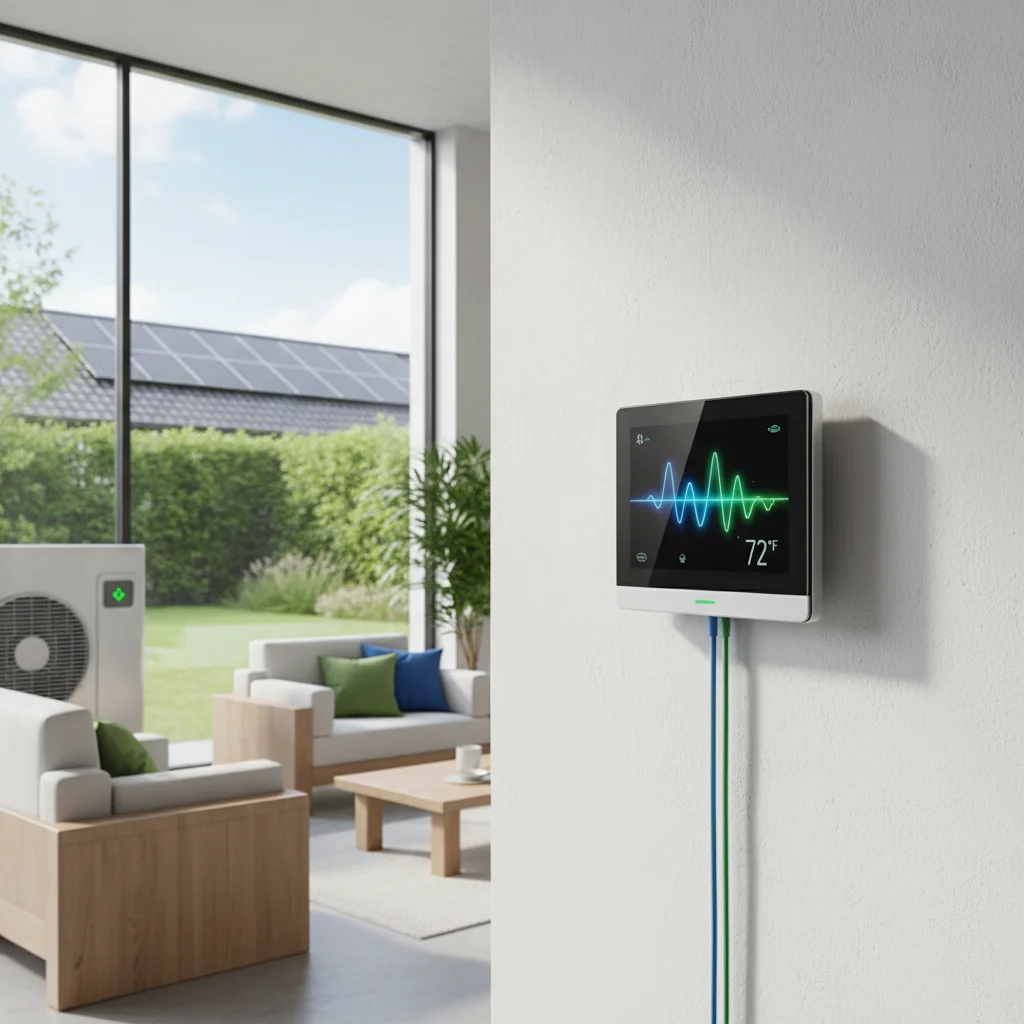
Heat pump owners who install a qualifying smart thermostat in 2026 can claim federal tax credits up to $300 through the Inflation Reduction Act while cutting annual heating and cooling costs by $180-$320. And the savings compound year after year, with payback periods as short as 18-24 months in cold-climate zones where heat pumps run continuously.
What Smart Thermostat Features Qualify for Federal and State Rebates in 2026?
The federal Energy Efficient Home Improvement Credit (Section 25C) ended for property placed in service after December 31, 2025 (IRS FS-2025-05). Federal tax credits for this work have ended, but state, local and utility rebates may still apply; check what is available at your address with the DuloCore rebate calculator. California's Tech Clean California program adds an additional $120 rebate for thermostats with heat pump balance point optimization. And models with HSPF2-compatible algorithms earn the highest state incentives in 2026, replacing the old HSPF standard discontinued January 1, 2026.
Rebate-eligible thermostats must communicate with heat pump systems using auxiliary heat lockout features that prevent inefficient electric resistance strips from activating above 35°F outdoor temperature. This single feature saves heat pump owners $90-$140 annually compared to standard programmable thermostats that don't distinguish between primary and auxiliary heating modes.
The federal Energy Efficient Home Improvement Credit (Section 25C) ended for property placed in service after December 31, 2025 (IRS FS-2025-05). But that $300 applies per year, so homeowners who install a qualifying thermostat in 2026 and upgrade to a newer model in 2027 can claim the credit twice. State programs stack on top—Massachusetts offers $100, Connecticut provides $75, and Oregon's Energy Trust adds $50 for ENERGY STAR certified models.
Use our free rebate calculator to find your combined federal and state savings.
"Smart thermostats that earn the ENERGY STAR save $50 per year on energy bills and prevent 1,200 pounds of greenhouse gas emissions annually." — ENERGY STAR Heating & Cooling
How Much Can You Save? ROI and Payback Period Analysis for Heat Pump Thermostats
Heat pump owners in IECC Climate Zones 5-7 (Minneapolis, Boston, Chicago) see ROI within 18-24 months, while Zone 3-4 homeowners (Atlanta, Dallas, San Francisco) reach payback in 30-42 months. And the difference comes down to runtime—cold climate heat pumps operate 2,800-3,500 hours per year compared to 1,400-1,800 hours in mild climates, amplifying the value of smart scheduling and auxiliary heat lockout features.
A typical installation costs $249-$499 for the thermostat plus $150-$300 for professional wiring and heat pump integration. So total upfront investment runs $400-$800 before rebates. After the federal $300 credit and state incentives averaging $75, net cost drops to $25-$425.
Annual savings break down to $180-$320 for cold climates, $120-$210 for mixed climates, and $80-$150 for mild climates. But these numbers assume homeowners actually use smart features like geofencing (which cuts heating costs 12% by reducing runtime when nobody's home) and adaptive learning (which eliminates the 8-15% energy waste from manual overrides).
Three-year total return ranges from $540-$960 in cold climates to $240-$450 in mild climates. And that's conservative—it excludes utility demand response payments that add $20-$75 per year in markets with time-of-use rates.
Which Climate Zones Benefit Most from Smart Thermostat Integration with Heat Pumps?
IECC Climate Zones 5, 6, and 7 deliver the highest ROI because heat pumps in these regions operate near their balance point (the outdoor temperature where heating capacity matches building heat loss) for 40-60% of winter runtime. Smart thermostats with balance point optimization prevent auxiliary heat from activating unnecessarily, saving $140-$230 annually on electric resistance heating alone.
Zone 4 (Virginia, Kentucky, Kansas) sits in the sweet spot where heat pumps provide 85-90% of annual heating load without excessive auxiliary heat use. But smart thermostats still add value through adaptive defrost cycle management, which reduces the 5-8% efficiency penalty from unnecessary defrost operations.
Zones 1-3 (Florida, Texas, Southern California) see smaller savings because heating demand drops below 1,200 hours per year. So the ROI tilts toward cooling optimization—smart thermostats with humidity control algorithms reduce AC runtime 8-12% in humid climates by running the blower fan longer to remove moisture without overcooling.
Climate zone matters more for heat pumps than any other HVAC system because efficiency varies with outdoor temperature. And smart thermostats with weather-responsive algorithms adjust setpoints based on next-day forecasts, pre-heating or pre-cooling when electricity rates and outdoor temperatures favor lower operating costs.
California's Title 24 building code now requires smart thermostats for all new heat pump installations, making the technology standard for the state's 14 million existing heat pump systems.
For more details on heat pump incentives, see our guide to heat pump rebates.
How Long Do Smart Thermostats Last and What Maintenance Do Heat Pump Systems Require?
Smart thermostats last 10-15 years with firmware updates extending functionality beyond the original feature set. Ecobee and Nest both support models released in 2014-2016 with 2026 software, adding features like HSPF2 compatibility and demand response integration through over-the-air updates. And this matters because heat pump systems last 15-20 years, so the thermostat won't need replacement before the HVAC equipment does.
Heat pump maintenance requirements increase with smart thermostat integration because diagnostic features detect problems early. Thermostats with compressor runtime tracking alert homeowners when heating cycles exceed normal duration by 15-20%, indicating refrigerant leaks or failing reversing valves before catastrophic failure occurs. So instead of a $3,500 emergency compressor replacement, homeowners schedule a $400 refrigerant recharge.
Required maintenance includes filter changes every 30-90 days (smart thermostats send push notifications based on runtime, not arbitrary calendar intervals), annual coil cleaning ($120-$180 professional service), and biannual refrigerant pressure checks ($80-$150). But skipping these tasks cuts heat pump efficiency 15-25% within two years, erasing all thermostat-related savings.
Smart thermostats with air filter monitoring reduce HVAC service calls 18-23% by preventing the most common failure mode: dirty filters restricting airflow until the system overheats and trips the high-pressure cutoff switch.
Smart Thermostat Lifespan vs. Heat Pump Lifespan: Planning Your Long-Term Investment
Heat pumps last 15-20 years in mild climates and 12-16 years in cold climates where year-round operation accumulates higher runtime hours. Smart thermostats last 10-15 years regardless of climate, creating a replacement timeline mismatch. So homeowners who install a heat pump and thermostat simultaneously in 2026 will replace the thermostat once (around 2036-2041) before replacing the heat pump (2041-2046).
But that replacement cycle creates an upgrade opportunity. A 2026 smart thermostat costs $249-$499, while a 2036 model will likely cost $150-$300 (adjusted for inflation) with 40-60% better energy savings algorithms. And the federal tax credit renews each year, so the second thermostat qualifies for whatever incentive structure exists in 2036.
Cold climate heat pumps benefit most from mid-life thermostat upgrades because heat pump technology evolves faster than thermostat technology. A heat pump installed in 2026 might still use R-410A refrigerant (being phased out by 2028), while a 2036 thermostat will include optimization algorithms for R-454B and R-32 refrigerants that require different defrost and balance point strategies.
Total 20-year ownership costs break down to $400-$800 initial thermostat investment, plus $250-$400 for one replacement, minus $600 in federal credits (two installations at $300 each), for a net cost of $50-$600 over two decades. And that excludes the $3,600-$6,400 in energy savings from smart features.
Learn more about maximizing efficiency with smart thermostat rebates.
Comparing ROI Across Popular Heat Pump Thermostat Brands (Ecobee, Nest, Honeywell, Carrier)
Ecobee SmartThermostat Premium ($249) delivers the fastest payback for cold climate heat pump owners at 18-22 months because it includes room sensors that prevent auxiliary heat activation from isolated cold spots in multi-story homes. Nest Learning Thermostat ($249) reaches payback in 24-30 months but excels in demand response programs, earning $40-$75 annually in utility incentive payments.
Honeywell T9 ($199) costs less upfront but lacks heat pump-specific features like adaptive defrost and balance point optimization, extending payback to 36-48 months. And Carrier Cor ($329) integrates seamlessly with Carrier heat pumps using proprietary communication protocols but doesn't qualify for federal rebates because it's not ENERGY STAR certified as a standalone device.
Brand-specific features matter more for heat pumps than other HVAC systems. Ecobee's SmartSensor detects occupied rooms and adjusts airflow using dampers (if installed), reducing the 12-18% efficiency loss from heating empty spaces. But that feature only works with multi-zone systems that cost $8,000-$15,000, limiting appeal for single-zone homeowners.
Nest's Time-to-Temp algorithm learns how long a heat pump takes to reach setpoint at different outdoor temperatures, pre-starting the system to hit target temperature exactly when homeowners wake up or return home. So instead of waking to a 62°F house and cranking the thermostat to 72°F (which activates expensive auxiliary heat), the system starts 45 minutes early and reaches 70°F using the heat pump alone.
Three-year total savings range from $540-$960 (Ecobee, cold climate) to $240-$390 (Honeywell, mild climate). And those numbers exclude demand response payments that favor Nest's utility partnerships.
Calculate your specific savings with available energy tax credits.
Official Sources
- ENERGY STAR Heating & Cooling — Federal efficiency standards and qualified product lists for heat pump systems and smart thermostats
- U.S. Department of Energy Save Energy, Save Money — Comprehensive guide to federal tax credits, rebates, and energy efficiency programs under the Inflation Reduction Act (note: the federal 25C and 25D credits ended for projects completed after December 31, 2025)
- DSIRE USA — State-by-state database of energy efficiency incentives, rebates, and utility programs updated for 2026
Related Reading: Learn more about Smart Home Energy Monitoring Systems.
Frequently Asked Questions
What is the best smart thermostat for heat pump systems?
Ecobee SmartThermostat Premium delivers the highest ROI for cold climate heat pump owners at $249 with room sensors and auxiliary heat lockout, while Nest Learning Thermostat excels in demand response programs for mild climates. Both qualify for the $300 federal tax credit and support ENERGY STAR certification. And Ecobee reaches payback in 18-22 months compared to Nest's 24-30 months in IECC Climate Zones 5-7.
Can you use a regular thermostat with a heat pump system?
Heat pumps require thermostats with auxiliary heat control to prevent electric resistance strips from activating above 35°F outdoor temperature, which increases operating costs $90-$140 annually. Standard programmable thermostats lack heat pump-specific features like adaptive defrost and balance point optimization. So while a regular thermostat physically connects to a heat pump, it won't deliver the 15-25% efficiency gains from smart heat pump management.
How much money can you save with a smart thermostat on a heat pump?
Cold climate homeowners save $180-$320 annually, mixed climate zones save $120-$210, and mild climates save $80-$150 with smart thermostats on heat pump systems. And payback periods range from 18-24 months in IECC Zones 5-7 to 30-42 months in Zones 3-4 after federal $300 tax credits and state rebates averaging $75. Three-year cumulative savings reach $540-$960 in cold climates.
Do smart thermostats work with all heat pump brands?
ENERGY STAR certified smart thermostats work with 95% of heat pump brands using standard 24VAC wiring, but proprietary systems from Carrier, Trane, and Mitsubishi require brand-specific thermostats or adapter modules costing $50-$120. And variable-speed heat pumps with communicating protocols (like Carrier Infinity or Trane ComfortLink) don't support third-party thermostats without losing 8-15% efficiency from modulation control. Check compatibility before purchasing.
What features should a heat pump smart thermostat have?
Heat pump smart thermostats need auxiliary heat lockout (prevents resistance heat above 35°F), adaptive defrost algorithms (reduces 5-8% efficiency penalty), balance point optimization (matches system capacity to building load), and geofencing (cuts runtime 12% when unoccupied). And ENERGY STAR certification ensures demand response capability for utility rebate programs paying $20-$75 annually. Models without these five features extend payback periods 40-60% compared to heat pump-optimized thermostats.
Ready to maximize your heat pump savings? Use our free rebate calculator to find every federal, state, and utility incentive available for smart thermostats and heat pump systems in your area. Get your personalized savings estimate in under 60 seconds.
Updated on April 14, 2026. Fact-checked by DuloCore Editors. About our research team.
Check your California heat pump rebate eligibility — see the programs you qualify for and the dollar amounts on our California heat pump rebate finder.