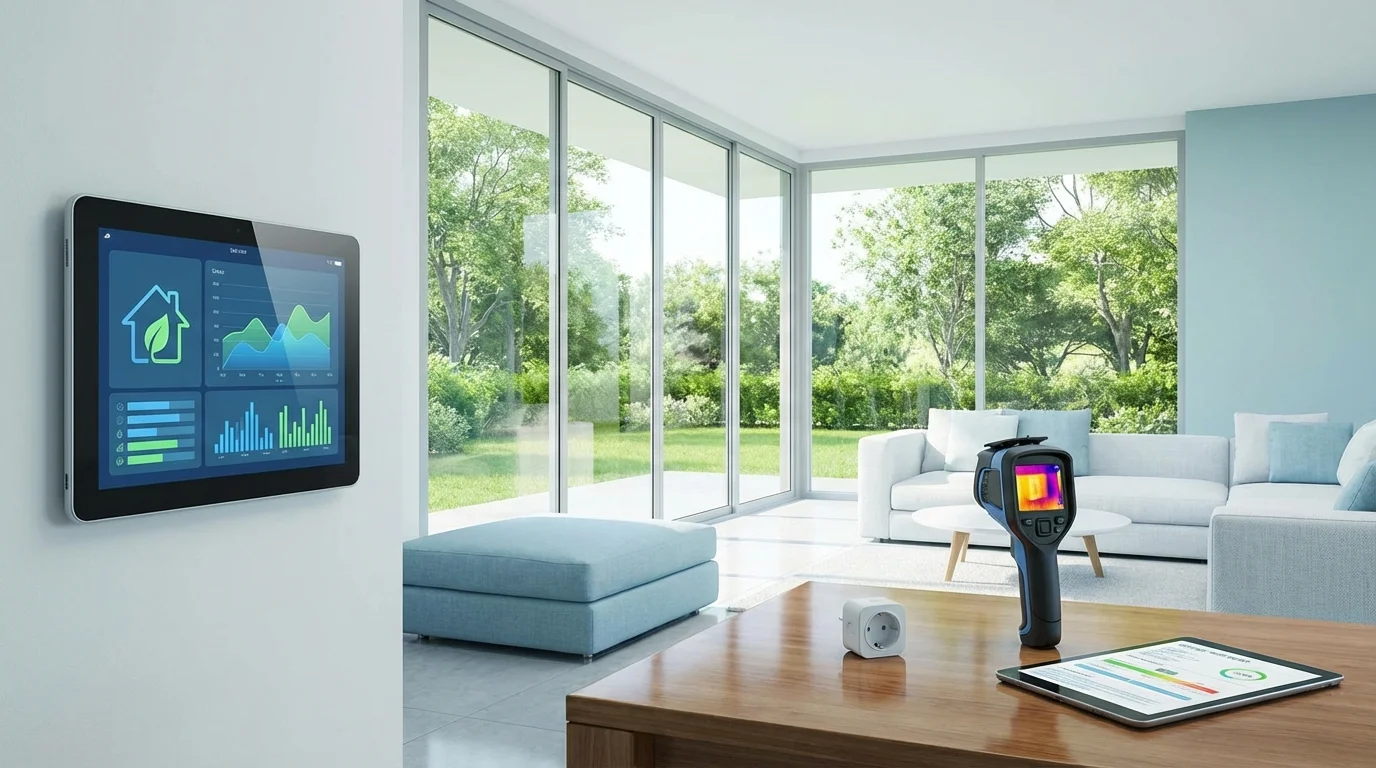
Phantom energy loads from devices in standby mode add up to 20% to the average U.S. household's annual electricity bill, essentially paying for power that isn't even being used. And with utility rates continuing to climb in 2026, this invisible drain on your wallet is becoming more costly than ever. Identifying these energy vampires is the first step toward cutting costs, but you can't manage what you don't measure.
The core tension for homeowners is the gap between high energy bills and the lack of visibility into what’s driving them. So this knowledge gap directly translates into wasted money, with the U.S. Department of Energy estimating that standby power costs consumers over $19 billion annually. A smart home energy monitor closes this gap by providing real-time, actionable data to pinpoint waste and reduce consumption by up to 15%.
What Financial Incentives and Rebates Are Available for Smart Home Energy Monitors?
Smart home energy monitoring systems qualify for a range of financial incentives, including state grants, utility company rebates, and sometimes components of larger federal programs in 2026. These incentives typically provide between $50 and $150 to offset the initial purchase price of qualifying monitoring equipment.
In 2026, homeowners can access funding from multiple sources to lower the cost of energy monitoring technology. And state energy offices often run programs offering direct rebates for devices that help consumers reduce their energy footprint. But utility providers are the most common source, frequently offering instant point-of-sale discounts or mail-in rebates for their customers who purchase specific models. While monitors themselves don't typically qualify for standalone federal energy tax credits, their installation can be part of a larger energy efficiency project that does. So it's essential to check with local utilities and state programs, as funding is geographically specific and often allocated on a first-come, first-served basis. Many of these programs are detailed on platforms like DSIRE.
Am I Eligible for Smart Energy Monitor Rebates Based on My State, Utility, Income, or Equipment?
Eligibility for smart energy monitor rebates in 2026 is determined by your geographic location, utility provider, income level, and the specific equipment purchased. Most programs require the monitor to be ENERGY STAR certified and are available only to residential customers within a specific service territory.
Your eligibility hinges on several key factors. First, you must be a customer of the utility offering the rebate. And many state-level programs are restricted to residents of that state. But some programs offer enhanced incentives for low-to-moderate income (LMI) households, with income thresholds typically set at 80% of the area median income; these programs can cover up to 100% of the equipment cost. The device itself must also meet program standards, which almost always means it needs to be a new, qualifying model listed on the utility's approved product list. So before purchasing, confirming your eligibility and the device's qualification is a critical step. A professional home energy audit can also identify opportunities where a monitor would be most effective.
What is the Application Process and What Are the Deadlines for Energy Monitor Funding?
The application process for a smart energy monitor rebate typically involves purchasing a qualifying device, submitting an online or mail-in form with proof of purchase, and adhering to strict program deadlines, which are often set for December 31, 2026, or until the allocated funds are exhausted.
To claim a rebate, homeowners first verify their eligibility and the product's qualification through their local utility's website. And after purchasing the monitor, they complete an application form, attaching a dated sales receipt or invoice. So this documentation is then submitted through an online portal or via mail. The processing time can range from 4 to 8 weeks before a check or bill credit is issued. But deadlines are non-negotiable; many 2026 programs close at the end of the calendar year or as soon as their budget is depleted, making timely submission crucial. Use our free rebate calculator to see which 2026 programs are still active in your area and find exact deadlines.
Can I Stack Multiple Smart Energy Monitor Incentives, and Are There Specific Contractor Requirements?
Homeowners can often stack a state-level rebate with a local utility incentive for the same smart energy monitor, but federal tax credits cannot be combined with other federal funding for the same expense. Since most monitors are DIY-installable, specific contractor licensing requirements are generally not applicable.
Stacking incentives is a powerful way to reduce out-of-pocket costs. And combining a $50 state rebate with a $75 utility rebate, for example, can cover the entire cost of a $125 monitoring system. But it's important to read the terms for each program, as some explicitly prohibit combining offers. So confirming with each program administrator is the best practice. Unlike major installations such as HVAC systems or solar panels, smart energy monitors are designed for homeowner installation and plug directly into the home's breaker panel. This DIY nature bypasses the need for licensed contractors, which simplifies the rebate process and eliminates installation labor costs that are mandatory for complex projects like heat pump rebates.
How Do Different Smart Home Energy Monitoring Systems Compare in Features and Long-Term Savings?
Smart home energy monitors like the Emporia Vue and Sense provide circuit-level, real-time data, while others offer whole-home analytics. These systems facilitate long-term savings of 10-15% on electricity bills, which translates to $150-$250 annually for a typical household by identifying and reducing energy waste.
Different systems offer distinct features affecting their utility and cost. Circuit-level monitors connect to individual breakers, allowing users to see exactly how much power the kitchen outlets or HVAC system is drawing. And whole-home monitors attach to the main service lines, providing a general overview of consumption. So the choice depends on the desired level of detail. Both types, however, empower users to spot inefficiencies, such as a faulty appliance or phantom loads, leading to behavioral changes that generate savings. Data from these devices helps optimize usage patterns, shift heavy consumption to off-peak hours, and justify further investments in energy efficiency, such as a geothermal tax credit qualifying system.
"DSIRE is the most comprehensive source of information on incentives and policies that support renewables and energy efficiency in the United States." — DSIRE
2026 Smart Energy Monitor Rebate Program Comparison
| Program Name | Rebate Amount | Eligibility Requirements | 2026 Deadline |
|---|---|---|---|
| State Energy Office Grant | Up to $100 | State residency, ENERGY STAR certified device | December 31, 2026 |
| Utility Instant Rebate | $50 at checkout | Must be a customer of the utility, purchase from participating retailer | October 31, 2026 |
| LMI Efficiency Program | 100% of cost (up to $200) | Income at or below 80% AMI, utility customer | Rolling (until funds depleted) |
Official Sources
- ENERGY STAR Rebate Finder — A tool from the U.S. Environmental Protection Agency to find local rebates on certified products.
- Database of State Incentives for Renewables & Efficiency (DSIRE) — A comprehensive database of state, local, utility, and federal incentives for energy efficiency.
- U.S. Department of Energy - Save Energy, Save Money — Federal guidance on energy-saving measures, tax credits, and financial assistance programs. (note: the federal 25C and 25D credits ended for projects completed after December 31, 2025)
Related Reading: Learn more about Smart Home Energy Management System.
Frequently Asked Questions
Who is eligible for smart home energy monitoring system rebates?
Eligibility for 2026 rebates primarily depends on your location and utility provider. You must typically be a residential customer of a participating utility company. And some state-run programs require state residency. Enhanced rebates or free devices are often available for low-to-moderate income households that meet specific income thresholds, usually defined as being at or below 80% of the Area Median Income (AMI). The equipment itself must also be on an approved product list.
How much can I save on a smart home energy monitor with rebates?
With rebates, homeowners can save between $50 and $150 on the purchase of a new smart home energy monitor in 2026. Some utility programs offer instant discounts at the point of sale, while others provide mail-in rebates. For qualifying low-income households, some programs cover 100% of the device cost, up to a cap of around $200. These upfront savings are in addition to the 10-15% average annual reduction on electricity bills.
What is the process to claim a smart home energy monitoring rebate?
The process involves four main steps. First, confirm your eligibility and that the device you intend to buy is on your utility's qualifying product list. Second, purchase the monitor and save the dated receipt. Third, complete the rebate application form, which is usually available on the utility's website. Finally, submit the form along with a copy of your receipt online or by mail before the program's 2026 deadline.
Find Every Rebate for Your Home
Don't leave money on the table. Smart energy monitors are just one of dozens of upgrades that qualify for rebates. Use DuloCore's free rebate calculator to instantly see every federal, state, and utility incentive you qualify for in 2026.
Calculate Your Savings NowUpdated: April 14, 2026 — fact-checked by DuloCore Research. About our editorial process.