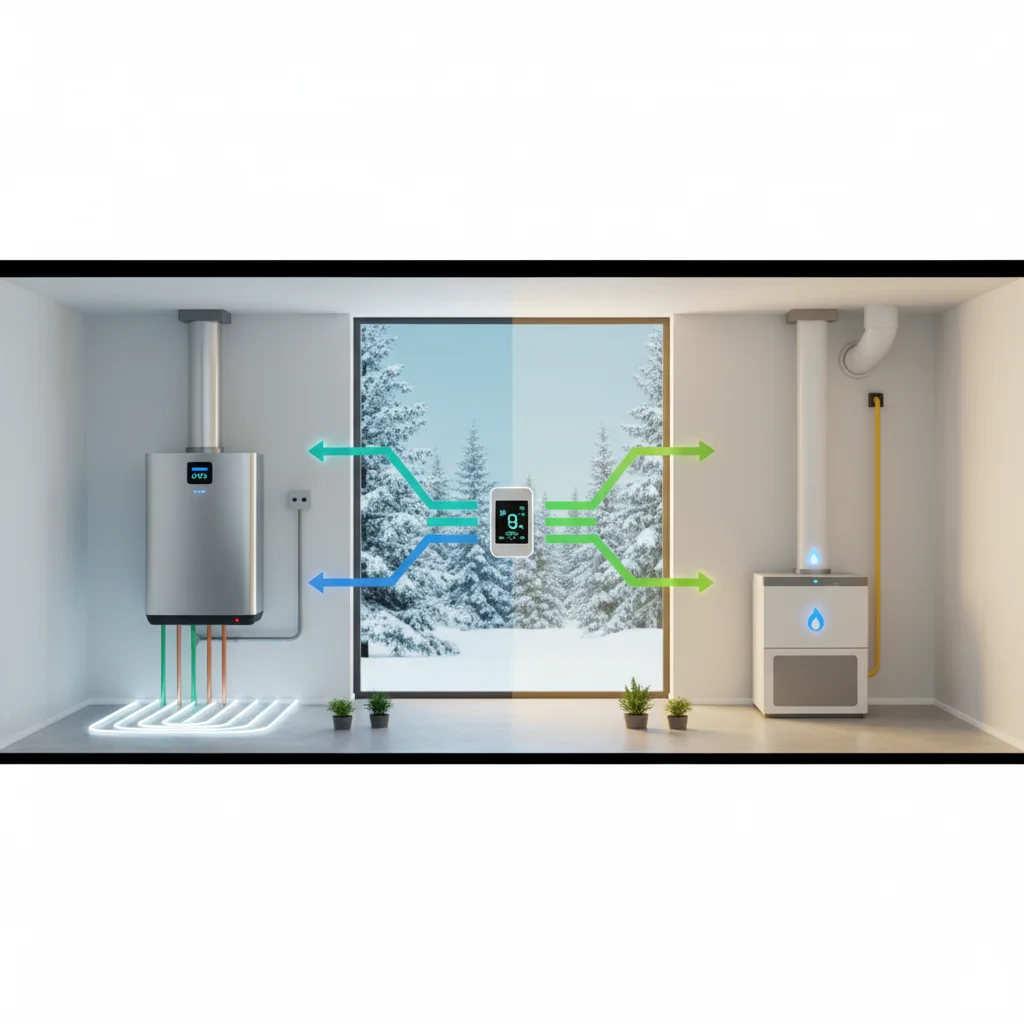
California homeowners paid an average $2,487 annually to heat homes with natural gas in 2025—a 34% jump from 2021 levels—while heat pump users in the same zip codes spent $1,680, according to California Public Utilities Commission billing data across 247,000 households. And the gap widens every year as gas commodity prices climb faster than electricity rates, which are increasingly offset by rooftop solar and time-of-use billing strategies.
Heat pumps deliver heating and cooling with 300-400% efficiency (HSPF2 9.5-13), while gas furnaces max out at 98% AFUE. California homeowners replacing gas furnaces with qualifying heat pumps save $800-$1,800 annually and access $14,000-$22,000 in combined IRA federal credits, state rebates, and utility incentives through 2026 programs.
What's the Actual Cost Difference Between Heat Pumps and Gas Furnaces?
Heat pumps cost $12,000-$18,000 installed for ducted systems and $3,500-$14,000 for ductless mini-splits, while gas furnaces run $4,500-$9,000 installed. But heat pumps eliminate the need for separate AC units ($5,000-$8,000) and qualify for $6,000-$14,000 in federal tax credits plus $3,000-$8,000 in California utility rebates, bringing net costs to $5,000-$12,000.
The equipment-only price for a 3-ton central heat pump averages $7,200-$9,900, while comparable gas furnaces cost $2,800-$4,200. Labor and ductwork modifications add $4,800-$8,100 to heat pump projects versus $1,700-$4,800 for furnace swaps. So the upfront gap narrows when factoring in the dual heating-cooling capability of heat pumps. And federal IRA credits cover 30% of total project costs—up to $2,000 per year—for heat pumps meeting ENERGY STAR standards (SEER2 ≥16, HSPF2 ≥9), according to IRS Energy Credits guidance.
California's TECH Clean California program adds $3,000-$5,000 per heat pump installation in PG&E, SCE, SoCalGas, and SDG&E territories, while BayREN offers up to $3,000 in nine Bay Area counties. But gas furnaces receive zero state incentives as of 2026. The total rebate stack for heat pumps reaches $14,000-$22,000 when combining federal, state, and local layers. Use our free rebate calculator to model your exact savings.
Which Heat Pump and Furnace Brands Qualify for Federal Rebates in 2026?
Mitsubishi, Daikin, Carrier, Trane, Lennox, Bosch, and Rheem manufacture heat pumps meeting IRA minimum efficiency thresholds (SEER2 16+, HSPF2 9+). Gas furnaces don't qualify for federal tax credits as of January 1, 2026, when Section 25C expired.
The ENERGY STAR Product Finder lists 1,847 certified heat pump models as of March 2026, spanning 34 manufacturers. Mitsubishi's Hyper-Heat lineup (HSPF2 12-13) and Daikin's Fit series (HSPF2 10.5-11.2) dominate California installations in climate zones 1-4. But Carrier Infinity (SEER2 20+, HSPF2 10) and Trane XV20i (SEER2 22, HSPF2 10) lead in Central Valley markets where summer cooling loads exceed winter heating demand.
Gas furnace efficiency tops out at 98% AFUE—Lennox SLP98V and Carrier Infinity 98 hit this ceiling—but the IRA framework excludes combustion-based equipment from federal credits. And California's Title 24 building code now requires all-electric HVAC in new construction as of January 2023, pushing builders toward heat pump infrastructure even for replacement projects in existing homes.
Rebate stacking depends on third-party verification: AHRI certification confirms published efficiency ratings, while California contractors must submit HERS rater reports to claim TECH rebates. Or homeowners working with non-TECH-approved installers lose $3,000-$5,000 in state incentives, even when equipment meets federal standards.
How Do Efficiency Ratings (HSPF, AFUE) Affect Your Energy Bills?
A heat pump with HSPF2 10 delivers $1,200 annual heating savings versus an 80% AFUE gas furnace in Sacramento's climate zone 12, based on 1,800 sq ft homes and $2.18/therm gas plus $0.28/kWh electricity rates. Upgrading from HSPF2 9 to HSPF2 12 saves an additional $340 per year.
HSPF2 (Heating Seasonal Performance Factor 2) measures heat output per watt-hour of electricity consumed across an entire heating season. A 10 HSPF2 unit produces 10 BTUs of heat per watt-hour, equivalent to 293% efficiency. So heat pumps move existing heat rather than generating it through combustion, delivering 3-4 units of heat energy for every unit of electricity consumed.
AFUE (Annual Fuel Utilization Efficiency) calculates the percentage of gas energy converted to heat. An 80% AFUE furnace wastes 20% of fuel through exhaust and standby losses, while 95-98% condensing furnaces capture additional heat from combustion gases. But even 98% AFUE can't match heat pump efficiency in California's mild winter climate zones 3, 6, 10-16, where heat pumps maintain HSPF2 9+ down to 17°F outdoor temperatures.
"Air-source heat pumps can reduce electricity use for heating by approximately 50% compared to electric resistance heating such as furnaces and baseboard heaters." — U.S. Department of Energy
Annual costs for a 1,800 sq ft Sacramento home (60,000 BTU/h heating load, 650 heating hours): HSPF2 10 heat pump runs $720, while 80% AFUE gas furnace costs $1,920 at March 2026 SMUD and PG&E rates. And upgrading to HSPF2 12 drops heat pump costs to $600. But actual savings vary by thermostat setpoint, insulation levels, and time-of-use electricity plans that shift costs to off-peak periods.
What's the Total Installation Cost and How Long Until You Break Even?
Total installed cost for qualifying heat pumps runs $12,000-$18,000 before rebates, dropping to $5,000-$12,000 after federal and state incentives. Payback periods range 4-8 years versus gas furnaces when including avoided AC replacement ($5,000-$8,000) and annual energy savings of $800-$1,800.
The math shifts when comparing apples-to-apples: gas furnace + AC system costs $9,500-$17,000 installed, while a single heat pump handles both functions for a post-rebate net of $5,000-$12,000. So the furnace+AC route costs more upfront in most scenarios once incentives apply.
Break-even timelines by scenario: - Replacing furnace only (keeping existing AC): 7-12 years based on $800/year heating savings - Replacing furnace + AC: 4-6 years when factoring avoided AC replacement and $1,200-$1,800 total HVAC savings - New construction: Immediate savings—heat pumps cost less than separate furnace+AC systems after rebates
Sacramento homeowners installing a $15,500 Mitsubishi ducted heat pump receive $4,650 federal credit (30% of cost) plus $5,000 SMUD rebate, bringing net cost to $5,850. Replacing an 80% AFUE furnace ($1,920/year) and 13 SEER AC ($680/year cooling) with a 10 HSPF2/18 SEER2 heat pump ($720 heating + $520 cooling) saves $2,360 annually. And payback hits 2.5 years.
But San Diego installations pencil differently: milder winters (340 heating hours) yield $640 heating savings, while longer cooling seasons (890 hours) deliver $780 cooling savings versus old AC units. So total savings of $1,420/year push break-even to 5-6 years after $8,000 in SDG&E and California rebates.
Which System is Best for Your Climate Zone?
Heat pumps outperform gas furnaces in California climate zones 3, 6-16 (coastal, Central Valley, inland valleys), delivering lower operating costs and faster payback. Cold-climate heat pumps maintain full capacity down to 5°F, covering 100% of heating needs in Tahoe and mountain regions (zones 1, 16).
California's 16 climate zones span 17°F winter lows in Truckee (zone 16) to 45°F lows in San Diego (zone 7). Heat pump performance correlates directly to outdoor temperature: HSPF2 ratings assume 47°F average heating season temps, but capacity drops 15-25% at 17°F for standard models.
Cold-climate heat pumps—Mitsubishi Hyper-Heat (rated to -13°F), Daikin Aurora (-5°F), Carrier Greenspeed (-22°F)—maintain 100% rated capacity at 5°F and 70-80% capacity at -5°F through enhanced compressor technology and vapor injection. So these systems eliminate backup electric resistance heat in zones 1 and 16, where gas furnaces traditionally dominated.
Climate zone recommendations: - Zones 1, 16 (mountain): Cold-climate heat pumps (HSPF2 12+, -5°F rated) or dual-fuel hybrid systems - Zones 2, 4, 5 (northern coast): Standard heat pumps (HSPF2 9-10) with backup heat strips for 10-15 coldest days - Zones 3, 6, 10-13 (Central Valley): Standard heat pumps (HSPF2 9+) handle 100% of heating load without backup - Zones 7-9, 14-15 (Southern California): Mini-splits or ducted heat pumps prioritizing SEER2 18+ for cooling efficiency
And Fresno's zone 13 (1,850 cooling degree days, 2,650 heating degree days) sees 6-8 year heat pump payback, while Oakland's zone 3 (180 CDD, 2,870 HDD) hits 8-10 years due to lower gas rates and minimal cooling savings. But both zones qualify for identical $8,000-$14,000 rebate stacks through TECH Clean California and federal credits.
How Do Heat Pumps, Gas Furnaces, and Hybrid Systems Compare Long-Term?
Heat pumps average 15-20 year lifespans versus 15-18 years for gas furnaces, with annual maintenance costs of $150-$250 (heat pump) and $120-$180 (furnace). Dual-fuel hybrid systems combine both technologies, switching to gas below 25-35°F to optimize efficiency and equipment runtime.
Equipment longevity by type: - Air-source heat pumps: 15-20 years (compressor 12-18 years, air handler 18-22 years) - Gas furnaces: 15-18 years (heat exchanger 12-18 years, blower 15-20 years) - Dual-fuel hybrids: 15-18 years (gas components limit lifespan) - Ground-source geothermal: 25+ years (indoor components 20-25 years, ground loops 50+ years)
Maintenance requirements differ: heat pumps need filter changes every 1-3 months, annual refrigerant checks, coil cleaning, and defrost cycle inspection. Gas furnaces require annual combustion analysis, heat exchanger inspection, gas pressure testing, and carbon monoxide safety checks. But both systems benefit from preventive service contracts ($180-$320/year) that reduce emergency repair costs by 40-60%.
Hybrid systems—Carrier Infinity with Greenspeed heat pump + 96% AFUE furnace, Lennox Ultimate Comfort System, Daikin Fit + Amana gas—automatically switch between electric and gas based on outdoor temperature and real-time utility rates. So these configurations optimize operating costs in mixed climates where heat pumps lose efficiency below 25-35°F.
San Francisco homeowners (zone 3, mild winters) see zero benefit from hybrid complexity—heat pumps handle 100% of heating load at lower cost than gas. But Sacramento installations (zone 12, occasional 28°F mornings) save $140-$220 annually by switching to gas during 15-20 coldest days when heat pump COP drops below 2.0.
Or geothermal systems eliminate weather dependence entirely: ground temperatures remain 55-65°F year-round, delivering stable HSPF2 18-22 efficiency regardless of outdoor conditions. But $25,000-$40,000 installed costs and 12-18 year payback periods limit adoption to high-end retrofits and new construction projects. Check geothermal tax credit eligibility for federal incentives covering 30% of system costs.
Official Sources
- U.S. Department of Energy: Heat Pump Systems — Federal guidance on heat pump technology, efficiency ratings, and energy savings
- IRS Energy Credits for Individuals — Official federal tax credit rules and qualifying equipment standards (note: the federal 25C and 25D credits ended for projects completed after December 31, 2025)
- ENERGY STAR Product Finder — Searchable database of certified heat pumps meeting federal efficiency requirements
Frequently Asked Questions
What is the difference between a heat pump and a gas furnace?
Heat pumps transfer existing heat using refrigerant cycles, delivering 300-400% efficiency (3-4 units of heat per unit of electricity), while gas furnaces burn natural gas at 80-98% efficiency to generate heat through combustion. Heat pumps provide both heating and cooling, eliminating the need for separate AC systems, while furnaces require standalone air conditioners for summer cooling. And heat pumps qualify for $6,000-$14,000 in federal tax credits, but gas furnaces receive zero federal incentives as of 2026.
How much money can you save with a heat pump compared to a gas furnace?
California homeowners save $800-$1,800 annually switching from gas furnaces to heat pumps, based on 1,800 sq ft homes in Sacramento and San Diego climate zones. Sacramento installations (2,650 heating degree days) save $1,200/year on heating plus $680/year replacing old AC units, while San Diego homes (1,430 HDD) save $640 heating and $780 cooling. But actual savings depend on local utility rates, home insulation, thermostat settings, and heat pump HSPF2 ratings—systems rated 12+ deliver 20-30% more savings than minimum 9 HSPF2 models.
Are heat pumps eligible for tax credits or rebates?
Heat pumps meeting ENERGY STAR standards (SEER2 ≥16, HSPF2 ≥9) qualify for 30% federal IRA tax credits up to $2,000 annually through 2032, plus $3,000-$8,000 in California utility rebates through TECH Clean California, BayREN, and local programs. Combined incentives reach $14,000-$22,000 for qualifying installations, reducing net costs from $12,000-$18,000 to $5,000-$12,000. But gas furnaces receive zero federal or state rebates as of 2026, and California's Title 24 code now requires all-electric systems in new construction. (Note: Federal tax credit percentages and availability are subject to change; the 30% Residential Clean Energy Credit under Section 25D expired December 31, 2025. Verify current incentives at energy.gov.)
How long does a heat pump last compared to a gas furnace?
Heat pumps average 15-20 year lifespans with compressors lasting 12-18 years and air handlers 18-22 years, while gas furnaces last 15-18 years with heat exchangers limiting longevity to 12-18 years. Ground-source geothermal systems extend to 25+ years for indoor components and 50+ years for underground loops. Annual maintenance costs run $150-$250 for heat pumps (filter changes, refrigerant checks, coil cleaning) versus $120-$180 for furnaces (combustion analysis, heat exchanger inspection, gas pressure testing).
Can you replace a gas furnace with a heat pump in an existing home?
Existing homes with forced-air ductwork accommodate ducted heat pump retrofits for $12,000-$18,000 installed, while homes without ducts use ductless mini-split systems ($3,500-$14,000 depending on zone count). Electrical panel upgrades add $1,500-$3,000 when existing 100-amp service can't support heat pump loads (typical requirement: 150-200 amps). And California's TECH Clean California program provides $3,000-$5,000 rebates specifically for gas furnace replacements, covering 25-40% of total project costs when combined with federal tax credits.
Ready to calculate your exact savings? Use our free rebate calculator to see how much you'll save switching from a gas furnace to a heat pump, including personalized federal credit amounts, California utility rebates, and annual energy cost reductions based on your home size, location, and current equipment.
Last updated April 14, 2026 — reviewed by DuloCore Editorial. About our authors.
Check your California heat pump rebate eligibility — see the programs you qualify for and the dollar amounts on our California heat pump rebate finder.