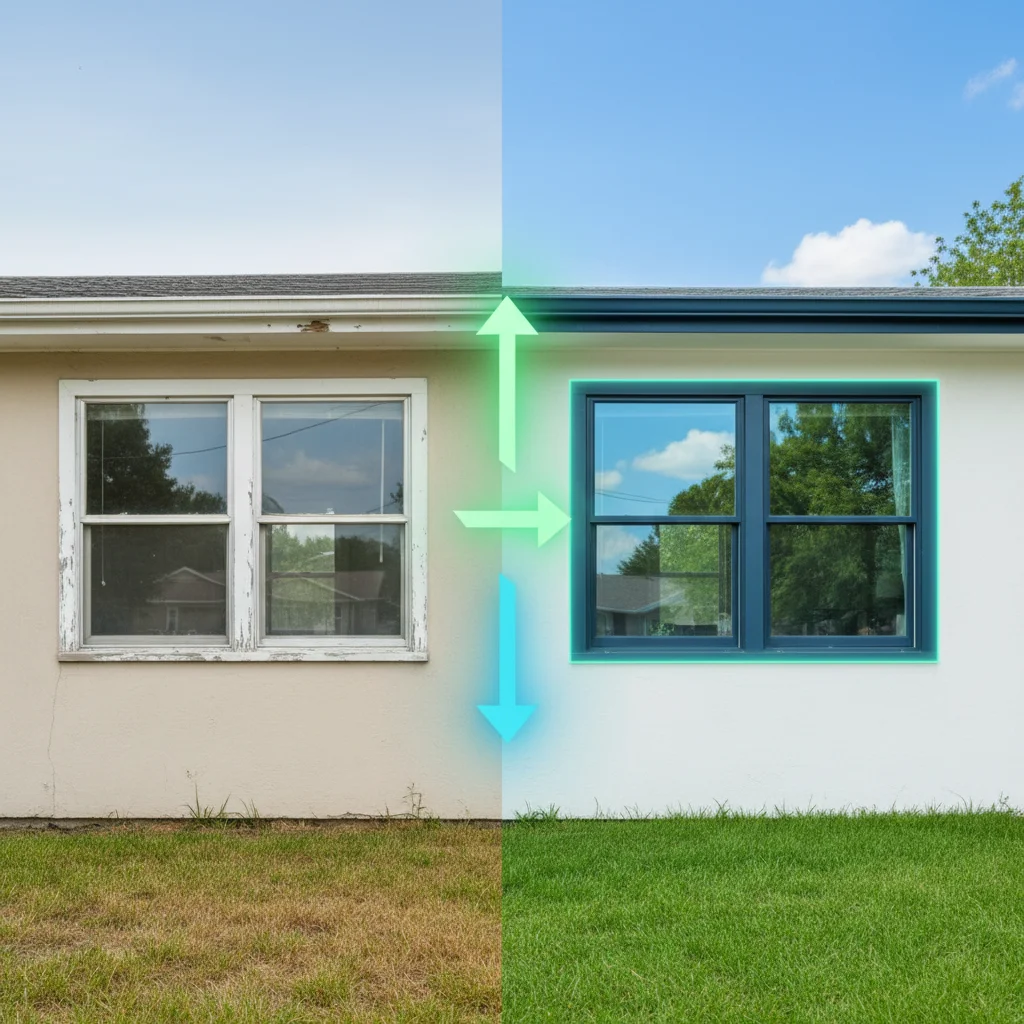
Up to 30% of a home's heating and cooling energy is lost through inefficient windows and doors. This energy drain translates directly into higher utility bills month after month, with aging, single-pane windows acting as thermal holes in a home's envelope. So replacing them isn't just about aesthetics; it's a direct countermeasure against escalating energy costs.
What's the Typical Cost and ROI for Energy-Efficient Window Replacement?
Energy-efficient window replacement is a home improvement project with a total cost ranging from $300 to $2,000 per window installed in 2026. So the project offers a return on investment of 70-80% at resale, with a typical payback period of 10-15 years from energy savings.
The total project cost depends on window material, size, and brand. And vinyl windows are the most affordable, typically costing $300-$800 per installation. But wood and fiberglass windows command a premium, often exceeding $1,500 per unit. Installation labor adds another $100-$300 per window to the final price. Homeowners recouping 70% of the cost at resale makes this one of the higher-value exterior upgrades. So when combined with federal and state window replacement rebates, the net cost drops, accelerating the payback timeline. The key is balancing upfront investment with long-term energy savings and property value increase.
So why does this matter? The upfront cost of a full window replacement, often ranging from $8,000 to $24,000, is a barrier for many homeowners. But failing to upgrade means continuing to overpay for energy by up to $583 per year for single-pane window owners, according to the Department of Energy. And these ongoing losses, combined with reduced home comfort and lower property value, create a clear financial incentive to invest in modern, high-performance windows.
Which Window Specifications and Brands Qualify for Energy Rebates and Incentives?
Windows qualifying for 2026 energy rebates and incentives must meet specific ENERGY STAR performance criteria, including a U-factor of 0.27 or less. So brands like Andersen, Pella, and Marvin consistently offer product lines that meet or exceed these ENERGY STAR criteria.
To qualify for incentives, windows must have a National Fenestration Rating Council (NFRC) label verifying their performance; the federal energy tax credits no longer apply (IRS FS-2025-05). The two key metrics are U-factor, which measures heat loss, and Solar Heat Gain Coefficient (SHGC), which measures how much solar radiation a window blocks. And for most U.S. climate zones, a U-factor ≤ 0.27 is required. So homeowners must purchase windows that are ENERGY STAR certified for their specific region. Many leading brands, including Jeld-Wen and Milgard, prominently feature qualifying models, simplifying the selection process for consumers seeking to maximize available financial incentives.
"ENERGY STAR certified windows and doors are independently tested and certified to meet strict energy-efficiency standards set by the U.S. Environmental Protection Agency." — ENERGY STAR
How Do Efficiency Ratings and Climate Zones Impact Your Window Selection and Savings?
Efficiency ratings like U-factor and SHGC directly determine a window's performance, while the homeowner's climate zone dictates the optimal combination for maximum energy savings. So selecting windows mismatched for a region, such as high-SHGC windows in a hot climate, negates potential savings of 10-25%.
The United States is divided into four climate zones for window efficiency ratings. And in cold northern zones, a low U-factor (≤0.27) is critical to prevent heat from escaping during winter. But in hot southern zones, a low SHGC (≤0.25) is more important to block solar heat and reduce cooling costs. The ENERGY STAR program provides specific recommendations for each zone. Choosing windows with the right NFRC ratings for a home's location ensures the investment delivers its full potential, reducing annual energy bills by an average of $366 when replacing double-pane windows. So this tailored approach is essential for achieving a faster return on investment.
Energy-Saving Home Upgrade Comparison
| Upgrade Program (2026) | Typical Rebate/Credit Amount | Key Eligibility Requirement |
|---|---|---|
| Window Replacement | The federal Energy Efficient Home Improvement Credit (Section 25C) ended for property placed in service after December 31, 2025 (IRS FS-2025-05). | ENERGY STAR Certified |
| Attic Insulation | 30% Tax Credit (this federal credit ended for property placed in service after December 31, 2025), up to $1,200 | Meets 2021 IECC Standards |
| Heat Pump Installation | The federal Energy Efficient Home Improvement Credit (Section 25C) ended for property placed in service after December 31, 2025 (IRS FS-2025-05). | Meets CEE Top Tier Specs |
What Are the Expected Lifespan and Maintenance Requirements for New Energy-Efficient Windows?
Modern energy-efficient windows have an expected lifespan of 20 to 40 years, with materials like fiberglass lasting even longer. So their maintenance requirements are minimal, primarily involving routine cleaning and inspection of seals, which contrasts sharply with the upkeep needed for older, single-pane wood windows.
The longevity of new windows is largely dependent on the frame material. Vinyl frames, the most common choice, typically last 20-40 years and require little more than cleaning with soap and water. And fiberglass frames are more durable, with a lifespan exceeding 40 years, and they resist warping or cracking in extreme temperatures. Wood windows offer a classic aesthetic but demand the most maintenance, including periodic painting or sealing to prevent rot. So regardless of material, annual inspection of caulking and weatherstripping is recommended to ensure the window's airtight seal remains intact, preserving its energy-saving performance for decades.
How Do New Windows Compare to Other Home Upgrades for Energy Savings?
New windows reduce annual energy bills by 10-25%, a smaller percentage than the 50% savings from a new heat pump but comparable to the 15% from attic insulation. But windows also provide a 70% ROI in home value, making them a multifaceted investment.
While upgrades like air sealing and adding attic insulation offer a faster payback period of 2-4 years, their impact on home value is less direct. And a high-efficiency HVAC system, particularly a heat pump, delivers the highest energy savings, often cutting heating and cooling costs by 50% or more. However, the cost is also higher, averaging $8,000-$20,000. So window replacement offers a unique combination of benefits: a 10-25% reduction in energy costs, a 70% return on investment at resale, and improved home comfort and curb appeal. Use our free rebate calculator to see how different upgrades stack up for your home. Homeowners often bundle windows with other projects like installing new heat pump rebates to maximize savings.
"DSIRE is the most comprehensive source of information on incentives and policies that support renewables and energy efficiency in the United States." — DSIRE
Official Sources
- ENERGY STAR Windows — Official EPA guidance on energy-efficient window specifications and climate zone recommendations.
- DSIRE Database — A comprehensive, state-by-state database of renewable energy and energy efficiency rebates and incentives.
Related Reading: Learn more about Door Weatherstripping Energy Savings and Energy Auditor Certification Programs.
Related Reading: Learn more about Door Weatherstripping Energy Savings and Energy Audit Report Example.
Related Reading: Learn more about Window Replacement Roi And Energy Savings.
Frequently Asked Questions
How much energy can I expect to save annually after replacing old windows?
Homeowners replacing single-pane windows with ENERGY STAR certified models save an average of $101–$583 per year on energy bills. And upgrading from double-pane windows still yields savings, typically around $27–$197 annually. So the exact amount depends on your local climate, window quality, and home size.
What are the eligibility requirements for energy efficiency window replacement rebates?
The federal Energy Efficient Home Improvement Credit (Section 25C) ended for property placed in service after December 31, 2025 (IRS FS-2025-05). ENERGY STAR certification for a climate zone generally requires a U-factor of 0.27 or lower and a specific SHGC rating. So state and utility rebates often have similar performance requirements, and the home must be your primary residence.
What is the typical rebate amount I can receive for energy-saving window upgrades?
The federal Energy Efficient Home Improvement Credit (Section 25C) ended for property placed in service after December 31, 2025 (IRS FS-2025-05). And state and local utility rebates vary widely, but they can offer an additional $50 to $200 per window, potentially adding another $1,000-$2,000 in savings for a whole-home project.
What is the process for applying for window replacement energy savings incentives?
Form 5695 only covers qualifying work completed by December 31, 2025 and claimed on a 2025 return; the federal 25C and 25D credits ended after that date (IRS FS-2025-05). For state or utility rebates, the process typically involves submitting an online application with proof of purchase and installation, often within 90 days of project completion.
Are there specific deadlines to apply for rebates on high-efficiency window installations?
Yes, deadlines are critical. The federal Energy Efficient Home Improvement Credit (Section 25C) ended for property placed in service after December 31, 2025 (IRS FS-2025-05). But state and utility rebate programs often have annual funding cycles that can be exhausted before the year ends. So it's essential to check program deadlines and apply within 30-90 days of installation.
Find Every Window Rebate You Qualify For
Don't leave money on the table. Our tool scans thousands of local and federal programs in seconds to find every dollar you're owed for your new windows.
Calculate Your Savings NowLast updated April 14, 2026 — reviewed by DuloCore Editorial. About our authors.
Check your California insulation rebate eligibility — see the programs you qualify for and the dollar amounts on our California insulation rebate finder.