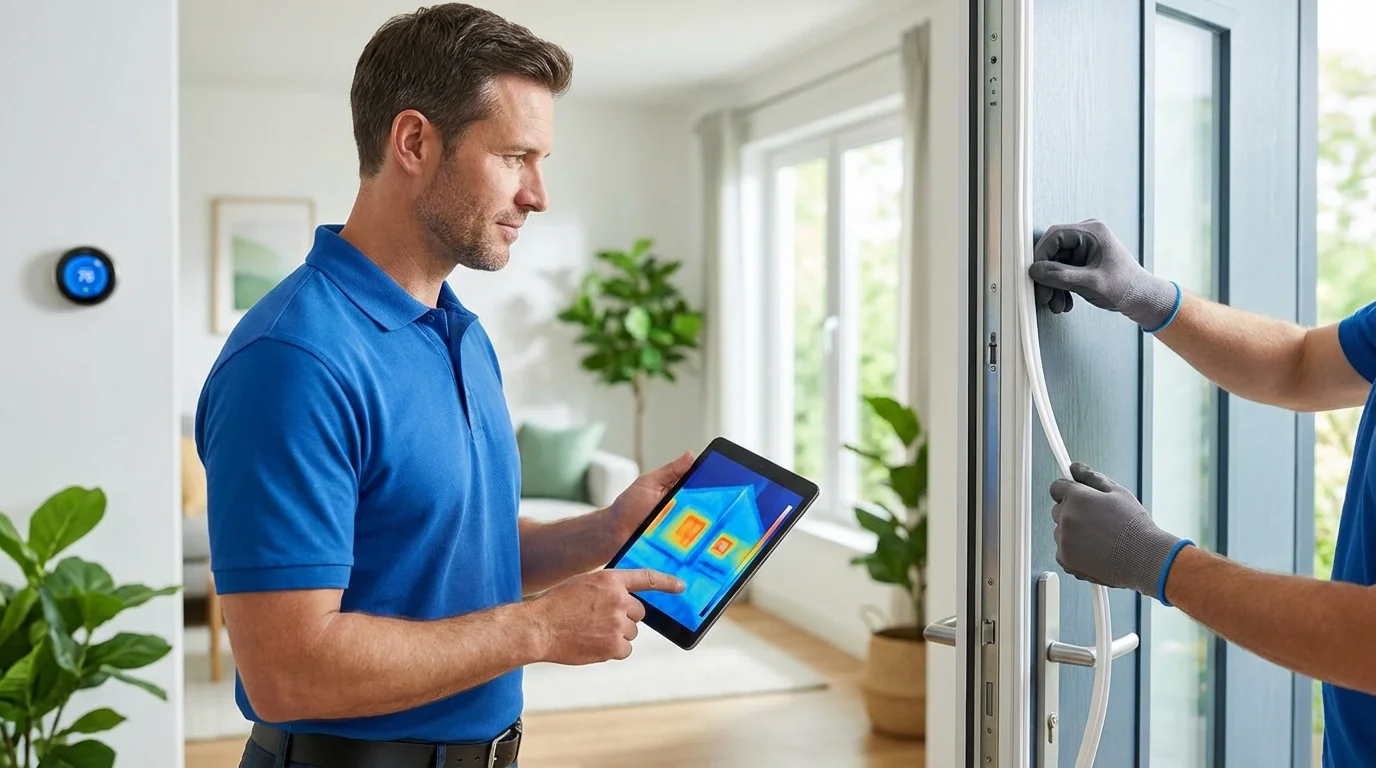
Air leaks from poorly sealed doors and windows account for up to 40% of a home's heating and cooling energy loss. That's equivalent to leaving a window wide open all year long, constantly draining your bank account through unnecessarily high utility bills. And with energy costs projected to increase by another 5-7% in 2026, sealing these drafts isn't just about comfort; it's a direct financial countermeasure against rising expenses.
How Much Can Door Weatherstripping Save You on Energy Bills Annually?
Door weatherstripping is a home improvement project that provides immediate energy savings of 10-15% on annual heating and cooling costs for homeowners. This direct reduction in air leakage lowers HVAC system runtime, resulting in an average annual bill reduction of $200 to $400, depending on climate zone and local utility rates for 2026.
Properly sealing air leaks around exterior doors is one of the most cost-effective energy efficiency upgrades available. And the U.S. Department of Energy states that homeowners save an average of 15% on heating and cooling costs by air sealing their homes and adding insulation. So this simple weekend project translates directly into lower utility bills month after month. The payback period for DIY weatherstripping is often less than one year. But professional installation also offers a fast return, typically within 2-3 years, especially when combined with a comprehensive home energy audit that identifies all sources of energy loss. The key is stopping conditioned air from escaping and outdoor air from entering, which reduces the constant workload on your furnace and air conditioner.
What State and Utility Rebates Are Available for Door Weatherstripping?
State and utility weatherstripping rebate programs are financial incentives that offer homeowners direct cash back, typically between $50 and $250, for purchasing and installing qualifying air sealing materials. These programs for 2026 aim to reduce overall grid demand by encouraging residential energy efficiency improvements, with funding allocated on an annual basis.
Dozens of state energy offices and local utilities offer rebates for air sealing and weatherstripping projects. And these programs are designed to lower the upfront cost of materials like foam tape, V-strips, and door sweeps. For example, Con Edison in New York offers up to $100 for air sealing improvements, while California’s PG&E provides similar incentives through its Home Energy Efficiency program. But funding is often limited and distributed on a first-come, first-served basis. Homeowners must verify the current status of 2026 programs in their specific service area. Many of these incentives are part of a broader package that includes rebates for insulation and even high-efficiency equipment like heat pump rebates. So checking with your local provider is the first step to unlocking these savings.
2026 Weatherstripping Rebate Program Comparison
| Program / Utility | Rebate Amount | Eligibility Highlights | Application Deadline |
|---|---|---|---|
| Massachusetts (Mass Save) | Up to 75% off materials | Must complete a no-cost home energy assessment first | Rolling (funds permitting) |
| California (PG&E) | $100 - $200 | For air sealing performed by a licensed contractor | December 31, 2026 |
| Texas (Austin Energy) | $250 | Single-family homes; must meet specific air leakage reduction targets | September 30, 2026 |
Do You Qualify? Understanding Eligibility and Income Limits for Weatherstripping Rebates
Rebate eligibility for door weatherstripping is a set of criteria defined by utility companies or state agencies that typically requires homeownership, a utility account in good standing, and sometimes adherence to income thresholds. For 2026, many programs also specify that materials must be ENERGY STAR® certified to qualify for the maximum incentive amount.
Eligibility rules vary widely between programs. And while many standard rebates are open to all customers, some of the most valuable programs are income-qualified. For instance, the federal Weatherization Assistance Program (WAP) prioritizes households at or below 200% of the federal poverty level, covering 100% of the cost for materials and labor. State-level programs often have their own income limits. A family of four in Illinois, for example, must have an annual income below $60,000 to qualify for certain state-funded initiatives. So homeowners must review the specific requirements for their local utility and state, as non-compliance with income verification or property type (e.g., single-family vs. multi-family) is the most common reason for a rejected application. You can use our free rebate calculator to check your eligibility.
How Do I Apply for Door Weatherstripping Rebates, and What Are the Deadlines?
The application process for weatherstripping rebates is a formal procedure requiring homeowners to submit proof of purchase, project photos, and a completed application form to their utility or state energy office. Deadlines for 2026 programs are strict, often falling at the end of the calendar year, like December 31, 2026.
Applying for a rebate is a straightforward but detail-oriented process. First, confirm program availability and deadlines for 2026 on your utility's website. Next, purchase qualifying materials and save all receipts. Some programs require pre-approval before work begins, while others only need post-installation documentation. The application is typically an online form where you upload itemized receipts and sometimes photos of the installed weatherstripping.
"The Database of State Incentives for Renewables & Efficiency® (DSIRE) is the most comprehensive source of information on incentives and policies that support renewables and energy efficiency in the United States." — DSIRE
So, it's critical to read all instructions carefully. A common mistake is missing the submission deadline, which is often a hard cutoff at the end of the fiscal or calendar year. Or applicants forget to include the contractor's license number if professional installation is required.
Can You Stack Rebates? Maximizing Your Savings with Contractor Requirements and Funding Status
Stacking rebates is the strategy of combining a local utility incentive, a state-level grant, and federal energy tax credits for the same weatherstripping project to maximize total savings. This approach is permitted by many 2026 programs, but homeowners must verify that each program's rules allow for combining with other financial incentives.
Maximizing savings requires a strategic approach. And the first step is to check if your local utility rebate can be combined with a state program. For example, a homeowner in Colorado often combines an Xcel Energy rebate with a state-level incentive. But some programs have anti-stacking clauses. Next, determine if the project qualifies for any federal tax credits under the current IRA framework. Weatherstripping falls under the home energy audit or building envelope categories, which offer a credit of up to 30% of the cost, capped at $600 annually for 2026. Many programs also require installation by a licensed and insured contractor from an approved list. So always verify a contractor's credentials before starting work. Finally, check the funding status of each program, as popular rebates run out of money before the official deadline.
Official Sources
- ENERGY STAR — A U.S. Environmental Protection Agency program providing credible, objective information on energy-efficient products and practices.
- Department of Energy (DOE) Energy Saver — Federal guidance on weatherization techniques, including air sealing and insulation, to reduce home energy costs.
- DSIRE — A comprehensive database of state and federal incentives for renewable energy and energy efficiency.
Related Reading: Learn more about Hvac Maintenance Energy Savings and Programmable Thermostat Energy Savings.
Related Reading: Learn more about Whole House Fan Energy Savings and Cool Roof Energy Savings.
Frequently Asked Questions
What types of door weatherstripping are eligible for energy savings rebates?
Most 2026 rebate programs cover common weatherstripping materials like adhesive-backed foam tape, V-strip (tension seal), felt, and door sweeps. To qualify, the products must often be new and meet specific durability standards. Some high-value utility rebates require the installation of a complete air sealing package, which also includes caulk and gaskets for windows and electrical outlets, not just door components.
How much can I typically save on my energy bill by weatherstripping my doors?
Homeowners typically save between 10% and 15% on their annual heating and cooling costs by properly weatherstripping exterior doors. For an average American household, this translates to a direct monetary savings of $200 to $400 per year, according to 2026 energy cost data from the U.S. Energy Information Administration. The exact amount depends on your climate zone and local energy prices.
How does the energy efficiency of weatherstripping compare to replacing an entire exterior door?
Weatherstripping an existing door provides approximately 80% of the energy savings of a full door replacement but at only 5-10% of the cost. A new ENERGY STAR certified door costs between $1,500 and $4,000 installed, while a complete DIY weatherstripping kit costs just $25 to $75. For pure return on investment, weatherstripping offers a much faster payback period of less than one year.
Find and Claim Your Rebates Now
Stop letting money leak out from under your doors. Use the DuloCore Rebate Calculator to instantly find every local, state, and federal incentive available for your home energy efficiency projects in 2026.
Updated on April 14, 2026. Fact-checked by DuloCore Editors. About our research team.