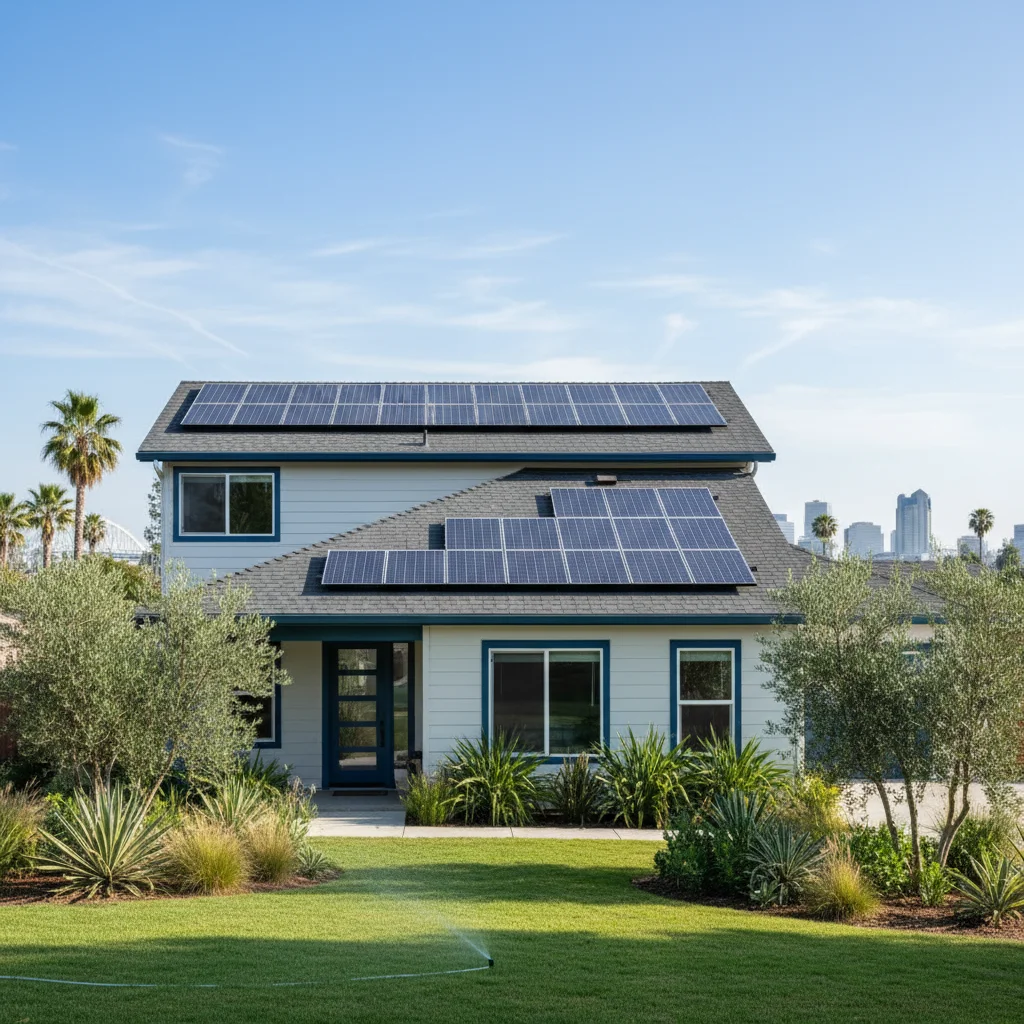
Sacramento homeowners paid an average of $18,240 for a 6-kilowatt solar panel system in 2026—but after federal tax credits and state rebates, that drops to $12,768, cutting grid electricity costs by 70-90% within the first year. And with California's average electricity rate hitting $0.34 per kilowatt-hour in early 2026, a typical household now saves $1,680 annually, putting payback periods at 7-8 years.
So what drives the final price? Installation labor, roof condition, panel efficiency, permitting fees, and inverter type create a $12,000-$28,000 range across Sacramento County. But the real variable isn't upfront cost—it's how much Sacramento Municipal Utility District (SMUD) pays for excess generation through net metering, and whether homeowners qualify for California's Solar Equity Resilience (SER) program that stacks an additional $3,000 on top of federal credits.
This matters because Sacramento's solar payback timeline is 2-3 years faster than the state average, thanks to SMUD's above-market net metering rates and 300+ days of annual sun. Homeowners who install in 2026 get no federal credit, because the federal Residential Clean Energy Credit (Section 25D) ended for expenditures made after December 31, 2025, and the IRS treats an expenditure as made when installation is completed (IRS FS-2025-05), but they can still capture California's SER incentive before funding runs out in Q3 2027.
How Much Does Solar Panel Installation Cost in Sacramento?
A typical 6-kilowatt residential solar system in Sacramento costs $18,000-$22,000 before incentives in 2026. Labor accounts for 30% of total cost, equipment 50%, and permits plus interconnection fees the remaining 20%. SMUD charges a $280 interconnection application fee, while Sacramento County's building permit runs $420-$680 depending on system size. And roof condition adds $1,200-$3,500 if structural reinforcement or re-roofing is required before installation.
After applying the 30% federal ITC, the net cost drops to $12,600-$15,400. California's SER program adds $3,000 for households earning below 80% of area median income, bringing final cost to $9,600-$12,400. SMUD's solar loan program offers 3.99% APR financing over 15 years, translating to monthly payments of $71-$91 for a 6-kilowatt system after incentives. Larger 8-kilowatt systems cost $24,000-$28,000 pre-incentive, or $13,800-$16,600 after federal and state credits. Solar panel rebates vary by installer and season, with Q1 installations averaging 8% lower cost than summer peak demand.
What Are the Best Alternatives to Solar Panels for Sacramento Homeowners?
Solar panels in Sacramento compete with three alternatives: battery storage systems, solar shingles, and community solar subscriptions. Tesla Powerwall 3 batteries cost $11,500 installed and pair with existing solar to provide backup during SMUD outages, but they don't generate power—only store excess solar generation. GAF Energy's Timberline Solar shingles integrate into roof replacement at $28,000-$32,000 for a 6-kilowatt system, offering aesthetic advantages but 12% lower efficiency than traditional panels.
Community solar programs let renters and homeowners subscribe to off-site solar farms without installation, saving 10-15% on electricity bills through SMUD's Neighborhood SolarShares program. Subscription costs $0 upfront, but savings cap at $240-$360 annually versus $1,680 from owned rooftop systems. Ground-mounted solar arrays cost $19,000-$24,000 for 6 kilowatts, ideal for properties with shaded roofs but requiring 400+ square feet of yard space. And solar carports run $22,000-$28,000, generating power while providing vehicle shade—popular in Sacramento's 105°F summer heat. Calculate potential savings with our rebate calculator to compare system types.
How Long Do Solar Panels Last and When Will You Need Replacements?
Solar panels installed in Sacramento carry 25-30 year performance warranties, degrading at 0.5% efficiency annually. A panel producing 300 watts in year one outputs 285 watts by year 10 and 262 watts by year 25. Inverters fail first—string inverters last 10-15 years at $1,200-$2,200 replacement cost, while microinverters reach 20-25 years with individual unit failures costing $150-$250 each. So total lifetime replacement costs add $2,400-$4,400 over 30 years.
Panel manufacturers like LONGi and Canadian Solar offer 25-year linear performance guarantees, ensuring minimum 85% output at year 25 or they replace the panel. Labor warranties cover installation defects for 5-10 years, while SMUD requires interconnection re-inspection every 15 years at $180 per visit. Roof penetrations for racking systems need resealing every 8-12 years, costing $400-$800 depending on array size. But panels themselves rarely fail—Sacramento's dry climate avoids the corrosion and moisture damage common in coastal regions, extending functional life to 35-40 years despite warranty expiration.
"Solar photovoltaic systems typically last 25 to 35 years, with minimal maintenance required beyond occasional cleaning and inverter replacement." — U.S. Department of Energy Solar Program
Learn about energy tax credits that reduce replacement costs for upgraded equipment after year 10.
What Incentives and Tax Credits Can Reduce Your Installation Costs?
The federal Residential Clean Energy Credit (Section 25D) ended for expenditures made after December 31, 2025, and the IRS treats an expenditure as made when installation is completed (IRS FS-2025-05). Check current state, local and utility incentives for your address with the DuloCore rebate calculator. California's SER program adds $3,000 for households earning below $78,000 (single) or $106,000 (family of four) in Sacramento County—funds distribute first-come, first-served with $84 million allocated statewide for 2026-2027.
SMUD's Solar and Storage Rebate offers $400 per kilowatt for battery systems paired with solar, capping at $3,200 for an 8-kilowatt battery. Property Assessed Clean Energy (PACE) financing through Renew Financial covers 100% of installation costs, repaid through property tax assessments over 20 years at 6.9% APR. And California's property tax exclusion ensures solar installations don't increase assessed home value or property taxes through 2027.
What's the Step-by-Step Process for Installing Solar Panels in Sacramento?
Sacramento solar installations follow a six-phase process spanning 45-90 days from contract to energization. Phase one: site assessment and system design (7-10 days), where installers evaluate roof condition, shading, electrical panel capacity, and SMUD interconnection requirements. Phase two: permitting (14-21 days), including Sacramento County building permits and SMUD interconnection application. Phase three: equipment procurement (10-14 days), ordering panels, inverters, racking, and monitoring systems.
Phase four: installation (1-3 days), mounting racking systems, attaching panels, running conduit, and connecting to the electrical panel. Phase five: inspection (7-14 days), where Sacramento County inspects electrical work and structural attachments, followed by SMUD's interconnection inspection. Phase six: permission to operate (5-10 days), SMUD installs a bidirectional meter and authorizes grid connection. And total timeline stretches to 120-150 days during peak season (March-June) when permit queues extend. Explore heat pump rebates to stack HVAC upgrades with solar installation for maximum savings.
Are There Deadlines for Federal Tax Credits or Local Rebates?
The federal Residential Clean Energy Credit (Section 25D) ended for expenditures made after December 31, 2025, and the IRS treats an expenditure as made when installation is completed (IRS FS-2025-05). Federal tax credits for this work have ended, but state, local and utility rebates may still apply; check what is available at your address with the DuloCore rebate calculator. California's SER program operates on rolling enrollment through September 30, 2027, but Sacramento County's $4.2 million allocation depletes historically by June each year. SMUD's Solar and Storage Rebate has no published end date but caps at 500 installations annually—2026 applications opened January 2 and reached 340 commitments by March 15.
PACE financing requires property tax payments current within 90 days of application, with no program expiration date announced through 2026. Sacramento County's expedited solar permit review (5-day turnaround) ends June 30, 2026, reverting to standard 14-21 day processing afterward. And SMUD's net metering 2.0 policy grandfather clause protects systems interconnected before December 31, 2026, from future rate structure changes—installations after January 1, 2027 face potential export rate reductions of 15-25%.
Official Sources
- Energy.gov Federal Solar Tax Credit — Current ITC rates and eligibility requirements (note: the federal 25D credit ended for expenditures made after December 31, 2025)
- DOE Homeowner's Guide to Solar — Federal guidance on solar installation and tax benefits
- DSIRE California Solar Incentives — Database of state incentives, rebates, and utility programs
Related Reading: Learn more about Residential Solar Installation Guide and Solar Panel Efficiency Ratings 2026.
Frequently Asked Questions
How much does solar panel installation cost in Sacramento?
Solar panel installation in Sacramento costs $18,000-$22,000 for a typical 6-kilowatt residential system before incentives in 2026. After applying the 30% federal ITC, net cost drops to $12,600-$15,400. California's Solar (this federal credit ended for expenditures made after December 31, 2025) Equity Resilience program adds $3,000 for qualifying households, bringing final cost to $9,600-$12,400. SMUD's interconnection fee adds $280, and Sacramento County building permits run $420-$680 depending on system size. (Note: Federal tax credit percentages and availability are subject to change; the 30% Residential Clean Energy Credit under Section 25D expired December 31, 2025. Verify current incentives at energy.gov.)
What rebates and incentives are available for solar panels in Sacramento?
Sacramento homeowners access four primary incentives in 2026: the federal Investment Tax Credit covering 30% of total costs, California's SER program offering $3,000 for income-qualified households, SMUD's Solar and Storage Rebate providing $400 per kilowatt for batteries, and California's property tax exclusion preventing assessed value increases. PACE financing through Renew Financial covers 100% upfront costs, repaid through property taxes at 6.9% APR over 20 years.
Are there any eligibility requirements for solar panel rebates in Sacramento?
California's SER program restricts eligibility to households earning below 80% of area median income: $78,000 for singles, $106,000 for families of four in Sacramento County. SMUD's Solar and Storage Rebate requires battery systems paired with solar panels, with installations completed by SMUD-approved contractors. And PACE financing demands property tax payments current within 90 days of application.
How long does it take to install solar panels in Sacramento?
Solar panel installation in Sacramento spans 45-90 days from contract to grid connection. Site assessment and design require 7-10 days, permitting takes 14-21 days (or 5 days under Sacramento County's expedited review through June 2026), equipment procurement needs 10-14 days, physical installation lasts 1-3 days, inspections take 7-14 days, and SMUD's permission to operate adds 5-10 days. Peak season installations (March-June) extend timelines to 120-150 days due to permit queue backlogs.
What is the difference between solar panel rebates and tax credits in Sacramento?
Solar panel rebates provide upfront cash incentives or point-of-sale discounts—California's SER program sends $3,000 directly to installers, reducing initial cost. Tax credits like the federal ITC reduce tax liability when filing returns—a $20,000 system generates a $6,000 credit on 2026 Form 5695, but requires sufficient tax owed to capture full value. Rebates don't require tax liability and apply immediately, while tax credits defer savings until the following April and benefit higher earners with larger tax bills.
Ready to see your exact solar savings? Use our free rebate calculator to calculate federal, state, and SMUD incentives for your Sacramento home—enter your roof size and electricity bill to get a personalized cost breakdown in under 60 seconds.
Last updated: April 14, 2026. Reviewed by the DuloCore Editorial Team. About our authors.
Check your California solar rebate eligibility — see the programs you qualify for and the dollar amounts on our California solar rebate finder.