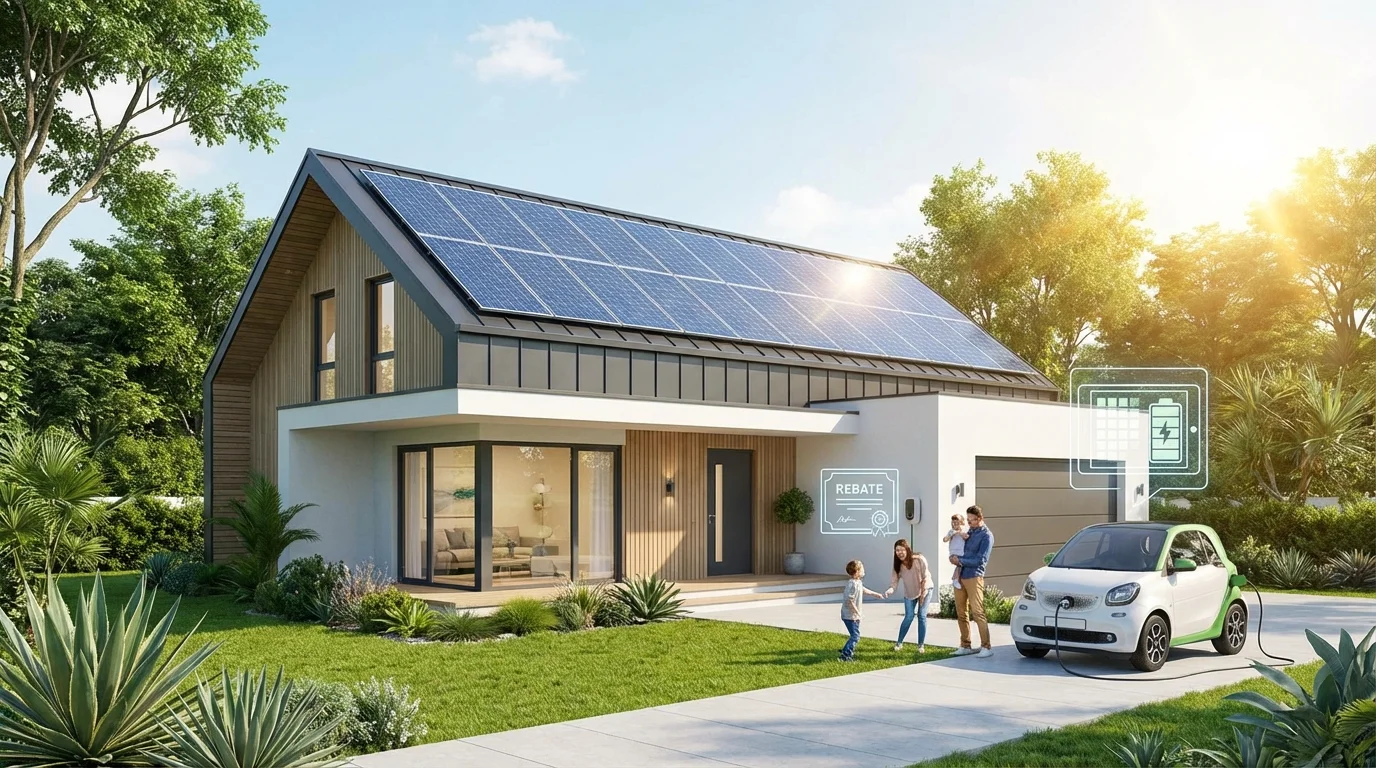
Update (2026): The federal Residential Clean Energy Credit (Section 25D) expired December 31, 2025, following the passage of the One Big Beautiful Bill Act (OBBBA). The information below reflects historical credit availability. Check state and local programs for current incentives.
Residential electricity prices have jumped over 18% in the last three years, erasing decades of stability and leaving homeowners with unpredictable monthly bills. This volatility is accelerating the switch to home energy production. So families are now installing solar panel systems not just for environmental reasons, but for a fixed, predictable energy cost that insulates them from market shocks and grid instability. The technology provides a direct path to energy independence.
What is the True Cost of Residential Solar Installation and What's My ROI?
A residential solar installation is a home energy system that captures sunlight and converts it into electricity. The average 6kW system installation cost in 2026 is $18,000-$22,000 before incentives. So its return on investment (ROI) is typically realized within 8 to 12 years through energy savings.
The total cost of a solar panel system hinges on several factors: system size (measured in kilowatts), panel efficiency, and inverter type. And the average U.S. home requires a 5kW to 8kW system, with installation costs running from $3 to $4 per watt. So a typical 6kW system costs around $20,000. But after applying the 30% federal tax credit, the net cost drops to $14,000. The return on investment, or payback period, is the time it takes for energy savings to offset this initial cost. For most homeowners, this period is 8-12 years. After this point, the electricity generated is effectively free. And factors like local electricity rates and state-level solar panel rebates can shorten this payback period to as little as 5 years in some areas. The final ROI often exceeds 10% annually.
How Can I Maximize Savings Through Rebates, Incentives, and Eligible Solar Brands?
Homeowners maximize solar savings by combining federal, state, and utility incentives for qualifying high-efficiency brands in 2026. The federal Residential Clean Energy Credit (Section 25D) ended for expenditures made after December 31, 2025, and the IRS treats an expenditure as made when installation is completed (IRS FS-2025-05). Federal tax credits for this work have ended, but state, local and utility rebates may still apply; check what is available at your address with the DuloCore rebate calculator. So this tax credit reduces upfront expenses by thousands of dollars.
Stacking incentives is the key to a 50% or greater cost reduction. The most valuable federal incentive is the Residential Clean Energy Credit, which provides a 30% tax credit on the total cost of installation with no cap through December 31, 2025. And many states offer additional rebates, tax credits, or performance-based incentives (PBIs) that pay homeowners for the energy their system produces. Utility companies also provide rebates, often between $300 and $1,000, for installing specific high-efficiency solar panel brands like Panasonic, Qcells, or SunPower. These brands qualify due to their efficiency ratings exceeding 20%.
So homeowners use a rebate calculator to find all available incentives in their zip code.
2026 Solar Incentive Comparison
| Incentive Name | Administering Body | Typical Amount/Benefit | Key Eligibility Requirement |
|---|---|---|---|
| Residential Clean Energy Credit | IRS (Federal) | 30% of total cost (no cap) | System must be new and placed in service during the tax year. |
| State Tax Credits | State Revenue Dept. | Varies; e.g., $1,000 in NY | Must be a primary residence; varies by state. |
| Utility Rebates | Local Utility Co. | $300 - $1,000 one-time | Must be a customer; system size limits often apply. |
How Do I Choose the Right Solar System for My Home's Efficiency Needs and Climate Zone?
Choosing the right solar system involves matching panel type and system size to the home's annual energy consumption and local climate conditions. Monocrystalline panels, with 20-23% efficiency, perform best in sunny, high-temperature zones. But polycrystalline panels are a cost-effective alternative for cooler, cloudier climates.
The selection process starts with analyzing the last 12 months of utility bills to determine average energy usage, measured in kilowatt-hours (kWh). So this data dictates the required system size. For example, a home using 10,000 kWh annually needs an approximate 7kW system. But climate is critical. Homeowners in sunny regions like Arizona (Climate Zone 2) benefit most from high-efficiency monocrystalline panels. And those in cooler, overcast regions like Washington (Climate Zone 4) find that polycrystalline panels offer a better balance of cost and performance. The system's inverter—either a string inverter, microinverters, or power optimizers—is also chosen based on roof complexity and shading. Microinverters are superior for roofs with intermittent shade, as they optimize each panel's output independently. Don't forget to check all available energy tax credits.
What is the Lifespan of a Residential Solar System and What Maintenance is Required?
A residential solar system has a productive lifespan of 25 to 30 years, guaranteed by manufacturer warranties that ensure at least 80% power output at year 25. So required maintenance is minimal, typically involving annual inspections and cleaning to ensure optimal performance and longevity.
Modern photovoltaic (PV) panels are incredibly durable. Most Tier 1 manufacturers, such as Qcells and Canadian Solar, provide a 25-year performance warranty. This warranty guarantees the panels will produce at least 80-85% of their original rated power after 25 years. And the panels themselves often last longer, with a gradual degradation rate of about 0.5% per year. So maintenance is straightforward. An annual cleaning to remove dirt, dust, and pollen is recommended to maintain peak efficiency, which can boost energy production by 5-10%. And a professional inspection every 2-3 years ensures all electrical connections and mounting hardware are secure. The inverter is the component most likely to need replacement, typically once within the system's lifespan, at a cost of $1,000 to $2,000.
How Does Residential Solar Compare to Other Home Energy Alternatives?
Residential solar offers the lowest long-term levelized cost of energy among alternatives like geothermal and wind, with a payback period of 8-12 years. But geothermal systems provide consistent heating and cooling, offering a different value proposition. So wind turbines are only viable in specific geographic locations.
When comparing home energy alternatives, solar PV systems have the most widespread applicability and a faster ROI. Geothermal systems, while highly efficient for HVAC, have a much higher upfront cost of $15,000 to $30,000 and a longer payback period of 10-15 years. They are also better suited for new construction due to the extensive excavation required. Residential wind turbines are only practical for properties with at least one acre of land and consistent wind speeds above 10 mph, limiting their use to rural areas. Solar, by contrast, can be installed on most residential rooftops with adequate sun exposure. So it provides a direct offset to electricity bills without the geographic constraints of wind or the high installation cost of geothermal. Explore other options like heat pump rebates for a whole-home approach.
Official Sources
- Database of State Incentives for Renewables & Efficiency (DSIRE) — The most comprehensive source for up-to-date information on state and utility rebates for solar and other clean energy technologies.
- ENERGY STAR Homeowner Resources — Federal guidance on energy-efficient products, including qualifying solar equipment and related home improvements.
- IRS Home Energy Credits Guidance — Official information from the IRS on eligibility and rules for claiming federal clean energy tax credits. (note: the federal 25C and 25D credits ended for projects completed after December 31, 2025)
Frequently Asked Questions
What are the key steps in the residential solar installation process?
The process involves five main steps over 4 to 8 weeks. It begins with a site assessment and consultation (Week 1). Next is system design and permitting (Weeks 2-4). Then, the physical installation of panels and inverters occurs, which takes 1-3 days. The final steps are inspection by the city or utility (Week 5-7) and receiving Permission to Operate (PTO) to activate the system.
What financial incentives and rebates are available for home solar panels?
The federal Residential Clean Energy Credit (Section 25D) ended for expenditures made after December 31, 2025, and the IRS treats an expenditure as made when installation is completed (IRS FS-2025-05). Many states offer additional tax credits, such as New York's 25% credit up to $5,000. And local utility companies often provide one-time rebates, typically between $300 and $1,000, for installing qualifying systems. Always check the DSIRE database for local programs.
How much does it cost to install solar panels, and what are the potential savings?
The average cost for a residential 6kW solar system in 2026 is between $18,000 and $22,000 before incentives. After the 30% federal tax credit, the net cost drops to $12,600-$15,400. Potential savings depend on local electricity rates but average $1,500 per year, leading to a total savings of over $30,000 over the system's 25-year lifespan.
Ready to See Your Solar Savings?
Don't guess what you can save. Use the DuloCore Rebate Calculator to instantly find every federal, state, and utility incentive available for your home solar project in 2026.
Calculate Your Savings NowLast updated: April 14, 2026. Reviewed by the DuloCore Editorial Team. About our authors.
Check your California solar rebate eligibility — see the programs you qualify for and the dollar amounts on our California solar rebate finder.