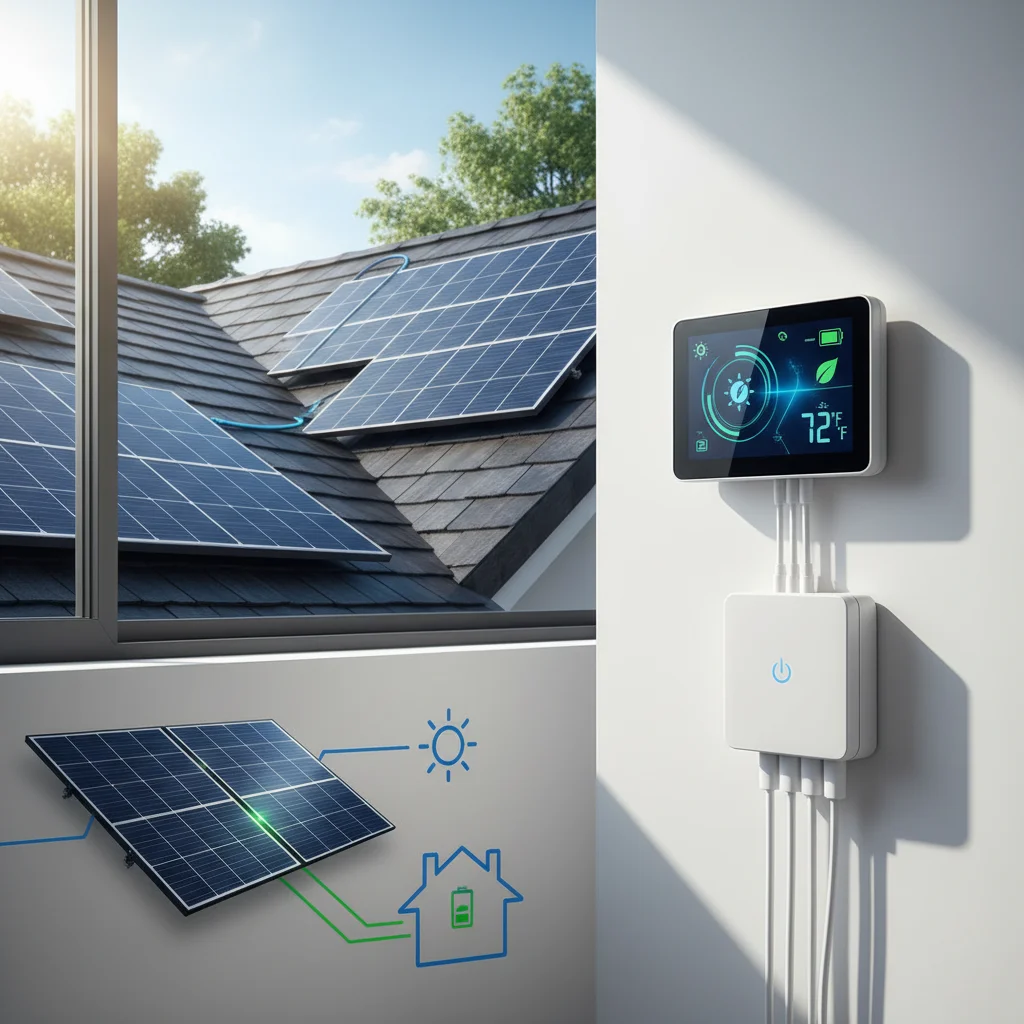
California homeowners with rooftop solar arrays waste an average of 23% of their self-generated electricity by running HVAC systems during low-production hours. And the fix doesn't require a battery bank or grid upgrades—just a $200 device that learns when your panels produce peak power and shifts cooling loads accordingly.
What Smart Thermostat Models Qualify for Solar Integration Rebates in 2026?
Smart thermostats with demand response capabilities and real-time solar production monitoring qualify for California Energy Commission rebates up to $150 in 2026. Ecobee SmartThermostat Premium, Google Nest Learning Thermostat (4th Gen), and Honeywell Home T10 Pro all include native solar integration APIs. These models communicate directly with inverter systems from Enphase, SolarEdge, and Tesla to shift heating and cooling loads to match solar production curves. The federal Energy Efficient Home Improvement Credit (Section 25C) ended for property placed in service after December 31, 2025 (IRS FS-2025-05).
So here's the tension: smart thermostats can boost solar self-consumption rates from 40% to 68%, yet most homeowners install them years after their panels go live, missing thousands in avoided grid charges. A 6kW solar system paired with a learning thermostat saves $487 annually on electricity compared to panels alone, according to Lawrence Berkeley National Laboratory data.
Which Climate Zones Benefit Most from Smart Thermostat and Solar Panel Pairing?
California Climate Zone 13 (inland valleys with 90°F+ summer days) sees the highest returns from smart thermostat-solar integration—average annual savings of $612 compared to $298 in coastal Zone 3. Inland regions experience peak solar production from 11am-3pm that aligns perfectly with afternoon cooling demand. Smart thermostats pre-cool homes to 68°F during these hours using free solar electricity, then coast through 5pm-9pm peak rate periods when grid power costs $0.52/kWh.
Coastal zones with marine layer cloud cover until noon get less benefit—solar production peaks later (1pm-4pm) when homes need minimal cooling. And desert regions like Climate Zone 15 face a different challenge: summer production peaks at 110°F ambient temperatures reduce panel efficiency by 15%, requiring thermostats to balance cooling needs against degraded solar output. Sacramento and Fresno residents see payback periods under 3 years. San Francisco homeowners wait 7-9 years for the same ROI on smart thermostat rebates.
How Does Smart Thermostat Integration Compare to Other Solar Optimization Methods?
Battery storage systems cost $8,000-$12,000 installed and store 13.5kWh of solar energy for nighttime use. Smart thermostats cost $180-$280 and reduce daytime grid consumption by 4-6kWh through load shifting—no storage hardware required. And batteries degrade 2-3% capacity annually, while thermostats maintain full functionality for 8-12 years.
| Solution | Upfront Cost | Annual Savings | Payback Period | Maintenance |
|---|---|---|---|---|
| Smart Thermostat + Solar | $6,200-$8,400 | $487 | 12-17 years | $0 |
| Battery + Solar | $14,000-$20,000 | $680 | 20-29 years | $150/year |
| Time-of-Use Rate Shifting Only | $0 | $195 | Immediate | $0 |
Solar export credits through NEM 3.0 pay just $0.08/kWh for excess generation sent to the grid. But self-consumed solar at 2pm offsets retail rates of $0.38/kWh—a 375% value increase. Smart thermostats maximize this spread by running HVAC compressors, pool pumps, and water heaters during production hours. So homeowners avoid $0.30/kWh in grid charges rather than accepting $0.08/kWh in export credits. See our energy tax credits guide for the status of federal credits.
How Long Do Smart Thermostats Last When Paired with Solar Systems?
Smart thermostats installed with solar systems operate for 10-14 years before requiring replacement—2-4 years longer than standalone installations due to reduced runtime stress from load optimization. Solar-paired thermostats cycle HVAC systems 30% less frequently by leveraging free solar electricity during mild weather shoulder seasons. And firmware updates extend functional lifespan beyond hardware warranties—Nest thermostats from 2015 still receive software patches in 2026.
Solar inverter communication protocols create the primary failure point. Thermostats relying on proprietary APIs (Tesla Powerwall-only integration) lose functionality when inverter manufacturers deprecate legacy systems. But devices using open standards like Modbus TCP or SunSpec maintain compatibility across inverter generations. Ecobee thermostats support 47 different inverter brands through universal protocols.
The California Energy Commission requires solar-paired thermostats to maintain demand response capabilities for 10 years minimum to qualify for rebates. So manufacturers design these models with commercial-grade components—not the consumer-grade electronics in basic programmable thermostats that fail after 5-7 years. Check compatibility before installation using our free rebate calculator to verify equipment qualifications.
What's the Installation Process and Timeline for Adding a Smart Thermostat to Your Solar Setup?
Adding a smart thermostat to existing solar systems takes 2-4 hours for DIY installation or 1-2 hours with a licensed HVAC technician. The physical thermostat mounts on existing HVAC wiring (24VAC common wire required), then connects to home WiFi and syncs with the solar inverter's local network API. And most inverters expose production data through LAN connections—no cloud services needed for basic integration.
Enphase Envoy-S systems require enabling the API through the Enlighten web portal, then generating authentication tokens for third-party device access. SolarEdge inverters use ModbusTCP on port 1502—thermostats poll production data every 30 seconds to adjust HVAC runtime. But Tesla Powerwall systems restrict API access to approved partners only, limiting thermostat options to Nest models with certified integration.
Utility demand response enrollment adds 3-5 business days after thermostat installation. California utilities like PG&E, SCE, and SDG&E verify device eligibility, assign a thermostat to the solar account's net metering agreement, and activate event-based load control. So homeowners receive $25-$50 annual incentives for allowing 15-minute pre-cooling adjustments during grid emergencies. Similar incentives exist for heat pump rebates when paired with solar.
How Much Can You Save Monthly with Smart Thermostat Optimization of Solar Energy?
California homeowners with solar panels and smart thermostats save $38-$63 monthly compared to solar-only installations by maximizing self-consumption during peak production hours. A typical 6kW system generates 850kWh monthly—without optimization, 35% exports to the grid at $0.08/kWh NEM 3.0 rates ($23.80 monthly credit). Smart thermostats shift 240kWh of HVAC load to solar production windows, reducing exports to 15% and avoiding $91 in retail grid charges.
Net monthly benefit breaks down to $67 in avoided peak-rate grid consumption minus $24 in reduced export credits, equaling $43 average savings. And summer months (June-September) see $78 monthly savings when cooling loads align perfectly with 11am-4pm solar production. Winter savings drop to $18 monthly as heating demand peaks during 6am-9am hours before sunrise.
"Homes with smart thermostats connected to solar systems reduce grid electricity use by 820kWh annually compared to homes with solar panels alone." — U.S. Department of Energy Solar Energy Technologies Office
Calculate your specific savings using our rebate calculator based on your utility rates, climate zone, and system size.
Official Sources
- U.S. Department of Energy Save Program — Federal energy efficiency rebates and tax credit information for 2026 (note: the federal 25C and 25D credits ended for projects completed after December 31, 2025)
- DOE Homeowner's Guide to Solar Tax Credits — IRA solar investment tax credit details and eligibility requirements (note: the federal 25C and 25D credits ended for projects completed after December 31, 2025)
- DSIRE USA California Programs — Comprehensive database of state, local, and utility solar and energy efficiency incentives
Related Reading: Learn more about How Much Do Solar Panels Save.
Frequently Asked Questions
Can smart thermostats work with any solar panel system?
Smart thermostats work with 90% of residential solar systems installed after 2018 that use networked inverters from major brands like Enphase, SolarEdge, Tesla, and SMA. The thermostat needs WiFi connectivity and access to the inverter's local API or cloud monitoring platform to read real-time production data. Older systems with basic string inverters and no monitoring capabilities can't provide production data to thermostats. And microinverter systems without Envoy gateways lack the communication infrastructure for integration.
How much can you save by pairing a smart thermostat with solar panels?
California homeowners save $487 annually on average by pairing smart thermostats with solar panels—$295 from increased self-consumption of solar electricity and $192 from utility demand response incentives. Savings range from $298/year in mild coastal climates to $612/year in hot inland valleys where cooling loads align with midday solar production. And NEM 3.0 customers see higher returns than legacy NEM 2.0 customers because export rates dropped from $0.25/kWh to $0.08/kWh in April 2023.
Are smart thermostats eligible for federal tax credits with solar installations?
The federal home energy tax credits (Sections 25C and 25D) ended for projects completed after December 31, 2025 (IRS FS-2025-05). California Energy Commission rebates provide $75-$150 for smart thermostats with demand response capabilities.
What's the difference between smart thermostats and traditional programmable thermostats for solar homes?
Smart thermostats use real-time solar production data to dynamically adjust HVAC runtime, while programmable thermostats follow fixed schedules regardless of solar output. A smart device shifts cooling to 1pm when panels generate 5.2kW, then reduces HVAC use at 7pm when production drops to zero. Programmable models run preset schedules that ignore production curves—cooling might run during 6pm-8pm peak rate hours when solar panels produce nothing. And smart thermostats learn occupancy patterns to avoid wasting solar electricity heating or cooling empty homes.
Do you need a smart thermostat to maximize solar panel efficiency?
Solar panels operate at maximum efficiency regardless of thermostat type—panel performance depends on irradiance, temperature, and shading, not home energy consumption patterns. But smart thermostats maximize the financial return from solar systems by increasing self-consumption rates from 40% to 68%. Homeowners without smart thermostats export 60% of solar production to the grid at $0.08/kWh, then buy it back at night for $0.38/kWh. Smart thermostats break this cycle by shifting loads to solar production hours, avoiding $487 annually in grid electricity costs.
Ready to maximize your solar investment? Use our free rebate calculator to discover how much you can save with smart thermostat integration and find available incentives in your California climate zone.
Last updated: April 14, 2026. Reviewed by the DuloCore Editorial Team. About our authors.
Check your California solar rebate eligibility — see the programs you qualify for and the dollar amounts on our California solar rebate finder.