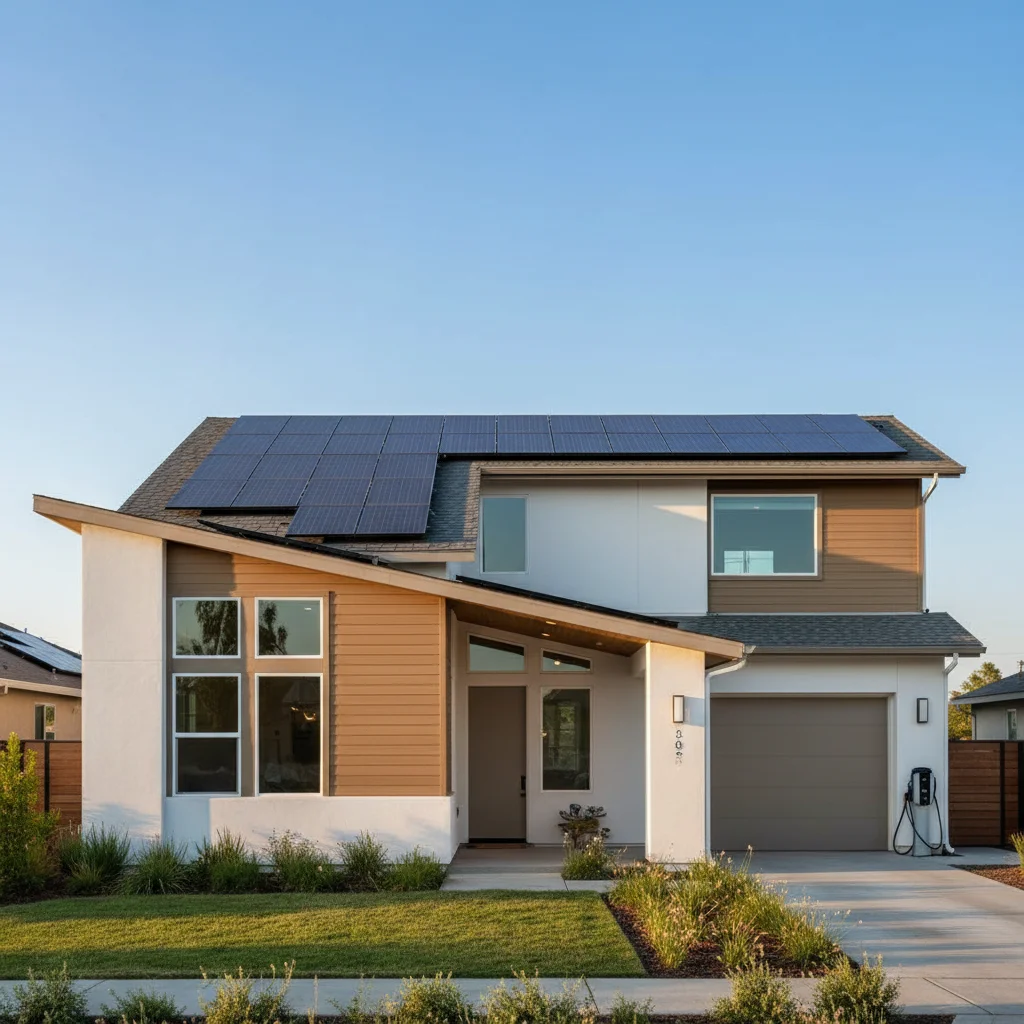
Fresno homeowners paid an average of $18,240 for solar panel installations in 2025, but the IRA federal tax credit reduced that cost to $12,768 after applying the 30% credit. And with California's SGIP battery storage incentive expiring in late 2026, the window for stacking incentives is closing fast.
How Much Does Solar Panel Installation Cost in Fresno?
Solar panel installation costs in Fresno range from $15,000 to $25,000 before incentives, with the average 6-kilowatt residential system costing $18,240 in 2026. The IRA federal tax credit reduces this by 30%, bringing net costs to $12,768. Installation prices vary based on system size, roof complexity, and equipment quality, with local labor costs averaging $0.75 to $1.25 per watt.
But Fresno's intense summer heat creates a hidden benefit. The city's 271 annual sunny days generate 15-20% more energy production compared to coastal California cities, accelerating payback periods to 6-8 years instead of the state average of 9-11 years.
So why does Fresno's climate matter for solar economics? Every degree above 77°F reduces panel efficiency by 0.5%, but Fresno's dry heat causes less degradation than humid climates. Panels lose only 0.3-0.5% annual efficiency in Central Valley conditions versus 0.8-1.2% in coastal fog zones.
Cost Breakdown by System Size
Fresno installers price systems at $2.85 to $3.40 per watt before incentives. A typical 6kW system for a 1,500-square-foot home costs $17,100 to $20,400, while larger 8kW systems for 2,500-square-foot homes run $22,800 to $27,200. And these prices include panels, inverters, racking, permits, and grid connection fees.
The federal Residential Clean Energy Credit (Section 25D) ended for expenditures made after December 31, 2025, and the IRS treats an expenditure as made when installation is completed (IRS FS-2025-05). Check current state, local and utility incentives for your address with the DuloCore rebate calculator. But Fresno homeowners can't combine this with California's expired SGIP solar incentive, which ended for standalone solar in 2024. The SGIP program now only covers battery storage systems, offering $200-$250 per kilowatt-hour until funds deplete in late 2026.
Local utility PG&E charges Fresno residential customers an average of $0.31 per kilowatt-hour under tiered pricing, with peak summer rates hitting $0.42 per kWh. Solar systems eliminate 85-95% of these charges, saving the average household $1,800 to $2,400 annually.
Installation Cost Factors
Roof characteristics drive 40-60% of price variation in Fresno installations. Concrete tile roofs add $2,500 to $4,000 for specialized mounting hardware, while metal roofs reduce installation time by 15-20%, cutting labor costs by $800 to $1,200. And homes requiring electrical panel upgrades pay an additional $1,500 to $3,000 for 200-amp service.
Tree removal and roof repairs must happen before installation. Trimming overhanging branches costs $300 to $800, while replacing damaged shingles runs $1,200 to $2,500 for typical repairs. Fresno's permitting fees total $450 to $650 through the city's expedited solar review process.
Premium equipment increases upfront costs but improves long-term returns. Tier 1 panels from manufacturers like SunPower or LG cost $0.45 to $0.65 more per watt than budget brands, adding $2,700 to $3,900 to a 6kW system. Microinverters add $1,800 to $2,400 versus string inverters but increase production by 5-12% in Fresno's partial shade conditions.
What Are the Best Alternatives to Solar Panels in Fresno?
The federal Residential Clean Energy Credit (Section 25D) ended for expenditures made after December 31, 2025, and the IRS treats an expenditure as made when installation is completed (IRS FS-2025-05). Federal tax credits for this work have ended, but state, local and utility rebates may still apply; check what is available at your address with the DuloCore rebate calculator. SGIP battery (this federal credit ended for expenditures made after December 31, 2025) incentives reduce net costs by $2,000 to $3,000 until program funds exhaust. Community solar programs let renters access solar savings without rooftop installation, charging $0.24 to $0.28 per kWh versus PG&E's $0.31 average rate.
Energy efficiency upgrades deliver faster payback than solar for many Fresno homes. Replacing a 20-year-old air conditioner with a heat pump costs $8,500 to $12,000 and qualifies for the IRA's $2,000 heat pump rebates, cutting cooling costs by 40-55%. And attic insulation upgrades cost $1,200 to $2,400 but reduce air conditioning loads by 20-30%, improving solar system economics.
So which path makes financial sense? Homes with monthly electric bills below $120 see better returns from efficiency upgrades first, then solar. Bills above $180 monthly justify immediate solar installation, especially with the SGIP battery deadline approaching.
Community Solar Programs
Fresno County offers three community solar programs for residents who can't install rooftop systems. PG&E's Solar Choice program allocates solar energy at $0.27 per kWh with no upfront cost, saving 13-16% versus standard rates. And participants avoid maintenance costs and equipment failures that rooftop owners face.
Community solar subscriptions require no credit check or home ownership. Renters and apartment dwellers save $15 to $35 monthly on typical subscriptions, with contracts lasting 12-36 months. But programs cap enrollment at 2 megawatts, creating 6-12 month waitlists during peak signup periods.
How Long Do Solar Panels Last in Fresno's Climate?
Modern solar panels last 25-30 years in Fresno's climate, with manufacturers guaranteeing 80-85% output after 25 years. Fresno's low humidity and minimal hail damage create ideal conditions for panel longevity, with degradation rates of 0.3-0.5% annually compared to the national average of 0.8%. Inverters require replacement after 10-15 years at a cost of $1,500 to $3,000, while panels themselves need only periodic cleaning to maintain peak production.
Central Valley heat accelerates inverter aging but has minimal impact on panel lifespan. String inverters fail at 12-14 years in Fresno's 100°F+ summers versus 15-17 years in coastal zones. But microinverter systems extend component life to 20-25 years by distributing heat load across multiple units instead of a single centralized inverter.
"Solar panels degrade at a median rate of 0.5% per year, meaning they'll operate at about 88% of their original capacity after 25 years." — National Renewable Energy Laboratory
So what maintenance extends panel life? Annual cleaning removes dust and pollen that reduce output by 3-7% in Fresno's agricultural air. Professional cleaning costs $150 to $250 and increases production by 5-12%, paying for itself in 4-6 months. And monitoring systems alert homeowners to performance drops from failed inverters or damaged panels.
Fresno installers offer 10-year workmanship warranties covering mounting hardware and electrical connections. Panel manufacturers provide 25-year performance warranties and 10-15 year equipment warranties. Extended warranties cost $800 to $1,400 and cover inverter replacement and panel repairs beyond standard coverage.
What Financing Options and Tax Credits Are Available for Solar Installation in Fresno?
The federal Residential Clean Energy Credit (Section 25D) ended for expenditures made after December 31, 2025, and the IRS treats an expenditure as made when installation is completed (IRS FS-2025-05). California's SGIP battery storage incentive provides $200-$250 per kilowatt-hour for systems installed by December 2026, cutting battery costs by $2,000 to $3,000. Solar loans through Fresno credit unions charge 4.5-7.9% APR for 10-20 year terms, with monthly payments of $140 to $180 for typical 6kW systems after applying federal credits.
PACE financing programs let homeowners add solar costs to property tax bills, with 20-year terms at 6.5-8.5% interest. And these loans don't require income verification or minimum credit scores, making solar accessible to more households. But PACE loans create a property lien that must be repaid before selling the home.
Cash purchases deliver the fastest payback at 6-8 years in Fresno, while financed systems extend payback to 9-14 years depending on interest rates. Use our free rebate calculator to compare financing options and estimate your specific savings based on current electric bills and roof characteristics.
Tax Credit Application Process
Form 5695 only covers qualifying work completed by December 31, 2025 and claimed on a 2025 return; the federal 25C and 25D credits ended after that date (IRS FS-2025-05). The credit reduces tax liability dollar-for-dollar, with unused amounts carrying forward to future tax years. And the credit covers all installation costs including equipment, labor, permits, and sales tax.
Solar systems must be operational by December 31, 2026 to claim the full 30% credit on 2026 tax returns. Installation contracts signed in 2026 but completed in 2027 still qualify for the 30% rate. But homeowners must have sufficient tax liability to claim the credit, making cash purchases less attractive for retirees with minimal income tax.
California offers no state-level solar tax credit in 2026, after the state's solar incentive programs ended in 2024. Local utilities provide time-of-use rates that increase solar savings by 18-25% versus flat-rate billing. And PG&E's Net Energy Metering 3.0 credits excess solar production at $0.05 to $0.08 per kWh, down from the previous $0.30 rate under older programs.
What Is the Solar Installation Process and Timeline in Fresno?
Solar installation in Fresno takes 45-75 days from contract signing to system activation, with 30-45 days allocated to permit approval and utility interconnection paperwork. Physical installation requires 1-3 days for typical residential systems, followed by city inspection within 5-10 business days. PG&E activates net metering accounts 10-25 days after receiving approval documentation, with faster processing for systems under 10 kilowatts.
Fresno's expedited solar permit process costs $450 to $650 and approves standard installations within 10-15 business days. Custom designs requiring structural calculations or electrical panel upgrades extend permit review to 20-30 days. And installations on historic properties face additional architectural review adding 15-25 days to the timeline.
So what slows down installations? HOA approval creates the longest delays, with review periods of 30-60 days common in Fresno's planned communities. State law prohibits HOAs from blocking solar installations, but associations review aesthetics and placement, sometimes requiring panel repositioning or screening.
Step-by-Step Installation
Site assessment happens within 7-10 days of contract signing, with installers measuring roof dimensions, evaluating electrical service, and calculating shading patterns. Engineers design the system layout and submit permit applications within 5-7 days. And homeowners review panel placement and inverter locations before installation begins.
Installation crews mount racking hardware, install panels, connect inverters, and complete electrical work in 6-12 hours for most homes. Larger 8-10kW systems require 2-3 days for complete installation. City inspectors verify electrical code compliance, grounding systems, and roof penetrations during a 30-60 minute inspection.
PG&E's Permission to Operate (PTO) arrives via email 10-25 days after passing inspection. Installers activate the system and configure monitoring apps during a final 1-2 hour visit. And most companies include a 30-day performance review to verify production meets design estimates.
How Do Solar Panel Costs Compare to Traditional Energy in Fresno?
Solar panels cost $0.06 to $0.09 per kilowatt-hour over their 25-year lifespan in Fresno, compared to PG&E's $0.31 average residential rate and projected $0.42 to $0.55 rates by 2030. A typical 6kW system producing 9,500 kWh annually saves $2,850 per year at current rates, reaching break-even in 6.5 years after federal tax credits. Traditional grid power costs the average Fresno household $3,720 annually, while solar systems eliminate 85-95% of these charges after installation.
But rate structures matter more than average costs. PG&E's time-of-use pricing charges $0.42 to $0.48 per kWh during 4-9 PM peak periods when solar production drops. Pairing solar with battery storage captures midday solar generation for evening use, increasing savings by $600 to $1,100 annually. And NEM 3.0's reduced export credits push the economics toward self-consumption rather than grid export.
Natural gas costs $0.04 to $0.06 per kWh for heating and cooking in Fresno, making gas appliances cheaper than electric equivalents. Solar's advantage comes from offsetting high-cost electric air conditioning, which consumes 45-60% of annual electricity in Central Valley homes. Replacing gas heating with electric heat pump rebates and powering it with solar delivers total energy savings of 35-50%.
Long-Term Cost Projection
PG&E rates increased 88% from 2015 to 2025, averaging 6.5% annual growth. Projecting this trend, electricity will cost $0.55 to $0.68 per kWh by 2035. Solar panels locked in at $0.06 to $0.09 per kWh save progressively more each year as grid rates climb, with lifetime savings of $45,000 to $72,000 for systems installed in 2026.
Maintenance costs average $150 to $400 annually for cleaning and monitoring, with one $2,000 to $3,000 inverter replacement after 12-15 years. Total 25-year ownership costs reach $18,500 to $24,000 including initial installation and all maintenance. And grid electricity for the same consumption totals $93,000 to $127,000 over 25 years at projected rate increases.
Official Sources
- U.S. Department of Energy Solar Tax Credit Guide — Federal solar tax credit details and eligibility requirements (note: the federal 25C and 25D credits ended for projects completed after December 31, 2025)
- DSIRE Solar Policy Database — Comprehensive database of state and local solar incentives and policies
- Energy.gov Solar Energy Resources — Federal energy efficiency and renewable energy information
Related Reading: Learn more about Solar Panel Installation Cost Breakdown and Solar Roof Tiles Vs Panels Cost.
Related Reading: Learn more about Solar Panel Installation Cost In Bay Area.
Related Reading: Learn more about Solar Panel Installation Cost In Central Valley.
Frequently Asked Questions
How much does solar panel installation cost in Fresno?
Solar panel installation in Fresno costs $15,000 to $25,000 before incentives, with the average 6kW system priced at $18,240 in 2026. The IRA federal tax credit reduces this by 30% to a net cost of $12,768. Final costs vary based on roof type, system size, and equipment quality, with local installers charging $2.85 to $3.40 per watt. Additional expenses include $450-$650 for permits and $1,500-$3,000 for electrical panel upgrades if needed.
What rebates and incentives are available for solar panels in Fresno?
The federal Residential Clean Energy Credit (Section 25D) ended for expenditures made after December 31, 2025, and the IRS treats an expenditure as made when installation is completed (IRS FS-2025-05). California's SGIP battery storage incentive offers $200-$250 per kilowatt-hour for systems installed by December 2026, but doesn't cover standalone solar panels. PG&E's Net Energy Metering 3.0 credits excess solar production at $0.05-$0.08 per kWh. No state-level solar tax credits exist in California for 2026.
Do I qualify for solar panel rebates in Fresno?
The federal Residential Clean Energy Credit (Section 25D) ended for expenditures made after December 31, 2025, and the IRS treats an expenditure as made when installation is completed (IRS FS-2025-05). The credit requires no income limits or means testing, covering primary residences and second homes. SGIP battery incentives require PG&E service and prioritize low-income households and high-fire-risk areas. And community solar programs accept renters and those without suitable roofs, with no credit check or income requirements.
How long does it take to install solar panels in Fresno?
Physical solar panel installation takes 1-3 days for typical residential systems in Fresno. The complete process from contract to activation spans 45-75 days, including 10-15 days for permit approval, 30-45 days for utility interconnection paperwork, and 10-25 days for PG&E's Permission to Operate. HOA approval adds 30-60 days for homes in planned communities. Expedited permitting reduces timeline by 5-10 days for standard installations under 10 kilowatts.
What is the payback period for solar panels in Fresno?
Solar panels in Fresno reach payback in 6-8 years with cash purchases after applying the 30% federal tax credit. Financed systems extend payback to 9-14 years depending on interest rates, with typical solar loans at 4.5-7.9% APR. Fresno's 271 annual sunny days and high electricity rates of $0.31 per kWh create faster payback than California's 9-11 year state average. Systems produce $2,850 in annual savings for the average household, with lifetime savings of $45,000-$72,000 over 25 years.
Ready to calculate your solar savings? Use our free rebate calculator to estimate your installation costs, available incentives, and payback period based on your specific roof and energy usage. Get your personalized solar analysis in under 2 minutes.
Last updated: April 14, 2026. Reviewed by the DuloCore Editorial Team. About our authors.
Check your California solar rebate eligibility — see the programs you qualify for and the dollar amounts on our California solar rebate finder.