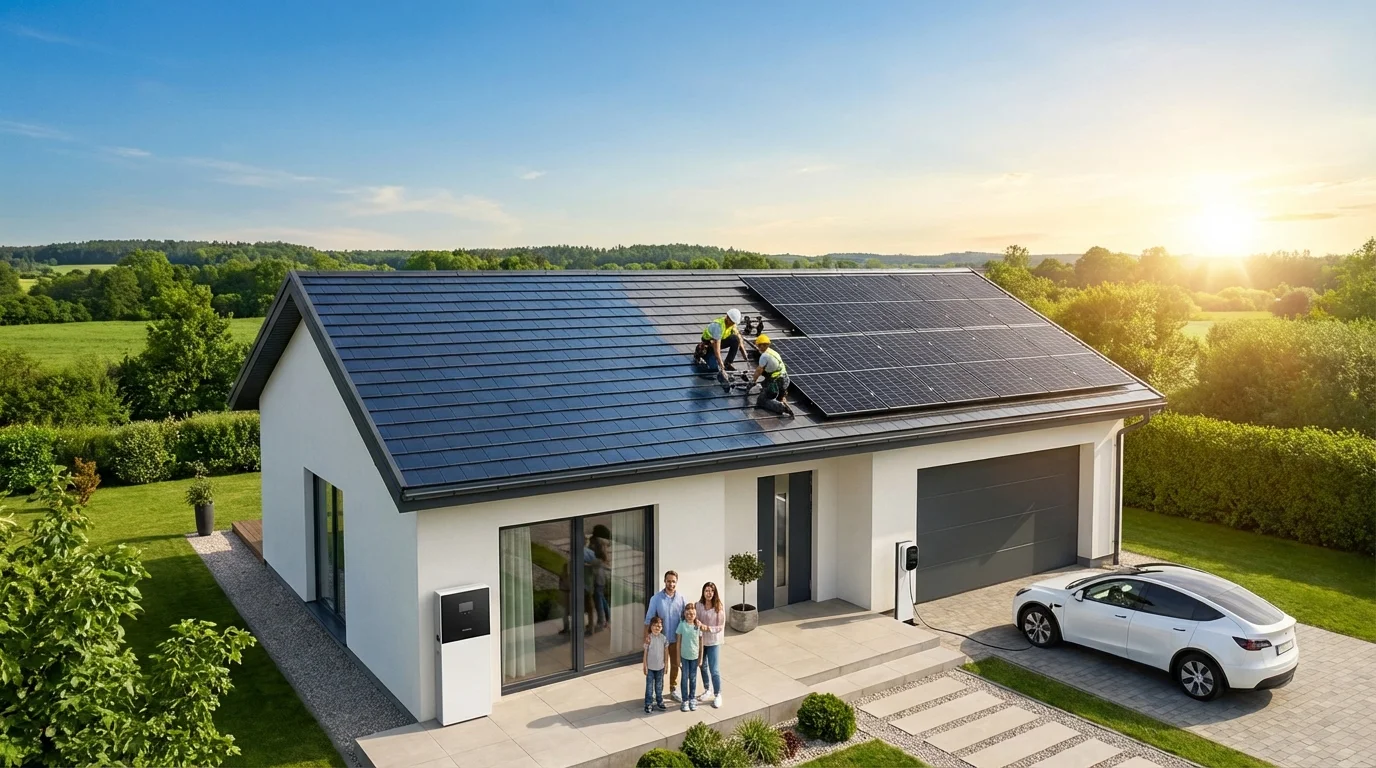
More than 4.2 million U.S. homes now have solar installations, a number that grows by over 25% each year as homeowners seek to lower their utility bills. The critical decision isn't just whether to go solar, but how. Choosing between integrated solar roof tiles and traditional solar panels involves a complex cost-benefit analysis that extends far beyond the initial price tag, directly impacting a home's value, aesthetic, and long-term energy savings for the next 25-30 years.
What's the True Upfront Cost of Solar Roof Tiles vs. Panels, Including Installation?
Solar roof tiles are a premium integrated roofing and power generation system costing between $20 to $30 per square foot, including a full roof replacement. For a 2,000 sq. ft. roof, the total cost for a solar tile system from brands like Tesla or GAF often ranges from $60,000 to $90,000 before incentives.
So homeowners face a choice with a $30,000+ price differential. The central tension is that solar tiles combine a full roof replacement with power generation. So, if a roof already needs replacing—a project costing $15,000 to $25,000 on its own—the incremental cost for the solar functionality becomes much more palatable. But for a home with a newer roof, traditional solar panels present a far lower initial investment, typically costing between $18,000 and $25,000 for a 7kW system. This decision hinges entirely on the existing condition and remaining lifespan of the current roof.
Traditional solar panels cost between $2.50 and $3.50 per watt installed, leading to a total system cost of $18,000 to $25,000 for a typical 7-kilowatt (kW) system. But solar roof tiles are priced differently, usually by the square foot, because they replace the entire roof. So the cost for a solar tile system averages $25 per square foot, or $75,000 for a 3,000 sq. ft. roof. And this price includes both active solar tiles and non-active, matching tiles. The primary cost driver for tiles is the necessity of a full roof tear-off and replacement, an expense not required for panel installations on a structurally sound roof. This makes panels the more economical choice for homes with 10+ years of roof life remaining. Find out more about specific solar panel rebates available in your area.
How Do Rebates and Incentives Impact the Cost, and Which Brands Qualify for Them?
Solar incentives in 2026, primarily through the federal IRA tax credit, reduce the net cost of both solar tiles and panels by 30%. This credit applies to the total project cost, including installation and any necessary roof work performed in conjunction with the solar install.
The federal Residential Clean Energy Credit (Section 25D) ended for expenditures made after December 31, 2025, and the IRS treats an expenditure as made when installation is completed (IRS FS-2025-05). Federal tax credits for this work have ended, but state, local and utility rebates may still apply; check what is available at your address with the DuloCore rebate calculator. So for a $25,000 solar (this federal credit ended for expenditures made after December 31, 2025) panel system, this credit returns $7,500 to the homeowner. And for an $80,000 solar tile roof, the credit is $24,000. Brands like Tesla, GAF, and Luma for solar tiles, along with panel manufacturers such as Qcells and REC, are eligible as long as the system is new and purchased, not leased. Many states and utilities also offer additional rebates, often between $500 and $2,000, which can be stacked with federal incentives. These programs are essential for lowering the net cost and accelerating the payback period for either technology. Understanding all available energy tax credits is key to an accurate budget. (Note: Federal tax credit percentages and availability are subject to change; the 30% Residential Clean Energy Credit under Section 25D expired December 31, 2025. Verify current incentives at energy.gov.)
What's the ROI and Typical Payback Period for Solar Roof Tiles vs. Panels?
The payback period for traditional solar panels is typically 7 to 12 years, driven by a lower initial investment and high energy production efficiency. Solar roof tiles have a longer payback period, often 10 to 15 years, due to their higher upfront cost of $60,000 or more.
The return on investment (ROI) calculation for solar tiles is more complex because it includes the value of a new 25-year warrantied roof. So if a homeowner already needs a $20,000 roof replacement, that cost is effectively subtracted from the solar tile investment, shortening the true payback period. And data shows homes with solar sell for 4.1% more on average. But panels offer a more direct and faster ROI based solely on energy savings against their $18,000-$25,000 installation cost. The best financial choice depends on whether the value of a new roof is a required expense or an optional upgrade. The U.S. Department of Energy provides tools to estimate savings.
"A solar PV system is a long-term investment. Like any home improvement, it is important to do your research to make sure you are making the best decision for your home and family." — U.S. Department of Energy
How Do Efficiency Ratings, Lifespan, and Maintenance Compare for Solar Tiles and Panels?
Modern monocrystalline solar panels offer efficiency ratings between 19% and 22%, converting more sunlight into electricity per square foot. Solar roof tiles generally have slightly lower efficiency, ranging from 17% to 20%, requiring a larger surface area to generate the same amount of power.
Both technologies boast a similar operational lifespan of 25 to 30 years, backed by performance warranties that typically guarantee 80-90% of original output after 25 years. And maintenance for both is minimal, usually just requiring occasional cleaning to remove debris that blocks sunlight. But repairs for solar tiles are more complex and expensive. So if a single tile fails, a specialized roofer is often needed to replace it without compromising the roof's integrity, whereas replacing a single panel is a more straightforward process for any certified solar installer. This potential for higher repair costs is a critical long-term consideration.
Which Solar Solution is Best Suited for Your Climate Zone and Home's Aesthetic?
Solar roof tiles provide a seamless, integrated aesthetic that is often preferred in neighborhoods with strict homeowners' associations (HOAs) or for historic homes. Panels offer a more traditional, utilitarian look that is widely accepted and more cost-effective for homeowners focused purely on energy production.
From a climate perspective, solar tiles from brands like GAF often carry superior wind and impact ratings, making them a durable choice in hurricane-prone regions or areas with frequent hail. Their integrated design also eliminates the risk of pest intrusion under the panels. But traditional panels are versatile and can be installed on almost any roof type and orientation, with racking systems that can be tilted for optimal sun exposure, a feature tiles lack. So in northern climates with lower sun angles, the ability to tilt panels provides a 5-10% performance advantage. Use our free rebate calculator to see which incentives are available for your home.
Are There Other Sustainable Alternatives, and How Do They Stack Up Against Solar Roof Tiles and Panels?
Beyond rooftop installations, homeowners have alternatives like community solar programs and ground-mounted solar arrays. Community solar allows participation in a local solar farm for a monthly credit on utility bills, requiring zero upfront investment and costing 5-15% less than standard utility rates.
Ground-mounted solar panels are another option for properties with sufficient land. And their installation cost is comparable to rooftop panels, around $2.70 to $3.80 per watt, but they often achieve 5-10% higher efficiency because their angle and orientation can be perfectly optimized. However, they consume valuable yard space and don't address roofing needs. Other clean energy upgrades, like installing high-efficiency heat pumps, offer different benefits. So while solar generates electricity, heat pump rebates help reduce overall energy consumption by up to 50%, providing an alternative or complementary path to a lower carbon footprint and reduced utility bills.
| Feature | Solar Roof Tiles | Traditional Solar Panels |
|---|---|---|
| Upfront Cost | $60,000 - $90,000 (includes new roof) | $18,000 - $25,000 (panels only) |
| Cost Per Watt | $4.00 - $6.50 | $2.50 - $3.50 |
| Efficiency Rating | 17% - 20% | 19% - 22% |
| Payback Period | 10 - 15 years | 7 - 12 years |
| Aesthetic | Seamless, integrated | Visible, mounted on roof |
| Best For | New construction or roof replacement | Homes with existing, healthy roofs |
Official Sources
- DSIRE - Database of State Incentives for Renewables & Efficiency — A comprehensive source for federal, state, and local clean energy incentives.
- ENERGY STAR Rebate Finder — A tool from the U.S. EPA to find local rebates on energy-efficient appliances and home improvements.
- DOE Homeowner's Guide to the Federal Tax Credit for Solar — Official guidance on qualifying for the 30% federal solar tax credit. (note: the federal 25C and 25D credits ended for projects completed after December 31, 2025)
Related Reading: Learn more about How Much Do Solar (this federal credit ended for expenditures made after December 31, 2025) Panels Save.
Frequently Asked Questions
What is the upfront cost difference between solar roof tiles and traditional solar panels?
Solar roof tiles have a total installation cost of $60,000 to $90,000, as the price includes a full roof replacement. Traditional solar panels cost between $18,000 and $25,000 for a standard 7kW system, assuming the existing roof is in good condition. So the initial cash outlay for tiles is at least $40,000 higher.
Are solar roof tiles more expensive to install than standard solar panels?
Yes, the installation for solar roof tiles is more expensive and complex. It involves a complete tear-off of the existing roof and installation by certified roofers and electricians, a process that can take 1-2 weeks. A standard solar panel installation takes 1-3 days and doesn't require altering the underlying roof structure, resulting in lower labor costs of $3,000 to $5,000.
Do solar roof tiles qualify for the same rebates and tax credits as solar panels, affecting the net cost?
The federal Residential Clean Energy Credit (Section 25D) ended for expenditures made after December 31, 2025, and the IRS treats an expenditure as made when installation is completed (IRS FS-2025-05). This credit applies to the total project cost, including materials and installation. So while the gross cost of tiles is higher, the dollar value of the tax credit is also proportionally greater, reducing the net cost for both technologies.
How does the long-term return on investment compare for solar roof tiles versus solar panels?
Traditional solar panels typically offer a faster return on investment, with a payback period of 7-12 years due to their lower initial cost. Solar roof tiles have a longer payback period of 10-15 years. However, their ROI calculation includes the value of a new 25-year warrantied roof, which adds an estimated $15,000 to $25,000 in home value immediately.
Is it more cost-effective to choose solar tiles if I need a full roof replacement?
Yes, choosing solar tiles becomes highly cost-effective if a roof replacement is already necessary. A new asphalt roof costs $15,000-$25,000. When this required expense is factored in, the incremental cost of adding solar functionality via tiles becomes much closer to the cost of installing panels on a new roof separately, making it a financially sound combined investment.
Updated: April 14, 2026 — fact-checked by DuloCore Research. About our editorial process.
Check your California solar rebate eligibility — see the programs you qualify for and the dollar amounts on our California solar rebate finder.