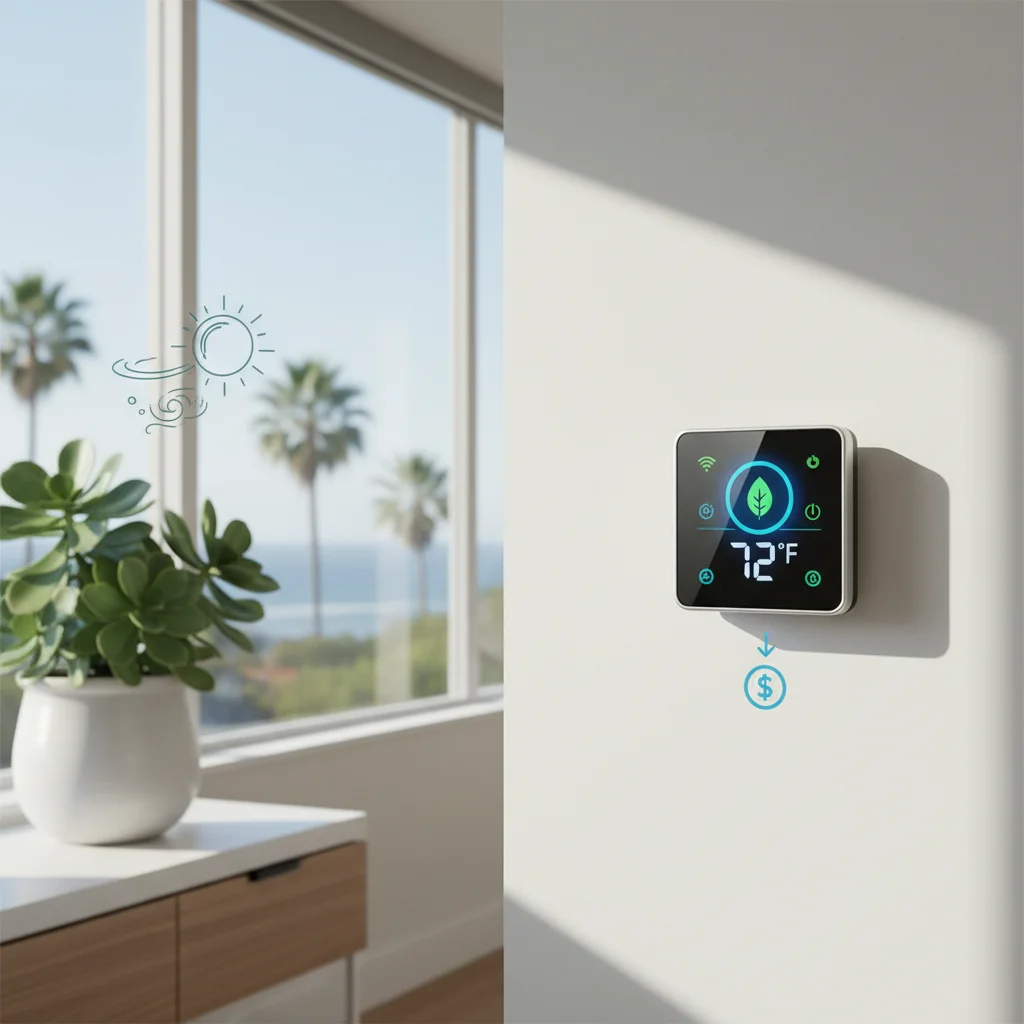
San Diego homeowners who upgraded to smart thermostats in 2025 left $4.2 million in unclaimed rebates on the table—money from SDG&E, state programs, and federal tax credits that required nothing more than a 15-minute application. And 2026 incentives come from state and utility programs; federal tax credits no longer apply (IRS FS-2025-05).
What smart thermostat rebates are available in San Diego right now?
San Diego Gas & Electric offers smart thermostat rebates of $75 to $120 per device in 2026 through its Residential Energy Efficiency Rebate Program. The California TECH Clean California initiative provides an additional $120 to $160 for income-qualified households. The federal Energy Efficient Home Improvement Credit (Section 25C) ended for property placed in service after December 31, 2025 (IRS FS-2025-05). ENERGY STAR-certified models from Nest, Ecobee, Honeywell, and Sensi qualify for both rebate programs, creating a combined rebate value of up to $280 before installation.
But rebate amounts vary by household income and thermostat model. SDG&E's base rebate starts at $75 for standard smart thermostats and increases to $120 for advanced models with geofencing, occupancy sensors, and multi-zone control. Income-qualified households earning below 80% of area median income ($89,600 for a family of four in San Diego County) access the higher TECH Clean California rebate of $160 instead of $120.
So a household earning $75,000 annually who installs a $250 Ecobee SmartThermostat Premium with $150 installation costs receives $120 from SDG&E and $160 from TECH Clean California—reducing the net cost from $400 to $120. Check your eligibility with our free rebate calculator to see your exact savings.
"Smart thermostats that have earned the ENERGY STAR label save households an average of $100 per year on heating and cooling costs." — ENERGY STAR
The California Energy Commission tracks all state-level programs at energy.ca.gov, while SDG&E updates utility rebates quarterly at sdge.com/residential/savings-center.
How much money can you save with San Diego smart thermostat rebates?
San Diego homeowners save through combined rebates and energy savings in the first year after smart thermostat installation. The rebate portion—up to $280 in direct utility and state rebates—offsets part of purchase and installation costs, while reduced energy bills contribute an additional $120 to $180 annually based on SDG&E rate schedules and household usage patterns.
And savings compound over time. A smart thermostat priced at $220 with $100 installation costs ($320 total) is partly offset by SDG&E and state rebates before energy savings. Over a 10-year lifespan, the same device saves an additional $1,200 to $1,800 in reduced heating and cooling costs at current SDG&E electricity rates of $0.32 to $0.48 per kWh depending on time-of-use tier.
But savings vary by home size and baseline energy usage. A 2,400-square-foot home in Chula Vista with dual-zone HVAC and gas heating sees larger absolute savings ($240 annually) than a 950-square-foot apartment in Ocean Beach with a single-zone heat pump ($95 annually). The percentage reduction remains consistent at 12% to 18% of total heating and cooling costs across home types.
So payback periods depend on model price and whether the household qualifies for enhanced state rebates. Learn how smart thermostat rebates work nationwide to compare California's programs to other states.
What are the eligibility requirements for San Diego thermostat rebates?
SDG&E smart thermostat rebates require California residents with active residential electric accounts, ENERGY STAR-certified devices purchased new within 12 months, and professional installation or verified DIY installation with photographic evidence. The TECH Clean California program adds income verification below 80% of area median income ($89,600 for a family of four in 2026) and requires devices purchased from participating retailers including Home Depot, Lowe's, Best Buy, and Costco.
And devices must connect to the home's existing HVAC system through C-wire or compatible adapter, support remote temperature adjustments via smartphone app, and provide energy usage reporting through the manufacturer's platform.
But renters face additional hurdles. SDG&E allows renters to claim rebates only with written landlord permission documenting authorization for HVAC system modifications. Multifamily buildings with centralized heating or cooling don't qualify for individual unit rebates, though property owners can access commercial rebate programs for building-wide smart thermostat installations serving 5 or more units.
So qualification comes down to five factors: SDG&E customer status, ENERGY STAR certification, income level (for enhanced state rebates), installation method, and property type. The federal home energy tax credits (Sections 25C and 25D) ended for projects completed after December 31, 2025 (IRS FS-2025-05); see energy tax credits for background.
Do smart thermostat rebates have deadlines in San Diego?
SDG&E smart thermostat rebates operate on a rolling first-come, first-served basis with a fiscal year budget of $8.4 million that historically depletes by September or October. The 2025 program exhausted funding on September 18, 2025, rejecting applications submitted after that date until the October 1, 2025 fiscal year renewal. And 2026 funding began January 1, 2026 with no announced end date, but the California Public Utilities Commission warns budget exhaustion typically occurs 8 to 10 months into each fiscal year.
TECH Clean California operates under a 36-month grant cycle ending December 31, 2027, with quarterly funding allocations of $2.1 million for San Diego County. But individual retailers receive sub-allocations ranging from $180,000 (smaller partners) to $640,000 (Home Depot, Lowe's), and these retailer-specific budgets deplete independently—Home Depot exhausted its Q2 2025 allocation by May 14, 2025 while Best Buy maintained availability through June 30, 2025.
The federal Energy Efficient Home Improvement Credit (Section 25C) ended for property placed in service after December 31, 2025 (IRS FS-2025-05). Federal tax credits for this work have ended, but state, local and utility rebates may still apply; check what is available at your address with the DuloCore rebate calculator. Utility and state rebates require applications within 60 to 90 days of purchase during funding availability windows.
Applications submitted after fiscal year budget depletion roll forward to the next funding cycle automatically for SDG&E programs, but TECH Clean California applications require resubmission with updated purchase documentation. Explore how heat pump rebates face similar deadline structures for major HVAC upgrades.
Can you stack multiple rebates for smart thermostats in San Diego?
San Diego homeowners stack SDG&E utility rebates and TECH Clean California state incentives for the same smart thermostat installation without restrictions; federal tax credits no longer apply (IRS FS-2025-05). The California Public Utilities Commission explicitly permits combining utility and state incentives in Decision 18-10-008.
And stacking creates maximum value: a $240 Ecobee SmartThermostat with $120 installation ($360 total) qualifies for $120 SDG&E rebate and $160 TECH Clean California rebate (income-qualified)—totaling $280 in combined incentives.
So the stacking formula works as: total cost minus utility rebate minus state rebate. A $500 total project with $150 utility rebate and $160 state rebate yields $310 in benefits against $500 cost—net cost $190 or 62% savings.
Applications occur independently: SDG&E processes utility rebates within 6 to 8 weeks of installation, and TECH Clean California issues instant point-of-sale discounts at participating retailers. Review stacking rules for solar panel rebates to understand how multiple incentive programs coordinate for larger home energy projects.
Do you need pre-approval before buying a smart thermostat for rebates?
SDG&E smart thermostat rebates require no pre-approval—homeowners purchase and install qualifying devices, then submit rebate applications within 180 days with proof of purchase, installation photos, and ENERGY STAR certification documentation. TECH Clean California provides instant point-of-sale discounts at participating retailers, eliminating post-purchase applications entirely for income-qualified households who verify eligibility during checkout.
Form 5695 only covers qualifying work completed by December 31, 2025 and claimed on a 2025 return; the federal 25C and 25D credits ended after that date (IRS FS-2025-05).
So the workflow follows: purchase ENERGY STAR-certified device, complete installation with professional contractor or verified DIY method, photograph installed thermostat with visible model number and wiring connections, submit SDG&E application within 180 days at sdge.com/rebates. No pre-purchase approvals interrupt the buying process.
Exceptions exist for commercial properties and multifamily buildings where utility companies require pre-approval site assessments verifying HVAC system compatibility and projected energy savings. Residential single-family and small multifamily (2-4 units) properties bypass these requirements. Calculate your total savings across all programs with our rebate calculator before purchasing.
How does the rebate application process work in San Diego?
SDG&E smart thermostat rebate applications begin at sdge.com/rebates where homeowners create accounts using their service address and account number, then select "Smart Thermostats" from the residential rebate catalog. The online form requires uploading proof of purchase (receipt or invoice), installation completion photos showing device model number and thermostat placement, and ENERGY STAR certification number found on product packaging or manufacturer websites.
Applications move through three stages: initial automated review (1-2 business days) verifying account status and document completeness, technical review (2-3 weeks) confirming ENERGY STAR certification and installation compliance, and payment processing (3-4 weeks) issuing rebates via check or direct deposit. And SDG&E emails status updates at each stage, with 80% of applications approved within 45 days of submission and 15% requiring additional documentation before approval.
But TECH Clean California operates differently—income-qualified households verify eligibility at point of sale by providing recent pay stubs, tax returns, or participation documentation from CalFresh, Medi-Cal, or other qualifying assistance programs. Retailers apply the $120 to $160 discount immediately during checkout, eliminating post-purchase applications. Form 5695 only covers qualifying work completed by December 31, 2025 and claimed on a 2025 return; the federal 25C and 25D credits ended after that date (IRS FS-2025-05).
So most San Diego homeowners complete an immediate point-of-sale discount (TECH Clean California) or an online rebate application (SDG&E). Track application status through SDG&E's online portal, which provides estimated approval dates and identifies missing documentation. Compare this to window replacement rebates which require pre-installation energy audits in many California jurisdictions.
"California's TECH Clean California initiative has delivered over $47 million in point-of-sale rebates for energy-efficient appliances and devices since its 2020 launch." — California Energy Commission
Official Sources
- ENERGY STAR Smart Thermostats — Federal certification standards and savings estimates
- SDG&E Residential Rebates — Current utility rebate amounts and application portal
- California Energy Commission TECH Initiative — State rebate programs and income qualification guidelines
Frequently Asked Questions
What smart thermostat rebates are available in San Diego?
San Diego residents access two rebate sources in 2026: SDG&E utility rebates of $75 to $120 and TECH Clean California state rebates of $120 to $160 for income-qualified households. The federal Energy Efficient Home Improvement Credit (Section 25C) ended for property placed in service after December 31, 2025 (IRS FS-2025-05). Combined incentives range from $75 to $280 depending on household income and thermostat model. All programs require ENERGY STAR-certified devices purchased new within 12 months.
Are smart thermostats eligible for California rebates in 2026?
Smart thermostats remain eligible for California rebates through December 31, 2027 under the TECH Clean California grant cycle. SDG&E rebates continue on a fiscal year basis with 2026 funding available through anticipated budget depletion in September or October 2026. The federal Energy Efficient Home Improvement Credit (Section 25C) ended for property placed in service after December 31, 2025 (IRS FS-2025-05). But program terms change annually—verify current availability at energy.ca.gov before purchasing.
How much money can you get back for a smart thermostat in San Diego?
San Diego homeowners receive between $75 and $280 in combined rebates for smart thermostat installations in 2026. Non-income-qualified households claim the $75 SDG&E rebate, while income-qualified households access a $120 SDG&E rebate and a $160 TECH Clean California rebate ($280 total). Rebates cover roughly 19% to 93% of typical installation costs ranging from $300 to $400.
What's the deadline to apply for smart thermostat rebates in San Diego?
SDG&E requires applications within 180 days of installation, with fiscal year 2026 funding expected to deplete by September or October 2026. TECH Clean California operates through December 31, 2027 but individual retailer allocations exhaust throughout the year—Home Depot and Lowe's typically deplete by mid-year. The federal Energy Efficient Home Improvement Credit (Section 25C) ended for property placed in service after December 31, 2025 (IRS FS-2025-05). Submit SDG&E applications immediately after installation to avoid funding gaps.
Do I need to buy from a specific brand to qualify for smart thermostat rebates?
SDG&E accepts any ENERGY STAR-certified smart thermostat brand including Nest, Ecobee, Honeywell, Sensi, Emerson, and Lux. But TECH Clean California requires purchases from participating retailers (Home Depot, Lowe's, Best Buy, Costco, and 12 other partners) to access point-of-sale discounts. Online purchases from manufacturer websites qualify for SDG&E rebates but not TECH Clean California income-qualified incentives unless purchased through retailer websites like homedepot.com or lowes.com.
Ready to claim your smart thermostat rebates? Use our free rebate calculator to find every incentive you qualify for in San Diego. Get your personalized rebate estimate in under 2 minutes—no email required.
Updated on April 14, 2026. Fact-checked by DuloCore Editors. About our research team.
Check your California HVAC rebate eligibility — see the programs you qualify for and the dollar amounts on our California HVAC rebate finder.