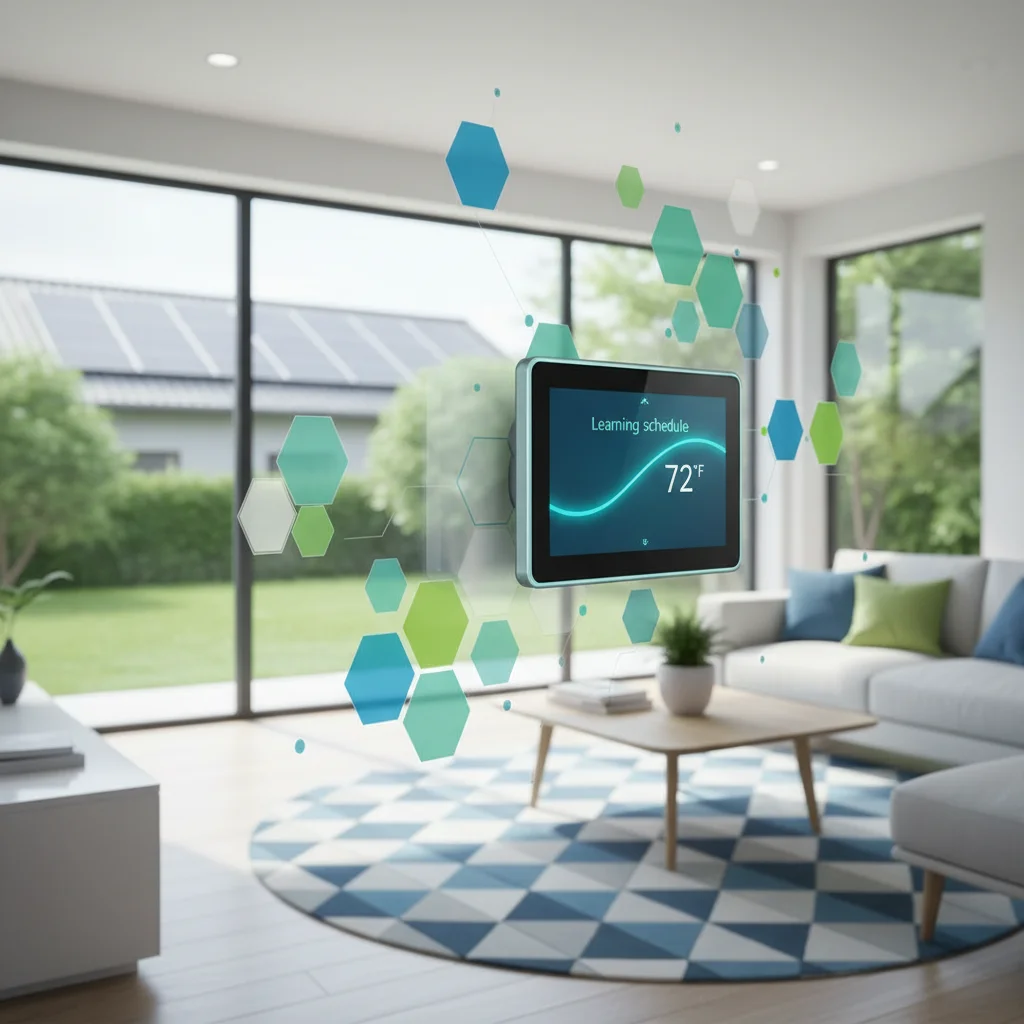
Households that install learning thermostats save an average of $180 annually on heating and cooling costs—without manually programming a single schedule. And in 2026, federal and state rebates can cut the upfront cost of a smart thermostat from $250 down to as low as $0 for qualifying households.
How Much Can You Save With a Smart Thermostat Learning Schedule?
Learning thermostats in 2026 reduce heating and cooling costs by 10-23% annually through automated schedule optimization. Homes in California see average savings of $15-$23 per month, or $180-$276 yearly, according to EPA Energy Star testing. Rebates through California's TECH Clean California program cover 100% of equipment costs for households earning below 80% of area median income, and utility rebates from PG&E, SoCal Edison, and SDG&E add $50-$100 in instant discounts at point of sale.
But savings vary by home size, climate zone, and existing HVAC efficiency. A 2,500-square-foot home in Sacramento with a 15-year-old furnace sees faster payback than a newer 1,200-square-foot condo in San Diego. And homes with inconsistent occupancy patterns—like remote workers who leave mid-afternoon—see 18-25% savings compared to 10-15% for households with fixed 9-to-5 schedules.
So the learning algorithm detects occupancy patterns, adjusts setpoints automatically, and eliminates the most common cause of energy waste: heating or cooling an empty home. Smart thermostat rebates stack with other HVAC upgrade incentives to reduce total project costs.
Which Smart Thermostats Qualify for Rebates and Tax Credits?
All EPA Energy Star-certified smart thermostats qualify for California state rebates and utility incentives in 2026. Eligible models include Nest Learning Thermostat (4th gen), Ecobee SmartThermostat Premium, Honeywell Home T9, Emerson Sensi Touch 2, and Lux Kono Smart. Federal tax credits under the Inflation Reduction Act do not cover standalone thermostats, but homeowners who install a qualifying heat pump or central air conditioner can include the thermostat cost in the equipment total for the 30% credit.
And California's TECH Clean California program requires thermostats to have auto-schedule learning, occupancy detection, and remote access via smartphone app. Models that only offer manual programming or preset schedules don't qualify. But most major brands released Energy Star-certified models in 2024-2025 that meet all requirements.
"ENERGY STAR certified smart thermostats save an average of 8% on heating and cooling bills, or about $50 per year." — EPA Energy Star
So verify your model on the Energy Star database before purchase, or check with your utility provider's approved equipment list. Use the rebate calculator to confirm eligibility for your specific model and address.
What's the Income Limit for Smart Thermostat Rebate Programs?
California's TECH Clean California program sets income limits at 80% of area median income for full rebates and extends coverage to 120% AMI for partial rebates in 2026. A four-person household in Los Angeles County qualifies for 100% equipment coverage with annual income below $79,200, or partial rebates up to $118,800. San Francisco County limits are $101,600 for full rebates and $152,400 for partial coverage due to higher regional median income.
And utility rebates from PG&E, SoCal Edison, and SDG&E don't impose income limits—all residential customers qualify for $50-$100 instant discounts regardless of earnings. But layering state and utility rebates requires income verification through tax returns or pay stubs submitted during the application process.
So households earning above 120% AMI still access utility rebates and can stack those with energy tax credits when installing qualifying HVAC equipment. Contractor partners handle income verification documents at point of sale to streamline approval.
How Do You Apply for Smart Thermostat Rebates and Tax Credits?
Applications for California smart thermostat rebates process through participating contractors enrolled in TECH Clean California or directly through utility provider portals in 2026. Homeowners select an approved contractor, choose an Energy Star-certified model, and submit income documentation if applying for state rebates. The contractor applies rebates at point of sale, reducing the upfront invoice before installation begins.
And utility rebates from PG&E, SoCal Edison, and SDG&E require online applications submitted within 90 days of installation. Homeowners upload proof of purchase, model number verification, and installer certification of proper setup. Rebate checks arrive 6-8 weeks after approval.
But instant rebates applied at checkout eliminate wait times for state programs—households see the discount immediately on the final invoice. So working with TECH-enrolled contractors simplifies the process compared to post-installation reimbursement applications.
What Are the Deadlines for Smart Thermostat Rebate Applications in Your State?
California's TECH Clean California program operates on a rolling basis with no fixed deadline, but funding allocates on a first-come, first-served basis until the $120 million annual budget depletes in 2026. Utility rebates from PG&E, SoCal Edison, and SDG&E accept applications year-round with 90-day submission windows after installation. The federal Energy Efficient Home Improvement Credit (Section 25C) ended for property placed in service after December 31, 2025 (IRS FS-2025-05). Federal tax credits for this work have ended, but state, local and utility rebates may still apply; check what is available at your address with the DuloCore rebate calculator.
And high-demand periods in summer and winter can exhaust state rebate funds 3-5 months before fiscal year-end. So installing equipment in spring or fall maximizes funding availability and avoids peak contractor scheduling delays.
But applications submitted after funding depletion roll into the next fiscal year queue. Contractors check real-time funding status before starting projects to confirm rebate availability.
Can You Stack Smart Thermostat Rebates With Other Energy Efficiency Programs?
California allows stacking of TECH Clean California rebates, utility incentives, and federal tax credits for comprehensive home energy upgrades in 2026. Homeowners who install a heat pump with a learning thermostat combine 30% federal tax credits on total equipment costs with state rebates covering the thermostat and utility rebates for the HVAC system. Total savings reach $2,000-$4,500 depending on equipment type and household income.
And pairing thermostat upgrades with attic insulation, air sealing, or duct improvements qualifies for additional rebates through California's Whole Home Program. But federal tax credits cap at $1,200 annually for home efficiency improvements excluding heat pumps, solar, or battery storage.
So strategic project bundling maximizes rebate stacking—installing a heat pump, smart thermostat, and insulation in the same year captures more incentives than spreading upgrades across multiple years. Contractors enrolled in multiple programs handle cross-program coordination.
Do You Need a Certified Contractor to Install a Learning Thermostat?
California rebate programs require professional installation by licensed HVAC contractors enrolled in TECH Clean California or utility-approved installer networks in 2026. DIY installations don't qualify for state rebates, but utility rebates from PG&E, SoCal Edison, and SDG&E allow homeowner self-installation with proof of purchase and equipment registration. Federal tax credits don't impose contractor requirements for standalone thermostats.
And professional installation ensures proper C-wire setup, compatibility testing with existing HVAC systems, and system calibration that prevents short-cycling or inefficient operation. Contractor certification verifies compliance with Title 24 energy code requirements for California homes.
But homeowners with basic electrical skills can install compatible models in 30-60 minutes if the existing thermostat has a C-wire. So checking HVAC compatibility before purchase determines whether professional installation is necessary regardless of rebate requirements.
Official Sources
- EPA Energy Star Smart Thermostats — Federal certification program and savings data
- DSIRE USA California Incentives — Comprehensive database of state and utility rebate programs
- DOE Energy Saver — Federal energy efficiency guidance and rebate information
Frequently Asked Questions
Do smart thermostats learn on their own or do I need to teach them?
Energy Star-certified learning thermostats auto-detect occupancy patterns through built-in sensors and automatically adjust schedules without manual programming. Models like Nest Learning Thermostat and Ecobee SmartThermostat observe when occupants wake, leave, return, and sleep for 7-14 days, then build optimized heating and cooling schedules. Manual overrides refine the algorithm but aren't required for basic operation.
How long does it take for a smart thermostat to learn my schedule?
Learning thermostats require 1-2 weeks of occupancy data to establish baseline schedules and 4-6 weeks to optimize energy savings in 2026. Nest models begin auto-adjustments after 7 days, while Ecobee systems collect 14 days of data before activating full learning features. Homes with irregular schedules need 3-4 weeks for accurate pattern recognition compared to 1-2 weeks for consistent routines.
Can a smart thermostat save money if I don't have a regular routine?
Homes with irregular schedules save 12-18% on heating and cooling costs with learning thermostats compared to 18-23% for fixed routines, according to 2025 EPA testing. Occupancy sensors detect presence in real-time and adjust temperatures within 15-30 minutes of occupants leaving or returning. Remote smartphone control lets users override schedules on unpredictable days without sacrificing comfort or efficiency.
What's the difference between learning schedules and manual programming?
Learning schedules use occupancy detection and behavioral algorithms to auto-adjust temperatures, while manual programming requires users to set specific times and temperatures for weekdays and weekends. Learning models adapt to schedule changes automatically—remote workers who shift hours mid-week don't reprogram settings. Manual thermostats maintain fixed schedules until users update them, which leads to 15-20% energy waste when routines change.
Do smart thermostats work with older heating and cooling systems?
Most smart thermostats install on HVAC systems manufactured after 2000, but homes with systems older than 20 years may need C-wire adapters or power extender kits that add $20-$40 to installation costs in 2026. Gas furnaces, electric heat pumps, central air conditioners, and multi-stage systems all support learning thermostat integration. But homes with line-voltage baseboard heaters or proprietary control systems require specialized models not covered by standard rebate programs.
Ready to calculate your smart thermostat rebate? Use our free rebate calculator to find state, utility, and federal incentives available at your address—and discover how much you'll save on heating and cooling costs with a learning schedule.
Updated on April 14, 2026. Fact-checked by DuloCore Editors. About our research team.
Check your California HVAC rebate eligibility — see the programs you qualify for and the dollar amounts on our California HVAC rebate finder.