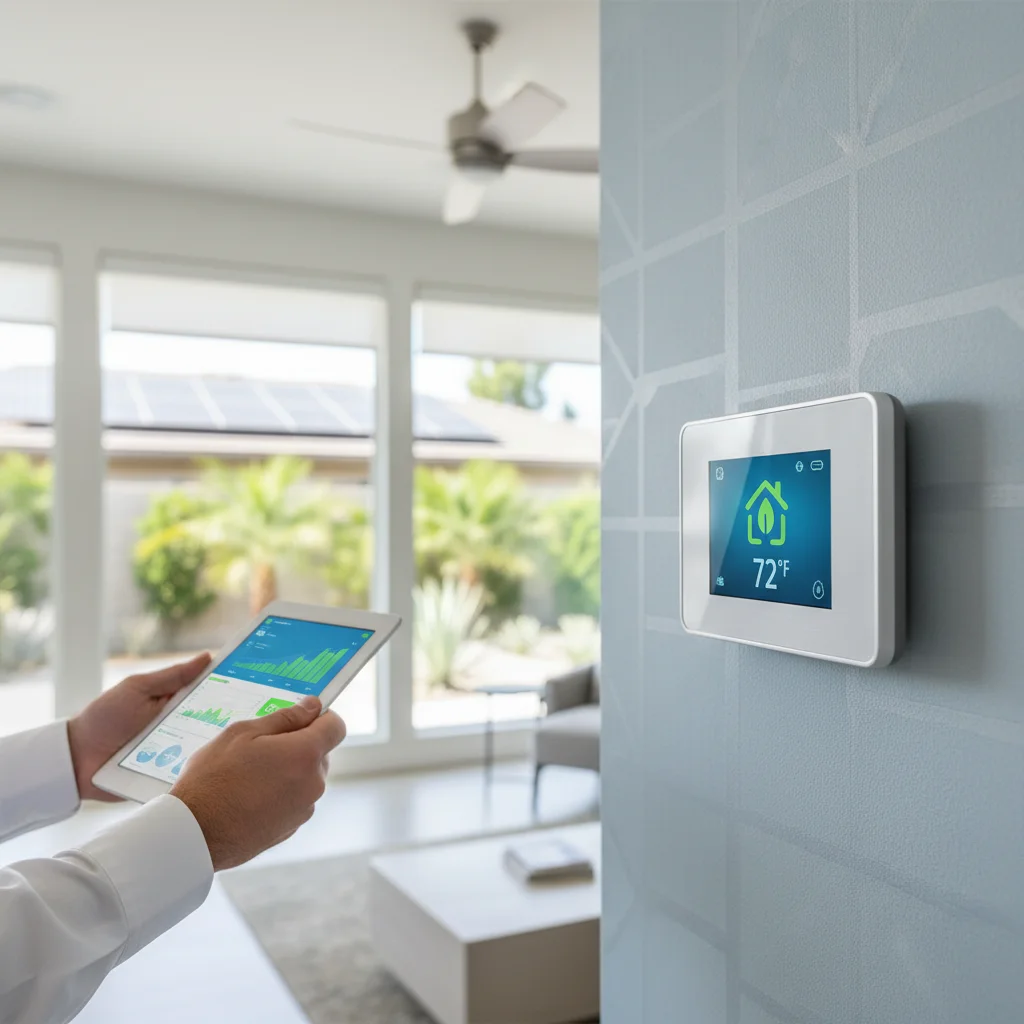
Orange County homeowners waste $347 every year on heating and cooling because thermostats don't adapt to occupancy patterns or utility time-of-use rates. Installing a smart thermostat cuts energy bills by 10-23% and unlocks rebates up to $130 from Southern California Edison, plus $300 federal tax credits through the Inflation Reduction Act framework active until 2032. But the savings depend on choosing qualified models, meeting contractor requirements, and navigating pre-approval rules that vary by utility territory and income bracket.
How Much Does Smart Thermostat Installation Cost in Orange County After Rebates?
Smart thermostat installation in Orange County costs $120-$300 for labor, plus $100-$250 for the device. Southern California Edison (SCE) and Southern California Gas Company (SoCalGas) offer rebates up to $130 for qualifying smart thermostats installed by licensed HVAC contractors. The federal Energy Efficient Home Improvement Credit (Section 25C) ended for property placed in service after December 31, 2025 (IRS FS-2025-05). Federal tax credits for this work have ended, but state, local and utility rebates may still apply; check what is available at your address with the DuloCore rebate calculator. So homeowners in SCE territory save $230-$380 through combined utility rebates and federal credits when hiring qualified contractors.
But DIY installations forfeit utility rebates. SCE requires C-20 HVAC contractor installation with documentation showing the thermostat connects to central heating and cooling systems rated at 10+ SEER2. Or homeowners earning below 80% Area Median Income qualify for the Energy Savings Assistance Program, which provides free smart thermostats and installation at zero cost through SCE's low-income weatherization initiative.
"Smart thermostats that have earned the ENERGY STAR label can save about 8% on heating and cooling bills, or $50 per year." — ENERGY STAR
Income-qualified households access installation services through the CARE or FERA rate programs. And landlords installing thermostats in rental units claim the federal credit only if they pay utility costs directly.
What Smart Thermostats Qualify for Orange County Rebates and Incentives?
SCE rebates require ENERGY STAR certified smart thermostats with occupancy sensing, geofencing, or learning algorithms. Ecobee SmartThermostat Premium ($249), Google Nest Learning Thermostat 4th Gen ($279), and Honeywell Home T9 ($199) meet 2026 qualification standards. But generic Wi-Fi thermostats without automated scheduling don't qualify—the device must demonstrate energy savings through occupancy detection or adaptive algorithms.
SoCalGas offers $75 rebates for thermostats controlling natural gas furnaces, stackable with SCE electric rebates if the system includes both gas heating and electric cooling. So households with dual-fuel HVAC systems claim $130-$205 combined rebates. And the federal tax credit covers thermostats installed as part of a complete HVAC upgrade, not standalone replacements.
Amazon Smart Thermostat ($80) qualifies for federal credits but not SCE rebates because it lacks third-party energy efficiency certification. Or homeowners replacing existing smart thermostats forfeit rebates—programs require first-time installation or replacement of non-programmable manual thermostats only.
Check the energy tax credits page for stacking rules with heat pump rebates on concurrent installations.
Am I Eligible for Smart Thermostat Rebates in Orange County (Income, Homeowner Status)?
SCE serves 85% of Orange County households and requires homeowners or tenants with landlord approval to claim rebates. Renters qualify if they install thermostats with written property owner consent and submit lease documentation. But landlords claim rebates only for properties where they pay utility bills—tenant-paid accounts require tenant application.
Income-qualified programs use 80% Area Median Income thresholds: $108,400 for a family of four in 2026. And households enrolled in CARE, FERA, or CalFresh automatically qualify for Energy Savings Assistance Program free installation without separate income verification. So 320,000 Orange County residents access zero-cost smart thermostats through existing rate assistance programs.
Orange County Water District customers don't receive water utility rebates for thermostats—only electric and gas providers offer HVAC incentives. Or homeowners with solar panels still qualify because thermostats reduce grid consumption during peak hours, lowering time-of-use charges from 4-9 PM when rates hit $0.52/kWh.
Calculate combined savings with our rebate calculator to compare utility rebates and federal credits.
What's the Deadline for Orange County Smart Thermostat Rebates in 2026?
SCE accepts smart thermostat rebate applications through December 31, 2026, with 60-day post-installation submission deadlines. Applications require dated invoices showing equipment model numbers, contractor license numbers, and installation addresses. But rebate funds operate on a first-come basis—SCE allocated $4.2 million for 2026 smart thermostat rebates, covering approximately 32,300 installations before funds exhaust.
SoCalGas extends its program through December 2026 with quarterly budget reviews. The federal Energy Efficient Home Improvement Credit (Section 25C) ended for property placed in service after December 31, 2025 (IRS FS-2025-05).
The federal Energy Efficient Home Improvement Credit (Section 25C) ended for property placed in service after December 31, 2025 (IRS FS-2025-05).
Installations completed in 2026 claim credits on 2026 tax returns filed by April 15, 2027. Or homeowners filing extensions submit by October 15, 2027, without penalty. So delaying installation past December 31, 2026, risks missing utility rebate funding even though federal credits remain active.
Can I Stack Smart Thermostat Rebates with Other Energy Efficiency Incentives?
SCE allows stacking smart thermostat rebates with home energy audits ($250), attic insulation rebates ($1,300), and duct sealing incentives ($400) in the same calendar year. But thermostats installed as part of a whole-house HVAC replacement claim either the thermostat rebate or the $3,000 heat pump rebate—not both. And federal tax credits impose $1,200 annual limits on efficiency improvements excluding heat pumps, so homeowners stacking insulation and thermostat credits stay below the cap with combined expenses of $4,000 or less.
SoCalGas rebates stack with SCE electric rebates when thermostats control dual-fuel systems. So households installing a $249 Ecobee thermostat with a gas furnace and electric air conditioner claim $75 SoCalGas + $130 SCE + $300 federal = $505 total incentives, reducing net cost to $64 after rebates.
The smart thermostat rebates page lists utility-specific stacking policies. Or homeowners bundling thermostats with EV charger installations claim separate $1,000 alternative fuel credits alongside efficiency credits.
Do I Need Pre-Approval Before Installing a Smart Thermostat in Orange County?
SCE and SoCalGas don't require pre-approval for smart thermostat rebates—homeowners submit post-installation applications with dated invoices and equipment documentation. But income-qualified Energy Savings Assistance Program participants schedule free pre-installation audits where SCE contractors assess HVAC compatibility and thermostat placement. And the program reserves smart thermostats for households with functioning central heating and cooling systems—window units and baseboard heaters don't qualify.
Federal tax credits require no pre-approval. Form 5695 only covers qualifying work completed by December 31, 2025 and claimed on a 2025 return; the federal 25C and 25D credits ended after that date (IRS FS-2025-05). Or the IRS audits claims lacking equipment model numbers and installation dates, so keep invoices for 7 years.
Homeowners replacing thermostats under home warranty plans forfeit rebates because warranty-covered installations don't constitute qualifying expenses. And new construction homes receiving builder-installed smart thermostats don't qualify—rebates require homeowner-initiated upgrades to existing properties occupied before thermostat installation.
What Contractor Requirements Apply to Smart Thermostat Installation for Rebates?
SCE requires C-20 HVAC or C-10 electrical contractor licenses for rebate-eligible installations. Contractors must verify thermostat compatibility with existing HVAC equipment and submit installation certificates documenting equipment model, serial number, and installation date. But homeowners hiring unlicensed handymen or completing DIY installations forfeit utility rebates—only federal tax credits allow self-installation if the homeowner uses the thermostat as their primary residence.
SoCalGas accepts installations by licensed contractors or homeowners for gas furnace thermostats, provided documentation shows the thermostat controls a natural gas heating system. And contractors participating in SCE's Quality Installation programs provide 1-year workmanship warranties covering wiring errors and compatibility issues.
The Contractor State License Board (CSLB) verifies active licenses at cslb.ca.gov. Or homeowners hiring unlicensed contractors void equipment warranties and rebate eligibility. So verify contractor credentials before installation to preserve $130-$505 in available incentives.
Comparison of Orange County Smart Thermostat Rebate Programs 2026
| Program | Rebate Amount | Eligibility | Deadline | Contractor Required |
|---|---|---|---|---|
| SCE Smart Thermostat Rebate | $130 | SCE customers, ENERGY STAR thermostat | December 31, 2026 | Yes (C-20/C-10 license) |
| SoCalGas Smart Thermostat Rebate | $75 | SoCalGas customers, gas furnace control | December 31, 2026 | Optional |
| IRA Energy Efficiency Credit | Ended Dec 31, 2025 | — | Ended Dec 31, 2025 | — |
| SCE Energy Savings Assistance | Free installation + device | Income ≤80% AMI or CARE/FERA enrolled | December 31, 2026 | Yes (SCE contractor) |
Official Sources
- U.S. Department of Energy ENERGY STAR Program — Federal guidance on qualified smart thermostat models and energy savings calculations
- IRS Energy Incentives for Individuals — Tax credit limits, filing requirements, and Manufacturer Certification Statement instructions (note: the federal 25C and 25D credits ended for projects completed after December 31, 2025)
- Database of State Incentives for Renewables & Efficiency — California utility rebate programs, income qualification thresholds, and application deadlines
Frequently Asked Questions
Can you install a smart thermostat yourself in Orange County?
Homeowners install smart thermostats themselves and claim federal tax credits, but forfeit SCE's $130 utility rebate requiring licensed contractor installation. DIY installation takes 30-90 minutes with basic wire labeling and smartphone app setup. But homes with incompatible wiring (24V vs 120V systems, missing C-wire) need professional rewiring costing $150-$300 to avoid equipment damage.
How much does a smart thermostat installation cost in Orange County?
Licensed contractor installation costs $120-$300 for labor, plus $100-$250 for the device. SCE rebates reduce costs by $130, and federal tax credits cover 30% of remaining expenses. So net cost after all incentives ranges from $63-$217 for professionally installed ENERGY STAR thermostats. Income-qualified households access free installation through SCE's Energy Savings Assistance Program.
What smart thermostat brands qualify for Orange County rebates?
Ecobee, Google Nest, Honeywell Home, Emerson Sensi, and Resideo thermostats qualify if they carry ENERGY STAR certification and feature occupancy sensing or learning algorithms. SCE publishes a qualified products list updated quarterly at sce.com/rebates. Amazon Smart Thermostat qualifies for federal credits but not utility rebates because it lacks third-party energy efficiency certification.
Do you need a professional to install a smart thermostat for rebates?
SCE requires C-20 or C-10 licensed contractors for $130 utility rebates. Federal tax credits allow homeowner installation without contractor requirements. So hiring a professional unlocks $130 additional utility rebates but costs $120-$300 in labor, making DIY installation cost-effective only for households ineligible for utility programs or comfortable with electrical wiring and HVAC compatibility troubleshooting.
How long does smart thermostat installation take in Orange County?
Professional installation takes 45-90 minutes including wiring verification, thermostat mounting, Wi-Fi setup, and HVAC compatibility testing. DIY installation takes 30-120 minutes depending on existing wiring complexity. Homes requiring C-wire installation add 1-2 hours for running new 18-gauge wire from the furnace to the thermostat location. And technicians complete Energy Savings Assistance Program installations in 60-90 minutes with same-day activation.
Ready to calculate your smart thermostat savings? Use our free rebate calculator to estimate your combined utility rebates and federal tax credits based on your Orange County zip code, utility provider, and household income. Get personalized installation cost projections and contractor recommendations in under 2 minutes.
Last updated: April 14, 2026. Reviewed by the DuloCore Editorial Team. About our authors.
Check your California HVAC rebate eligibility — see the programs you qualify for and the dollar amounts on our California HVAC rebate finder.