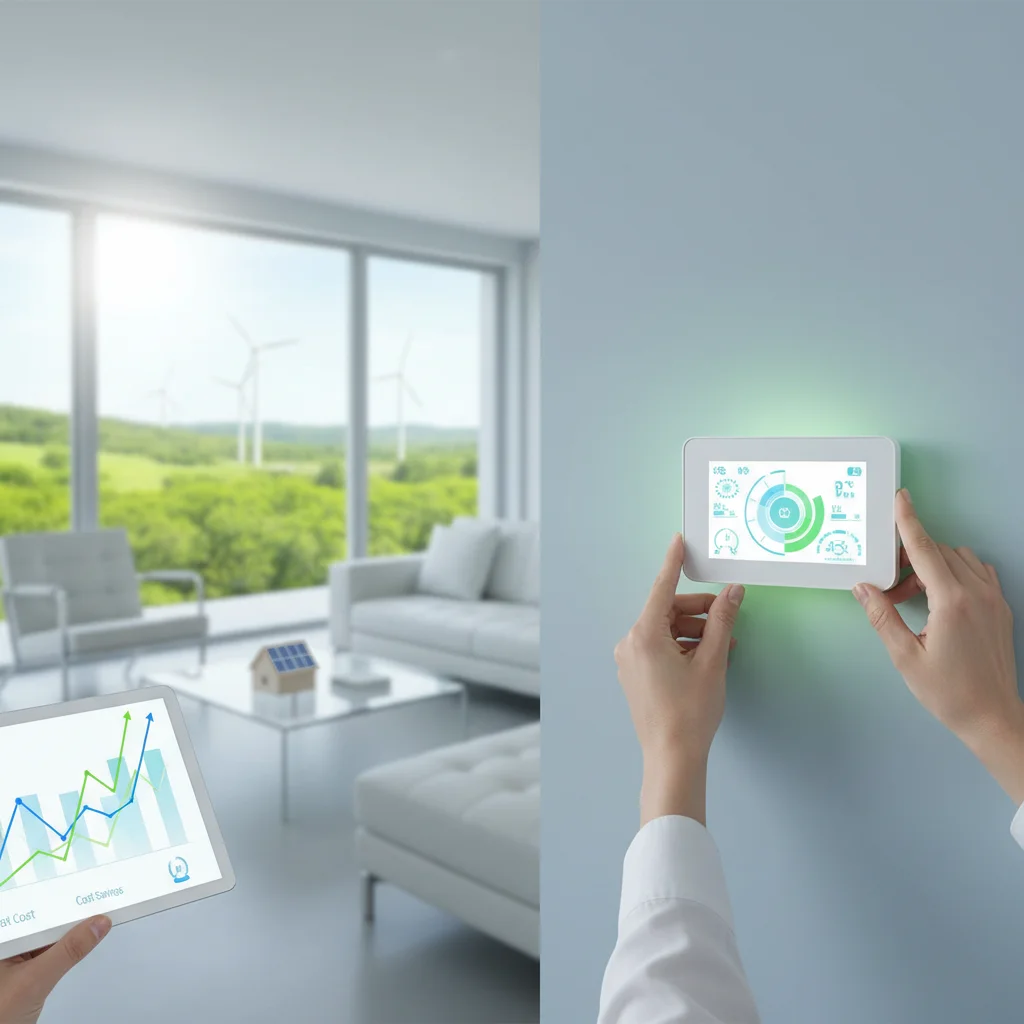
Smart thermostats cut heating and cooling costs by 8-23% annually, but professional installation adds $80-$350 to upfront costs—and rebates now cover anywhere from $30 to $300 of that expense in California. And the difference between self-installation and hiring an HVAC technician determines not just your out-of-pocket cost, but whether your system qualifies for utility rebates that require professional setup with load management features.
How Much Does Smart Thermostat Installation Cost With Rebates and Tax Credits?
Professional smart thermostat installation costs $150-$450 total, with $70-$130 for the device and $80-$350 for labor. California utilities offer rebates from $50-$300, reducing net cost to $0-$250. DIY installation eliminates labor costs but may disqualify homeowners from utility rebates requiring professional setup and grid-connected demand response features.
Most HVAC contractors charge $80-$150 for basic installation when replacing an existing thermostat with a compatible C-wire. But homes lacking a C-wire face $150-$350 in added labor for new wiring or installation of a power adapter. And electrical work requiring permits pushes total installation costs to $400-$700 in San Francisco and Los Angeles counties.
The Energy Star Most Efficient list includes 47 smart thermostat models eligible for utility rebates, but only 23 qualify for the highest incentive tiers requiring OpenADR 2.0b certification for automated demand response. So homeowners selecting basic Wi-Fi thermostats without grid integration sacrifice $100-$200 in available rebates.
Major California utilities structure smart thermostat rebates in three tiers: $50 for basic programmable models, $125 for Wi-Fi-enabled thermostats, and $200-$300 for advanced models with utility-controlled demand response. And Pacific Gas & Electric's SmartRate program adds an extra $50 instant rebate for customers enrolling in time-of-use pricing.
"Smart thermostats with demand response capability provide grid services worth $50-$120 per device annually through load shifting during peak events." — U.S. Department of Energy
What Income Limits Apply to Federal and State Smart Thermostat Rebate Programs?
California's Energy Savings Assistance Program restricts smart thermostat rebates to households earning 200% of federal poverty level or less—$31,200 for individuals, $64,800 for families of four in 2026. But investor-owned utility rebates through PG&E, SCE, SoCalGas, and SDG&E impose no income limits, offering $50-$300 to all residential customers with valid account numbers.
Income-restricted programs deliver higher incentives. The ESA program provides free smart thermostat installation worth $400-$600 for qualified low-income households, compared to standard $125-$200 rebates available to all customers. And multifamily properties with 5+ units in disadvantaged communities access additional funding through the California Public Utilities Commission's Multifamily Affordable Solar Housing program.
Municipal utility districts operate separate rebate structures. Sacramento Municipal Utility District offers $50 rebates with no income verification, while Los Angeles Department of Water & Power provides tiered rebates: $75 standard, $150 for moderate-income households earning 80-120% area median income. So a family of three earning $98,000 in Los Angeles County qualifies for enhanced LADWP rebates but exceeds ESA eligibility thresholds.
Federal tax credits no longer apply to standalone smart thermostats. The federal Energy Efficient Home Improvement Credit (Section 25C) ended for property placed in service after December 31, 2025 (IRS FS-2025-05). Federal tax credits for this work have ended, but state, local and utility rebates may still apply; check what is available at your address with the DuloCore rebate calculator. But smart thermostats paired with new heat pumps may qualify for the 30% heat pump rebates under the federal Heat Pump Installation Rebate program when applications open in late 2026.
How Do I Apply for Smart Thermostat Rebates in California?
California utility customers apply for smart thermostat rebates online through utility-specific portals within 60-180 days of installation. PG&E customers submit applications via pge.com/rebates with proof of purchase, installation date, and thermostat serial number. SCE processes rebates through sce.com/residential/rebates-savings, requiring photos of installed equipment and Account Number verification.
Applications require five documents: itemized receipt showing purchase date and model number, photos of installed thermostat displaying account number on-screen, contractor invoice listing labor costs separately, thermostat serial number, and utility account number matching installation address. And contractors must hold a C-20 Warm-Air Heating, Ventilation and Air-Conditioning license for rebates requiring professional installation.
Processing times vary by utility and season. PG&E processes 90% of complete applications within 6-8 weeks, issuing payment via bill credit or check based on customer preference. But Southern California Edison extends processing to 10-12 weeks during peak summer months when application volume triples.
Pre-approval isn't required for smart thermostats under $500, but projects exceeding this threshold trigger additional documentation requirements. And customers who've claimed three or more appliance rebates in a 12-month period face extended review periods of 90-120 days. Use our free rebate calculator to estimate your total savings and confirm program eligibility before purchase.
"California's investor-owned utilities issued 187,000 smart thermostat rebates worth $23.4 million in 2025, reducing peak demand by 65 megawatts during summer heat events." — California Public Utilities Commission
What's the Deadline for Claiming Smart Thermostat Installation Incentives?
Most California utility rebate programs require applications within 90-180 days of installation, with PG&E enforcing a 180-day deadline, SCE requiring 90 days, and SoCalGas allowing 120 days from purchase date. Applications submitted after these deadlines are automatically rejected with no appeals process. And rebates claimed in December face processing delays extending into February due to year-end audit requirements.
State-funded programs operate on fiscal year cycles. The ESA program allocates funding annually from July 1-June 30, with first-come-first-served distribution exhausting budgets 3-5 months early in high-demand regions like Los Angeles and Alameda counties. So homeowners applying after March face 50-70% rejection rates due to depleted funding even when meeting all eligibility criteria.
Federal programs maintain different timelines. The IRA's energy tax credits for home upgrades continue through 2032 with no annual funding caps, but smart thermostats qualify only when bundled with heat pump installations exceeding $8,000 total project cost. And the federal Heat Pump Installation Rebate program launching in late 2026 will enforce point-of-sale instant rebates with 30-day application windows for contractor reimbursement.
Installation date determines eligibility year. Equipment purchased December 15, 2025 but installed January 8, 2026 qualifies for 2026 program year funding, not 2025 allocations. But thermostats purchased and installed in 2025 cannot be resubmitted under 2026 programs—one rebate per device per household lifetime applies across all California utility programs.
Can You Stack Multiple Rebates for Smart Thermostat Installation?
California allows stacking utility rebates with federal tax credits, but prohibits combining multiple utility incentives from the same program administrator. PG&E customers cannot claim both the standard $125 smart thermostat rebate and the $75 time-of-use enrollment bonus—only the higher amount applies. But customers can combine a $125 PG&E thermostat rebate with a separate $50 municipal rebate from Alameda Municipal Power when properties receive dual utility service.
Federal and state incentive stacking rules changed in 2026. The expired 25C tax credit allowed unlimited stacking with state and utility rebates through December 2025, but the current IRA framework treats smart thermostats as ineligible standalone improvements. So homeowners installing thermostats with qualifying heat pump systems can claim the 30% federal tax credit on the heat pump cost while applying utility rebates to the thermostat separately.
Employer and manufacturer incentives stack with utility programs. Tech companies including Google, Amazon, and Apple offer employee discounts of $50-$100 on Nest and Ecobee models, stackable with full utility rebates. And manufacturer mail-in rebates from Honeywell ($30) and Emerson ($40) can be combined with utility incentives if claim forms are submitted to different entities within required timeframes.
Multifamily properties face different stacking limitations. Buildings with 5+ units cannot combine California Solar Initiative Thermal rebates with ESA program benefits, and property owners claiming commercial utility rebates forfeit residential program eligibility. But individual tenants in master-metered buildings can claim personal rebates for in-unit thermostats even when landlords receive commercial incentives for common area equipment.
What Documentation Do You Need to Claim Smart Thermostat Rebates?
California utility rebates require six core documents: dated itemized receipt showing thermostat model and purchase price, contractor invoice with C-20 license number for professional installation, photos of installed thermostat displaying utility account number on device screen, thermostat serial number matching manufacturer database, utility account number, and Energy Star certification proof from energystar.gov/products.
Contractor documentation must separate material and labor costs. Invoices listing "smart thermostat installation: $350 total" trigger automatic rejections—rebate processors need line items showing "$85 device, $265 labor, $0 permit fees" to validate eligible expenses. And installations requiring electrical permits need approved permit copies with final inspection stamps from county building departments.
Photos require specific elements. Applications need full-view photos showing thermostat mounted on wall with visible account number on screen, close-up of model number label on device back or side, and HVAC system photo showing thermostat wires connected to air handler or furnace. But bathroom mirror selfies with thermostats in background or photos with blocked serial numbers cause 3-week resubmission delays.
Income verification documents apply only to restricted programs. ESA applicants submit tax returns, recent pay stubs covering 30 consecutive days, or benefit award letters from CalFresh, Medi-Cal, or SSI programs. And moderate-income tiers require W-2 forms plus HUD income calculation worksheets listing all household members over 18.
Energy Star certification proof comes from manufacturer spec sheets or energystar.gov product finder database exports showing model numbers matching purchased equipment. Applications claiming rebates for non-certified models face automatic rejection—California utilities maintain an approved products list updated quarterly, and devices purchased before Energy Star certification dates don't qualify for retroactive rebates.
Official Sources
- U.S. Department of Energy: Energy Saver — Federal guidance on home energy efficiency upgrades, rebates, and smart thermostat benefits
- ENERGY STAR Product Finder — Database of certified smart thermostats eligible for utility rebates
- DSIRE: Database of State Incentives for Renewables & Efficiency — Comprehensive catalog of California energy rebate programs by utility and region
Frequently Asked Questions
How much does a smart thermostat installation cost?
Professional smart thermostat installation costs $230-$480 total: $70-$130 for the device, $80-$350 for labor. Basic installations replacing existing programmable thermostats with compatible wiring cost $150-$250, while homes needing new C-wire installation pay $350-$480. DIY installation eliminates labor costs but may disqualify homeowners from utility rebates requiring professional setup.
What rebates are available for smart thermostat installation?
California utilities offer $50-$300 rebates for Energy Star certified smart thermostats. PG&E provides $125 standard rebates, $200 for demand response models. SCE offers $75-$125 tiered by features. SoCalGas pays $100 for Wi-Fi thermostats. And low-income ESA program participants receive free installation worth $400-$600.
Are smart thermostats eligible for the 25C energy tax credit?
No. The Section 25C Energy Efficient Home Improvement Credit expired December 31, 2025. The federal Energy Efficient Home Improvement Credit (Section 25C) ended for property placed in service after December 31, 2025 (IRS FS-2025-05).
How long does it take to get a smart thermostat rebate?
California utility rebates process in 6-12 weeks. PG&E completes 90% of applications within 6-8 weeks, SCE takes 8-10 weeks, and SoCalGas processes in 10-12 weeks. Applications submitted in November-December face extended 12-16 week processing due to year-end volume. Payment arrives via bill credit or check based on customer preference.
What's the difference between a smart thermostat rebate and a tax credit?
Rebates reduce upfront purchase price through utility bill credits or instant discounts, typically $50-$300 per thermostat in California. Tax credits reduce federal income tax liability when filing annual returns, previously offering $300 maximum under expired 25C rules. Rebates don't require tax filing. Form 5695 only covers qualifying work completed by December 31, 2025 and claimed on a 2025 return; the federal 25C and 25D credits ended after that date (IRS FS-2025-05).
Ready to maximize your smart thermostat savings? Use our free rebate calculator to find every incentive you qualify for—utility rebates, manufacturer offers, and federal tax credits—with instant estimates based on your zip code and income level.
Last reviewed: April 14, 2026. Reviewed by DuloCore Energy Specialists. About the team.
Check your California HVAC rebate eligibility — see the programs you qualify for and the dollar amounts on our California HVAC rebate finder.