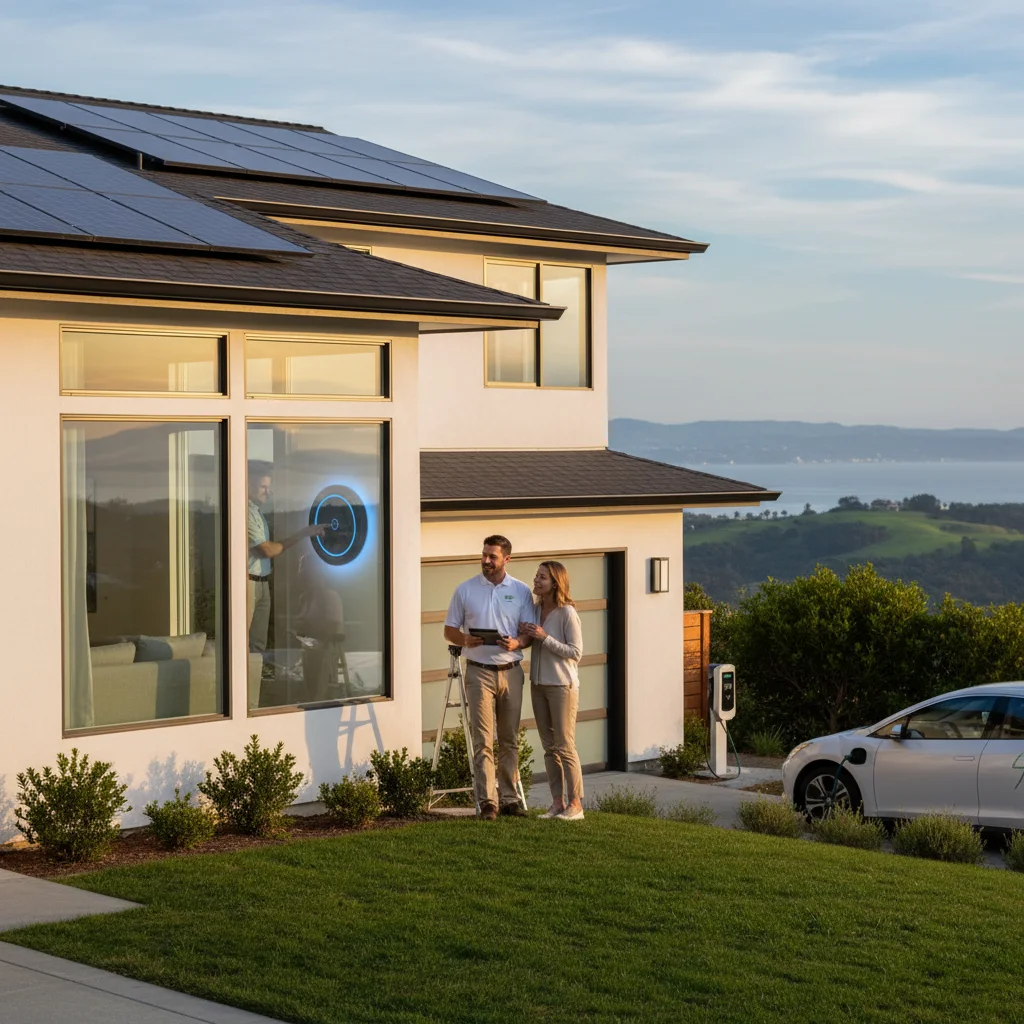
Bay Area homeowners replaced over 47,000 thermostats with smart models in 2025, unlocking $2.1 million in utility rebates. And those rebates just increased for 2026. Pacific Gas & Electric now pays $75 per qualifying thermostat installation, while Peninsula Clean Energy added a $50 stacking incentive for income-qualified households. Local contractors report 8-12 week backlogs as demand surges ahead of California's 2027 mandate requiring smart controls in all new HVAC installations.
How Much Does Smart Thermostat Installation Cost in the Bay Area?
Smart thermostat installation in the Bay Area costs $250-$450 for professional labor plus $120-$250 for the device in 2026, with PG&E and municipal utility rebates reducing net costs to $45-$375 depending on income qualification and local program stacking rules.
Professional installation runs $250-$350 for standard single-stage HVAC systems and $350-$450 for multi-stage heat pumps or dual-fuel systems. DIY installation saves labor costs but disqualifies homeowners from income-qualified rebate tiers that require contractor certification. PG&E's 2026 Smart Thermostat Program pays $75 for standard installations and $120 for income-qualified households earning below 80% area median income. And Peninsula Clean Energy adds $50 for customers in San Mateo County. Silicon Valley Clean Energy provides $75 for Santa Clara County residents. So a Milpitas homeowner earning $68,000 annually pays $120 for a Nest Learning Thermostat after stacking a $50 device rebate, $75 SVCE incentive, and $120 PG&E income-qualified payment against a $365 total cost.
Compare your local smart thermostat rebates to calculate actual savings.
What Is the Step-by-Step Application Process for Bay Area Rebates?
Bay Area smart thermostat rebate applications require pre-approval documentation, contractor certification verification, proof of purchase, installation photos, and utility account linking through online portals within 60-90 days of installation for 2026 programs.
PG&E requires pre-enrollment at pge.com/smartthermostat before purchase. Homeowners upload contractor license verification, device serial number, and ENERGY STAR certification within 14 days of installation. Income-qualified applicants submit tax returns or CalFresh documentation proving household income below 80% AMI—$106,200 for a family of four in San Francisco County in 2026. Peninsula Clean Energy processes applications within 30 days but requires separate enrollment at peninsulacleanenergy.com/rebates after PG&E approval. And Silicon Valley Clean Energy automatically applies its $75 credit to utility bills for pre-enrolled customers within 45 days.
But East Bay Community Energy uses a different system: customers submit paper applications with contractor invoices and device UPC codes to [email protected] within 90 days. The agency processes claims in 6-8 weeks and issues checks rather than bill credits. Marin Clean Energy requires appointments with its customer service team at 1-888-632-3562 to verify HVAC compatibility before approving smart thermostat rebates. Use our free rebate calculator to estimate your total savings across stacked programs.
What Are the Eligibility Requirements and Contractor Qualifications?
Bay Area smart thermostat rebate eligibility requires ENERGY STAR certification, C-20 or C-10 licensed contractor installation for income-qualified tiers, active utility accounts, and qualifying HVAC systems installed after January 1, 2020 per 2026 program rules.
PG&E accepts 47 thermostat models in 2026, including Nest Learning Thermostat (4th Gen), ecobee Smart Thermostat Premium, Honeywell Home T9, and Emerson Sensi Touch 2. Devices need Wi-Fi connectivity and ENERGY STAR Version 4.0 certification or higher. Contractors performing income-qualified installations carry active California C-20 (Warm-Air Heating) or C-10 (Electrical) licenses and complete PG&E's Smart Thermostat Installation Training Module—a 90-minute online course updated annually.
And HVAC systems installed before 2020 don't qualify for rebates unless homeowners also upgrade to heat pump systems through separate heat pump rebates that allow thermostat bundling. Rental properties qualify only if landlords or property managers apply and agree to maintain smart scheduling for 3 years. Peninsula Clean Energy requires homeowners to maintain active Peninsula Power accounts for 12 months post-installation. So customers switching to PG&E's standard service within a year refund rebates plus 5% annual interest.
When Are the Deadlines for Smart Thermostat Rebate Programs?
Bay Area smart thermostat rebates operate on fiscal year cycles with most 2026 programs accepting applications through June 30, 2027, but PG&E's income-qualified tier historically exhausts funding by November and Silicon Valley Clean Energy caps participation at 12,000 households annually.
PG&E allocated $8.4 million for smart thermostat rebates in fiscal year 2025-2026 (July 1, 2025 to June 30, 2026). The utility exhausted income-qualified funding on November 18, 2025—4.5 months ahead of schedule. Standard rebates remained available through June. For 2026-2027, PG&E increased income-qualified funding 40% to $4.7 million but applications now require waitlist enrollment after 80% budget depletion.
Peninsula Clean Energy operates on calendar years with applications closing December 31, 2026 or when 8,500 rebates process—whichever occurs first. Silicon Valley Clean Energy caps participation at 12,000 households per fiscal year and pauses new applications when 11,000 enroll. And East Bay Community Energy accepts applications year-round but processes claims in order received with 12-16 week delays common October through January. Marin Clean Energy doesn't publish hard deadlines but reserves the right to modify or suspend programs with 30 days notice.
Check current energy tax credits for federal incentives that don't have waiting lists.
| Program | Rebate Amount | Income-Qualified Bonus | Application Deadline | Annual Cap |
|---|---|---|---|---|
| PG&E | $75 | +$45 | June 30, 2027 | $8.4M budget |
| Peninsula Clean Energy | $50 | +$30 | Dec 31, 2026 | 8,500 rebates |
| Silicon Valley Clean Energy | $75 | +$50 | June 30, 2027 | 12,000 households |
| East Bay Community Energy | $60 | +$40 | Rolling | No stated cap |
| Marin Clean Energy | $100 | +$50 | Ongoing | Subject to change |
Can You Stack Smart Thermostat Rebates With Other Bay Area Incentives?
Bay Area homeowners stack smart thermostat rebates with utility programs, municipal incentives, and retailer promotions but can't combine multiple utility rebates from overlapping service territories or duplicate federal tax credits for the same device in 2026.
PG&E allows stacking its $75-$120 smart thermostat rebate with Community Choice Aggregator programs like Peninsula Clean Energy ($50) or Silicon Valley Clean Energy ($75) as long as customers receive electric service from the CCA. So a San Mateo homeowner served by Peninsula Clean Energy and PG&E gas stacks both rebates for $125-$170 total. But customers can't stack PG&E's rebate with SMUD or other municipal utility programs serving separate territories.
Retailer promotions from Best Buy, Home Depot, and Costco offering $20-$50 manufacturer rebates stack with all utility incentives. And local water districts including East Bay Municipal Utility District provide $40-$75 rebates for smart controllers managing irrigation alongside HVAC thermostats—these stack because they control different systems. California's TECH Clean California Initiative pays contractors $150-$500 for heat pump installations that include smart thermostats, but the contractor receives that payment, not the homeowner.
Federal tax credits don't apply to standalone smart thermostat purchases in 2026. The federal Energy Efficient Home Improvement Credit (Section 25C) ended for property placed in service after December 31, 2025 (IRS FS-2025-05). Federal tax credits for this work have ended, but state, local and utility rebates may still apply; check what is available at your address with the DuloCore rebate calculator.
How Do You Check Your Funding Status and Track Your Rebate?
Bay Area smart thermostat rebate applicants track funding status through utility online portals using application reference numbers, with PG&E providing real-time updates at pge.com/myenergy and Community Choice Aggregators sending email notifications within 5-7 business days of status changes in 2026.
PG&E's online portal at pge.com/myenergy displays application status, document review progress, and estimated payment dates. Approved rebates appear as bill credits within 2-3 billing cycles or 60-75 days. And income-qualified applicants receive separate checks mailed to billing addresses within 45 days of approval. Peninsula Clean Energy sends automated email updates to registered addresses when applications move from "submitted" to "under review" to "approved" or "additional information needed." The utility posts average processing times—currently 22 days for standard applications and 34 days for income-qualified reviews—at peninsulacleanenergy.com/rebates/status.
Silicon Valley Clean Energy automatically applies approved rebates to utility bills and sends confirmation emails with credit amounts and application dates. East Bay Community Energy provides phone status checks at 1-833-699-3223 Monday-Friday 8am-6pm. Marin Clean Energy requires customers to log in to marincleanenergy.com/account to view rebate status since the utility doesn't send proactive email notifications.
"Smart thermostats reduce heating and cooling costs 10-23% annually and improve grid reliability by enabling demand response during peak events" — U.S. Department of Energy
Official Sources
- DOE Energy Saver — Federal guidance on smart thermostats, energy efficiency rebates, and home improvement tax credits (note: the federal 25C and 25D credits ended for projects completed after December 31, 2025)
- DSIRE California — Comprehensive database of California utility rebates, state incentives, and local smart thermostat programs
- PG&E Smart Thermostat Program — Official Bay Area utility rebate application portal and eligibility requirements
Related Reading: Learn more about Thermostat Rebates Bay Area.
Frequently Asked Questions
Can I get a rebate for installing a smart thermostat in the Bay Area?
Yes. Bay Area homeowners receive $50-$170 in combined utility rebates for smart thermostat installations in 2026 depending on location and income qualification. PG&E pays $75-$120, Peninsula Clean Energy adds $50, Silicon Valley Clean Energy provides $75, East Bay Community Energy offers $60, and Marin Clean Energy pays $100. Income-qualified households earning below 80% area median income receive 40-67% higher rebates across all programs.
How much rebate money can I get for a smart thermostat installation?
Bay Area smart thermostat rebates range from $50 to $220 in 2026. Standard rebates pay $50-$100 per device. Income-qualified tiers add $30-$50 bonuses. Homeowners stacking PG&E's $120 income-qualified rebate with Peninsula Clean Energy's $50 incentive and a $50 retailer promotion receive $220 total—covering 60-88% of device and installation costs depending on contractor rates and thermostat model selection.
What smart thermostats qualify for Bay Area rebates?
Bay Area rebate programs accept 47 ENERGY STAR certified models in 2026 including Nest Learning Thermostat, ecobee Smart Thermostat Premium, Honeywell Home T9, Emerson Sensi Touch, Lux Kono Smart, and Bosch BCC100. Devices need Wi-Fi connectivity, mobile app control, and ENERGY STAR Version 4.0 or higher certification. PG&E maintains a complete qualifying products list at pge.com/smartthermostat updated quarterly.
Do I need a licensed contractor to install a smart thermostat for the rebate?
Standard rebate tiers allow DIY installation for PG&E ($75), Peninsula Clean Energy ($50), and Silicon Valley Clean Energy ($75) programs. But income-qualified rebates requiring $120-$170 payments mandate professional installation by California C-20 or C-10 licensed contractors who complete utility-specific training modules. Contractors provide installation verification, system compatibility certifications, and 1-year workmanship warranties required for income-qualified rebate approval.
When is the deadline to apply for smart thermostat rebates in California?
Most Bay Area smart thermostat programs accept 2026 applications through June 30, 2027 or December 31, 2026 depending on utility fiscal year schedules. But income-qualified funding historically exhausts 4-6 months early, with PG&E depleting its $4.7 million allocation by mid-November 2026. Silicon Valley Clean Energy caps participation at 12,000 households annually and pauses enrollment when 11,000 applications process—typically March or April.
Ready to calculate your smart thermostat rebate savings? Use our free rebate calculator to compare PG&E, Community Choice Aggregator, and stacking incentives based on your exact Bay Area location, income level, and HVAC system type. Get personalized results in under 60 seconds.
Last updated: April 14, 2026. Reviewed by the DuloCore Editorial Team. About our authors.
Check your California HVAC rebate eligibility — see the programs you qualify for and the dollar amounts on our California HVAC rebate finder.