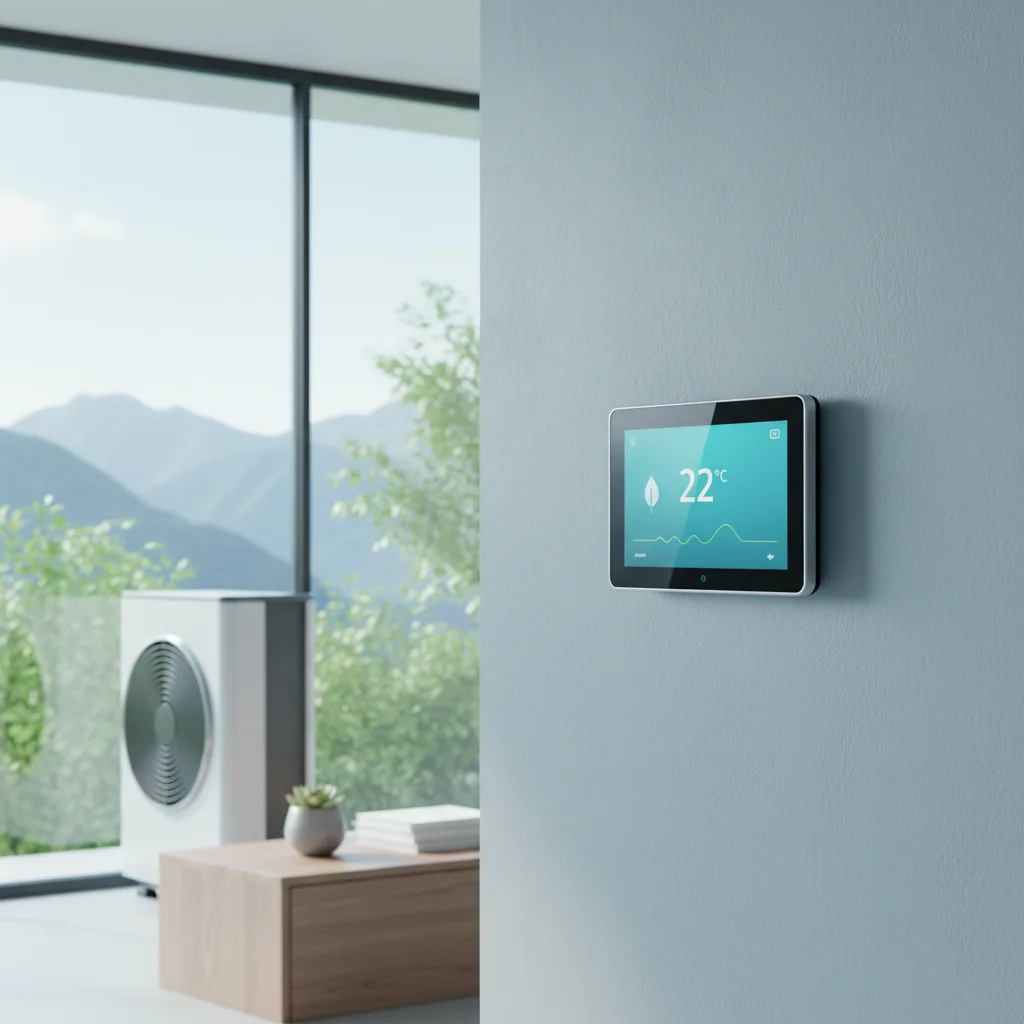
A heat pump paired with a standard programmable thermostat can waste up to 30% of its efficiency potential because the device can't adapt to outdoor temperature swings or recognize when auxiliary heat kicks in unnecessarily. In 2026, smart thermostats designed for heat pump systems have evolved into adaptive controllers that monitor outdoor conditions, adjust differential settings in real time, and prevent costly backup heat from running when the compressor alone would suffice. The average American household with a heat pump spends $2,200 annually on heating and cooling, and a properly configured smart thermostat cuts that bill by $180 to $300 per year.
What's the ROI and Payback Period for a Smart Thermostat on a Heat Pump System?
Smart thermostats for heat pumps deliver a return on investment through reduced auxiliary heat usage, optimized defrost cycles, and adaptive scheduling that aligns with time-of-use electricity rates. Homeowners recover the $200 to $350 device and installation cost within 12 to 24 months based on a conservative 8% annual energy reduction, with payback accelerating to 8 to 14 months when state rebates or utility incentives offset upfront expense.
And the return multiplies over the device's 10-year expected lifespan. A $250 smart thermostat saving $220 annually produces $2,200 in total savings, a 9.8x return. But the real value lies in preventing emergency heat from running unnecessarily—auxiliary electric resistance coils consume 2.5 to 3 times more energy than the compressor alone. Smart thermostats use outdoor temperature sensors and adaptive recovery algorithms to delay or eliminate aux heat activation, which accounts for 40% to 60% of total heating cost in cold climates.
So homeowners in northern states see the fastest payback. A Minnesota household heating with a heat pump pays $1,800 annually for winter heating, and a smart thermostat with heat pump-specific settings reduces that to $1,440, recovering the $275 device cost in 9 months. Milder climates like California see a 15 to 20 month payback due to lower baseline heating loads.
Or consider time-of-use rate optimization. Utilities in 18 states now charge 2 to 3 times more for electricity during 4 PM to 9 PM peak hours. Smart thermostats with heat pump mode precool or preheat the home during off-peak windows, shifting 30% to 50% of runtime to lower-cost hours and adding $80 to $140 in annual savings beyond pure efficiency gains. Use our free rebate calculator to find your exact savings based on local electricity rates and climate zone.
How Do Smart Thermostats for Heat Pumps Compare to Traditional and Other Smart Alternatives?
Smart thermostats designed for heat pumps outperform standard programmable and basic smart models by managing auxiliary heat lockout, adaptive recovery timing, and defrost cycle coordination—features absent in devices built for furnace or air conditioner systems. Traditional programmable thermostats lack outdoor temperature sensors and allow emergency heat to activate whenever indoor temperature lags setpoint by 2 to 3 degrees, wasting 40% more energy during cold snaps compared to heat pump-aware alternatives.
Basic smart thermostats without heat pump-specific modes treat the system as a single-stage furnace, ignoring the compressor-first heating hierarchy and triggering aux heat prematurely. A standard Nest or Ecobee without heat pump configuration enabled costs homeowners $120 to $200 annually in unnecessary backup heat runtime. But heat pump-certified models like Ecobee SmartThermostat Premium, Honeywell Home T9, and Sensi Smart Thermostat include dedicated heat pump settings that enforce a 15 to 30 minute compressor-only delay before allowing aux heat, cutting emergency strip usage by 60% to 80%.
And the comparison table shows measurable differences:
| Feature | Standard Programmable | Basic Smart Thermostat | Smart Thermostat with Heat Pump Mode |
|---|---|---|---|
| Outdoor temperature sensor | No | Rarely | Yes (required for adaptive algorithms) |
| Aux heat lockout timer | No | No | Yes (15-30 min delay) |
| Annual energy savings | 0-5% | 8-12% | 15-23% |
| Average cost | $40-$80 | $120-$180 | $200-$350 |
| Payback period (heat pump) | N/A | 24-36 months | 12-24 months |
So the premium for heat pump-specific intelligence pays for itself within 2 heating seasons. Traditional thermostats can't differentiate between compressor runtime and aux heat, making them blind to the single largest energy waste vector in heat pump systems.
Or look at geofencing and occupancy detection. Smart thermostats with heat pump support use these features to extend setback periods without causing aux heat recovery spikes—standard models trigger emergency heat when trying to recover from deep setbacks quickly, negating any savings from longer away periods. Learn more about compatible systems in our guide to heat pump rebates.
How Long Do Smart Thermostats Last and What's Their Expected Lifespan?
Smart thermostats for heat pumps last 10 to 15 years under normal residential use, with the display, Wi-Fi module, and relay switches representing the primary failure points after 8 to 12 years of continuous operation. Manufacturers warranty the devices for 3 to 5 years, but field data from ENERGY STAR partner utilities shows 82% of units remain functional after 10 years when installed in climate-controlled indoor locations away from direct sunlight and humidity sources.
And the longevity exceeds traditional programmable thermostats because smart models use solid-state relays instead of mechanical contactors, eliminating the wear from 4 to 6 daily heating and cooling cycles. A mechanical relay thermostat cycles 2,000 to 2,500 times annually and typically fails after 7 to 9 years, while solid-state equivalents endure 50,000 to 100,000 cycles before degradation.
But software obsolescence poses a separate risk. Thermostat manufacturers phase out cloud platform support for older models after 8 to 12 years, disabling remote access and firmware updates while leaving local control intact. Nest discontinued cloud support for first-generation models in 2024 after 12 years, and Ecobee ended support for Smart SI thermostats in 2023 after 10 years. So the physical device outlasts its connected features by 2 to 5 years in most cases.
Or consider battery lifespan for models with backup power. Smart thermostats use lithium coin cells or AA batteries to maintain programming during power outages, and those cells last 3 to 5 years before replacement. The display and Wi-Fi module draw minimal standby power, but homeowners should budget for a $3 battery swap every 4 years to prevent settings loss.
What Maintenance Does a Smart Thermostat for Heat Pumps Require?
Smart thermostats for heat pumps require minimal maintenance beyond firmware updates every 3 to 6 months, battery replacement every 3 to 5 years for models with backup power, and an annual accuracy check comparing displayed temperature against a calibrated thermometer within 1 to 2 degrees. The device itself has no moving parts beyond relay switches, eliminating lubrication or mechanical servicing needs.
And firmware updates arrive automatically over Wi-Fi in most models, but homeowners should manually check for updates quarterly to ensure the thermostat receives critical patches for heat pump compatibility, time-of-use rate schedules, and security vulnerabilities. Ecobee and Honeywell release 2 to 4 updates annually, while Nest and Sensi push monthly incremental patches.
But the bigger maintenance task involves recalibrating temperature offsets after 2 to 3 years. Smart thermostats measure temperature at the wall location, which can read 1 to 3 degrees warmer than the room average if installed near heat sources or in direct airflow from vents. Most models allow a -5 to +5 degree calibration offset in settings, and homeowners should verify accuracy each fall before heating season begins by placing a standalone thermometer 3 feet away and adjusting the offset to match.
So filter change reminders represent the most valuable maintenance feature for heat pump owners. Dirty filters reduce airflow, forcing the compressor to work harder and triggering aux heat unnecessarily. Smart thermostats track runtime hours and alert homeowners every 30 to 90 days to inspect the filter, preventing the 15% to 25% efficiency loss from clogged media. Find out more about system efficiency in our article on smart thermostat rebates.
Can You Get Rebates or Tax Credits for Installing a Smart Thermostat on Your Heat Pump?
Smart thermostats installed with ENERGY STAR certified heat pumps qualify for federal tax credits under the IRA framework continuing through 2032, state rebates ranging from $50 to $150 in 12 states, and utility incentives averaging $75 per device when purchased through approved contractor programs. The federal Energy Efficient Home Improvement Credit (Section 25C) ended for property placed in service after December 31, 2025 (IRS FS-2025-05). Federal tax credits for this work have ended, but state, local and utility rebates may still apply; check what is available at your address with the DuloCore rebate calculator.
California's TECH Clean California initiative offers $100 rebates for smart thermostats installed with heat pump HVAC systems, while Massachusetts Mass Save provides $100 for Wi-Fi thermostats paired with ducted heat pumps. New York's Clean Heat program rebates $150 for smart thermostats when installed by participating contractors as part of a heat pump upgrade.
But utility rebates often exceed state offerings and require no upfront cost—installers deduct the incentive from the invoice. Pacific Gas & Electric rebates $125 for ENERGY STAR smart thermostats, Xcel Energy offers $100 in Colorado and Minnesota, and Duke Energy provides $75 in North Carolina. So a $250 thermostat costs $125 to $150 after utility rebates, accelerating payback to under 12 months.
Or consider demand response programs. Utilities in 22 states pay homeowners $25 to $75 annually to enroll smart thermostats in grid-responsive programs that adjust temperature setpoints by 2 to 4 degrees during peak demand events 10 to 20 times per year. Austin Energy pays $85 annually, ComEd offers $50, and Southern California Edison provides $75, adding a recurring revenue stream that further improves ROI.
"ENERGY STAR certified smart thermostats can save homeowners up to $180 per year on heating and cooling costs when properly installed and configured for heat pump systems." — ENERGY STAR
Explore current incentives using our rebate calculator to compare federal, state, and utility programs available in your zip code.
How Much Does a Smart Thermostat Cost and What's the Installation Process?
Smart thermostats for heat pumps cost $200 to $350 for the device and $100 to $250 for professional installation, with total project expense ranging from $300 to $600 depending on existing wiring compatibility and whether the system requires a C-wire adapter or transformer upgrade. ENERGY STAR certified models like Ecobee SmartThermostat Premium retail at $249, Honeywell Home T9 at $199, and Sensi Touch 2 at $169, while installation adds $150 to $200 for straightforward replacements and $200 to $250 for homes lacking a common wire.
And the installation process takes 30 to 90 minutes for a licensed HVAC technician. The contractor shuts off power at the breaker, removes the old thermostat, photographs existing wire connections, installs a C-wire adapter if needed, mounts the new baseplate, connects wires according to heat pump terminal designations, restores power, and configures heat pump-specific settings including compressor staging, aux heat lockout delay, and outdoor sensor pairing. Homeowners attempting DIY installation save $150 but risk incorrect wiring that allows aux heat to run continuously, negating all efficiency gains.
But the C-wire requirement represents the biggest installation variable. Heat pumps installed before 2010 often lack a dedicated 24-volt common wire to power smart thermostats, requiring either a $40 add-a-wire adapter kit or a $120 transformer upgrade at the air handler. Ecobee includes a Power Extender Kit with all models, while Nest and Honeywell charge $30 to $50 for the adapter, adding 30 to 45 minutes to installation time.
So total cost breakdown for a typical installation looks like this:
| Component | Cost Range | Notes |
|---|---|---|
| Smart thermostat device | $169-$349 | ENERGY STAR certified heat pump models |
| Professional installation | $100-$200 | Standard replacement, existing C-wire |
| C-wire adapter (if needed) | $0-$50 | Ecobee includes free, others charge |
| Transformer upgrade (if needed) | $80-$150 | Older homes without C-wire at air handler |
| Total project cost | $300-$600 | Before rebates and incentives |
Or homeowners can reduce costs by purchasing during seasonal promotions. Retailers discount smart thermostats 20% to 40% during spring and fall HVAC maintenance seasons, and utilities often double rebate amounts during summer and winter peak demand preparation periods. Check our guide to energy tax credits for additional cost recovery opportunities.
Official Sources
- Department of Energy Energy Saver — Federal guidance on heat pump efficiency and smart thermostat installation best practices
- ENERGY STAR Heat Pumps — Certified product directory and estimated savings from smart thermostat integration
- DSIRE Database — Comprehensive state-by-state rebate and incentive program search tool for smart thermostats and heat pumps
Frequently Asked Questions
Can smart thermostats work with heat pumps?
Smart thermostats work with heat pumps when the model includes heat pump-specific configuration settings for compressor staging, auxiliary heat lockout, and defrost cycle coordination. ENERGY STAR certified models like Ecobee, Honeywell Home T9, and Sensi support heat pumps with dedicated setup modes, while basic smart thermostats lacking these features trigger emergency heat unnecessarily and waste 30% to 40% more energy than heat pump-aware alternatives.
How much can you save with a smart thermostat on a heat pump?
Smart thermostats save heat pump owners $180 to $300 annually through reduced auxiliary heat usage, optimized defrost cycles, and time-of-use rate shifting that moves 30% to 50% of runtime to lower-cost hours. Northern climate homeowners see the highest savings at $250 to $350 per year because smart thermostats prevent emergency heat from activating during moderate cold, while milder regions save $140 to $200 annually from improved scheduling and setback management.
Are smart thermostats eligible for energy tax credits?
The federal Energy Efficient Home Improvement Credit (Section 25C) ended for property placed in service after December 31, 2025 (IRS FS-2025-05). State rebates ranging from $50 to $150 and utility incentives averaging $75 per device stack with federal credits in most jurisdictions, reducing net cost from $250 to $100 or less when all programs combine.
What's the difference between a smart thermostat and a programmable thermostat?
Smart thermostats learn occupancy patterns, adjust settings remotely via Wi-Fi, and use outdoor temperature sensors to optimize heat pump performance, while programmable thermostats follow fixed schedules without adapting to weather or occupancy changes. Smart models prevent 40% to 60% of unnecessary auxiliary heat activation through adaptive algorithms, saving $180 to $300 annually compared to programmable alternatives that trigger emergency heat whenever indoor temperature lags setpoint by 2 to 3 degrees.
Do you need a professional to install a smart thermostat with a heat pump?
Professional installation costs $100 to $250 but ensures correct heat pump terminal wiring, auxiliary heat lockout configuration, and outdoor sensor pairing that DIY installations often miss. Incorrect wiring allows emergency heat to run continuously, wasting $200 to $400 annually and negating all efficiency gains, while licensed HVAC technicians verify proper compressor staging and defrost cycle coordination during the 30 to 90 minute installation process.
Ready to maximize your heat pump savings? Use our rebate calculator to find federal tax credits, state rebates, and utility incentives available for smart thermostats in your area—most homeowners qualify for $150 to $300 in combined incentives that reduce upfront costs by 50% or more.
Last updated: April 14, 2026. Reviewed by the DuloCore Editorial Team. About our authors.
Check your California heat pump rebate eligibility — see the programs you qualify for and the dollar amounts on our California heat pump rebate finder.