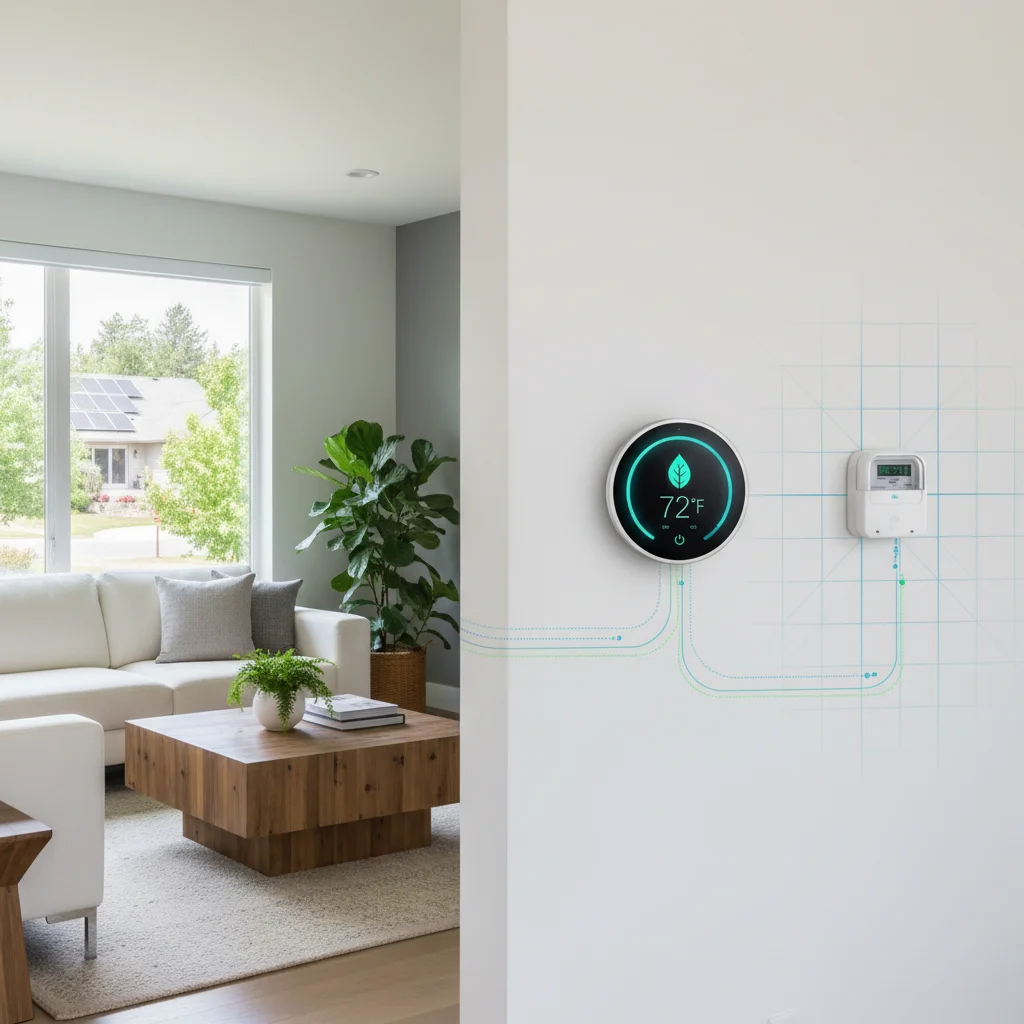
California's electrical grid hit peak demand 47 times in summer 2025, triggering rolling blackouts that cost homeowners an average of $380 in spoiled food and lost productivity. Smart thermostat demand response programs pay homeowners $25 to $150 annually to let utilities automatically adjust temperatures during these peak events, cutting grid strain by up to 3 gigawatts statewide while keeping homes comfortable within 2-4°F of the original setting.
What Is Smart Thermostat Demand Response and How Does It Work?
Smart thermostat demand response is a utility-managed program that automatically adjusts participating thermostats by 2-4°F during peak electricity demand events, typically lasting 1-4 hours on hot afternoons. Utilities send signals directly to enrolled thermostats when grid strain reaches critical levels, temporarily reducing air conditioning load across thousands of homes simultaneously. Participants earn $25-$150 per year in bill credits or cash incentives, with most programs offering override options if comfort becomes an issue during adjustment periods.
Utilities use OpenADR (Open Automated Demand Response) protocol to communicate with smart thermostats from brands like Nest, Ecobee, Honeywell, and Emerson. The thermostat receives the adjustment signal, shifts the temperature setpoint by the predetermined amount, and reverts to normal settings once the demand response event ends. And most programs limit adjustments to 10-15 events per year, each lasting 2-4 hours during summer peak periods between 2 PM and 8 PM.
California's three major investor-owned utilities—Pacific Gas & Electric, Southern California Edison, and San Diego Gas & Electric—all operate demand response programs for smart thermostats. But participation is voluntary, and homeowners can opt out of individual events through their thermostat app or by manually overriding the temperature adjustment. Data from the 2025 summer season shows that 87% of enrolled participants never opted out of a single event, indicating minimal comfort impact for most households.
The California Public Utilities Commission estimates that residential demand response programs reduced peak demand by 1,200 megawatts in 2025, equivalent to the output of two natural gas power plants. So expanding smart thermostat enrollment from the current 340,000 households to 1 million could eliminate the need for $800 million in peaker plant construction. Learn more about related programs through smart thermostat rebates offered by California utilities.
How Much Can You Save With Smart Thermostat Demand Response Programs?
Pacific Gas & Electric's SmartRate program pays participants $50-$100 annually in bill credits, with exact amounts determined by thermostat model and total hours of participation during summer peak events. Southern California Edison's Summer Discount Plan offers $75 annually for air conditioning load control, while San Diego Gas & Electric's Summer Saver program provides $30-$50 per connected device. And these incentives stack on top of the $50-$100 annual energy savings from smart thermostat automation features, bringing total annual value to $100-$200.
Participants in PG&E's SmartRate program saved an average of $127 in 2025 through combined demand response credits and time-of-use rate optimization. But savings vary based on home size, baseline electricity usage, and climate zone—a 2,000-square-foot home in Fresno typically sees 30% higher participation payments than a similar home in coastal San Mateo due to more frequent peak events. The California Energy Commission projects that statewide expansion to 1 million enrolled thermostats would generate $150 million in annual consumer savings by 2028.
Bay Area utility Silicon Valley Power offers the highest per-event payment at $3-$5 per participation, with participants averaging 12 events annually for total credits of $36-$60. So homeowners who enroll in multiple programs—such as both utility demand response and grid services programs like OhmConnect—can earn $200-$300 annually. Check your eligibility and calculate potential savings with our free rebate calculator that factors in both demand response payments and smart thermostat installation incentives.
Demand response payments qualify as utility bill credits rather than taxable income, meaning participants keep 100% of the incentive value without reporting requirements. And the payback period for a $130 smart thermostat purchased specifically for demand response participation is typically 12-18 months, after which all payments represent pure savings. Additional information on federal incentives is available through energy tax credits that cover smart home efficiency upgrades.
What Are the Eligibility Requirements for Smart Thermostat Demand Response?
Homeowners must own a compatible smart thermostat from an approved manufacturer list that includes Nest, Ecobee, Honeywell Home, Emerson Sensi, and Lux. Participants need an active residential electricity account with the enrolling utility, a Wi-Fi connection with minimum 2 Mbps upload speed, and central air conditioning or heat pump controlled by the smart thermostat. And most programs require the thermostat to have been installed within the past 3 years, though PG&E accepts devices up to 5 years old with verified firmware updates.
Renters qualify for demand response programs if they pay the electricity bill directly and obtain written permission from the property owner to install a smart thermostat. But properties with shared HVAC systems serving multiple units are ineligible because the utility cannot isolate individual unit load control. The thermostat must be connected to the utility's OpenADR server continuously during the May-October enrollment period, with connection interruptions beyond 7 consecutive days resulting in program removal.
Geographic eligibility varies by utility service territory and climate zone. Southern California Edison restricts enrollment to Climate Zones 9-15, covering inland and desert areas with the highest cooling loads, while PG&E accepts participants across all 16 climate zones in its territory. So coastal homeowners in moderate climates qualify despite experiencing fewer demand response events, typically 3-5 per summer compared to 12-15 events in inland valleys.
Business customers are excluded from residential demand response programs but qualify for separate commercial programs with higher payment rates of $200-$500 annually. And homeowners with backup generators or solar-plus-storage systems remain eligible, though battery discharge during demand response events may reduce overall household savings. Additional home efficiency upgrades like heat pump rebates can further reduce peak load and increase demand response payment potential.
What Documents Do You Need Before Applying for Demand Response Programs?
Enrollment requires a utility account number, service address verification through a recent electricity bill dated within 60 days, and the smart thermostat's MAC address or serial number for OpenADR registration. Participants must provide an active email address for event notifications and program communications, with utilities sending 24-48 hour advance notice before each demand response event. And homeowners installing a new thermostat specifically for the program need proof of purchase dated within the current calendar year.
Southern California Edison requires additional documentation for new construction homes, including a certificate of occupancy dated within 12 months and confirmation of HVAC system commissioning by a licensed contractor. But existing homes with thermostats already installed need only the utility account number and thermostat device ID, streamlining enrollment to a 5-7 minute online process. Pacific Gas & Electric accepts smartphone screenshots showing the thermostat connected to the home Wi-Fi network as sufficient proof of installation and connectivity.
Renters must submit a landlord authorization form signed within 30 days of enrollment, explicitly granting permission to install permanent electrical equipment and participate in utility load control programs. And properties with solar installations require a net energy metering agreement number, though this doesn't affect demand response eligibility or payment amounts. The utility verifies all documentation electronically during enrollment, with instant approval for 94% of applications that include complete information.
No income verification, credit checks, or energy audits are required for demand response program participation, unlike some rebate programs that tier incentives by household income. So enrollment is open to all residential customers meeting the basic equipment and connectivity requirements, regardless of home value or energy usage levels. Tax returns and identification documents are never requested as part of the standard enrollment process.
Is Pre-Approval Required Before Installing a Smart Thermostat?
No pre-approval is necessary to purchase and install a smart thermostat before enrolling in demand response programs, and most utilities encourage homeowners to complete installation first to verify compatibility and connectivity. But enrolling in the demand response program before installation guarantees device compatibility, as utilities maintain real-time lists of approved models that receive OpenADR firmware updates. And Pacific Gas & Electric offers instant enrollment at the time of smart thermostat purchase through participating retailers like Home Depot and Lowe's, with in-store kiosks that complete registration in 3-4 minutes.
Southern California Edison requires thermostat registration within 90 days of installation to qualify for the full annual incentive, with pro-rated payments for mid-season enrollments. So a homeowner installing a smart thermostat in July and enrolling immediately receives 50% of the annual $75 incentive for the remaining summer months, then qualifies for the full amount in subsequent years. San Diego Gas & Electric allows retroactive enrollment for thermostats installed up to 12 months prior, maintaining full incentive eligibility regardless of installation date.
Utilities process demand response enrollments in 1-3 business days, with immediate participation in the next scheduled peak event after approval. And the OpenADR connection test happens automatically during enrollment, alerting homeowners to any Wi-Fi or firewall issues that would prevent successful participation. Failed connection tests delay enrollment until connectivity issues are resolved, but don't disqualify the household from future participation once problems are fixed.
Professional installation by an HVAC contractor isn't required for demand response eligibility, as 82% of smart thermostat installations are DIY projects completed in 30-45 minutes. But homes with uncommon wiring configurations or multi-stage HVAC systems may need professional installation to ensure proper thermostat function and demand response signal compatibility. Additional efficiency upgrades can be explored through heat pump rebates that often include smart thermostat installation as part of the rebate package.
What Is the Application Process and Timeline for Enrollment?
Homeowners enroll through the utility's online demand response portal by entering their utility account number, service address, and smart thermostat device information, with the entire process taking 5-10 minutes to complete. The utility sends a verification email within 24 hours containing a unique enrollment code, which homeowners enter into their thermostat's companion app to complete OpenADR registration. And the thermostat automatically connects to the utility's demand response server within 48 hours, making the home eligible for the next scheduled peak event.
Pacific Gas & Electric processes 97% of demand response enrollments within 48 hours during non-peak periods (October-April), while summer enrollments may take 3-5 business days due to higher application volume. But utilities prioritize enrollment during heat waves, with expedited 24-hour processing when demand response capacity is most critical. Southern California Edison sends push notifications through the thermostat app confirming successful enrollment and providing the annual incentive amount based on device model and climate zone.
The enrollment year runs from May 1 through October 31 for most California utilities, aligning with the summer peak demand season when demand response events occur. So homeowners enrolling in November receive confirmation but don't participate in events or earn incentives until the following May. And early enrollment in March-April often qualifies for bonus incentives of $10-$25, encouraging homeowners to register before peak season begins.
Demand response events are announced 24-48 hours in advance through email, text message, and in-app notifications, giving participants time to pre-cool homes or adjust schedules if needed. And events typically last 2-4 hours between 2 PM and 8 PM on days when forecasted temperatures exceed 95°F and grid load approaches capacity limits. Post-event notifications confirm participation and credit amounts within 72 hours, with payments appearing as bill credits on the next monthly statement.
Can You Stack Smart Thermostat Rebates With Other Energy Incentives?
Smart thermostat demand response payments stack with utility rebates of $50-$120 for ENERGY STAR certified thermostat purchases, allowing homeowners to recover 100% of device costs through combined incentives. The federal Energy Efficient Home Improvement Credit (Section 25C) ended for property placed in service after December 31, 2025 (IRS FS-2025-05). Federal tax credits for this work have ended, but state, local and utility rebates may still apply; check what is available at your address with the DuloCore rebate calculator. California utilities explicitly allow stacking demand response with time-of-use rate programs, where shifting energy use to off-peak hours generates additional savings of $15-$30 monthly.
Homeowners participating in both demand response and third-party grid services programs like OhmConnect or Leap earn dual incentives during overlapping events, with total payments reaching $8-$12 per event. But utilities prohibit simultaneous enrollment in multiple utility-operated demand response programs, meaning participants must choose between PG&E's SmartRate and PG&E's Peak Day Pricing, not both. So strategic program selection based on climate zone and historical event frequency maximizes annual earnings, with inland homeowners typically benefiting more from SmartRate's higher per-event payments.
Solar and battery storage rebates through SGIP (Self-Generation Incentive Program) stack with demand response participation, and homes with batteries can discharge stored energy during events instead of reducing cooling, maintaining full comfort while still earning incentives. And HVAC upgrade rebates from programs like BayREN or Tech Clean California allow homeowners to install high-efficiency heat pumps or air conditioners alongside smart thermostats, qualifying for $1,500-$3,000 in equipment rebates plus ongoing demand response payments. Calculate your combined savings across multiple programs with our rebate calculator that factors in federal, state, and utility incentives.
Income-qualified programs like CARE (California Alternate Rates for Energy) and FERA (Family Electric Rate Assistance) stack with demand response, providing 20-35% monthly bill discounts in addition to participation payments. And weatherization assistance programs covering insulation, air sealing, and duct repairs reduce HVAC runtime, decreasing the impact of demand response temperature adjustments while maintaining or increasing incentive payments. The California Public Utilities Commission explicitly encourages incentive stacking to maximize participation in residential efficiency and grid services programs.
Official Sources
- U.S. Department of Energy's Save Energy, Save Money — Federal guidance on energy efficiency programs and residential demand response
- DSIRE USA — Comprehensive database of state incentives for renewables and efficiency, including California utility programs
Frequently Asked Questions
What is smart thermostat demand response and how does it work?
Smart thermostat demand response is a utility program that automatically adjusts enrolled thermostats by 2-4°F during peak electricity demand periods, typically lasting 2-4 hours on hot summer afternoons. Utilities send OpenADR protocol signals to participating thermostats when grid capacity reaches critical levels, temporarily reducing air conditioning load across thousands of homes simultaneously. Homeowners earn $25-$150 annually in bill credits for participation, with most programs allowing manual override if comfort becomes an issue during the 10-15 annual adjustment events.
Are smart thermostats eligible for rebates in California?
California utilities offer $50-$120 rebates for ENERGY STAR certified smart thermostats, with PG&E providing $75, SCE offering $85, and SDGE paying $50 for qualifying models from Nest, Ecobee, Honeywell, and other approved manufacturers. The federal Energy Efficient Home Improvement Credit (Section 25C) ended for property placed in service after December 31, 2025 (IRS FS-2025-05). Rebates stack with demand response payments, allowing homeowners to recover 100% of device costs through combined incentives within the first 12-18 months.
How much can you save with a smart thermostat demand response program?
Participants save $100-$200 annually through combined demand response payments ($50-$100) and automated thermostat energy savings ($50-$100), with exact amounts varying by utility territory, climate zone, and home size. Pacific Gas & Electric's SmartRate program paid an average of $127 per household in 2025, while Southern California Edison's Summer Discount Plan provides $75 annually for air conditioning load control. And homeowners who enroll in both utility demand response and third-party grid services programs like OhmConnect earn $200-$300 annually from combined participation payments.
What is the deadline to apply for smart thermostat rebates?
Demand response enrollment is accepted year-round, though the active participation season runs May 1 through October 31 when peak events occur and incentive payments are earned. Smart thermostat rebates from California utilities typically require purchase and installation within the current calendar year, with most programs accepting applications through December 31, 2026 for devices installed in 2026. The federal Energy Efficient Home Improvement Credit (Section 25C) ended for property placed in service after December 31, 2025 (IRS FS-2025-05).
What's the difference between a smart thermostat and a demand response thermostat?
All demand response thermostats are smart thermostats, but not all smart thermostats support utility demand response programs through OpenADR protocol connectivity. Smart thermostats include Wi-Fi connectivity, app control, and automated scheduling features, while demand response capability requires additional firmware allowing utilities to send temperature adjustment signals during peak events. And manufacturers like Nest, Ecobee, Honeywell Home, and Emerson Sensi offer demand response-enabled models starting at $130, which qualify for both utility rebates and ongoing participation payments of $50-$100 annually.
Ready to start earning from demand response and smart home efficiency? Use our free rebate calculator to find every available incentive for your home, including smart thermostat rebates, demand response payments, and federal tax credits. Get your personalized savings estimate in 2 minutes.
Last reviewed: April 14, 2026. Reviewed by DuloCore Energy Specialists. About the team.
Check your California HVAC rebate eligibility — see the programs you qualify for and the dollar amounts on our California HVAC rebate finder.