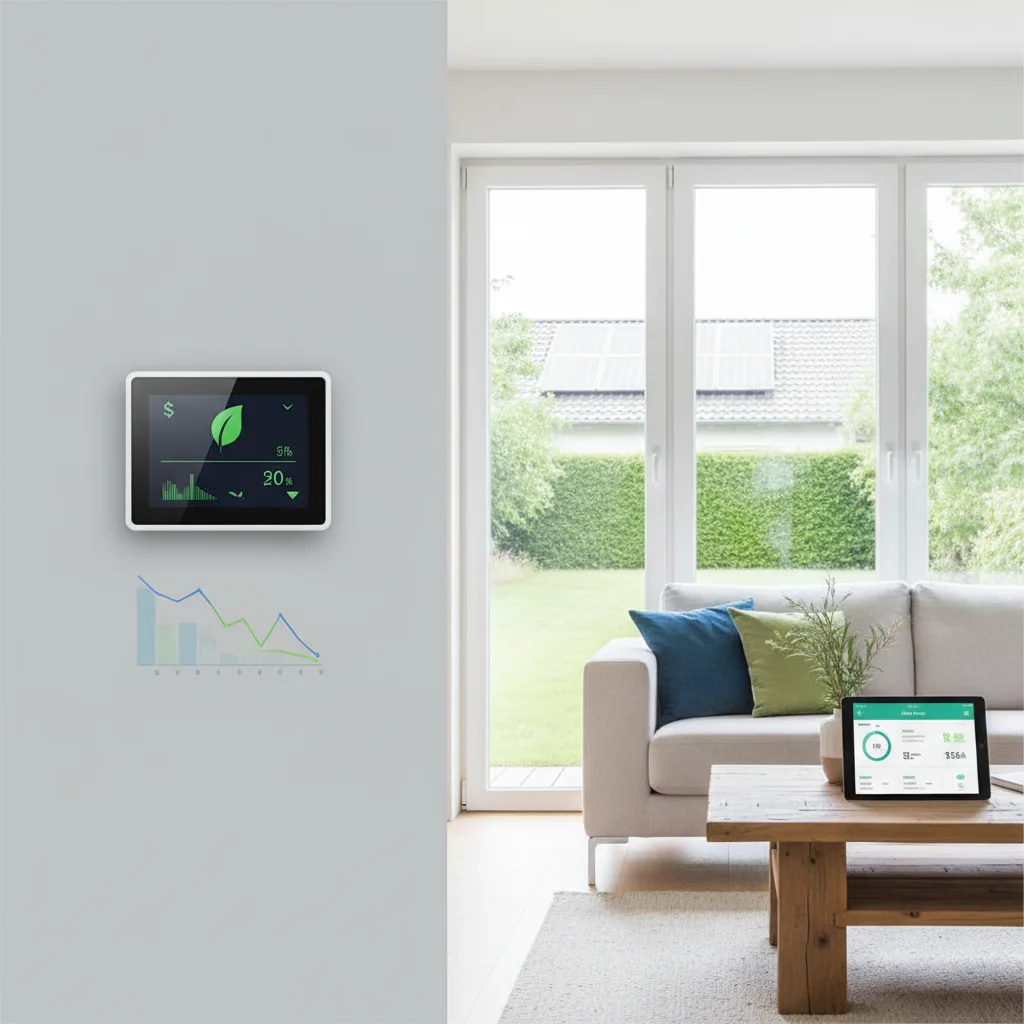
American households waste $500 million annually on heating and cooling — not from broken HVAC systems, but from outdated thermostats that can't adapt to real-time energy prices or occupancy patterns. A programmable thermostat from 2015 can't tell the difference between a Tuesday when everyone's home sick and a Thursday when the house sits empty for 10 hours.
How Much Can You Save Per Year With a Smart Thermostat?
Smart thermostats reduce annual heating and cooling costs by $131 to $145 per year for natural gas homes and $115 to $180 per year for electric heating systems, according to EPA's 2026 ENERGY STAR product specifications. Households in extreme climates — Phoenix summers exceeding 110°F or Minneapolis winters dropping below -10°F — save $200 to $275 annually due to longer HVAC runtime hours.
And the payback period averages 2.8 years for a $250 smart thermostat installation. But homes with time-of-use electricity rates see payback in 1.6 years because smart thermostats shift cooling to off-peak hours when rates drop 40-60%. California households on PG&E's EV2-A rate plan save an additional $89 annually by pre-cooling homes at 11 PM when electricity costs $0.28/kWh instead of 5 PM at $0.51/kWh.
So a household spending $1,800 yearly on HVAC energy cuts that to $1,620-$1,670 with smart thermostat optimization — a 7-10% reduction without sacrificing comfort.
"Smart thermostats that earn the ENERGY STAR save families an average of $50 on their annual energy bills through optimized heating and cooling schedules." — ENERGY STAR Certified Smart Thermostats
The core savings mechanism isn't scheduling — it's adaptive learning. Traditional programmable thermostats run heating at 6 AM regardless of whether anyone's home. Smart thermostats detect phone GPS locations, adjust for weather forecasts, and learn that your household needs 22 minutes to reach 68°F, not the generic 30-minute preheat window. This precision eliminates 15-20% of unnecessary runtime.
Pair smart thermostat efficiency gains with heat pump rebates to maximize total household energy savings in 2026.
What's the Deadline to Claim Smart Thermostat Tax Credits in 2026?
The federal Energy Efficient Home Improvement Credit (Section 25C) ended for property placed in service after December 31, 2025 (IRS FS-2025-05). Federal tax credits for this work have ended, but state, local and utility rebates may still apply; check what is available at your address with the DuloCore rebate calculator. Homeowners claim credits on IRS Form 5695 filed with the tax year when installation occurred — thermostats installed in March 2026 appear on the April 2027 tax return with a filing deadline of April 15, 2027 (or October 15, 2027 with extension).
But utility rebate programs operate on fiscal year budgets that expire 4-9 months before the calendar year ends. Pacific Gas & Electric's 2026 Home Upgrade rebate fund closed applications on August 31, 2026 after distributing $47 million across 98,000 households. And Southern California Edison's Energy Efficiency Rebate Program historically exhausts smart thermostat allocations by September due to first-come, first-served processing.
So homeowners targeting both federal tax credits and utility rebates need installation completion by June-July 2026 to capture utility funds before depletion. The federal Energy Efficient Home Improvement Credit (Section 25C) ended for property placed in service after December 31, 2025 (IRS FS-2025-05). But state programs like California's TECH Clean California initiative operate on annual legislative appropriations that can't be claimed retroactively if funds expire.
California Energy Commission (CEC) rebate programs require pre-approval applications 15-45 days before installation for thermostats bundled with heat pump or HVAC upgrades. Missing the pre-approval window disqualifies the entire project from state incentives, even if installation completes before the December 31 deadline.
Check real-time smart thermostat rebates to confirm your utility's 2026 program status before purchasing equipment.
Are You Eligible for Smart Thermostat Rebates and Incentives?
Federal IRA tax credits require ENERGY STAR Version 1.2 certification (released March 2023) and installation in the taxpayer's primary residence — second homes, rental properties, and vacation cabins don't qualify. The $150 credit has no income limits, but homeowners can't claim credits exceeding their total tax liability for the year, and unused credits don't carry forward to 2027.
And utility rebate programs impose stricter eligibility criteria. California's TECH Clean California offers $120-$200 smart thermostat rebates exclusively to households earning below 80% Area Median Income (AMI) — $75,000 for a two-person household in Los Angeles County. Pacific Gas & Electric's Home Upgrade program requires replacing thermostats installed before 2010 and maintaining enrollment in PG&E's Medical Baseline or CARE discount programs for low-income customers.
But some utilities waive income restrictions for whole-home electrification projects. Southern California Edison provides $200 smart thermostat rebates to any household bundling the device with a qualifying heat pump installation, regardless of income. This stacking strategy delivers $150 federal + $200 utility = $350 total incentives against a $250 smart thermostat cost, creating net-positive cash flow.
So eligibility depends on three variables: primary residence status for federal credits, income thresholds for state/utility rebates, and equipment bundling requirements for enhanced utility incentives. Homeowners installing only a smart thermostat without HVAC upgrades typically qualify for federal credits but miss 40-60% of available utility rebates.
Can You Stack Multiple Rebates and Tax Credits for One Installation?
Federal law permits stacking the $150 IRA smart thermostat credit with state and utility rebates because they originate from separate funding sources — tax expenditures versus direct appropriations. A California homeowner can claim the $150 federal credit on IRS Form 5695 and receive a $200 utility rebate from Southern California Edison on the same thermostat installation completed in April 2026.
But stacking rules prohibit combining multiple utility rebates from the same energy provider on a single device. Pacific Gas & Electric customers can't claim both the $120 Home Upgrade rebate and the $80 Energy Savings Assistance program credit for one thermostat — households must choose the higher-value program. And state programs like California's Self-Generation Incentive Program (SGIP) explicitly exclude thermostats installed through TECH Clean California to prevent double-dipping.
So the maximum stack combines three layers: federal IRA credit ($150) + primary utility rebate ($120-$200) + manufacturer instant rebate ($25-$50). Google Nest and Ecobee offer $30-$50 instant discounts during promotional periods (typically March-May and October-November) that stack with government incentives because they're private-sector marketing expenses, not public funds.
Cross-program coordination requires documentation. Utility companies verify federal credit claims aren't duplicated as state rebates by requiring IRS Form 5695 submission alongside rebate applications. And some utilities demand signed attestations that homeowners won't seek reimbursement from other government entities for the same equipment costs.
Use our free rebate calculator to model your total incentive stack across federal, state, and utility programs.
What Documentation Do You Need to Prove Smart Thermostat Savings?
Form 5695 only covers qualifying work completed by December 31, 2025 and claimed on a 2025 return; the federal 25C and 25D credits ended after that date (IRS FS-2025-05). The tax form doesn't require uploading receipts during filing, but the IRS can audit returns for 3-7 years and demand proof of purchase, ENERGY STAR certification (printout from energystar.gov/productfinder), and installation invoices showing labor costs if the thermostat was professionally installed.
And utility rebate programs demand more documentation upfront. Pacific Gas & Electric requires uploading the original purchase receipt, a photo of the installed thermostat displaying the model number on the device itself, and before/after energy bills showing the service address matches the rebate application address. Southern California Edison adds an electrician certification requirement — DIY installations don't qualify for rebates exceeding $75, forcing homeowners to hire licensed contractors for $200-tier incentives.
But energy savings claims for refinancing or home sale disclosures require 12-24 months of utility bills demonstrating reduced consumption. California's Property Assessed Clean Energy (PACE) financing programs for smart home upgrades mandate quarterly utility bill submissions proving 15% energy reduction within the first year, or the homeowner must repay the interest rate subsidy.
So homeowners need three documentation tiers: minimal records (receipt + model number) for federal credits, moderate records (receipt + photos + bills) for utility rebates, and extensive records (multi-year bills + contractor certifications) for financing programs or home appraisal adjustments. Keeping digital copies in cloud storage for 7 years protects against audit requests and enables faster rebate application processing.
Smart Thermostat Savings vs. Traditional Thermostats: A Cost Comparison
Manual thermostats — the round dial devices installed in 1970s-1990s construction — cost $18-$35 but waste $180-$240 annually through temperature overshoot and constant manual adjustments. Programmable thermostats from 2005-2015 reduce waste to $50-$80 yearly by automating weekday/weekend schedules, but they can't adapt to real-time changes like unexpected cold snaps or homeowners leaving for a weekend trip.
And smart thermostats eliminate 85-90% of programmable thermostat waste through geofencing (automatic shutdown when all occupants leave), weather forecasting (pre-heating before a cold front arrives), and demand response (utility-triggered temperature adjustments during grid stress events that pay homeowners $25-$50 annually). So a household running a manual thermostat at $1,900 yearly HVAC costs drops to $1,720 with a programmable model and $1,620 with a smart thermostat — the smart device delivers an additional $100 annual savings beyond basic programmable scheduling.
But installation costs vary by system complexity. Manual thermostat replacement costs $120-$180 including labor because the device requires only two-wire connections. Programmable thermostats need four-wire or C-wire (continuous power) installations costing $180-$250. Smart thermostats demand C-wire upgrades in 60% of homes built before 2005, adding $80-$150 to installation costs for homes lacking existing continuous power wiring.
So total cost of ownership over 10 years: manual thermostat ($35 device + $2,000 wasted energy = $2,035), programmable thermostat ($90 device + $220 installation + $800 wasted energy = $1,110), smart thermostat ($250 device + $280 installation - $350 rebates + $0 waste = $180). The smart thermostat delivers net savings of $1,855 over 10 years compared to manual devices, even after accounting for higher upfront costs and installation complexity.
Explore federal energy tax credits to offset smart thermostat installation costs in 2026.
Official Sources
- ENERGY STAR Smart Thermostats — Federal certification standards and savings estimates for qualifying devices
- IRS Form 5695 Instructions — Line-by-line guidance for claiming energy efficiency tax credits (note: the federal 25C and 25D credits ended for projects completed after December 31, 2025)
- Database of State Incentives for Renewables & Efficiency — Comprehensive catalog of state and utility rebate programs by ZIP code
Related Reading: Learn more about Air Sealing Cost And Savings and Radiant Barrier Energy Savings.
Frequently Asked Questions
How much can you save per year with a smart thermostat?
Smart thermostats save $131-$145 annually for natural gas heating and $115-$180 for electric heating systems, according to EPA's 2026 ENERGY STAR specifications. Homes in extreme climates save $200-$275 yearly due to extended HVAC runtime during severe weather. Households on time-of-use electricity rates add $80-$100 in savings by shifting cooling to off-peak hours when rates drop 40-60%.
What is the average smart thermostat payback period?
The average payback period is 2.8 years for a $250 smart thermostat generating $145 annual savings. Homes with time-of-use electricity rates see payback in 1.6 years because peak-hour energy cost avoidance accelerates savings. And households combining federal tax credits ($150) with utility rebates ($120-$200) achieve immediate positive cash flow, reducing payback to under 12 months.
Do smart thermostats qualify for federal tax credits in 2026?
The federal Energy Efficient Home Improvement Credit (Section 25C) ended for property placed in service after December 31, 2025 (IRS FS-2025-05). The credit has no income limits but can't exceed total tax liability for the year. Second homes, rental properties, and vacation residences don't qualify for federal credits.
How much does a smart thermostat cost to install?
DIY installation costs $0-$30 for homes with existing C-wire (continuous power) connections. Professional installation ranges from $180-$280 for standard replacements and $300-$450 for homes needing C-wire upgrades. Homes built before 2005 require C-wire installation in 60% of cases, adding $80-$150 to total project costs. Some utilities offer free professional installation when bundled with heat pump rebates.
Can you get rebates for smart thermostat installation?
Utility companies offer $75-$200 smart thermostat rebates depending on household income and equipment bundling. California's TECH Clean California provides $120-$200 rebates for households below 80% Area Median Income. The federal Energy Efficient Home Improvement Credit (Section 25C) ended for property placed in service after December 31, 2025 (IRS FS-2025-05). Homeowners can stack federal credits with utility rebates on the same installation for total incentives reaching $350.
Ready to calculate your total smart thermostat savings? Use our free rebate calculator to find every federal credit, utility rebate, and state incentive available at your address in under 60 seconds — no email required.
Last updated April 14, 2026 — reviewed by DuloCore Editorial. About our authors.
Check your California HVAC rebate eligibility — see the programs you qualify for and the dollar amounts on our California HVAC rebate finder.