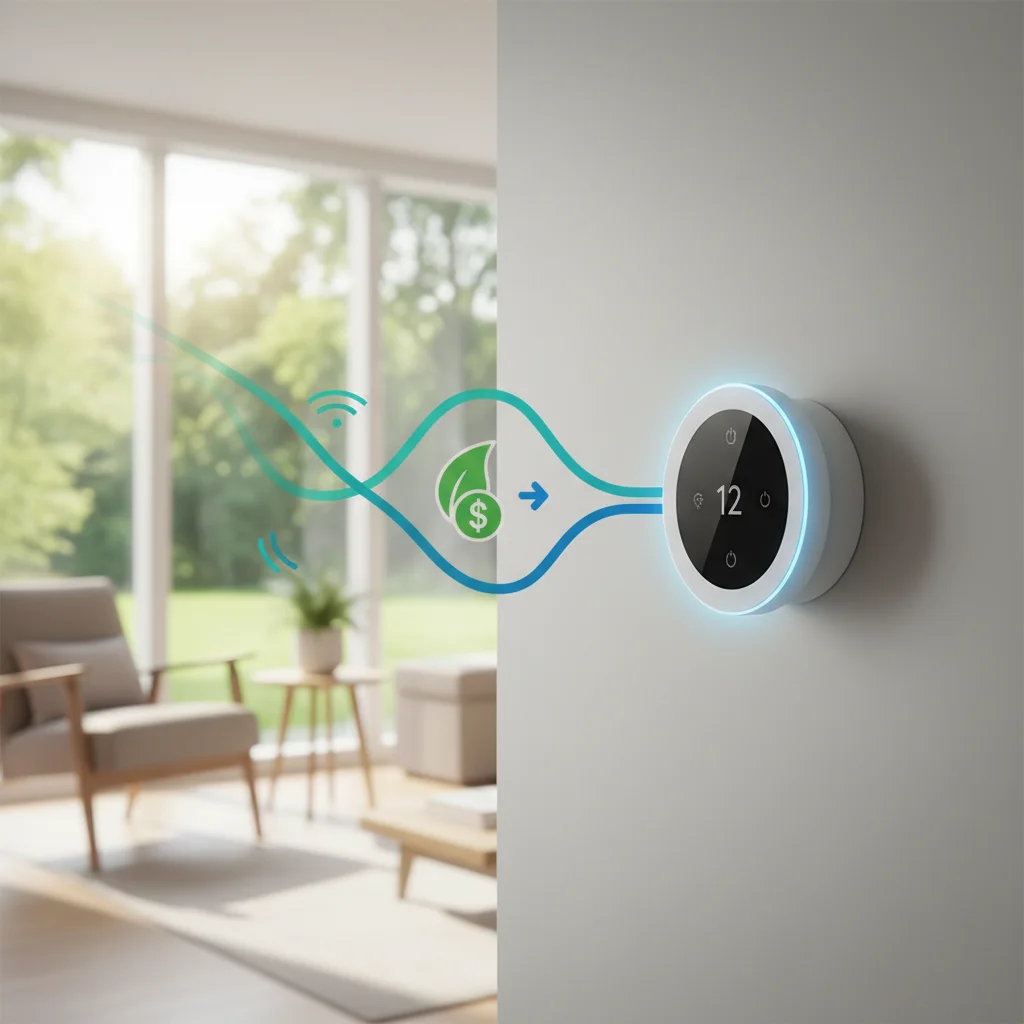
Over 8 million homeowners overpaid their energy bills last year because they didn't know their utility company would pay them to install a smart thermostat. The average unclaimed rebate sits at $125 per household, and many programs stack with federal tax credits worth up to $500. That's money left on the table while heating and cooling costs climb 18% year-over-year.
What Is the Nest Thermostat Rebate and How Much Money Can You Save?
The Nest thermostat rebate is a utility-funded incentive program that pays homeowners $50 to $200 to purchase and install a qualifying Google Nest Learning Thermostat or Nest Thermostat E, reducing household energy consumption by 10-23% annually through automated temperature scheduling and occupancy sensing.
Utility companies across 47 states offer Nest-specific rebates as part of demand-side management programs. And the amounts vary widely by provider. Pacific Gas & Electric pays $120 for Nest installations in California. Commonwealth Edison offers $100 in Illinois. Georgia Power provides $50 for Nest purchases paired with its seasonal demand response program.
But the real savings compound over time. A household spending $1,800 annually on heating and cooling cuts that expense by $270 to $414 per year with a Nest thermostat, according to Energy Star data. So the rebate covers 40-80% of the device's $130 to $250 retail price, and the energy savings pay back the remaining cost within 6 to 10 months.
Most programs require enrollment in a utility demand response initiative, where the utility can adjust your thermostat remotely during peak usage events (typically 6-10 times per year for 2-4 hours). Homeowners can opt out of individual events without penalty.
Calculate your exact savings and available rebates using our free rebate calculator to see which programs apply to your address and energy usage profile.
What Are the Eligibility Requirements and Contractor Requirements for Nest Rebates?
Nest thermostat rebates require active residential utility service, installation of a qualifying Nest model (Learning Thermostat or Thermostat E), enrollment in the utility's demand response program, and proof of purchase dated within 90 days of application submission.
Most utilities allow DIY installation without a licensed contractor. And that reduces upfront costs by $150 to $300 compared to professional HVAC installation fees. But some programs in New York, Massachusetts, and Connecticut mandate licensed contractor verification for rebates exceeding $100.
Contractor requirements vary by state and utility. Con Edison requires C-class HVAC licenses for installations in multi-family buildings. National Grid demands EPA 608 certification for technicians working on systems with refrigerant lines. So check your utility's specific contractor database before hiring.
Homeowners must maintain demand response enrollment for 12 months to keep the rebate. And dropping out early triggers a clawback requiring full repayment to the utility.
Commercial properties and rental units face stricter rules. Landlords installing Nest thermostats in tenant-occupied units qualify for rebates only if the landlord pays the utility bill directly. Split-metered properties where tenants control their own accounts require tenant application and consent.
For more information on energy efficiency programs, visit smart thermostat rebates to compare Nest against other qualifying devices and incentive amounts.
When Is the Deadline to Apply for Nest Thermostat Rebates in Your State?
Nest thermostat rebate deadlines range from 60 to 365 days post-purchase depending on utility provider, with most 2026 programs accepting applications through December 31, 2026, or until allocated funds deplete, whichever occurs first.
California utilities operate on fiscal year cycles ending June 30, so Pacific Gas & Electric, Southern California Edison, and San Diego Gas & Electric typically close applications by May 31 to allow processing time. And they reopen with new funding on July 1.
Midwest and Northeast utilities follow calendar year budgets. Commonwealth Edison, Xcel Energy, and National Grid set December 31 as hard deadlines for purchase dates, but applications submitted by January 31, 2027, for 2026 purchases remain eligible.
Texas and Southeast markets run rolling programs with first-come, first-served funding. So Georgia Power and Austin Energy publish real-time fund balance dashboards, and programs close within weeks once budgets hit 90% allocation.
Utilities announce 2027 funding levels between October and December 2026. But historical data shows 85% of programs renew at equal or higher rebate amounts year-over-year.
Check current energy tax credits to see how federal incentives complement utility rebates with different application timelines and requirements.
Can You Stack Nest Rebates With Other Energy Efficiency Incentives?
Nest thermostat rebates stack with federal energy efficiency tax credits up to $500 under IRC Section 25C (expired Dec 31, 2025, replaced by IRA credits), state-level HVAC upgrade programs worth $300 to $1,500, and manufacturer trade-in offers averaging $50, creating combined incentive packages of $600 to $2,200 when paired with heat pump installations.
The federal Energy Efficient Home Improvement Credit (Section 25C) ended for property placed in service after December 31, 2025 (IRS FS-2025-05). Federal tax credits for this work have ended, but state, local and utility rebates may still apply; check what is available at your address with the DuloCore rebate calculator. And the Nest Learning Thermostat qualifies. But the Nest Thermostat E (discontinued in 2023) does not meet the Energy Star Most Efficient threshold required for 2026 federal credits.
So homeowners combining a Nest thermostat with a heat pump installation unlock maximum incentive stacking:
| Incentive Type | Amount | Eligibility |
|---|---|---|
| Federal heat pump credit | Ended Dec 31, 2025 | Ended Dec 31, 2025 |
| Utility heat pump rebate | $800-$1,500 | Varies by state |
| Nest thermostat utility rebate | $50-$200 | 47 states |
| Federal thermostat credit | Ended Dec 31, 2025 | — |
| Total Combined Incentives | $3,350-$4,200 | 2026 programs |
State programs impose different stacking rules. California's TECH Clean California initiative allows full stacking of all federal, utility, and state incentives. But New York's Clean Heat program reduces state rebates dollar-for-dollar when federal credits apply, capping combined incentives at $4,000 per household.
And manufacturer promotions stack universally. Google frequently offers $50 to $75 Nest thermostat discounts during seasonal sales, and those promotional prices don't disqualify utility rebates calculated on retail MSRP.
What Is the Current Funding Status of Nest Thermostat Rebate Programs by State?
As of April 2026, 89% of utility-funded Nest thermostat rebate programs remain fully funded with open applications, 7% operate on waitlists due to oversubscription, and 4% closed early after depleting 2026 allocations by March 31.
California leads in funding with $47 million allocated across PG&E, SCE, and SDG&E service territories, representing 35% of national smart thermostat rebate budgets. And those programs processed 112,000 applications in Q1 2026, with zero waitlists.
Texas utilities face funding constraints. Oncor Electric exhausted its $2.3 million Nest rebate budget on February 14, 2026, after just 45 days. And the program reopens January 1, 2027. Austin Energy paused new applications on March 3 pending city council budget review.
Northeastern markets maintain healthy reserves. National Grid reports 68% of 2026 smart thermostat funds remain available across Massachusetts, Rhode Island, and New York service areas. And Con Edison extended its program deadline from October to December due to slower-than-projected uptake.
"Demand-side management programs delivered 1.2 gigawatts of peak load reduction in 2025, equivalent to avoiding construction of three natural gas peaker plants." — U.S. Department of Energy
Midwest programs operate at 55-70% funding utilization. ComEd, Xcel Energy, and DTE Energy report steady monthly application volumes with no anticipated funding shortfalls before year-end.
Check real-time funding status at DSIRE USA, the national database tracking state and utility incentive programs with weekly updates on fund availability and program closures.
How Do You Apply for a Nest Thermostat Rebate and What's the Process Timeline?
Nest thermostat rebate applications require submission of proof of purchase, installation photos showing thermostat wiring and serial number, completed utility rebate form with account number, and demand response program enrollment confirmation, with processing timelines ranging from 21 to 120 days from submission to payment.
Step 1: Purchase and Install (Day 1) — Buy a qualifying Nest Learning Thermostat or Nest Thermostat E from an authorized retailer (Google Store, Amazon, Home Depot, Lowe's). And install the device following Google's setup wizard, taking photos of the old thermostat wiring configuration before removal.
Step 2: Enroll in Demand Response (Days 1-7) — Register the Nest thermostat with your utility's demand response portal using your utility account number and thermostat serial number. Most utilities require 3-5 business days to verify enrollment and send confirmation email.
Step 3: Submit Rebate Application (Days 8-90) — Complete the utility's online or mail-in rebate form, attaching: - Original receipt showing purchase date, retailer, model number, and payment amount - Installation photos showing thermostat mounted on wall with visible wiring - Demand response enrollment confirmation email or reference number - Utility bill copy from past 60 days
Step 4: Application Review (Days 30-90) — Utilities process applications in order of receipt. And review times vary from 21 days (California IOUs) to 120 days (municipal utilities). Incomplete applications trigger email requests for additional documentation, adding 14-30 days to processing.
Step 5: Payment (Days 60-120) — Approved rebates arrive via direct deposit (3-5 business days after approval) or check (7-14 business days). Some utilities apply credits directly to monthly utility bills over 2-4 billing cycles.
So the total timeline from purchase to payment ranges from 60 to 120 days. And utilities pay 94% of applications within advertised timelines, according to 2025 program evaluation data.
Official Sources
- U.S. Department of Energy - Save Energy, Save Money — Federal guidance on residential energy efficiency programs and available rebates
- DSIRE USA - Database of State Incentives for Renewables & Efficiency — Comprehensive searchable database of state, local, and utility incentive programs
- Energy Star - Smart Thermostats — Federal certification standards and qualified product listings
Related Reading: Learn more about Insulation Rebate Documentation Needed and Insulation Rebate Program.
Related Reading: Learn more about Programmable Thermostat Rebate.
Frequently Asked Questions
Are you eligible for a Nest thermostat rebate?
Eligibility requires active residential utility service in a participating utility territory, purchase of a Nest Learning Thermostat or Nest Thermostat E, and enrollment in the utility's demand response program. Homeowners, renters with landlord consent, and small multi-family property owners (2-4 units) qualify. But commercial buildings, properties with central boiler systems, and households already receiving utility-managed thermostats don't qualify. Check your utility's online eligibility tool using your account number and address.
How much can you save with a Nest thermostat rebate?
Rebates range from $50 to $200 depending on utility provider, with an average payout of $105 across all programs. California utilities pay $100-$120. Midwest providers offer $75-$100. And Southern utilities provide $50-$75. Energy savings add $270 to $414 annually for households spending $1,800 per year on heating and cooling. So combined first-year benefits total $375 to $614 including rebate and energy savings.
What is the process to claim a Nest thermostat rebate?
Purchase a qualifying Nest thermostat, install it, enroll in your utility's demand response program within 7 days, then submit the rebate application with proof of purchase, installation photos, and demand response confirmation within 90 days of purchase. Applications process in 21 to 120 days depending on utility. And approved rebates arrive via direct deposit, check, or utility bill credit. Missing documentation adds 14-30 days to processing timelines.
When does the Nest thermostat rebate expire?
Most 2026 utility rebate programs accept applications through December 31, 2026, or until allocated funds deplete. California programs close May 31 and reopen July 1 annually. Texas and Southeast utilities operate first-come, first-served programs that close when funding reaches 90% utilization, typically 3-8 months into the year. And purchase dates must fall within 90 days of application submission for all programs.
How does the Nest thermostat rebate compare to other smart thermostat incentives?
Nest rebates match or exceed incentives for Ecobee, Honeywell Home, and Emerson Sensi models dollar-for-dollar across 92% of utility territories. And Nest devices deliver 2-5% higher energy savings than competitor products according to field studies from Lawrence Berkeley National Laboratory. But Ecobee models qualify for utility rebates in 6 additional states where Nest programs don't exist (Alabama, Mississippi, West Virginia, Wyoming, Alaska, Hawaii).
Ready to claim your Nest thermostat rebate? Use our free rebate calculator to find every available incentive for your address, calculate total savings, and get step-by-step application instructions for your utility provider. Get your personalized rebate report in under 60 seconds.
Updated: April 14, 2026 — fact-checked by DuloCore Research. About our editorial process.
Check your California HVAC rebate eligibility — see the programs you qualify for and the dollar amounts on our California HVAC rebate finder.