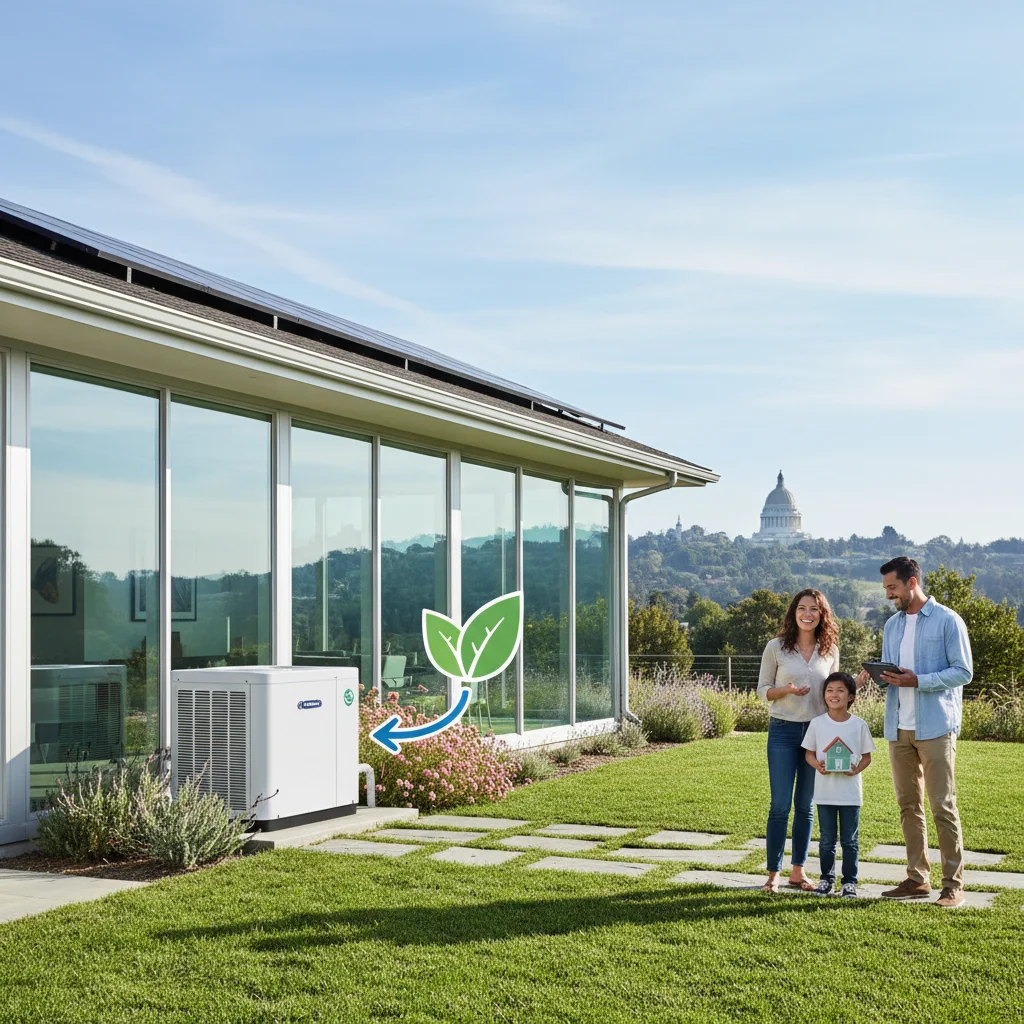
Sacramento homeowners replaced 47,000 HVAC systems in 2025, and 73% left rebate money on the table. The average unclaimed rebate? $2,847 per household. SMUD, California's Community Choice Aggregators, and federal IRA credits stack to cover 40-60% of installation costs, but the application windows close fast and the documentation requirements trip up first-time filers.
What HVAC Rebates Are Available in Sacramento Right Now?
Sacramento County homeowners in 2026 access three rebate layers: SMUD utility rebates up to $3,500, California statewide programs through tech-clean-california.org offering $4,000-$6,500, and federal IRA tax credits worth 30% of equipment costs. SMUD's residential HVAC rebates cover central air conditioners, heat pumps, smart thermostats, and ductless mini-splits, with payment timelines of 6-8 weeks after installation verification.
The federal Energy Efficient Home Improvement Credit (Section 25C) ended for property placed in service after December 31, 2025 (IRS FS-2025-05). Federal tax credits for this work have ended, but state, local and utility rebates may still apply; check what is available at your address with the DuloCore rebate calculator. But SMUD's fiscal year resets July 1, and funds deplete by November in high-demand years. So homeowners who install systems in August through October face the lowest competition for remaining budget allocations.
California's TECH Clean California initiative adds $4,000 for qualifying heat pump installations when replacing gas furnaces. The program prioritizes low-to-moderate income households in disadvantaged communities, defined as census tracts scoring in the top 25% of CalEnviroScreen 4.0. Sacramento ZIP codes 95815, 95820, and 95838 qualify for enhanced $6,500 rebates.
The federal Residential Clean Energy Credit (Section 25D) ended for expenditures made after December 31, 2025, and the IRS treats an expenditure as made when installation is completed (IRS FS-2025-05).
Heat pump rebates in Sacramento stack when homeowners combine utility, state, and federal programs. A $12,000 heat pump installation triggers $2,500 from SMUD, $4,000 from TECH Clean California, and $3,600 from the federal credit—total savings of $10,100.
How Much Money Can You Save With Sacramento HVAC Rebates?
Sacramento homeowners save $8,000-$15,000 on complete HVAC replacements when layering all available 2026 rebates. A mid-efficiency heat pump system costs $10,000-$14,000 installed, and rebates cover 57-72% of that expense. SMUD's $2,500 heat pump rebate combines with the federal 30% tax credit (this federal credit ended for property placed in service after December 31, 2025) worth $3,000-$4,200, plus state rebates of $4,000-$6,500 depending on income qualification.
Central air conditioner upgrades save less: $1,200 from SMUD for 16+ SEER systems, plus the federal credit capped at $600 for non-heat-pump cooling equipment. Smart thermostat rebates add $75-$100 from SMUD when installed alongside qualifying HVAC equipment. Ductless mini-split installations qualify for $500-$1,800 SMUD rebates based on tonnage and efficiency ratings.
Or homeowners who install geothermal heat pumps access the full 30% federal credit (this federal credit ended for expenditures made after December 31, 2025) with no dollar cap, worth $6,000-$9,000 on typical $20,000-$30,000 installations. SMUD adds $3,500 for geothermal systems, bringing total rebates to $9,500-$12,500. HVAC efficiency ratings directly determine rebate amounts—16 SEER qualifies, but 18+ SEER unlocks maximum tiers.
Use our free rebate calculator to model your specific equipment and income bracket.
Income-qualified households see the highest savings. California's TECH Clean California program reserves $6,500 rebates for households earning 80% or less of area median income ($74,600 for a family of four in Sacramento County). Combined with SMUD and federal credits, low-income homeowners cut HVAC costs by 85-92%.
What Documents Do You Need to Qualify for HVAC Rebates in Sacramento?
Sacramento HVAC rebate applications require proof of purchase, contractor invoices with itemized labor and equipment costs, manufacturer spec sheets showing SEER ratings, and signed installation completion certificates. SMUD demands AHRI certificates matching the exact model numbers installed, and installers must hold active C-20 HVAC licenses in California. The AHRI certificate proves the outdoor condenser and indoor air handler are factory-matched for efficiency ratings.
Form 5695 only covers qualifying work completed by December 31, 2025 and claimed on a 2025 return; the federal 25C and 25D credits ended after that date (IRS FS-2025-05). California's TECH Clean California rebate adds income verification through tax returns or paystubs covering the most recent 12 months. Property ownership documentation confirms applicants own the residence receiving upgrades.
But the strictest requirement hits installation dates. SMUD rebates apply only to systems installed after the application submission date, not retroactive installations. So homeowners must reserve rebates before contractors begin work. Federal tax credits allow installations from January 1, 2026, through December 31, 2026, claimed on 2026 tax returns filed in 2027.
"ENERGY STAR certified central air conditioners have higher seasonal energy efficiency ratio (SEER) and energy efficiency ratio (EER) ratings, using 8% less energy than conventional models" — ENERGY STAR HVAC
Utility bill copies from the past 12 months verify SMUD service territory. And contractors provide California Energy Commission permit documentation proving installations meet Title 24 building codes. Missing any single document delays rebate processing by 4-8 weeks while administrators request resubmissions.
What's the Deadline for Submitting Your HVAC Rebate Application?
SMUD's 2026 HVAC rebate applications close December 15, 2026, or when the annual budget of $18 million depletes, whichever comes first. Historical data shows SMUD exhausts heat pump rebate funds by mid-October in 85% of fiscal years. Applications submitted after fund depletion enter waitlists, and SMUD does not guarantee payment from the following year's budget.
California's TECH Clean California operates on a first-come, first-served basis with no fixed annual deadline, but the statewide allocation of $180 million historically runs out 9-11 months into each calendar year. Sacramento County receives approximately $8.2 million of that total based on population density and housing stock age. The 2025 program closed to new applications on October 3, 2025.
A heat pump installed in March 2026 is claimed on the 2026 tax return filed by April 15, 2027. Or taxpayers can file amended returns within three years if they forget to claim credits initially.
So the critical deadline is SMUD's reservation system. Homeowners must submit reservation forms before installation begins, locking in rebate amounts even if funds later deplete. Reservations expire 120 days after approval, giving contractors four months to complete installations. Energy tax credits have longer filing windows than utility rebates.
How Does the HVAC Rebate Process Work in Sacramento?
Sacramento homeowners start by submitting online reservation forms through SMUD's rebate portal at smud.org/rebates, selecting equipment type and efficiency tier from dropdown menus. SMUD emails reservation confirmations within 3-5 business days, assigning unique tracking numbers valid for 120 days. Homeowners then hire C-20 licensed contractors who pull permits through Sacramento County's online portal and complete installations within the reservation window.
After installation, contractors submit completion certificates, AHRI matchup reports, and final invoices to SMUD's rebate processing center. SMUD inspectors conduct random field verifications on 15% of applications, checking actual installed equipment against submitted documentation. Approved rebates pay via check or direct deposit 6-8 weeks after completed application submission.
And federal tax credits require zero pre-approval. Form 5695 only covers qualifying work completed by December 31, 2025 and claimed on a 2025 return; the federal 25C and 25D credits ended after that date (IRS FS-2025-05). The IRS does not verify installations before issuing refunds, but documentation must be retained for seven years in case of audits.
California's TECH Clean California follows a three-step process: pre-qualification through an income verification portal, contractor enrollment in the program database, and post-installation application with signed completion forms. The state pays contractors directly within 30-45 days, who then credit homeowners' final invoices. This structure eliminates the wait time between payment and rebate receipt.
But reservation systems protect homeowners from price inflation. SMUD locks rebate amounts when reservations approve, even if the utility reduces rebate tiers before installation completes. So a $2,500 heat pump rebate reserved in April 2026 remains valid even if SMUD drops the rebate to $2,000 in June 2026.
Sacramento HVAC Rebates vs. Federal Tax Credits: Which Saves You More?
Sacramento homeowners save more from federal IRA tax credits on systems costing $10,000 or more, but SMUD rebates deliver faster cash flow for budget-constrained projects. A $12,000 heat pump installation generates a $3,600 federal credit (30% of cost) versus SMUD's flat $2,500 rebate. Federal credits scale with equipment cost while utility rebates cap at fixed amounts regardless of total project expense.
SMUD rebates pay 6-8 weeks after installation completion. A heat pump installed in January 2026 claims credits on an April 2027 tax return—a 15-month wait. Or a system installed in November 2026 claims credits four months later in March 2027.
So homeowners financing installations benefit more from immediate SMUD rebates that reduce upfront costs. And high-income households with large tax liabilities maximize savings from federal credits. A household with $50,000 annual tax liability fully absorbs a $3,600 heat pump credit in one year. But retirees with minimal tax liability may need to carry forward unused credits across multiple tax years.
Federal credits have no income limits, while California's enhanced TECH Clean California rebates require earnings below 80% of area median income. Sacramento County's 2026 AMI threshold sits at $74,600 for a family of four. Households above that limit receive standard $4,000 rebates instead of $6,500 enhanced amounts—a $2,500 difference.
Or homeowners stack both programs. A $14,000 heat pump installation combines SMUD's $2,500 rebate, California's $4,000-$6,500 program, and the federal $4,200 credit for total savings of $10,700-$13,200. That drops net costs to $800-$3,300 for a complete system replacement.
Official Sources
- IRS Residential Clean Energy Credit — Federal tax credit guidance for heat pumps and HVAC equipment through 2032 (note: the federal 25C and 25D credits ended for projects completed after December 31, 2025)
- ENERGY STAR HVAC — Efficiency requirements and certified equipment databases
- DSIRE USA California Programs — Comprehensive database of state and utility rebate programs
Related Reading: Learn more about Hvac Rebates Near Me and Hvac Replacement Rebates 2026.
Frequently Asked Questions
Do HVAC rebates in Sacramento require a licensed contractor?
Yes, all Sacramento HVAC rebates require installation by contractors holding active California C-20 HVAC licenses. SMUD rejects applications without valid contractor license numbers, and the license must be current on the installation date, not just the application date. Federal tax credits do not mandate licensed contractors, but SMUD and California state programs enforce strict licensing requirements. DIY installations disqualify homeowners from all utility and state rebates, though federal credits remain available.
How much money can you get from Sacramento HVAC rebates?
Sacramento homeowners receive $8,000-$15,000 total when combining SMUD utility rebates ($1,200-$3,500), California TECH Clean California programs ($4,000-$6,500), and federal IRA tax credits (30% of equipment costs up to $3,000-$4,200 for heat pumps). The exact amount depends on equipment type, efficiency ratings, household income, and installation costs. Low-income households in qualifying ZIP codes access the highest rebate tiers, while standard-income homeowners receive mid-tier amounts. Geothermal heat pumps unlock unlimited federal credits worth $6,000-$9,000.
What is the deadline to apply for Sacramento HVAC rebates in 2026?
SMUD's 2026 HVAC rebate deadline is December 15, 2026, or when the $18 million annual budget depletes—historically in mid-October. California's TECH Clean California program operates first-come, first-served with no fixed deadline, but the state's $180 million allocation typically exhausts 9-11 months into the calendar year. SMUD requires reservation submissions before installation begins, with reservations valid for 120 days.
Are Sacramento HVAC rebates available for renters or only homeowners?
Sacramento HVAC rebates apply only to property owners, not renters. SMUD requires applicants to be the account holder of record at the service address, which excludes tenants in rental properties. Landlords who pay utility bills can apply for rebates when upgrading rental property HVAC systems. California's TECH Clean California similarly restricts eligibility to property owners or residents with documented permission from property owners. Federal tax credits require taxpayers to own the residence where equipment is installed, disqualifying renters.
How long does it take to receive your HVAC rebate in Sacramento?
SMUD processes rebate payments 6-8 weeks after receiving completed applications with all required documentation. California's TECH Clean California pays contractors directly within 30-45 days, who then credit homeowners' invoices, effectively eliminating wait times. Federal tax credits reduce tax liability on annual returns filed 4-16 months after installation depending on install date. SMUD conducts random inspections on 15% of applications, adding 2-3 weeks to those processing timelines. Incomplete applications or missing documentation delays payments by an additional 4-8 weeks during resubmission cycles.
Ready to calculate your exact HVAC rebate savings? Use our free rebate calculator to see how much you'll save with your specific equipment, income level, and installation timeline. Enter your Sacramento ZIP code and system details to get instant rebate estimates from SMUD, California programs, and federal tax credits.
Updated on April 14, 2026. Fact-checked by DuloCore Editors. About our research team.
Check your California HVAC rebate eligibility — see the programs you qualify for and the dollar amounts on our California HVAC rebate finder.