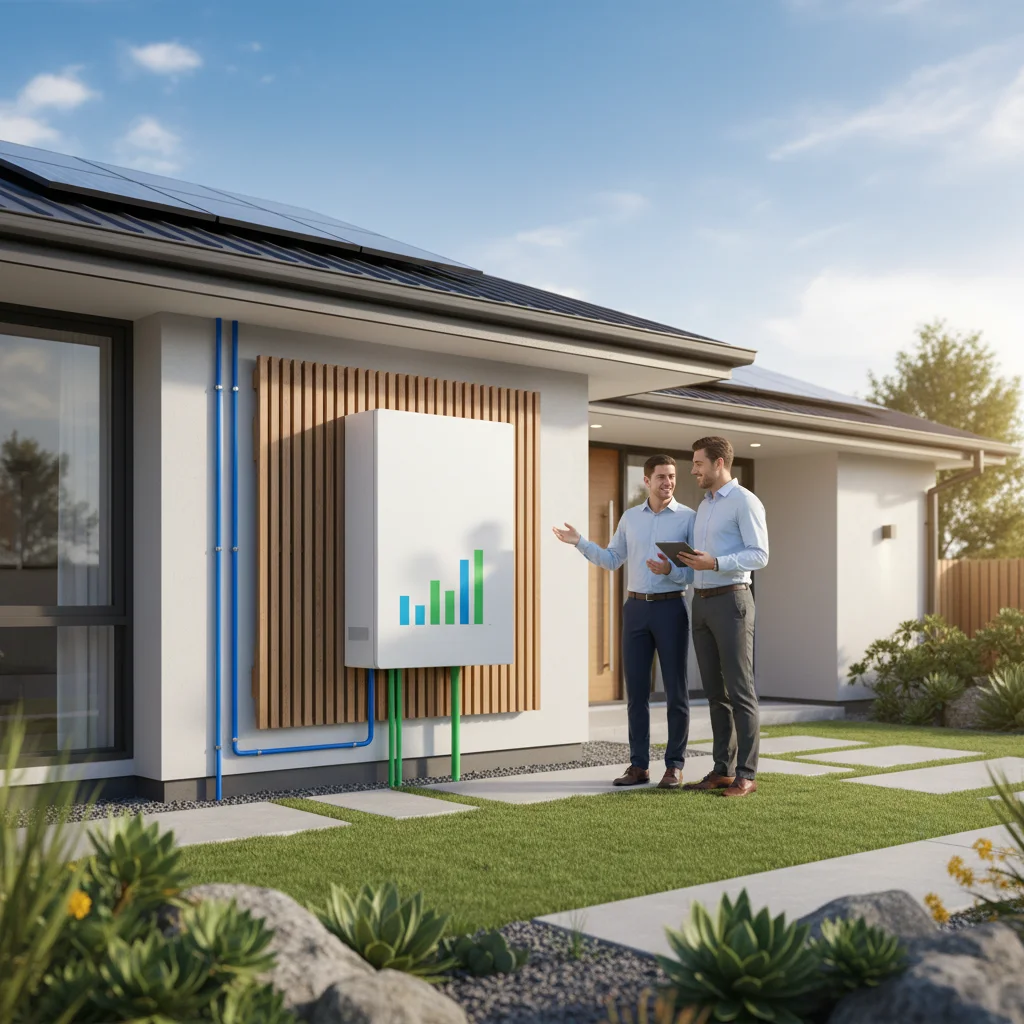
Orange County homeowners paid an average of $12,847 for complete HVAC system replacements in 2025, with costs ranging from $8,200 for basic split systems to $28,500 for high-efficiency heat pump installations. The federal Residential Clean Energy Credit (Section 25D) ended for expenditures made after December 31, 2025, and the IRS treats an expenditure as made when installation is completed (IRS FS-2025-05). Federal tax credits for this work have ended, but state, local and utility rebates may still apply; check what is available at your address with the DuloCore rebate calculator.
How Much Does HVAC Installation Cost in Orange County in 2026?
HVAC installation costs in Orange County range from $8,200 to $28,500 for conventional systems and $31,000 to $45,000 for geothermal heat pumps as of 2026. Central air conditioning units cost $5,800-$12,400 installed, while ducted heat pumps run $10,200-$18,700. Labor accounts for 35-40% of total project costs due to California's prevailing wage requirements and contractor licensing standards.
The cost breakdown varies by system type. Split-system air conditioners with standard efficiency (14-16 SEER2) cost $8,200-$11,500 installed in a 1,800-square-foot home. High-efficiency systems (18-22 SEER2) run $11,800-$16,300. Heat pumps cost $2,400-$4,700 more than AC-only systems because they provide both heating and cooling. And geothermal systems require $15,000-$22,000 in drilling and ground loop installation before equipment costs.
"High-efficiency HVAC systems typically use 20-40% less energy than standard models, resulting in lower utility bills throughout the system's lifespan." — U.S. Department of Energy
Equipment costs represent 60-65% of total installation expense. A 3-ton Carrier or Trane heat pump costs $4,200-$7,800 for the outdoor unit, $1,100-$2,400 for the indoor air handler, and $800-$1,600 for the thermostat and controls. Labor for a complete changeout runs $3,200-$5,800 and includes refrigerant line installation, electrical work, ductwork modifications, and system commissioning. Orange County contractors charge $95-$145 per hour, roughly 18% higher than California's statewide average.
Permit fees add $450-$850 to project costs. The County of Orange charges $312 for mechanical permits plus $0.42 per square foot for residential projects. Cities like Irvine and Newport Beach assess additional plan review fees of $180-$290. So a complete HVAC replacement in a 2,000-square-foot home incurs $650-$850 in permit and inspection costs before work begins.
Ductwork replacement or modification adds $2,800-$8,500 depending on home layout and accessibility. Homes built before 1990 often need complete duct replacement to meet current Title 24 energy code requirements. Duct sealing and insulation improvements cost $1,200-$2,400 and improve system efficiency by 15-25%. California requires duct leakage testing on all new installations, adding $275-$380 to project costs.
Use our free rebate calculator to estimate your total project cost after federal tax credits and local utility rebates.
What's the ROI and Payback Period for a New HVAC System?
New HVAC systems in Orange County generate average annual savings of $840-$1,680 on cooling costs and $520-$1,140 on heating costs for homes switching from systems 15+ years old to high-efficiency heat pumps. The combined payback period ranges from 7.2 to 12.8 years before incentives, or 4.9 to 8.4 years after applying the 30% federal tax credit. Geothermal (this federal credit ended for expenditures made after December 31, 2025) systems show longer initial payback of 12-18 years but deliver $2,400-$3,800 in annual energy savings over their 25-30 year lifespan. (Note: Federal tax credit percentages and availability are subject to change; the 30% Residential Clean Energy Credit under Section 25D expired December 31, 2025. Verify current incentives at energy.gov.)
Southern California Edison customers who upgrade from 13 SEER AC to 18 SEER2 heat pumps save approximately $1,260 annually based on 2026 electricity rates of $0.32 per kWh. And homes with natural gas furnaces that switch to heat pumps eliminate $480-$890 in annual gas charges while reducing cooling costs by 22-35%. But the actual savings depend on home size, insulation levels, thermostat settings, and local climate zone.
"Heat pumps can reduce electricity use for heating by approximately 50% compared to electric resistance heating such as furnaces and baseboard heaters." — U.S. Department of Energy
Coastal Orange County homes in climate zones 6 and 7 see faster payback than inland areas because cooling dominates annual energy use. A 2,200-square-foot home in Laguna Beach saves $1,840 annually by upgrading to a 20 SEER2 heat pump, achieving payback in 6.8 years after federal credits. But a comparable home in Anaheim (climate zone 9) saves $2,180 annually due to higher cooling loads, reaching payback in 5.9 years.
Geothermal systems deliver the highest lifetime savings but require patient capital. A $42,000 geothermal installation qualifies for a $12,600 federal tax credit, reducing net cost to $29,400. Annual energy savings of $2,800-$3,400 yield a 10.2-year payback period. Over 25 years, cumulative savings reach $70,000-$85,000 compared to conventional HVAC systems, delivering a 238% return on investment.
Resale value increases by $3,200-$7,800 for homes with recently installed high-efficiency HVAC systems according to 2025 Orange County real estate data. Homes with geothermal systems command premiums of $12,000-$18,500 in high-end coastal markets. So the investment contributes to both monthly cash flow and long-term home equity.
Learn more about maximizing system performance with proper HVAC efficiency practices.
Are You Eligible for Federal Tax Credits or Rebates on HVAC Installation?
The federal Residential Clean Energy Credit (Section 25D) ended for expenditures made after December 31, 2025, and the IRS treats an expenditure as made when installation is completed (IRS FS-2025-05). Check current state, local and utility incentives for your address with the DuloCore rebate calculator.
California doesn't offer statewide HVAC rebates in 2026, but Orange County homeowners access incentives through Southern California Edison's Energy Efficiency Rebate Program. SCE provides $200-$500 for ENERGY STAR certified heat pumps and $1,000-$1,500 for ductless mini-split systems installed in homes without existing central air. And low-income households (≤80% area median income) qualify for $3,000-$6,000 in additional rebates through the Energy Savings Assistance Program.
The federal Residential Clean Energy Credit (Section 25D) ended for expenditures made after December 31, 2025, and the IRS treats an expenditure as made when installation is completed (IRS FS-2025-05).
Municipal incentives vary by city. Irvine offers expedited permitting and fee waivers worth $280-$450 for ENERGY STAR heat pump installations. Huntington Beach provides $500 rebates for systems 18 SEER2 or higher through the city's Climate Action Plan funding. But most Orange County cities don't maintain active HVAC incentive programs in 2026 beyond state and federal benefits.
Income eligibility determines rebate amounts for utility programs. SCE's standard rebates require no income verification. But households earning ≤80% AMI ($89,600 for a family of four in Orange County) qualify for enhanced rebates of $3,000 for central heat pumps and $4,500 for geothermal systems. And the California Alternate Rates for Energy (CARE) program provides 30-35% electricity bill discounts that amplify long-term savings from efficient systems.
The federal tax credit applies to primary residences and vacation homes but excludes rental properties. Form 5695 only covers qualifying work completed by December 31, 2025 and claimed on a 2025 return; the federal 25C and 25D credits ended after that date (IRS FS-2025-05). No lifetime cap exists for geothermal installations, so a $42,000 system generates a $12,600 credit. But air-source heat pumps cap at $2,000 per year regardless of system cost. Explore additional opportunities with energy tax credits for insulation and weatherization improvements.
What Factors Affect HVAC Installation Costs in Orange County?
System size accounts for 40-55% of cost variation in Orange County HVAC installations. A 2-ton system (suitable for 900-1,200 square feet) costs $7,200-$10,800 installed, while a 5-ton system (2,400-3,000 square feet) runs $13,500-$21,400. Contractors calculate required tonnage using Manual J load calculations that factor in home size, insulation levels, window area, orientation, and local climate data. Oversized systems cost more upfront and reduce efficiency by 12-18% due to short cycling.
Equipment efficiency ratings create $3,200-$8,900 price spreads within the same system size. A 16 SEER2/8.5 HSPF2 heat pump costs $10,200-$13,800 for a 3-ton system, while a 22 SEER2/10.5 HSPF2 variable-speed model runs $15,800-$19,200. Variable-speed compressors add $2,400-$4,100 to equipment costs but reduce energy consumption by 25-35% compared to single-stage systems. And inverter-driven compressors extend equipment life by 3-5 years through reduced mechanical stress.
Home age and existing infrastructure drive 30-45% of labor cost variability. New construction installations cost $5,200-$7,800 for a complete 3-ton system because ductwork, electrical, and refrigerant lines install during framing. But retrofit installations in homes built before 1980 require electrical panel upgrades ($1,200-$2,800), asbestos duct wrap abatement ($2,400-$4,200), and structural modifications for equipment access. Homes with inadequate attic access incur $800-$1,500 in additional labor for equipment hoisting and placement.
Refrigerant regulations affect replacement costs. California banned R-410A refrigerant for new installations starting January 1, 2025, requiring all new systems to use R-454B or other low-GWP alternatives. Early adopter systems using next-generation refrigerants cost $800-$1,400 more than legacy R-410A units. But the phase-out increases R-410A recharge costs to $95-$145 per pound for existing systems, making replacement more economically attractive than repair for units 12+ years old.
Contractor licensing and insurance requirements create 15-22% cost premiums in Orange County compared to states with less stringent regulations. California requires HVAC contractors to hold C-20 Warm Air Heating, Ventilating, and Air Conditioning licenses, maintain $15,000 contractor bonds, and carry $1 million in general liability insurance. These compliance costs add $45-$75 per hour to labor rates but ensure quality workmanship and consumer protections. Check heat pump rebates to offset higher installation costs.
How Do Orange County HVAC Installation Costs Compare to Nearby Counties?
Orange County HVAC installation costs run 8-14% higher than Riverside County and 6-11% higher than San Bernardino County for comparable systems in 2026. A 3-ton heat pump costs $11,200-$15,800 installed in Orange County versus $9,800-$13,400 in Riverside and $10,100-$13,900 in San Bernardino. But Orange County costs track 3-7% lower than Los Angeles County and 12-18% lower than coastal Ventura County due to less competitive contractor markets and higher permitting fees in those regions.
Labor rates create the largest cost differential. Orange County contractors charge $95-$145 per hour compared to $78-$115 in Riverside County and $82-$118 in San Bernardino County. And Los Angeles County rates reach $105-$158 per hour due to higher commercial insurance costs and union prevailing wage requirements that affect residential contractor rates. So identical equipment and materials cost $1,800-$3,200 more in labor when installed in Los Angeles versus Orange County.
Permit fees vary significantly across county lines. Orange County charges $312 base mechanical permit fees plus per-square-foot assessments totaling $650-$850 for typical residential projects. Riverside County charges flat $285 mechanical permits regardless of project scope. San Bernardino County assesses $340-$520 based on equipment value. And Los Angeles County's complex fee structure generates $580-$920 in total permit costs including mandatory AQMD (Air Quality Management District) equipment registration fees of $95-$145.
"Proper sizing and installation are key elements in determining air conditioner efficiency. A unit that's too large will cycle on and off frequently, wasting energy." — ENERGY STAR
Energy costs affect payback periods more than installation prices. Orange County's average electricity rate of $0.32 per kWh through Southern California Edison exceeds Riverside County's $0.28 per kWh (served by Southern California Edison and Riverside Public Utilities) and San Bernardino County's $0.27 per kWh. But the higher rates accelerate savings from efficient systems—a homeowner who saves 3,800 kWh annually realizes $1,216 in Orange County versus $1,026 in San Bernardino County.
Coastal proximity drives premium pricing within Orange County. Contractors serving Newport Beach, Laguna Beach, and Dana Point charge 12-18% more than those in inland cities like Santa Ana, Anaheim, and Garden Grove due to higher business operating costs and affluent customer demographics. A $14,500 installation in Irvine costs $16,800-$17,900 in coastal communities for identical scope and equipment specifications.
What's the Timeline and Process for Getting Your HVAC System Installed?
HVAC system installation in Orange County takes 1-3 days for standard replacements and 5-8 days for complex projects requiring ductwork modifications or electrical upgrades. The complete process from initial consultation to final inspection spans 2-4 weeks during moderate demand periods (March-May, September-November) and 4-8 weeks during peak summer months when contractor schedules fill 3-4 weeks in advance. Permit approval adds 3-10 business days depending on municipal review backlog and project complexity.
The process begins with home assessment and load calculation. Contractors perform Manual J calculations using ACCA (Air Conditioning Contractors of America) protocols to determine proper system size based on home square footage, insulation R-values, window area, ceiling height, and occupant count. This 60-90 minute assessment includes ductwork inspection, electrical panel evaluation, and equipment access verification. And contractors provide written proposals with equipment specifications, labor breakdown, timeline estimates, and warranty terms within 2-3 business days.
Permit acquisition occurs before installation begins. Contractors submit mechanical permit applications to Orange County or municipal building departments including equipment cut sheets, load calculations, and site plans. Standard replacements receive over-the-counter approval in 1-2 days. But projects requiring electrical upgrades or duct modifications undergo plan review taking 5-10 business days. So homeowners should add permit wait time to overall project schedules when planning installations.
Installation follows a structured sequence. Day 1 includes old equipment removal, refrigerant recovery, and preparation of equipment pads or platforms. Contractors install outdoor condenser units, indoor air handlers, refrigerant line sets, condensate drains, and thermostat wiring on Days 1-2. Electrical connections, system charging, airflow balancing, and commissioning occur on Day 2-3. And ductwork modifications or electrical panel upgrades extend timelines by 1-3 additional days depending on scope.
Final inspection and approval complete the process. Orange County requires mechanical inspections after installation to verify code compliance, proper refrigerant charge, correct airflow, adequate combustion air (for gas furnaces), and electrical safety. Inspectors check duct leakage using fan pressurization testing, requiring ≤6% leakage for new installations per Title 24 standards. Inspection scheduling adds 2-5 business days after installation completion. And contractors provide homeowner training on thermostat operation, filter replacement, and maintenance requirements during the final walkthrough.
Official Sources
- U.S. Department of Energy - Heat Pump Systems — Federal guidance on heat pump efficiency, types, and savings potential
- Internal Revenue Service - Residential Clean Energy Credit — Official IRS information on federal tax credits for HVAC and renewable energy systems (note: the federal 25C and 25D credits ended for projects completed after December 31, 2025)
- ENERGY STAR - Air Conditioning — EPA efficiency standards and qualified product listings
Frequently Asked Questions
How much does HVAC installation cost in Orange County?
HVAC installation costs in Orange County range from $8,200 to $28,500 for conventional systems in 2026. Central air conditioning units cost $5,800-$12,400, ducted heat pumps run $10,200-$18,700, and geothermal systems cost $31,000-$45,000 installed. The median cost for a 3-ton heat pump replacement in a 1,800-square-foot home is $13,200 including equipment, labor, permits, and system commissioning.
What rebates are available for HVAC installation in Orange County?
Southern California Edison provides $200-$500 rebates for ENERGY STAR certified heat pumps and $1,000-$1,500 for ductless mini-split systems in 2026. Low-income households (≤80% area median income of $89,600 for a family of four) qualify for enhanced rebates of $3,000-$6,000 through SCE's Energy Savings Assistance Program. Some Orange County cities offer expedited permitting and fee waivers worth $280-$450 for high-efficiency installations.
Can I get a tax credit for HVAC installation in Orange County?
The federal Residential Clean Energy Credit (Section 25D) ended for expenditures made after December 31, 2025, and the IRS treats an expenditure as made when installation is completed (IRS FS-2025-05).
How long does HVAC installation take in Orange County?
Standard HVAC replacement takes 1-3 days from equipment removal to final commissioning in Orange County. The complete process from initial consultation to final inspection spans 2-4 weeks during moderate demand periods and 4-8 weeks during peak summer months. Permit approval adds 3-10 business days. Complex projects requiring ductwork modifications, electrical panel upgrades, or structural changes extend installation timelines by 2-5 additional days depending on project scope.
What is the average lifespan of an HVAC system in Orange County?
HVAC systems in Orange County last 12-18 years for air conditioning units, 15-20 years for heat pumps, and 25-30 years for geothermal systems with proper maintenance. Coastal homes experience 15-20% shorter lifespans due to salt air corrosion affecting outdoor components. Annual maintenance extends system life by 3-5 years and maintains efficiency within 5-8% of factory ratings. Systems operating in climate zones 6-7 last longer than those in inland zones 9-10 due to reduced cooling load stress.
Ready to calculate your savings? Use our free rebate calculator to estimate total project costs after federal tax credits and local utility rebates. Get personalized results based on your home size, current system, and zip code in under 2 minutes.
Updated: April 14, 2026 — fact-checked by DuloCore Research. About our editorial process.
Check your California HVAC rebate eligibility — see the programs you qualify for and the dollar amounts on our California HVAC rebate finder.