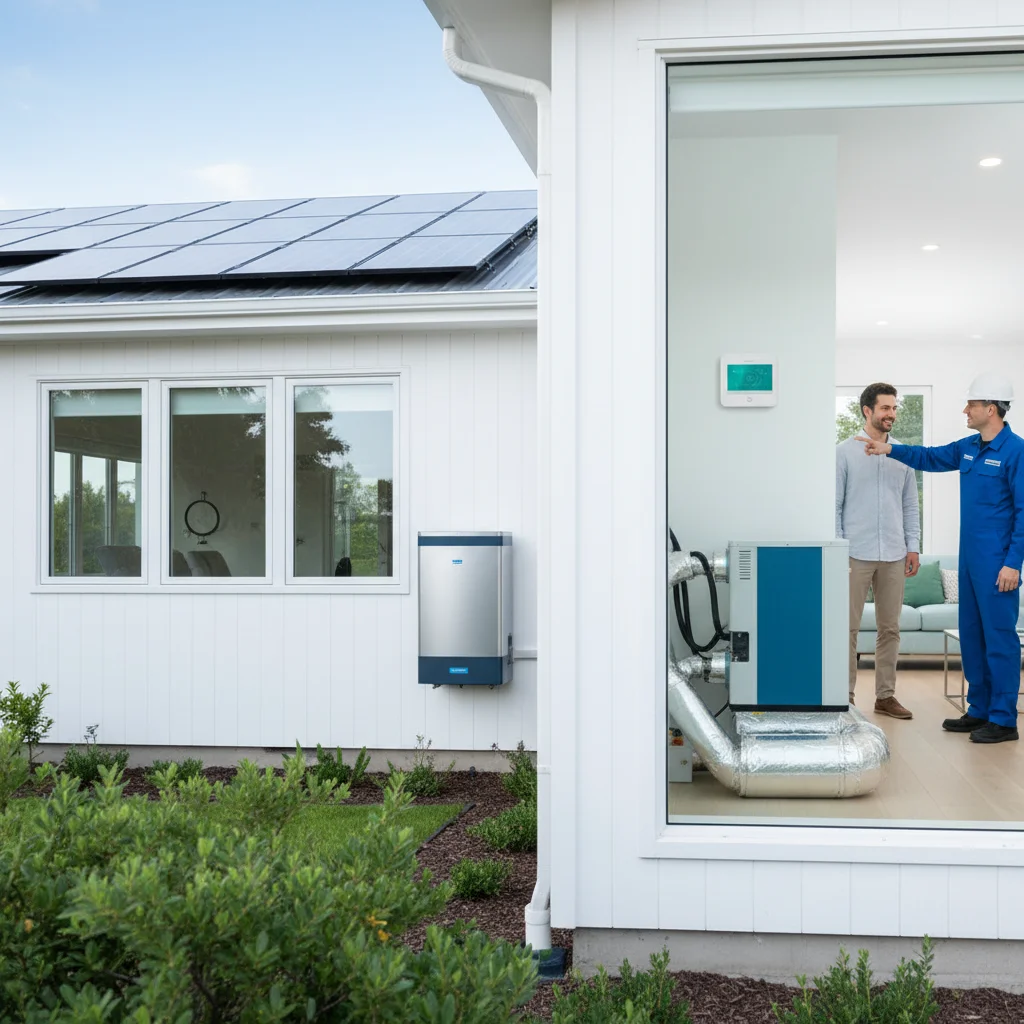
A properly sized HVAC system cuts energy bills by 20-40% compared to an oversized unit, but 60% of California homes run equipment that's too large, wasting $500-$1,200 annually. And contractors earn higher margins on bigger systems, creating a conflict of interest that costs homeowners thousands over a system's 15-20 year lifespan.
How Much Does HVAC Installation Cost and What's the Payback Period?
HVAC installation in California costs $5,500-$12,500 for a complete system replacement in 2026, with heat pumps averaging $8,000-$15,000 depending on capacity and efficiency ratings. The payback period ranges from 5-12 years for heat pumps versus traditional gas furnaces, with federal IRA tax credits covering 30% of qualifying equipment through 2032. And homes switching from electric resistance heating see payback in 3-5 years, while gas furnace replacements take 8-12 years to break even through energy savings.
The cost breakdown includes equipment ($3,000-$7,000), labor ($2,000-$4,000), permits ($150-$500), and disposal of old equipment ($200-$400). But installation complexity adds $1,500-$3,000 for homes requiring ductwork modifications or electrical panel upgrades. So total project costs reach $15,000-$20,000 for comprehensive retrofits with new ducts and zoning controls.
Energy savings average $800-$1,500 annually for heat pump installations replacing gas furnaces in California's climate zones 3-16. Use our free rebate calculator to estimate savings based on your current system and home size. And homeowners in PG&E territory qualify for additional $2,000-$3,000 rebates through the Tech Clean California program in 2026.
"Heat pump technology has advanced significantly, with cold-climate models now operating efficiently at temperatures as low as -15°F." — U.S. Department of Energy
How Long Will Your New HVAC System Last and What Factors Affect Lifespan?
HVAC systems last 15-20 years for heat pumps and air conditioners, while gas furnaces operate 20-25 years with proper maintenance in California's mild climate. Annual maintenance extends equipment life by 30-40%, preventing premature failures that cost $2,500-$6,000 for compressor or heat exchanger replacement. And coastal installations face accelerated corrosion, reducing lifespan to 12-15 years without protective coatings.
The primary lifespan factors include installation quality (40% impact), maintenance frequency (30% impact), and runtime hours (20% impact). So systems cycling on and off frequently wear out faster than properly sized equipment with longer run cycles. And oversized units short-cycle every 5-8 minutes instead of optimal 15-20 minute cycles, doubling wear on compressors and blower motors.
Maintenance schedules require annual inspections ($120-$180) covering refrigerant levels, electrical connections, condensate drainage, and airflow measurement. But neglecting filter changes every 1-3 months reduces efficiency by 15% and cuts equipment life by 5-7 years through dust buildup on coils and motors. For guidance on maximizing efficiency throughout the system's life, see our HVAC efficiency guide.
Warranty coverage typically includes 5-10 years on compressors and heat exchangers, with 1-2 years on labor through the installing contractor. And extended warranties add $300-$800 but rarely cover the most common failures like fan motors, capacitors, and control boards.
HVAC Installation vs. Repair: When Should You Replace Instead of Fix?
The $5,000 rule determines replacement timing: multiply the repair cost by the system's age, and replace if the result exceeds $5,000. A $600 repair on an 8-year-old system equals $4,800 (repair), while the same repair on a 12-year-old unit equals $7,200 (replace). And systems requiring refrigerant recharge plus compressor replacement ($2,500-$4,000) rarely justify repair after 10 years of service.
Efficiency improvements deliver $400-$900 annually in savings when upgrading from 10 SEER equipment to 16-18 SEER heat pumps. But repair costs under $1,000 on systems younger than 10 years typically make financial sense. So homeowners face the break-even calculation: will energy savings offset the $8,000-$12,000 replacement cost within the remaining equipment life?
Multiple repairs within 24 months signal systemic failure, with total costs exceeding 50% of replacement price in 40% of cases. And refrigerant leaks in R-22 systems (manufactured before 2010) cost $150-$300 per pound for discontinued refrigerant, making replacement economically superior.
The federal Energy Efficient Home Improvement Credit (Section 25C) ended for property placed in service after December 31, 2025 (IRS FS-2025-05). Federal tax credits for this work have ended, but state, local and utility rebates may still apply; check what is available at your address with the DuloCore rebate calculator. Learn more about available incentives in our energy tax credits overview.
What Are the Best HVAC Alternatives to Traditional Central Air Systems?
Ductless mini-split heat pumps cost $3,000-$5,000 per zone and eliminate the 20-30% energy loss through leaky ductwork in California homes. Multi-zone systems serve 2-5 rooms for $7,000-$15,000, providing independent temperature control that cuts cooling costs by 25-40% compared to central air. And installation takes 1-2 days without ductwork demolition or drywall repair.
Geothermal heat pumps deliver 300-400% efficiency but require $20,000-$30,000 upfront investment for ground loop installation. The payback period extends to 10-15 years in California's mild climate, versus 5-8 years in heating-dominant regions. So California homeowners rarely justify geothermal economics despite 50-year ground loop lifespan.
Hybrid systems pair electric heat pumps with gas furnace backup, switching fuel sources based on outdoor temperature and utility rates. The crossover point typically occurs at 30-40°F when gas heat becomes cheaper than electricity. And hybrid installations cost $8,000-$13,000, splitting the difference between standard heat pumps and dual-fuel systems.
Window heat pumps ($800-$1,500 each) serve single rooms, offering 3-4x efficiency versus resistance heaters or window AC units. But whole-home coverage requires 5-8 units totaling $5,000-$10,000 installed. For heat pump-specific incentive information, review our heat pump rebates guide.
"Properly installed heat pumps can deliver one-and-a-half to three times more heat energy than the electrical energy they consume." — ENERGY STAR
Step-by-Step: What to Expect During Professional HVAC Installation
Professional HVAC installation takes 1-3 days depending on system complexity and ductwork modifications required for California building codes. Day one includes old equipment removal, refrigerant recovery, and electrical service verification. And contractors perform Manual J load calculations to size equipment correctly, preventing the oversizing epidemic affecting 60% of installations.
The installation sequence starts with outdoor condenser placement on vibration-isolating pads, followed by refrigerant line routing through walls or attics. So contractors drill 3-4 inch penetrations and seal them with weatherproof boots to prevent moisture intrusion. And indoor air handler installation requires mounting brackets, condensate drainage to approved discharge points, and electrical connections to dedicated 240V circuits.
Ductwork inspection reveals leaks costing 20-30% of system capacity, with mastic sealant and metal tape repairs adding $500-$1,500 to project costs. But unaddressed duct leakage eliminates efficiency gains from new equipment. And building departments require pressure testing showing less than 6% leakage at 25 pascals for Title 24 compliance.
Final startup includes refrigerant charge verification using superheat and subcooling measurements, airflow balancing to manufacturer specifications (350-450 CFM per ton), and thermostat programming. So installers provide written documentation of refrigerant charge, electrical measurements, and airflow readings for warranty validation and future service reference.
Are You Eligible for Tax Credits or Rebates on Your HVAC Installation?
The federal Energy Efficient Home Improvement Credit (Section 25C) ended for property placed in service after December 31, 2025 (IRS FS-2025-05). Equipment must achieve 16 SEER2/9.5 HSPF2 minimum ratings for ducted systems or 16 SEER2/10.0 HSPF2 for ductless units. And the credit applies to both equipment and installation labor costs, delivering $2,400-$4,500 in tax savings on typical California installations.
California utility rebates add $2,000-$3,000 through programs like Tech Clean California (PG&E), SoCalGas Save Money Save Energy, and SDGE Self-Generation Incentive Program. But income-qualified households earning below 80% of area median income receive enhanced rebates of $4,000-$8,000 under the IRA's Home Electrification and Appliance Rebates (HEAR) program launching in 2026.
Eligibility requirements include professional installation by licensed HVAC contractors, manufacturer certification documentation, and proof of payment within the tax year. Form 5695 only covers qualifying work completed by December 31, 2025 and claimed on a 2025 return; the federal 25C and 25D credits ended after that date (IRS FS-2025-05). Calculate your potential savings with our rebate calculator before scheduling installation.
"The Database of State Incentives for Renewables & Efficiency (DSIRE) tracks over 3,000 programs nationwide." — DSIRE USA
Stacking federal credits with state and utility rebates reduces net installation costs by 40-60% for qualifying heat pump projects. And local air quality management districts offer additional $500-$1,500 incentives for replacing pre-2010 furnaces in non-attainment zones.
Official Sources
- U.S. Department of Energy - Energy Saver — Federal energy efficiency guidance and residential HVAC technology information
- ENERGY STAR — EPA program providing efficiency ratings and product specifications for qualifying HVAC equipment
- Database of State Incentives for Renewables & Efficiency — Comprehensive tracking of state, utility, and local rebate programs
Related Reading: Learn more about Humidifier Energy Consumption Guide and Property Manager Energy Audit Guide.
Frequently Asked Questions
How much does a new HVAC system cost to install?
Complete HVAC system installation costs $5,500-$12,500 in California for standard equipment, with heat pump systems ranging $8,000-$15,000 depending on capacity and efficiency ratings. The cost includes equipment, labor, permits, and old system disposal. And homes requiring ductwork modifications or electrical panel upgrades pay $15,000-$20,000 for comprehensive retrofits with new ducts and zoning controls.
What qualifications do I need to install an HVAC system myself?
California law prohibits DIY HVAC installation work involving refrigerant handling, requiring EPA Section 608 certification and state contractor licensing (C-20 HVAC license). Electrical work demands C-10 electrical contractor licensing for connections exceeding 240V/60A capacity. And permit applications require licensed contractor information, with building departments rejecting homeowner-pulled permits for refrigerant systems. Unlicensed installation voids equipment warranties and creates liability for refrigerant leaks.
How long does it take to install a new HVAC system?
Professional HVAC installation takes 1-3 days for complete system replacement, with simple changeouts (same location, no ductwork) finishing in 6-8 hours. And installations requiring duct modifications, electrical panel upgrades, or zoning controls extend to 3-5 days. Permitting and inspection add 1-2 weeks to project timelines in most California jurisdictions.
What is the difference between HVAC installation and replacement?
HVAC installation refers to adding new systems to homes without existing forced-air equipment, requiring complete ductwork design and installation costing $3,000-$8,000. Replacement swaps existing equipment with new units using current ductwork and electrical infrastructure, reducing labor costs by 30-50%. And replacement projects take 1-2 days versus 3-7 days for new installations with full duct runs.
Do I need a permit to install a new HVAC system?
California building codes require permits for all HVAC installations involving refrigerant systems, electrical work, or ductwork modifications. Permit costs range $150-$500 depending on jurisdiction and project scope. And inspections verify refrigerant charge, electrical connections, combustion safety (gas furnaces), and duct leakage testing for Title 24 compliance. Unpermitted work creates resale liability and voids equipment warranties.
Ready to see how much you can save? Use our free rebate calculator to estimate your federal tax credits, state rebates, and annual energy savings based on your current system and home specifications. Get your personalized savings report in under 2 minutes.
Last reviewed: April 14, 2026. Reviewed by DuloCore Energy Specialists. About the team.
Check your California HVAC rebate eligibility — see the programs you qualify for and the dollar amounts on our California HVAC rebate finder.