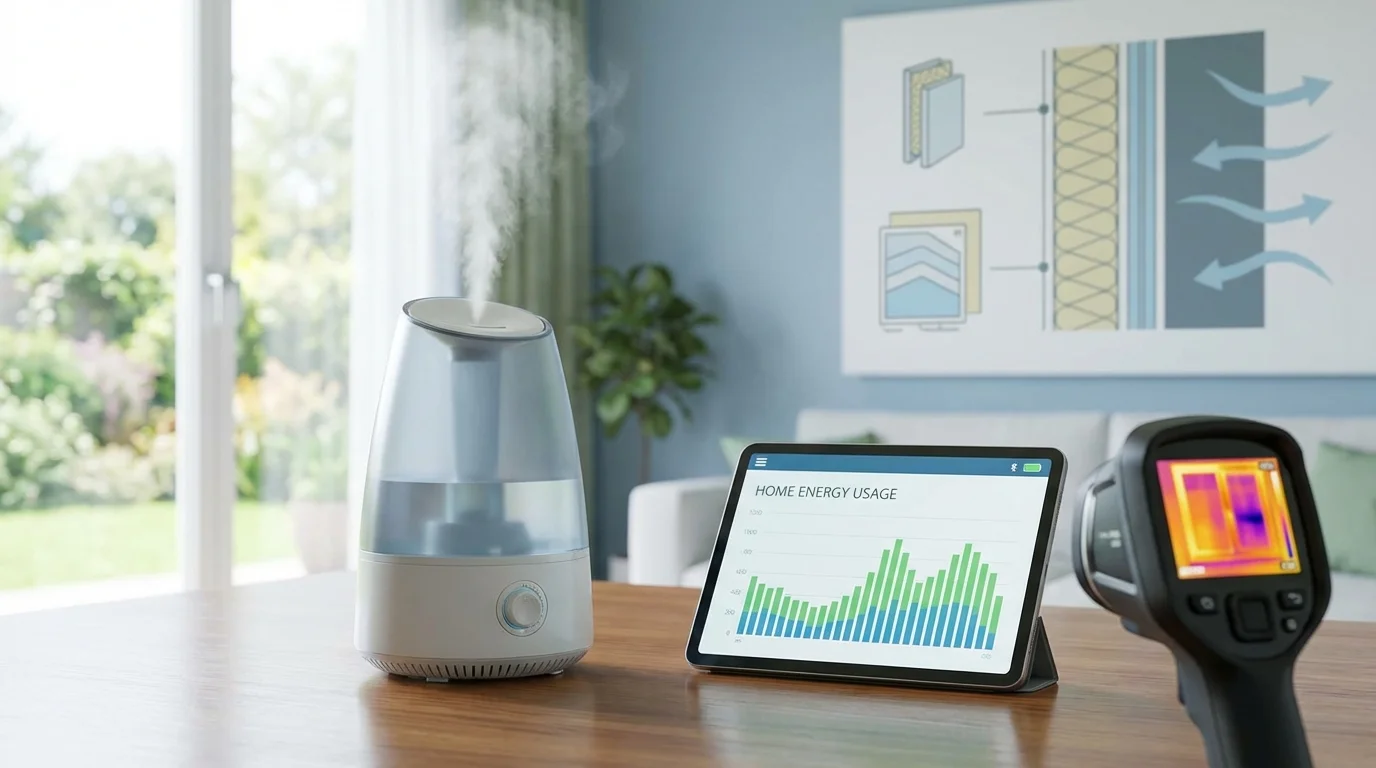
Running a humidifier 12 hours a day through a single winter season can add between $20 and $200 to your electricity bill, a cost equivalent to leaving a 60-watt light bulb on continuously for four months. With electricity rates increasing by an average of 4.3% annually, the operational cost of small home appliances is no longer a trivial expense. So understanding the energy profile of different humidifier models is critical for managing household budgets and reducing energy waste.
How much electricity do humidifiers consume, and what's the average monthly cost?
A humidifier’s electricity consumption varies by type, with cool-mist models using 20-60 watts and warm-mist models using 150-400 watts. This results in a monthly operating cost of $3 to $28 for 2026, assuming 12 hours of daily use at the national average electricity rate.
Humidifier energy use depends directly on the technology it employs. Evaporative and ultrasonic cool-mist humidifiers are the most efficient, typically consuming between 20 and 60 watts. But warm-mist models, which boil water to create steam, use between 150 and 400 watts—a 500% increase in energy demand. For example, a 50-watt cool-mist unit running 12 hours daily uses 0.6 kWh, costing about $3.60 per month. And a 300-watt warm-mist unit uses 3.6 kWh under the same conditions, costing over $21.60 per month. So the choice of model directly impacts your utility bill. Performing a home energy audit can identify other small appliances contributing to high energy costs.
So why does this matter? A single warm-mist humidifier can consume more energy over a winter than a new ENERGY STAR® certified refrigerator does in a month. Over a five-month heating season, that single appliance can add over $100 to your utility bills. And this cumulative financial impact, multiplied across millions of households, represents a drain on both personal finances and the energy grid. But choosing an efficient model and operating it correctly reduces this cost by up to 75%.
What state and utility rebates are available for energy-efficient humidifiers, and what's the typical rebate amount?
State and utility rebates for standalone humidifiers are uncommon in 2026. But, whole-home humidifiers integrated with high-efficiency HVAC systems often qualify for rebates ranging from $50 to $300 as part of a comprehensive system upgrade, incentivizing holistic energy efficiency improvements rather than single-appliance purchases.
Most 2026 energy efficiency programs focus on appliances with a higher energy draw, such as those covered by heat pump rebates. Portable humidifiers typically fall below the threshold for individual incentives. The opportunity for savings emerges when a whole-home humidifier is installed as part of a new, high-efficiency furnace or heat pump system. In these cases, utilities like Con Edison or PG&E offer tiered rebates for the entire HVAC package. For example, installing an ENERGY STAR® certified furnace with an integrated humidifier can unlock a combined rebate of $250. So homeowners should review their local utility’s HVAC rebate catalog to find these bundled offers.
"DSIRE is the most comprehensive source of information on incentives and policies that support renewables and energy efficiency in the United States." — DSIRE
How do I qualify for humidifier rebates, considering income limits and eligible equipment?
Qualification for 2026 whole-home humidifier rebates hinges on purchasing an integrated, ENERGY STAR® certified HVAC system. Enhanced rebates, which add $100-$400 to the standard amount, are available for households with incomes below 80% of the Area Median Income (AMI), making upgrades more accessible.
To access these incentives, the primary requirement is the equipment itself. The entire system, not just the humidifier component, must meet specific efficiency ratings set by the utility provider, often exceeding federal minimum standards. And homeowners must be customers in good standing with the sponsoring utility. For income-qualified programs, applicants must provide documentation verifying their household income falls below the specified AMI threshold. These enhanced LMI (Low-to-Moderate Income) rebates are designed to offset a larger portion of the upfront cost, often covering up to 50% of the equipment price. These incentives often complement federal energy tax credits, further reducing the net cost.
2026 Humidifier & HVAC Rebate Program Comparison
| Program / Utility | Rebate Amount (Whole-Home System) | Eligibility Requirements | Application Deadline |
|---|---|---|---|
| Mass Save® | $100 - $500 | ENERGY STAR® certified furnace with integrated humidifier | Dec 31, 2026 |
| Xcel Energy (CO) | $50 - $250 | Must be installed by a registered contractor | 90 days post-install |
| Focus on Energy (WI) | $75 - $300 | Equipment must meet program efficiency tiers | Dec 31, 2026 |
What's the application process for humidifier rebates, including deadlines, funding status, stacking rules, and contractor requirements?
The 2026 application process requires submitting a digital application with a dated invoice and ENERGY STAR® model numbers within 90 days of installation. Most programs have a December 31, 2026, deadline, but funding is first-come, first-served. Stacking with federal credits is allowed; contractor installation is mandatory.
Applying for a rebate is a straightforward but detail-oriented process. First, a licensed HVAC contractor must install the qualifying system. So "DIY" installations are ineligible. After installation, the homeowner or contractor completes an online application form through the utility’s portal. This requires uploading a copy of the final paid invoice and photos of the installed equipment's model and serial numbers. It's critical to monitor the program’s funding status, as popular rebates can be exhausted before the official deadline. Stacking rules permit combining the utility rebate with federal IRA tax credits, but not with other utility offers for the same piece of equipment. Use our free rebate calculator to find your potential savings.
How can I choose and operate the most energy-efficient humidifier for my home?
To maximize energy efficiency, select an ultrasonic or evaporative cool-mist humidifier, as they consume 50-75% less electricity than warm-mist models. Operate the unit with a built-in humidistat set between the Department of Energy-recommended 30% and 50% relative humidity to prevent unnecessary runtime and energy waste.
The most critical decision is choosing the right type. Cool-mist models use a fan or ultrasonic vibrations to create mist, a low-energy process using 20-60 watts. But warm-mist units use a heating element to boil water, a process that demands 150-400 watts. This means a warm-mist model costs up to four times more to operate. An integrated humidistat is another essential feature; it automatically shuts the unit off when the desired humidity level is reached, preventing over-humidification and saving an estimated 10-20% in energy costs. Regular maintenance, such as cleaning the unit and replacing filters per manufacturer instructions, also ensures the humidifier operates at peak efficiency.
"By using energy-efficient products, it is possible for consumers to reduce their energy bills, and at the same time, reduce our nation’s dependence on foreign oil and clean up the environment." — U.S. Department of Energy
Official Sources
- ENERGY STAR® — Federal program providing credible, objective information on the energy efficiency of products.
- Database of State Incentives for Renewables & Efficiency (DSIRE) — The most comprehensive source for federal, state, and utility energy rebates and incentives.
Related Reading: Learn more about Renewable Energy Home Integration Guide.
Frequently Asked Questions
How much electricity does a humidifier typically use?
A humidifier's electricity usage ranges from 20 to 400 watts. Cool-mist ultrasonic and evaporative models are highly efficient, using only 20-60 watts. In contrast, warm-mist vaporizers are energy-intensive, consuming between 150 and 400 watts because they must boil water to produce steam.
What factors affect the energy consumption of a humidifier?
The primary factors are the humidifier's type (cool mist vs. warm mist), its size or capacity, the fan and mist level settings, and the total daily runtime. Warm-mist models consume up to 500% more energy than cool-mist versions. A larger unit or a higher setting will also increase wattage draw.
Are warm mist humidifiers more energy-intensive than cool mist models?
Yes, warm mist humidifiers are significantly more energy-intensive. They use a heating element to boil water, consuming 150-400 watts on average. Cool mist models use an ultrasonic transducer or a fan, which requires only 20-60 watts. This makes cool mist technology approximately 75% more energy-efficient.
How can I minimize the energy cost of running my humidifier?
To minimize costs, choose an ENERGY STAR® certified cool-mist model, which uses 75% less energy than a warm-mist unit. Use the built-in humidistat to maintain a humidity level of 30-50%, preventing the unit from running constantly. Clean the device regularly to ensure it operates at peak efficiency.
What is the average monthly cost to operate
Last updated April 14, 2026 — reviewed by DuloCore Editorial. About our authors.